from The Open University
Alternatively you can skip the navigation by pressing 'Enter'.
Get Started menu item
What's On menu item
TV
-
Monday 20th May
- 9:00am, Eden, Bang Goes The Theory s6e5
- 9:30am, Eden, Bang Goes The Theory s6e6
- 2:00pm, Eden, Bang Goes The Theory s6e5
- 2:30pm, Eden, Bang Goes The Theory s6e6
- 7:00pm, Eden, Bang Goes The Theory s6e5
- 7:30pm, Eden, Bang Goes The Theory s6e6
- 10:00pm, BBC Four, Timewatch: Last Day of WW1
Radio
- Monday 20th May
- Wednesday 22nd May
- Friday 24th May
- Sunday 26th May
-
Monday 20th May
Life in the Palaeozoic
Fossils are a glimpse into the distant past and fascinate young and...
Fossils are a glimpse into the distant past and fascinate young and old alike. This unit will introduce you to the explosion of evolution that took place during the Palaeozoic era. You will look at the many different types of creatures that existed at that time and how they managed to evolve to exist on land.
After studying this unit you should be able to:
- describe some key events in the evolution of life during the Palaeozoic Era, such as the first appearance of major groups of invertebrates and vertebrates, and the invasion of the land;
- identify some common types of fossil organisms that were living in Palaeozoic seas, and comment on their likely environment and geological age;
- make inferences from fossils about the biology and mode of life of some Palaeozoic organisms.
- Duration: 12 hours
- Published on: Tuesday 17th May 2011
- Level: Introductory
- Posted under: Natural History
Life in the Palaeozoic
Introduction

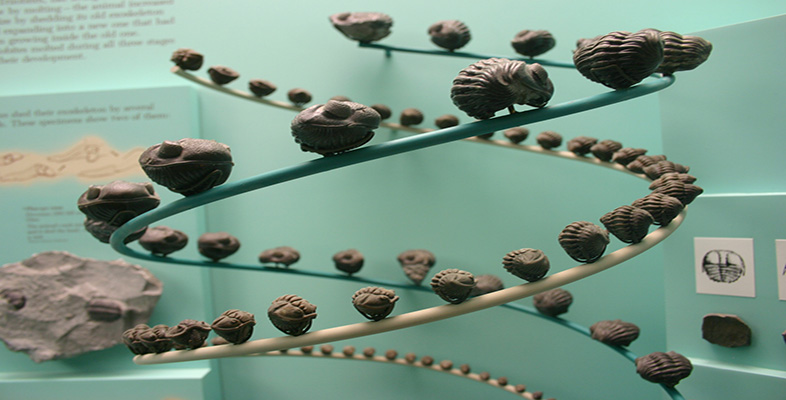
The Palaeozoic Era was a very important time in the history of life. Using evidence from fossils, we start by looking at the Cambrian explosion, when many forms of animal life first appeared about 545 million years ago. Then we move on to study creatures living in the Ordovician seas, including the extinct trilobites. Next, we'll investigate the invasion of land by plants and invertebrates that occurred in the Silurian Period, and look at life in Silurian seas. You'll also learn about the Devonian Period, when vertebrates first moved onto land. The unit finishes with a brief outline of vertebrate evolution.
This unit is from our archive and is an adapted extract from Fossils and the history of life (S193) which is no longer taught by The Open University. If you want to study formally with us, you may wish to explore other courses we offer in this subject area [Tip: hold Ctrl and click a link to open it in a new tab. (Hide tip)] .
Archive content
This is an extract from an Open University course which is no longer available to new students. If you found this interesting you could explore more free Natural History course units or view the range of currently available OU Natural History courses.
Other pages You might like

Try: Introducing environmental decision...
Many of the decisions we make have implications for our environment, particularly those...

Try: Studying mammals: A winning design
The term mammal encompasses a huge variety of animals, including humans. But what makes a...

Try: Surviving the winter
In this unit, we study one aspect of the fluctuating nature of an organism's environment....

Try: Studying Darwin
This unit brings together a collection of units from the OpenLearn site that would be of...

Try: Studying mammals: The insect hunters
From pygmy shrews to armadillos, a wide range of mammals survive on a diet made up...

Try: Studying mammals: Return to the water
Some of the most unusual and versatile of all the mammals are the groups that live, feed...

Try: iSpot: Sharing nature
This unit provides a valuable resource for anyone with an interest in nature. It will...

Try: Studying mammals: Meat eaters
The powerful and majestic carnivores are the focus of many television documentaries. In...

Try: An introduction to biological...
This unit is concerned with macroevolution – the patterns and processes of evolution...

Try: Studying mammals: Plant predators
From the mouse-deer to the elephant, plant eaters come in all shapes and sizes. But how...

Try: Animals at the extremes: Hibernation...
Hibernation is an ingenious adaptation that some animals employ to survive difficult...

Try: Studying mammals: The opportunists
Many mammals are food specialists, with complex adaptations that gear them toward a...
Comments
Be the first to post a comment
Copyright & revisions
Copyright information
- Creative-Commons: The Open University is proud to release this free course under a Creative Commons licence. However, any third-party materials featured within it are used with permission and are not ours to give away. These materials are not subject to the Creative Commons licence. See terms and conditions. Full details can be found in the Acknowledgements section.
Feeds
If you enjoyed this, why not follow a feed to find out when we have new things like it? Choose an RSS feed from the list below. (Don't know what to do with RSS feeds?)
Remember, you can also make your own, personal feed by combining tags from around OpenLearn.
Alternative Formats
Tags, Ratings and Social Bookmarking
Page Tags
Sign in or create a free account to add tags to your personal tag cloud using:
Have you tried our free courses?
Free stuff to your door
Living with Poverty
OU TV & Radio
-
Bang Goes The Theory s6e5Eden
Tuesday 1:00 -
Bang Goes The Theory s6e7Eden
Tuesday 1:00 -
Bang Goes The Theory s6e6Eden
Tuesday 1:25 -
Bang Goes The Theory s6e6Eden
Tuesday 1:25 -
Bang Goes The Theory s6e8Eden
Tuesday 1:25
Views
Votes
Comments
Tags
- climate change (373)
- business (277)
- diaries (194)
- bottom line (169)
- food (168)
- Rough Science (162)
- BBC Two (145)
- internet (145)
- BBC Radio 4 (140)
- BBC (133)
- Scotland (121)
- points for debate (120)
- listings (120)
- Bang goes the Theory (116)
- children (116)
- Creative Climate (116)
- English Civil War (115)
- astronomy (108)
- Thinking Allowed (105)
- religion (98)
- marketing (94)
- 20th century (94)
- Charles I (93)
- communication (92)
- evolution (91)
- sustainability (89)
- research (88)
- architecture (85)
- energy (83)
- Charles Darwin (78)
OpenLearn Links
Copyrighted imageCredit: Background image Lucian Milasan | Dreamstime.com