Session 1: What is the IoE?
Use 'Print preview' to check the number of pages and printer settings.
Print functionality varies between browsers.
Printable page generated Friday, 17 April 2026, 12:00 PM
Session 1: What is the IoE?
Introduction
Early in your reading you will discover that the terms ‘internet of everything’ and ‘internet of things’ are interchangeable. Many British readers will be used to the different words being used for the same thing. In our living rooms, we can equally sit on a sofa or a settee. There is no difference between the two, we are sitting on the same thing.
This is the same for the internet of everything (IoE) and the internet of things. The IoE is an evolving idea, at its simplest level, we are using the internet to communicate with multiple distributed devices. In the hope that it will make our lives easier, offer new opportunities and extend the human experience. As you read this course, you will discover some of the ideas already explored with IoE as well as begin to formulate your own view how IoE could a game changer. From smart homes to smart cities and agile manufacturing, IoE offers us some interesting opportunities.
A note about spellings: While The Open University is a UK organisation, Cisco, who originally developed this course, are based in the USA. Therefore you may notice that some of the images contain the original American spellings.
This free course, Internet of everything, presents introductory material and is intended to be easily accessible for those with some basic knowledge of computer systems and how they operate.
When you have read this chapter, you will have explored:
- the sheer scale of the internet
- how the physical world can connect to the internet
- how the internet has already changed our lives
- where we (the people) fit in with the evolving internet
- where we (the people) fit in with the evolving internet.
Before you start, The Open University would really appreciate a few minutes of your time to tell us about yourself and your expectations of the course. Your input will help to further improve the online learning experience. If you’d like to help, and if you haven’t done so already, please fill in this optional survey.
1.1 Internet of everything
In the first session of the Internet of everything we will introduce you to the internet and how it is evolving into the IoE. The internet has evolved in ways that we could never have imagined. In the beginning, advancements occurred slowly. Today, innovation and communication are happening at a remarkable rate.
Think back 5, 10, 15 years and consider how you and maybe others around you used the internet. What has been a game changer in their lives as well as your own?
From its humble beginning as the Advanced Research Projects Agency Network (ARPANET) in 1969, where it interconnected a few sites, it is now predicted that the internet will interconnect 50 billion things by 2020. The internet now provides global connections that make web surfing, social media, and smart mobile devices possible.
Watch how the internet emerged over the last 25 years and take a glimpse into the future!

1.1.1 Evolution of the internet
You may not have realised that the evolution of the internet has witnessed four distinct phases. Each phase has a more profound effect on business and society than the phase before. This course offers a combination of phases one, two and three to simply explain phase four.
| Phase 1 | Phase 2 | Phase 3 | Phase 4 |
| Connectivity | Networked economy | Collaborative experiences | Internet of everything |
| Digitise access to information | Digitise business process | Digitise interactions (business and social) | Digitise the world, connecting |
|
|
|
|
| The first phase started over 20 years ago and is referred to as ‘connectivity’. Email, web browsing and searching for content was just beginning. | The second phase started in the late 1990s and was the ‘networked economy’ phase. This was the birth of e-commerce and digitally connected supply chains. It changed the way we shopped and how companies reached new markets. | The third phase started in the early 2000s and is known as the ‘collaborative experiences’ phase. This phase is dominated by widespread use of social media, mobility, video, and Cloud computing. This phase completely transformed the world of work. | The current phase is called the ‘internet of everything (IoE)’. This phase connects people, processes, data, and things, turning information into actions that create new capabilities, richer experiences, and unprecedented opportunities. |
1.1.2 Cisco’s intelligent network
As a technological society, we are entering the fourth phase of the internet, which we call the internet of everything (IoE). Cisco’s intelligent network works at the centre of the IoE.
Cisco has been finding new ways to communicate and collaborate for years. The benefit of the IoE is derived from the combined impact of these connections and the value this increased connectedness creates as ‘everything’ comes online.
The next big wave is going to be around the internet of everyting. It will be implemented by combining things with processes, with business changes, with people. And, it will drive a productivity number, and a financial number, that is just mind-boggling.
1.1.3 The internet: the place to go
Normally, when people use the term internet, they are not referring to the physical connections in the real world. Rather, they tend to think of it as a formless collection of connections. It is the ‘place’ people go to find or share information. It is the 21st century library, video store, and personal photo album.

In actuality, the internet is essentially a network of networks.
Each of us connects to the internet using a physical cable or through wireless media. Underneath this network of networks lies a very real backbone of connections that bring the world to our personal computing devices.
The figure is an oversimplified map of global internet traffic; however, it depicts how countries and continents are connected. View this TeleGeography map that depicts the location of submarine cables.
After you have opened the map, click any cable on the map to highlight that cable and see the points at which it connects with land. (Alternatively, you can select any cable from the list to the right of the map.)
Click any city on the map to see a list of all the cables that connect to that city.
A great amount of engineering, effort, and money goes into the planning and deployment of each of these cables.
Figure 2 is a connected map that highlights the transition to the IoE. Click on ‘view larger image’ to see a clearer version.

1.1.4 The circle story
In a very short time, the internet has dramatically changed how we work, live, play, and learn. Yet, we have barely scratched the surface. Using existing and new technologies, we are connecting the physical world to the internet. It is by connecting the unconnected that we transition from the internet to the internet of everything.
Watch Cisco’s vision of how the internet of everything could impact your everyday life.

Transcript
1.1.5 People, process, data and things
The IoE incorporates four pillars to make networked connections more relevant and valuable than ever before: people, process, data, and things. The information from these connections leads to decisions and actions that create new capabilities, richer experiences, and unprecedented economic opportunity for individuals, businesses, and countries.
People  |
Process |
Data |
Things |
| Today, most people connect socially through their web-enabled devices. As the IoE evolves, we will connect in new and valuable ways. Wearable devices and clothing are already changing how we connect. | Processes occur between all of the other pillars in the IoE. With the correct processes, connections become more valuable. These connections provide the right information, delivered to the right person, at the right time and in the most relevant way. | Data is the information generated by people and things. This data, when combined with analytics, delivers actionable information to people and machines. Better decisions are made and better results are achieved. | Things are physical objects that are connected to the internet and to each other. These devices are sensing and collecting more data, becoming context-aware, and providing more experiential information to aid both people and machines. |
1.1.6 Interactions of the IoE

The interactions between the elements in the four pillars create a wealth of new information. The pillars interact in a way that establishes three main connections in the IoE environment: people communicate with people (P2P), machines communicate with people (M2P), and machines communicate with machines (M2M).
1.2 The value of the IoE
As we become used to the internet of everything, we will need to change the way we behave and use the internet. This isn’t as difficult as it may seem. After all, many of you reading this will have experienced various changes in experience since the popularisation of the internet in the mid 1990s. Many of you have seen the emergence of webmail, online films and music, social media, messaging apps and interactive games (including Pokemon Go). Each relying on the internet and also changing the way that we use it.
1.2.1 Changing behaviours

People, businesses, and governments must constantly adapt to change.
In 2012, the number of internet-connected devices exceeded the number of people on earth.
With this increased use of technology, people are now exchanging more information, ideas, and opinions than before. The internet is changing the way we communicate, collaborate, and learn. It has changed the way we engage with others and with the products that we use.
People have the ability to react to current news, events, marketing pushes, and products like never before. The ability to gather information and process that information using digital processing power is available at the click of a mouse or the touch of a screen.
1.2.2 Organisations adapt or lose competitive edge
Organisations must be agile and adjust to the changing trends in technology. organisations can use this technology to streamline operational cost through the use of collaboration and automation. In addition, businesses provide more relevant offerings using real-time data gathered from customers.
Organisations must also modify the way they advertise and sell products to customers. Technology is changing individual behaviors, such as how they learn about products, how they compare competitors, and even their purchasing patterns. For this reason, organisations must be able to customise their advertisements and special promotions toward certain customers and cut costs with targeted advertising. Additionally, customers, as a group, can affect the bottom line of the company by expressing their comments online. organisations must be able to react quickly, to counter any negative feedback entered by customers or employees.
These new technologies and trends can lead to tremendous success for some organisations. For other organisations, the failure to adapt to the new trends will likely result in the loss of their competitive edge. They will fail to meet the needs and expectations of the customers they serve. Consider, for example, how internet streaming is affecting the business operations and profit margins of movie rental stores, as shown in the figure. This is also happening with music and printed media.
The IoE forces organisations to adapt, or settle for diminishing impact on their business and society.
Governments and technology
Governments are not immune to the change caused by rapid information exchange through technology. Officials can respond quickly to emergencies through real-time data. Citizens can connect through social media and gather support for change.
1.2.3 Barcelona: a smart city
Governments can embrace this technological change, and benefit from it, by incorporating technology into the operation of a city. In 2011, the city council in Barcelona, Spain launched the ‘Barcelona as a People City’ project. This project uses technical innovations to foster economic growth and the welfare of its citizens.
Watch how Barcelona embraces the IoE to improve the life of its citizens, generate new business opportunities, and reduce operating expenses.

Transcript
1.2.4 Hyper-aware, predictive, agile
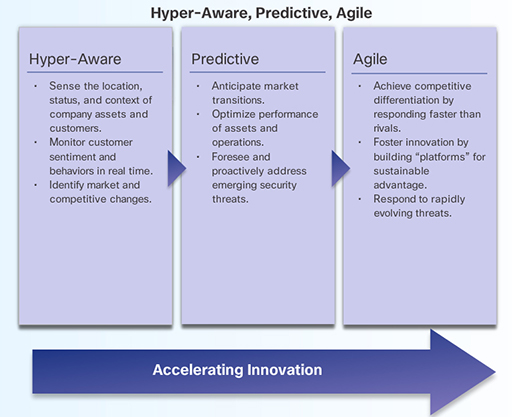
What does it mean to be IoE-ready? IoE-ready is characterised by three critical attributes:
- hyper-awareness – sensors can capture real-time data on products
- ability to predict – new types of data analysis tools allow an organisation to forecast future trends and behaviours
- agility – increasingly accurate predictions allow organisations to be more responsive and flexible to emerging marketplace trends and threats.
Combining these three attributes allows organisations to better create, communicate, and deliver their offerings.
1.2.5 IoE and industries
For organisations to realise the potential value of the IoE, they must focus on the IoE-driven capabilities that most benefit their organisation. This can vary across industries.
Table 3 displays some of the potential uses of the IoE across multiple industries, including manufacturing, energy firms, and retail organisations.
| Manufacturing | Energy firms | Retail |
| IoE capabilities may include real-time, multidimensional data analysis, intergrated video collaboration, and remote tracking of physical assets. | IoE capabilities may include integration of sensor data, ability to direct staff, and predictive analytics. | IoE capabilities may include video, customer behaviour analysis, data analytics and visualisation, and location-based marketing on any device. |
The IoE affects five core priorities of an organisation (Table 4).
| Customer experience | Innovation | Employee productivity | Asset utilisation | Supply |
| Improving customer relationships to garner more of the market. | Reducing time to market products and improving product development to meet customer needs. | Providing the ability to be more productive and scalable. | Lowering costs. | Identifying areas of waste and delay, while increasing logistical efficiency. |
1.2.6 Maximising IoE value

For organisations to join the IoE economy, and maximise the value of their IoE implementation, organisations must consider:
- Investing in a high-quality technology infrastructure and tools – A secure and reliable network infrastructure is required to support the IoE.
- Adopting and following inclusive practices – An inclusive environment is one in which the employees of that environment feel as though they are part of the change. It is an open atmosphere where individuals feel that they are included.
- Developing effective information-management practices – Management must be able to embrace and promote change. Information sharing and management must be supported, and data extracting techniques must be developed so that the right information is provided at the right time, to the right people and things.
Organisations are able to achieve a significant competitive advantage by adapting their business processes through the use of IoE technologies.
1.2.7 Internet of everything and Cisco
Cisco is uniquely positioned in that it has end-to-end solutions already within its product line, and is continuing to innovate to support the IoE. Cisco’s contribution to the IoE is the software, hardware, and platforms that support the internet. These platforms will enable the next phase of the IoE.
Watch Dave Evans, Cisco’s Chief Futurist, describing how the IoE will change the world for the better by creating more relevant and valuable connections.

Transcript
Learn more about the IoE at Cisco’s IoE website.
1.3 Globally connected
The reality is that we are all globally connected. For many of us, our friends on social media no longer reside down our street or in our town. Humanity has become globally connected and the internet has offered us a way to stay in touch professionally and personally with like minded souls.
Networking technology provides this foundation, the internet is after all a network of interconnected networks. From your home network to large corporate systems the shape of the internet is continually changing and offering us new ways to interconnect technologies such as the IoE.
1.3.1 Networks are the foundation
Fifty billion things provide trillions of gigabytes of data. How can they work together to enhance our decision-making and interactions to improve our lives and our businesses? Enabling these connections are the networks that we use daily. These networks provide the foundation for the internet and, ultimately, the IoE.
Networks continue to evolve
The methods that we use to communicate continue to evolve. Whereas we were once limited to face-to-face interactions, breakthroughs in technology have significantly extended the reach of our communications. From cave paintings, to the printing press, to radio, to television, and to telepresence, each new development has enhanced our ability to communicate with others.
Networks of many sizes
Networks form the foundation of the IoE. Networks come in all sizes. They can range from simple networks consisting of two computers to networks connecting millions of devices.
Simple networks in homes enable sharing of resources, such as printers, documents, pictures, and music between a few local computers.
In businesses and large organisations, networks can provide products and services to customers through their connection to the internet. Networks can also be used on an even broader scale to provide consolidation, storage, and access to information on network servers. Networks allow for email, instant messaging, and collaboration among employees. In addition, the network enables connectivity to new places, giving machines more value in industrial environments.
The internet is the largest network in existence. In fact, the term internet means a ‘network of networks’. The internet is literally a collection of interconnected private and public networks. Businesses, small office networks, and even home networks usually provide a shared connection to the internet.
| Small home networks | Small office/home office networks | Medium to large networks | World wide networks |
| Small home networks connect a few computers to each other and the internet. | The small office/home office network enables computers to connect to a corporate network, to access resources. | Medium to large networks can have many locations with thousands of interconnected computers. These networks could include newer places in the network (PINs). Examples are plant area networks (PANs) and field area networks (FANs) that extend the reach and power of the network for new applications and devices. | The internet is a network of networks that connects hundreds of millions of computers everywhere. |
1.3.2 Components of the network
The path that a message takes from source to destination can be as simple as a single cable connecting one computer to another, or as complex as a network that literally spans the globe. This network infrastructure is the platform that supports the network. It provides the stable and reliable channel over which our communications can occur.
Click each button in the figure to highlight the corresponding network components.
Devices and media are the physical elements, or hardware, of the network. Hardware is often the visible components of the network platform such as a laptop, PC, switch, router, wireless access point, or the cabling used to connect the devices. Occasionally, some components may not be so visible. In the case of wireless media, messages are transmitted through the air using invisible radio frequency or infrared waves.
Network components are used to provide services and processes. These are the communication programs, called software, that run on the networked devices. A network service provides information in response to a request. Services include many of the common network applications people use every day, like email hosting services and web hosting services. Processes provide the functionality that directs and moves the messages through the network. Processes are less obvious to us but are critical to the operation of networks.
1.3.3 End devices
The following animation shows an IP packet being sent from one end device to another. Click on the full screen button to view.

The network devices that people are most familiar with are called end devices. All computers connected to a network that participate directly in network communication are classified as hosts. These devices form the interface between users and the underlying communication network.
Some examples of end devices are:
- computers (workstations, laptops, file servers, and web servers)
- nsetwork printers
- VoIP phones
- TelePresence endpoints
- security cameras
- mobile handheld devices (smartphones, tablets, PDAs, and wireless debit/credit card readers and barcode scanners) sensors such as thermometers, weight scales, and other devices that will be connected to the IoE.
End devices are either the source or destination of data transmitted over the network. In order to distinguish one end device from another, each end device on a network is identified by an address. When an end device initiates communication, it uses the address of the destination end device to specify where the message should be sent.
A server is an end device that has software installed that enables it to provide information, like email or web pages, to other end devices on the network. For example, a server requires web server software to provide web services to the network.
A client is an end device that has software installed to enable it to request and display the information obtained from a server. An example of client software is a web browser, like internet Explorer. Figure 8 provides a brief description of each. Press each plus symbol to view the end device to server interaction.
1.3.4 Intermediary network devices

Intermediary devices interconnect end devices. These devices provide connectivity and work behind the scenes to ensure that data flows across the network. Intermediary devices connect the individual hosts to the network and can connect multiple individual networks to form an internetwork.
Examples of intermediary network devices are:
- switches and wireless access points (network access)
- routers (internetworking)
- firewalls (security).
The management of data as it flows through the network is also a role of the intermediary device. These devices use the destination host address, in conjunction with information about the network interconnections, to determine the path that messages should take through the network.
Processes running on the intermediary network devices perform these functions:
- regenerate and retransmit data signals
- maintain information about what pathways exist through the network and internetwork
- notify other devices of errors and communication failures
- direct data along alternate pathways when there is a link failure
- classify and direct messages according to quality ofsService (QoS) priorities
- permit or deny the flow of data, based on security settings.
1.3.5 Network media

Communication across a network is carried over a medium, such as through a cable or through the air. The medium facilitates communication from source to destination.Modern networks primarily use three types of media to interconnect devices and to provide the pathway over which data can be transmitted. As shown in the figure, these media are:
- metallic wires within cables
- glass or plastic fibres (fibre optic cable)
- wireless transmission.
The signal encoding that must occur for the message to be transmitted is different for each media type. On metallic wires, the data is encoded into electrical impulses that match specific patterns. Fiber optic transmissions rely on pulses of light, within either infrared or visible light ranges. In wireless transmission, patterns of electromagnetic waves depict the various bit values.
Different types of network media have different features and benefits. Not all network media have the same characteristics, nor are they appropriate for the same purposes. The criteria for choosing network media are:
- the distance the media can successfully carry a signal
- the environment in which the media is to be installed
- the amount of data and the speed at which it must be transmitted
- the cost of the media and installation.
1.3.6 Types of networks

Network infrastructures can vary greatly in terms of:
- size of the area covered
- number of users connected
- number and types of services available.
Figure 11 illustrates the two most common types of network infrastructure:
- Local area network (LAN) −a network infrastructure that provides access to users and end devices in a limited area such as a home, school, office building, or campus. It provides high speed bandwidth to internal end devices and intermediary devices.
- Wide area network (WAN) − a network infrastructure that interconnects LANs over wide geographical areas such as between cities, states, provinces, countries, or continents. WANs are usually owned by an autonomous organisation, such as a corporation or a government. WANs typically provide link speeds between LANs that are slower than the link speeds within a LAN.
1.3.7 The internet is bringing the world together

Although there are benefits to using a LAN or WAN, most individuals need to communicate with a resource on another network. This network may be outside of the local network. This communication is achieved using the internet.
The internet is not owned by any individual or group. The internet is a worldwide collection of interconnected networks (internetworks or internet for short), cooperating with each other to exchange information using common standards. Through telephone wires, fibre optic cables, wireless transmissions, and satellite links, internet users can exchange information in a variety of forms, as shown in the figure.
1.3.8 The converged network
Modern networks are constantly evolving to meet user demands. Early data networks were limited to exchanging character-based information between connected computer systems. Traditional telephone, radio, and television networks were maintained separately from data networks. In the past, every one of these services required a dedicated network, with different communication channels and different technologies to carry a particular communication signal. Each service had its own set of rules and standards to ensure successful communication.

Consider some schools that were cabled for a computer network 30 years ago. Classrooms were cabled for the computer network. They were also cabled for a telephone network. And, they were cabled for a video network. These networks were disparate; meaning that they could not communicate with each other, as shown in Figure 13.

Advances in technology are enabling us to consolidate these different kinds of networks onto one platform referred to as the ‘converged network’. Unlike dedicated networks, converged networks are capable of delivering voice, video streams, text, and graphics between many different types of devices over the same communication channel and network structure, as shown in Figure 14. Previously separate and distinct communication forms have converged onto a common platform. This platform provides access to a wide range of alternative and new communication methods that enable people to interact directly with each other almost instantaneously.
On a converged network there are still many points of contact and many specialised devices, such as personal computers, phones, TVs, and tablet computers, but there is one common network infrastructure. This network infrastructure uses a common set of rules, agreements, and implementation standards.
1.3.9 Lab: mapping the internet


Would you like to see how long it takes for data to travel from your computer to a remote destination and back? In Figure 15, the ping command took an average of 20 milliseconds to receive a reply from the server at www.cisco.com.
Would you like to see the path that data travels to reach a destination? In Figure 16, the tracert command generated a path showing that data passed through seven intermediary devices on its way from source to destination.
Network administrators and technicians use ping and tracert to test network connectivity and resolve problems. To further explore these two utilities, download Lab - Mapping the internet.
1.3.10 Packet tracer: packet switching simulation
Packet Tracer is a fun, take-home, flexible software program that allows you to experiment with network behavior, build network models, and ask ‘what if’ questions. In this activity, you will explore how Packet Tracer serves as a modeling tool for network representations. While doing so, you will explore a simulation of how packets are created and sent across the network traveling from source device to destination device.
Watch this demonstration of the Packet Tracer – Packet Switching Simulation activity.

Transcript
The video demonstration is the primary source for how to navigate the activity. However, after viewing the video, you can download the following files to investigate the activity on your own.
- Packet Tracer – Packet Switching Simulation.pdf
- Packet Tracer – Packet Switching Simulation A.pkz
- Packet Tracer – Packet Switching Simulation B.pkz
Essential note: If you are new to Packet Tracer, you can watch a tutorial. You must install Packet Tracer before you can open .pkz files. To install Packet Tracer, return to the course progress page where a copy is available to download and install .
Packet Tracer is available for both Microsoft Windows and Linux systems. The Open University Cisco Academy team support a moderated Facebook Community helping Mac users port this application onto all versions of the Apple Mac OSX. For more information, you will need to join the community.
Cisco also offer a free course on how to use Packet Tracer and how to obtain a free copy.
1.3.11 Planning for the future
The convergence of the different types of networks onto one platform represents the first phase in building the intelligent information network that will support the IoE. This convergence includes consolidating the applications that generate, transmit, and secure data. The underlying processes that drive this explosive growth have resulted in a network architecture that is both capable of supporting change and expansion. It is this converged network that serves as the fundamental building block for the IoE.
Watch the video of real-life experiences of business owners, government officials, and healthcare providers as they work towards making the IoE a reality.

Transcript
1.4 Terms and concepts practice
This activity will help you to test some of the terms and concepts you’ve been introduced to.
Two lists follow, match one item from the first with one item from the second. Each item can only be matched once. There are 11 items in each list.
-
converged networks
-
LAN
-
WAN
-
end device
-
intermediary
-
people
-
things
-
data
-
M2M
-
M2P
-
P2P
Match each of the previous list items with an item from the following list:
a.physical objects with sensors that are connected to a network
b.provides access to users and end devices in a limited area
c.exchange information, ideas, and opinions through the use of data and technology
d.data, voice, and video all use the same network media
e.machine to people
f.machine to machine
g.the source and destination of messages transmitted over a network
h.collected and transmitted by people and connected things
i.people to people
j.device connects individual hosts to the network or connects networks to each other
k.interconnects LANs over a broad geographic area
- 1 = d,
- 2 = b,
- 3 = k,
- 4 = g,
- 5 = j,
- 6 = c,
- 7 = a,
- 8 = h,
- 9 = f,
- 10 = e,
- 11 = i
1.5 Session 1 quiz
Check what you have learned in Session 1.
Use ‘ctrl’ (cmd on a Mac) or right-click to open the quiz in a new window or tab then come back here when you’re finished.
1.6 Summary
The evolution of the internet has witnessed four distinct phases:
- connectivity
- networked economy
- collaborative experience
- the internet of everything (IoE).
The internet is essentially a network of networks. Underneath this network of networks lies a very real backbone of connections that bring the world to our internet-enabled devices. The IoE is bringing together:
- people
- process
- data
- things.
There are three main connections in the IoE environment:
- people communicate with people (P2P)
- machines communicate with people (M2P)
- machines communicate with machines (M2M).
The IoE brings value to organisations in these five areas:
- customer experience
- innovation
- employee productivity
- asset utilisation
- supply.
Networks provide the foundation for the internet and, ultimately, the IoE. The components of a network fall into one of three categories:
- devices
- media
- services.
The two most common types of networks are LAN and WAN. Consolidating different types of networks onto one platform creates a ‘converged network’. Unlike dedicated networks, converged networks are capable of delivering voice, video streams, text, and graphics between many different types of devices over the same communication channel and network structure.
References
TeleGeography (n.d.) 'Submarine cable map' [Online]. Available at http://www.submarinecablemap.com/ Accessed 12 July 2016.
Acknowledgements
The Internet of everything free course is brought to you by The Open University. This course was originally developed by Cisco Systems Ltd and adapted for OpenLearn by The Open University. The collaboration of The Open University and Cisco Systems to develop and deliver this course as part of OpenLearn’s portfolio will provide and extend free learning in this important and current area of study.
Except for third party materials and otherwise stated (see terms and conditions), this content is made available under a Creative Commons Attribution-NonCommercial-ShareAlike 4.0 Licence.
The material acknowledged below is Proprietary and used under licence (not subject to Creative Commons Licence). Grateful acknowledgement is made to the following sources for permission to reproduce material in this course:
Videos: © Cisco Systems http://www.cisco.com/ https://creativecommons.org/ licenses/ by-nc-nd/ 4.0/
Every effort has been made to contact copyright owners. If any have been inadvertently overlooked, the publishers will be pleased to make the necessary arrangements at the first opportunity.
Don't miss out
If reading this text has inspired you to learn more, you may be interested in joining the millions of people who discover our free learning resources and qualifications by visiting The Open University – www.open.edu/ openlearn/ free-courses.