

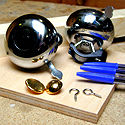
 What you need:
2 bicycle bell tops
Wood for base about 15cm square
2 Wood for upright 30cm x 2.5cm
2 The barrels from three plastic biros
Metal button or large-headed drawing pin
Screw hook and eye
Insulated wire for earthing
Saws, screwdrivers, glue, hammers and drill bits.
What to do:
Fix the wooden central upright to the base. Drill a hole through the base, then make a small pilot hole in the upright and screw it to the base. If you can, try countersinking the hole so that the screw head won't scratch your table.
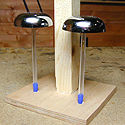 Glue the bicycle bell tops onto two of the biro barrels.
You now need to mount the bells on the base board. When the bells are in place their edges need to be about 2.5cm apart and an equal distance from the central upright.
Drill two holes for the biro barrels, part-way through the base, and fit the barrels. You can fix them with a little glue if they wobble at all.
Glue the metal button to the tip of the last biro barrel (where the pen insert used to be).
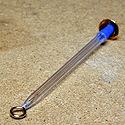 Now fix a screw-eye into the plastic fitting in the top of the barrel, and the hook into the central wooden upright, so that you can hang the pen centrally. It should swing unimpeded, and hit both bells.
Use the screw fixing on one bell to connect a length of wire to earth. This could be a water pipe, or a metal spike in the ground. Don't fiddle with plugs and sockets, and if you are uncertain whether what you are doing is safe, please stop!
If it is not thunderstorm weather you can test your predictor by using a balloon you have rubbed on your jumper or hair.
Hold the balloon near the unearthed bell and your predictor should start to ring.
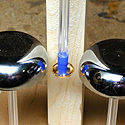 Remember that static only accumulates when the air is dry, so you need to test your predictor on a dry day (if you find one).
If you know a friendly physics teacher you might be able to test it using a Van der Graff generator, which generates a bit more static than a balloon.
Do not use any other sort of electrical supply, and especially not the mains.
How it works:
The idea is simple. Just before a thunderstorm, the air will be highly charged with static electricity and this will collect on the unearthed bell. The charge bell will then attract the ringer because if the bell is say positive, the ringer (which is insulated) will be relatively negative. However, when the ringer touches the bell (making it ring) it will immediately collect the positive charge. The bell and ringer, now both positively charged, will repel each other and the ringer will be pushed towards the earthed bell. When it touches the earthed bell (making it ring) it loses its charge because the bell is connected to earth. The ringer will swing back and the cycle starts again. So when you get a continuous ringing sound, you know to look out for the impending thunder and light show.
Rate and Review
Rate this activity
Review this activity
Log into OpenLearn to leave reviews and join in the conversation.
Activity reviews