- Current section: Introduction
- Learning outcomes
- 1 Introduction
- 2 Effects of eutrophication
- 3 Causes and mechanisms of eutrophication
- 4 Managing eutrophication
- 5 Summary
- Acknowledgements
from The Open University
Alternatively you can skip the navigation by pressing 'Enter'.
Eutrophication
Managing eutrophication is a key element in maintaining the earth's biodiversity. Eutrophication...
Managing eutrophication is a key element in maintaining the earth's biodiversity. Eutrophication is a process mostly associated with human activity whereby ecosystems accumulate minerals. This unit explains how this process occurs, what its effects on different types of habitat are, and how it might be managed.
By the end of this unit you should be able to:
- Describe the principal differences between a eutrophic and an oligotrophic ecosystem.
- Explain the mechanisms by which species diversity is reduced as a result of eutrophication. (Questions 2.1 and 2.2)
- Contrast the anthropogenic sources that supply nitrogen and phosphorus to the wider environment, and describe how these sources can be controlled. (Question 3.1)
- Describe how living organisms can be used as monitors of the trophic status of ecosystems. (Question 4.1)
- Compare the advantages and disadvantages of three different methods for combating anthropogenic eutrophication. (Question 4.2)
- Duration: 12 hours
- Published on: Monday 16th May 2011
- Level: Intermediate
- Posted under: Environmental Science
Contents
Eutrophication
Introduction

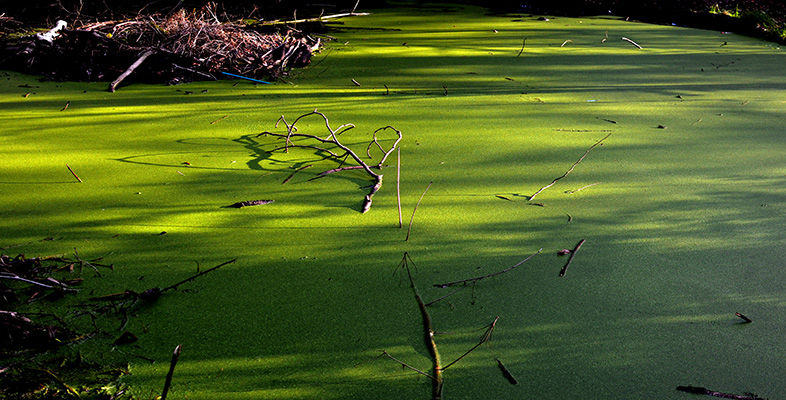
Eutrophication describes the biological effects of an increase in the concentration of nutrients. The collective term ‘nutrients’ refers to those elements that are essential for primary production by plants or other photosynthetic organisms. Eutrophication is most often caused by increases in the availability of nitrogen and phosphorus, commonly present in soil and water in the form of nitrate and phosphate, respectively. However, altered concentrations of any plant nutrient may have a recognizable biological effect. Eutrophication can occur in any aquatic system (freshwater or marine), and the term is also used to describe the process whereby terrestrial vegetation is affected by nutrient-enriched soil water.
This unit is an adapted extract from the course Environmental science (S216) [Tip: hold Ctrl and click a link to open it in a new tab. (Hide tip)]
Other pages You might like

Try: World in transition: Managing Resources
Do you take your access to water for granted? The Peruvian and Tanzanian communities...

Try: Telescopes and spectrographs
This unit looks at how telescopes and spectrographs are designed to improve our ability...

Study: Environment: sharing a dynamic planet
Gain an understanding of today’s challenging environmental issues by exploring key...

Try: Reducing your ecological footprint
Concerned about your impact on the environment? Interested in learning how to shape a...

Try: Energy resources: Water quality
Water is arguably the most important physical resource as it is the one that is essential...

Study: Certificate of Higher Education in...
This certificate combines aspects of science, technology and social science to explore...

Try: Environment: LA River
Who killed the river that runs through Los Angeles? Did you even know there was a river?...

Try: Biofuels
This unit investigates what is meant by a biofuel and covers the advantages of using...

Study: Cell biology
Cell biology explores the origins of cells and the generation of cell diversity, as well...

Try: World in transition: Migration and Trade
What does it mean to be poor, or an immigrant? What form should Aid take? This album...

Try: Energy resources: Geothermal energy
Energy from sources other than fossil and nuclear fuels is to a large extent free of the...

Study: Practical environmental science
Explore the natural world through practical activities ranging from the use of...
Comments
Be the first to post a comment
Copyright & revisions
Copyright information
- Creative-Commons: The Open University is proud to release this free course under a Creative Commons licence. However, any third-party materials featured within it are used with permission and are not ours to give away. These materials are not subject to the Creative Commons licence. See terms and conditions. Full details can be found in the Acknowledgements section.
Feeds
If you enjoyed this, why not follow a feed to find out when we have new things like it? Choose an RSS feed from the list below. (Don't know what to do with RSS feeds?)
Remember, you can also make your own, personal feed by combining tags from around OpenLearn.
Alternative Formats
Tags, Ratings and Social Bookmarking
Page Tags
Sign in or create a free account to add tags to your personal tag cloud using:
Have you tried our free courses?
Free stuff to your door
Living with Poverty
OU TV & Radio
-
Secrets Of Our Living Planet: Magical ForestEden
Friday 0:01 -
Timewatch: Last Day of WW1BBC Four
Friday 0:05 -
Life In Cold BloodEden
Friday 11:00 -
Life In Cold BloodEden
Friday 11:00 -
Life In Cold BloodEden
Friday 15:00
Views
Votes
Comments
Tags
- climate change (373)
- business (278)
- diaries (194)
- bottom line (169)
- food (168)
- Rough Science (162)
- internet (146)
- BBC Two (145)
- BBC Radio 4 (141)
- BBC (134)
- listings (121)
- Scotland (121)
- points for debate (120)
- Bang goes the Theory (116)
- children (116)
- Creative Climate (116)
- English Civil War (115)
- astronomy (108)
- Thinking Allowed (105)
- religion (98)
- marketing (94)
- 20th century (94)
- Charles I (93)
- communication (92)
- evolution (91)
- sustainability (89)
- research (88)
- architecture (85)
- energy (83)
- Charles Darwin (78)
OpenLearn Links
Copyrighted imageCredit: Background image Lucian Milasan | Dreamstime.com