
Find out more about The Open University's Science courses and qualifications
Pumice is a fine-grained volcanic rock. It is very light grey to medium grey in colour. It contains a lot of empty gas bubbles, so it is very light and looks rather like a sponge. Sometimes pumice is so light that it will float on water.
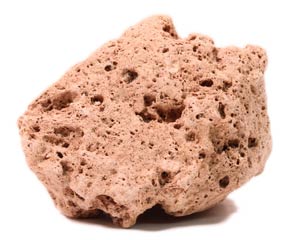 Pummice
How is it formed?
Pumice is formed when volcanoes erupt explosively. It comes from the same kind of magma which would form granite or rhyolite, that is, a magma that contains lots of silica (quartz).
Magma with lots of silica is usually thick and sticky. Some of the gases which cause the explosive eruption get trapped in the magma and form gas bubbles. These are preserved as holes when the rock cools as it comes flying out of the volcano.
Get closer to Geology
-
Geology toolkit
Take part now to access more details of Geology toolkitDiscover the unique landscape of Great Britain and Ireland with our interactive Geology Toolkit, featuring a geology timeline, rock analyser, rock cycle, landscape features and safety tips.

-
Geology toolkit: landscape features
Take part now to access more details of Geology toolkit: landscape featuresThe Geology Toolkit helps explain some of the UK's familiar landscapes
-
The first geological map of the UK
Read now to access more details of The first geological map of the UKOne of the most important maps of the UK ever made – described as the ‘Magna Carta of geology’ – is to go on permanent public display in Cambridge after being restored to its former glory.
Study a free course
-
An introduction to geology
Learn more to access more details of An introduction to geologyIn this free course, An introduction to geology, you will explore basic geological processes, focusing on how, where and why different rocks and natural resources form across the Earth.

-
An introduction to minerals and rocks under the microscope
Learn more to access more details of An introduction to minerals and rocks under the microscopeIn this free course, An introduction to minerals and rocks under the microscope, you will experience the study of minerals using a polarising microscope. While the study of minerals can involve electron or ion beam chemical analysis, the polarising microscope remains the prime tool for the study of rock thin sections and is the foundation of ...

-
Practising science: Reading the rocks and ecology
Learn more to access more details of Practising science: Reading the rocks and ecologyHave you ever wondered how scientists analyse the environment? This free course, Practising science: Reading the rocks and ecology, introduces you to the techniques used by science students at residential schools. You will learn how to determine where rocks have come from and how they were made. You will also examine the processes involved in ...


Rate and Review
Rate this article
Review this article
Log into OpenLearn to leave reviews and join in the conversation.
Article reviews