The family at the centre of early learning
Use 'Print preview' to check the number of pages and printer settings.
Print functionality varies between browsers.
Printable page generated Friday, 3 April 2026, 7:27 PM
The family at the centre of early learning
Introduction
In this free course, The family at the centre of early learning, you will explore the effect of family on children’s early development. The eminent child psychologist Urie Bronfenbrenner remarked, ‘every child needs an adult who is crazy about him (or her) in order to grow up’ (Bronfenbrenner, cited in Penn, 2008, p. 46). Such key adults are often found within the family, making this social group significant for young people throughout their childhood and beyond. For young children the family is the foundation for their developing sense of belonging and self-identity. It also stands at the centre of their early learning.
However the family is not a fixed entity. Families are made up of different ‘constellations’; they are infinitely varied, and people within family groups connect in different ways. Children themselves are also active in using relationships within their family to explore their own learning opportunities:
Childhood… varies across contexts and by circumstance, shaped by the durable patterns of‘rules and resources’ that structure human life.
Children differ, and what they find important also differs— they present a multiplicity of voices, rather than a singular viewpoint.
So, thinking generally about the family as a context for children’s learning is made up with complex layers of relationships and cultural influences unique to each group.
In this course, you will begin to explore these complexities further. You will start by thinking about the ways in which childhood experiences have an impact on how, as adults, we understand and respond to children. You will then look in more detail at learning within the family, using the description of one five-year-old girl’s trip to London with her grandparents to reflect on what this involves. You will also become more familiar with looking at the findings from research studies in order to understand complex ideas – in this instance, the influence of culture on children’s learning. Finally, the course closes by looking specifically at ‘stay and play’ or ‘parent and toddler’ sessions, so that you can consider whether family learning changes as children begin to attend organised groups away from their home environment.
This OpenLearn course is an adapted extract from the Open University course E109 Exploring perspectives on young children’s lives and learning.
Learning Outcomes
After studying this course, you should be able to:
- consider how a person’s childhood experiences of family practices and traditions can influence the way they parent their own children
- describe what companionable learning involves involves and why it is important for early childhood practitioners to understand the knowledge that young children bring to an early childhood setting from home
- outline why the influence of a community’s culture on children’s experiences will vary from family to family
- discuss how children and parents extend their understanding of each other when they attend group sessions run by early childhood practitioners.
1 Remembering childhood
Penn and McQuail (1997) found that students drew heavily on childhood memories to inform their practice. This is a reason to reflect back upon your own childhood experiences with your parent(s), carers or extended families. Reflecting back on your childhood experiences with your parent(s), carers or extended families, you may feel that they influenced how you understand children, childhood and possibly parenthood or practice. Can you see traits, dispositions, temperaments and attitudes in yourself that you think might be passed on from previous generations? Or perhaps, as a parent, you can identify aspects of your parenting style with how you were brought up.
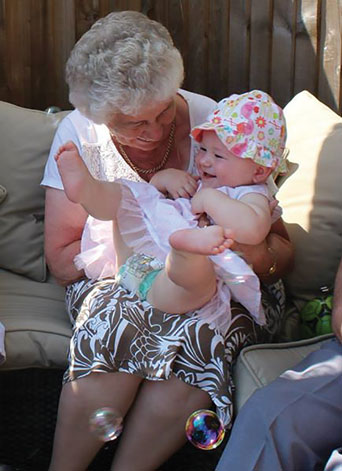
Look at this photograph of Evie and her Grandmother enjoying a song together. Evie’s favourite songs are ‘Pat-a-cake,’ ‘Round and round the garden like a teddy bear’, ‘This little piggy’, ‘Rock-a-bye baby’ and ‘One, two, buckle my shoe’; songs which have been handed down through the generations in her family. They formed part of her mother’s childhood experience and now they have significance as part of this family’s culture.
Although ‘“culture” describes a set of related beliefs and practices of a particular community’, it is important to recognise that ‘not everyone in the community will understand or practise them in the same way’ (Penn, 2009, p. 49). Singing and clapping games between adults and children are common across many communities, but they will be practised differently from group to group and also within each group. Evie’s experience of traditional songs and rhymes will be shaped by the way she plays these games with particular members of her family. So ‘culture’ refers to social influences on children’s learning on many different levels.
Activity 1
Take some time to think about the play, songs or activities that you enjoy sharing with young children that you know. These may your own children, children within your extended family, children of friends or children you know as a practitioner. Make a list of these activities in the space provided below. Try to be as specific as you can for example name your favourite songs or rhymes or give some detail about the activity.
When you have finished making the list look at each of the items and ask yourself if these remind you of any memories of your own childhood. Can you see any connections with your own family life or the community in which you grew up?
Comment
You may have found some connections with your own play memories much clearer than others, for example the link that Evie’s mother was able to make between the songs she sang to her daughter and her own childhood experiences. Others will be less obvious or may take you more time to reflect on. Try to keep these in mind and return to them as you work your way through the course. The family and the culture surrounding it are in many respects the foundations of children’s learning and so the connections are more deep-seated than we at first realise.
Key points
- Childhood memories are valuable in understanding the influence of family on the experience of childhood.
- Children’s experiences of play and interaction are influenced by their family culture and wider culture.
2 Exploring learning in family situations
A socio-cultural view of learning is that it involves coming to understand different possibilities in relationships with others (Lave and Wenger, 1991). This means that parents are frequently engaging in learning interactions, guiding their children’s participation in everyday, authentic activities without necessarily being aware that they are doing so (Rogoff, 2003). Think for a moment about the types of feelings and learning that may occur when on a shopping trip, visiting a relative, collecting water, taking a walk together, having a cuddle, splashing in puddles, tending to animals, making jelly, building a train, or pretending to hide from monsters.
The way that everyday activities can support the development of children’s relationships and participation can be seen as ‘companionable learning’ (Roberts, 2011). This means that children in these situations will experience:
- making their own decisions and choices
- a sense of security and belonging
- sharing communication
- a sense of well-being.
2.1 Cerys goes to London
You will see these aspects of companionable learning in this vignette about five-year-old Cerys’s day out with her grandparents.
Example 1: Cerys’ trip to London
Cerys’s grandparents took her to London to visit ‘Big Ben’ as she had often talked about ‘Little Ben’ near where her grandmother works and a ‘Baby Ben’ near where she lives. Cerys helped to buy tickets and deal with the money, and the family talked about their journey to London on the train.
When they were looking towards Big Ben from across the river at the London Eye, Cerys’s grandmother gave her a camera. At first she took photos looking downwards through the criss-cross bars of the London Eye towards the floor below where the people appeared as ‘little dots’. Later, her grandfather took a picture of Cerys with her grandmother in front of Big Ben, indicating the size of the people compared to the monuments and reflecting part of Cerys’s interest in the monuments themselves. But it also introduced her to mathematical concepts such as proportion, perspective and looking from different angles – concepts that are valuable frameworks for developing problem-solving skills and empathy.

They went to a restaurant in London’s China Town, where Cerys chose noodles, like her grandparents. When the owner asked the family what they would like to drink, her grandparents asked for Chinese tea. Cerys replied, ‘I would like some Chinese lemonade, please.’

On the way home, a passenger had left a newspaper on the seat of the underground tube train. Cerys snapped it up and sat in the same pose as the man who had left it. She moved her head from side to side, reading the paper as the train took them home.
Cerys’s grandparents facilitated her place as a decision maker by following her lead, looking at things of interest from her perspective, adding to Cerys’s sense of wonder. The message that Cerys received from her grandparents was that they thought she was worth listening to and was a competent person in her own right. Cerys actively drew on social and cultural cues or prompts from her grandparents to help her know what to do, such as taking photos, counting money and ordering a drink. They moved between facilitating opportunities for Cerys’s explorations of Big Ben and the ‘little dots’, participation (taking photos, ordering herself a drink) and directly intervening (showing her things, role-modelling and making conversation). She was allowed time and space in an unhurried day, and she took advantage of this by exploring. She was able therefore to bring her own purpose to the activities, formulating her own questions and different ways of understanding.
Cerys’s grandparents provided a secure boundary through an authoritative, gentle but firm approach. Through their undivided attention, she enjoyed a strong sense of belonging. By using appropriate prompts and vocabulary (‘look over there’, ‘opposite’, ‘Big Ben’, ‘up’, ‘down’, ‘across’), Cerys’s grandparents shared communication as they learned together from the day’s activities. Cerys learned more about her grandparents’ love, empathy and playfulness, and they learned similar things about her. Their day of companionable learning together added to everyone’s sense of well-being.
You can see from this example that learning within the family can be a rich and sophisticated experience for children. In contrast, in more formal learning situations, such as in school, practitioners are having to both promote and restrict children’s activities as a result of external pressures; for example, through the creation of out-of-bounds places or of ‘special’ provision. Consequently, the children internalise boundaries created by the adults in relation to both time and space (Macdonald, 2021). The learning that children experience in such family situations, is not directed however, it is holistic. It does not focus on particular subjects or skills, as they are learning about many things at the same time.
Activity 2
In the following film clip you will meet Viola, a girl who lives in Pistoia, a city in northern Italy. You will hear her parents talking about her day and what this involves, with a focus on her activities outside her time at the nursery she attends regularly. Watch the video below, and as you watch, build up a picture of all of Viola’s learning experiences with her family. Draw on both the action that you see and what her parents say about her daily routine.
You may find it useful to watch the clip two or three times, so as to get a ‘feel’ for the film and what is said first, before you go on to review it in greater detail later.

Transcript
List each of Viola’s learning experiences in the box below.
When you have finished watching the clip and noting your observations, look at your completed list, and write a couple of sentences in the box below, about what strikes you about Viola’s learning experiences with her family.
Comment
Observations from the clip
You probably noted that, outside nursery, Viola is involved in a wide range of learning experiences both with her parents and her grandparents. These activities involve play both indoors and outdoors, as well as interactions with different people outside the family group – for example, at her dance class. You also get a sense that engaging in these learning activities is part of the family routine, part of their unique family culture. The experiences that Viola’s parents talk about are also a clear example of ‘companionable learning’. Viola experiences a sense of belonging from the attention of those closest to her. They share communication between each other, and there is a concern for Viola’s well-being (snacks and naps are built into her routine at home). Finally, her parents recognise her as a decision maker. They describe the choices she makes when they play with her in her bedroom, and we see her deciding to dress up as a ballerina at the end of the clip.
Key points
- In family situations, learning can be seen as a shared, companionable activity.
- Companionable learning promotes decision making, belonging, communication and well-being.
3 The influence of culture on children’s learning and experiences: some cross-cultural research
‘Child-rearing practices and beliefs reflect local conceptions of how the world is and how the child should be readied for living in it.’
This quote from the renowned psychologist Jerome Bruner is helpful for thinking about the connection between culture and childhood, as it highlights that child-rearing is not the same everywhere. What children experience in their families, the learning that they participate in, will be shaped by the conditions, traditions and beliefs of their community or their world. So, for example, Alma Gottlieb (2004), an anthropologist who undertook research in the Côte d’Ivoire, West Africa, in the late 1970s, suggested that the way babies and infants are carried, soothed, bathed and fed varies according to cultural context. In the Côte d’Ivoire community, she found that both adults and other children looked after and comforted children. Siblings, friends and cousins played peek-a-boo, chatted and teased younger children as well as teaching them life skills. Babies seemed in tune with the natural rhythms and routines of mothers going about their daily lives, with their mothers them to sleep at the same time as working. Gottlieb also reflected that the notions of effective child-rearing as expressed in parenting manuals in the western world were not ‘truths’ applicable to all family cultures. This is a reminder that cultural influences have many layers, some of which may be linked to traditions, customs and wider community practices. The impact of these community traditions on childhood experiences can be distilled by the ways that different family groups operate and the relationships between those closest to the child.
3.1 Similarities and differences
A group of international researchers, Catherine Cameron, Roger Hancock, Giuliana Pinto, Beatrice Gamannossi and Sombat Tapanya, studied the play of five 30-month-old girls in their homes in five different locations around the globe: Thailand, Italy, Peru, the USA and Turkey (Cameron et al., 2011). They found clear similarities in the domestic play of all the children – for example, in the use of natural materials and everyday items (pots, pans, wraps, bags, buggies and dolls) in their games. The children also often used one object to symbolise something else in their play, like Selin in Turkey whose cooking pot became a hat, much to the amusement of her family. Equally, the researchers found differences that were linked to the five children’s motivation to ‘re-enact roles that are meaningful from their own cultural perspectives’ (Cameron et al., 2011, p. 84). As you read the following excerpts from the research findings, which feature Beatrice from Italy and Juanita from Peru, think about what is influencing the children’s play.
Example 2: Beatrice and her doll
Beatrice feeds her doll, ‘Coccolone’, whom she has set up in a pushchair on the balcony. She calls for her mother’s assistance, who asks, ‘Shall we put his bib on?’ Beatrice asks her mother to do it after she tried herself; she is undeterred as mother and child work together to arrange the feeding equipment. Beatrice feeds her doll with precise hand movements, which include picking up food that fell on the floor and wiping the baby’s mouth carefully with the bib.

Example 3: Juanita takes care
Juanita also draws on her observations and experiences. She wraps a small doll in a blanket and walks around, holding the doll very close to her, comforting, rocking and patting the doll while her aunt sits knitting nearby. Juanita’s observations of the important women in her life – her mother, aunts and grandmother, engaged in their daily work around her – are apparent in her resourceful play. When her grandmother places a mat on the floor, Juanita arranges her doll and other toys on the mat (including a rabbit, which she also pats). She makes use of a manta (a large colourful cloth used by Peruvian mothers to wrap their children) to wrap gently around her toy rabbit – until it becomes too difficult to manage and the rabbit is dropped on its head!
Juanita uses a chair as a table top where she arranges domestic materials to hand, like those she has seen in her mother’s shop. She incorporates books and objects into her play to explore what she has seen others doing and what she has experienced herself.
The researchers noted that Beatrice brought her own experience of family mealtime rituals to her detailed play; she knew exactly how she wanted to feed her baby, including subtle behaviour such as wiping food away from her mouth. Juanita’s play appeared to be more influenced by specific people, namely the women in her family and their daily activities. Interestingly, the children experienced the adults taking on different roles in sharing their play. Beatrice’s mother was often a co-player entering into dialogue within the roles that were being acted out, whereas Juanita’s aunt was much more on the periphery watching her niece’s activity and occasionally offering directions. These variations again highlight that whilst cultural influences linked to traditions, customs and wider community practices do influence children’s experiences, their impact is distilled by the ways different family groups operate and the relationships with those closest to the child.
3.2 Shared learning in families
From your reading so far, you are probably beginning to recognise that the relationship between children’s learning, their family and ‘culture’ has many different dimensions. A research study examining the learning around literacy between children and their grandparents (Jessel et al., 2011) provides a final example in this section of the way these factors are interwoven. The study explored the interactions between children aged three to six years old and their grandparents in Sylheti/Bengali-speaking families of Bangladeshi origin, and monolingual English-speaking families of mixed ethnicity in each family’s home in East London. It found that the experience was of a joint learning enterprise for both children and adults. The children brought their knowledge of the English language and contemporary stories, which they shared. The grandparents brought other aspects of language and tradition, as well as connections with the values of their cultural heritage.
Example 4: Story reading in Bengali
Razia reads a Bengali text – a chora (a rhyme with a religious and moral tone to it) – to her grandson, six-year-old Sahil. Razia lowers her tone and she is serious. Sahil repeats the few words as they proceed. Accuracy of repetition in pronunciation is important. Correction and demonstration in how the sounds are formed are emphasised in Razia’s teaching. There are benefits in terms of rhyme and phonological awareness together with meaning.
When Razia reads ‘Snow White’ to Sahil, she is less serious; she lets Sahil be the ‘expert’ from his experiences of the story from Disney and from school, supporting his enthusiasm and confidence. The use of touch and movement was emphasised by researchers as being important both in the relationships and in co-constructing learning. As Razia reads, Sahil climbs around her. Razia comments, ‘I love it. I don’t want them to just sit straight. That’s what grandchildren do: they play and learn.’
Key points
- Children’s experiences in their families will be influenced by the conditions, traditions and beliefs of their community.
- Broader cultural influences on children’s experiences will vary from family to family.
4 Learning in the family: attending groups together
Even from an early age children experience rapidly expanding social worlds beyond the family as they begin to spend time outside the home. Many young children attend group sessions with their parents, often facilitated by early childhood practitioners, where they will learn together alongside other peers and adults. The name given to such groups (‘Parent and toddler’, ‘Stay and play’ or ‘Play together’, for example) emphasises their difference from other early childhood provision where the child is left with practitioners while the parents pursue other activities elsewhere (Needham and Jackson, 2012). Similarly, the learning experiences for children attending these sessions have their own character as they involve elements of the very familiar (the parent or carer who attends) set within less established relationships and environments.
4.1 Parents’ voices

The parents and carers who attended ‘stay and play’ sessions at a nursery in Scotland clearly felt that their children gained a great deal from the sessions, as the following comments show:
‘He gets to meet new friends and be around babies of similar ages, and just gets used to being around other children; also the things with the different shapes and music and noises and that, getting him used to that as well is really good.’
‘I think he enjoys everything here. It’s like the sand and he loves the kitchen, and he’s just worked up the courage to go through the tunnel and chute now, you know; for a long time he would go up and come back down. He’s plucked up the courage to go through there. So, I think he’s just, he’s a first trial sort of thing, it’s good for him to get out and mix with other children, so get a wee bit more independent, especially when he’s staying with Grandma …’
‘When we come to the sessions, he absolutely loves building towers, painting, playing with good things that we don’t generally do at home. He quite likes messy play, but loves interacting with other children, and I love it because it gets him used to coming to nursery and being with other kids and having the teachers here as well. I can leave and he doesn’t really mind.’
They recognised, from their children’s perspective, that attending ‘stay and play’ provided new play and social opportunities that they could not, or did not, experience at home. There was also an emphasis on the sessions being transitional, allowing the children to gradually get used to ‘being around other children’, ‘coming to nursery’ and, consequently, being ‘a wee bit more independent’ from the attachments of family and home. When asked what they themselves got from attending the sessions, the same group of parents and carers were equally positive:
‘I find it’s a good opportunity to meet other people, other mums. Being a first-time mum myself, it’s good to get a bit of advice and ask questions if there’s things that I’m not sure of, and just a good chance to catch up with other people, meet new friends.’
‘It helps me to get out with him and go somewhere that’s going to benefit both of us really. Give us a bit of other mums and grandparents to talk to, and the girls who take the club are really helpful as well if you’re worrying about anything. Or I think he’s maybe a wee bit too shy or not independent enough, they can give you hints and tips and how to help that.’
‘It’s good to do things here that you don’t have to then do in your own house, like painting things. Because on the Monday afternoons, we’ll paint a bit here, like the shaving foam, so you don’t always have to get shaving foam out at home after doing it here and things like that, and shredded paper. It’s not something I would sit at home and do, shred all loads of paper and let them play with it, so it’s nice to get an opportunity of different things that you play here and then play with different things at home.’
Interestingly, there was some emphasis on being able to develop ‘companionable’ learning with their children by sharing new play experiences that were more difficult to engage with at home, such as messy play. However, the parents and carers here also saw personal benefits from attending, which included getting child-rearing advice and making social connections with other adults with young children.
4.2 Different purposes
Similar multiple benefits for both children and parents experiencing such sessions was a theme that emerged from Martin Needham and Dianne Jackson’s research study that compared parent–toddler groups in England and Australia (Needham and Jackson, 2012). They found that the groups were valued because they offered new play and social experiences for the children and an informal, accessible route to sources of support, advice and signposting to other services for parents. However, the fact that the groups fulfilled so many different functions created some tensions around purpose, which had to be managed by parents, children and the practitioners involved, as these practitioners noted in the research interviews:
‘The parents I think get a lot out of spending time with each other. That is always a dilemma because I think, for some of them, it’s life-saving but that means they don’t spend much time with their children so it’s kind of how you mediate between those two things.’ (Facilitator, Australian parent–toddler group)
‘[…] I think parents need to understand also that they’ve got to be there with them, for them not to play on their own, for them not to supervise them, but to support them also to be involved because it is a stay and play.’ (Practitioner, English parent-toddler group)
Consequently, such groups offer an extension of learning within the family for the children who attend in many different ways.
Equally, it is important to remember that the children will be significant contributors to the learning experiences within these sessions. This parent from the nursery in Scotland recognised the contribution that her son was making to her understanding of him as a person:
‘And I get to watch him playing with other children, interacting, learning to share, which is a big thing at this age.’
Sessions such as ‘stay and play’ or parent–toddler groups provide a setting in which children’s capacity to influence their surrounding world can be recognised. In such environments beyond the home, all family members have the opportunity to extend their learning about each other.
Another Australian study (Townley, 2022) also highlighted the importance of choosing a playgroup that would build and nurture their family or child’s identity. Laura explained that her family’s motivation for becoming involved in a network of LGBTQ families was to protect themselves from hostile attitudes.
We keep it safe, we keep it tight knit. Especially this time with the whole [marriage] equality thing going on it’ s just a bit of nastiness, so we just wanna keep the niceness around, for the moment. (Laura)
Lexi had a strategy of attending a number of playgroups, each of which nurtured one aspect of her children’s identity.
Yeah look at all the otherness aspect in my life, ok the gays mums, find some gay families, breastfeeding, find some other breast feeders, twins find some other twins. So everywhere that there is a potential point of difference I’ve tried to normalise by surrounding them with others in the same boat. (Lexi)
When reflecting on issues of family identity, it is also important to recognise the knowledge and understanding that each family brings with it. We refer to this as their ‘funds of knowledge’ (Moll et al., 1992). As Rose Drury notes in an online seminar (Early Education, 2021) the funds and knowledge concept is helpful with all children, but particularly helpful when thinking about bilingual children because they are coming with linguistic and cultural forms of knowledge. This might, for example, include knowledge about languages, histories and places, as well as about types of narratives, foods or clothing, or attitudes to particular issues or experiences of travel. Practitioners can draw upon these funds of knowledge when children enter the early childhood setting. They can work with this sense of identity to build a closer relationship with the child and their family. This does not mean it is always a simple process though. An interesting example of this is evident in a study from Malta, in which a practitioner describes running a session with a mother and child online:
I saw that the mother of Child 3 was getting frustrated that her son was distracted. She was telling him‘Attenzione Maestra!’ I tried to tell her its okay and not to worry and that it is normal to get distracted a little bit. But I could not tell her there and then because she does not understand me. It was useless telling her it is okay to get distracted, give him five mins and then we pull his attention back to us… It is useless telling her because shedoes not understand. So, I had to write to her on Teams so that she can use Google Translate, etc, etc.
In analysing this interaction, the researcher talks about the frustration in evidence for all three parties due to language challenges. She also notes the cultural differences that might be in evidence around the importance of play (Zammit and Refalo, 2021). It is interesting to think too about the agency being shown by the child, who does not wish to pay attention to the Maestra!
Activity 3
Talking about ‘Stay and play’
Watch the film clip below, about a ‘stay and play’ group that runs as part of a children’s centre in Bristol. As you watch, listen to the different perspectives of the parents and practitioners on the benefits of attending such groups.

Transcript
Now watch the clip a second time. You are going to make notes on the views on the benefits of ‘stay and play’ sessions of the people who are interviewed in the space provided. You can use the ‘pause’ button as you watch the film to make the note taking easier.
| Practitioners | Parents |
|---|---|
Erin |
Adimma |
Ian |
Siobhan |
Anjali |
|
When you have watched the film a second time and made the notes look at the practitioners’ and the parents’ comments. Are there any differences in their views?
Comment
You will notice that many of the issues you have read about regarding groups that parents and children attend together are raised in the film clip. Both practitioners and parents see the benefits of the sessions but there seem to be slight differences in emphasis. For the practitioners the learning experiences during ‘Stay and play’ for both children and parents are highlighted. For the parents the social aspect appears to be a key element through making new connections with other parents and finding out ‘you are not on your own’ (parent interviewee, Bristol).
Finding out about local ‘stay and play’ groups
Attending ‘Stay and play’ is clearly an important extension of routines for the families in the film clip, but the interviewees do not mention how they first found out about the group. Was it through ‘word of mouth’ or because the centre’s location was close by? Imagine you are a new parent in the area where you live. How would you go about finding out about where ‘stay and play’ or ‘parent and toddler’ sessions run? Note down a few ideas in the box below.
Comment
When you have noted down your ideas, you could ask people you know the same question and see if they have some more ideas you could add to your list. When you have completed your list try one or two of the suggestions. Do they lead you to find out about local provision? What does this say about the support your local community provides for parents and families?
Key points
- ‘Stay and play’ type sessions offer multi-faceted learning experiences for children, parents and practitioners.
- Children and parents extend their understanding of the relationships between them at group sessions that they attend together.
5 Quiz
This short quiz is intended for you to review your understanding of this course. There are three questions each one relating to a particular section. You may wish to look back over each section before you complete the questions or try answering them first and looking back to review the points if necessary.
Activity 4
- Complete the following sentence by selecting the three words that you think apply:
Looking back to Section 2 will help you with this question.
Comment
The learning that children experience within families is holistic, shared and companionable.
It is holistic because children learn many different things from one single experience. It is shared and companionable because children and family members learn from each other.
a.
True
b.
False
The correct answer is b.
Comment
The statement is ‘False’ because cultural influences have many layers and their impact on children’s experiences are distilled by the ways individual family groups operate and the relationships between those closest to the child.
Looking back to Section 3 will help you with this question.
- Complete the following sentence by selecting the word or phrase that you think applies.
Looking back to Section 4 will help you with this question.
Comment
‘Stay and play’ sessions provide children with new play and social opportunities that they cannot or do not experience at home. Equally parents learn new things about their child as they are seeing them in a different environment. They can also access child-rearing advice and make social connections with other adults with young children from their community.
Further thinking and discussion points
- In your view, what do families bring to a child’s experiences, learning and development that others cannot?
- Do you think your own memories of childhood influence your understanding of children’s experiences and your interactions with young children?
- What do you think about cultural influences and the impact they have on childhood experiences in families? Are the influences stronger for some families than others, and if so, why do you think this is the case?
- Do you think that the importance of the family as a place for shared learning diminishes as children move on to attend more provision away from their parents and carers?
Conclusion
‘Families’ are uniquely placed to contribute to their children’s capable and competent learning and development in everyday life. It is important to remember that, across the world, wider contexts beyond the home can profoundly affect childhood experiences and family life.
This free course, The family at the centre of early learning, you have looked to the wider social, cultural and political backdrop of young children’s lives and learning and have focused on the positive learning relationships that can exist in any family. You have explored how ordinary, everyday domestic activities can sustain rich companionable learning between children and those closest to them. You have also considered how the traditions and cultural practices of the community to which the family belongs filter through to the child’s experiences. Ultimately every home revolves around individual relationships and ways of doing things and as such the family represents a unique foundation for early childhood.
References
Cameron, C.A., Pinto, G., Accorti Gamannossi, B., Hancock, R. and Tapanya, S. (2011) ‘Domestic play collaborations in diverse family contexts’, Australasian Journal of Early Childhood, vol. 36, no. 4, pp. 78–85.
Dadds, M. (2002) ‘The “hurry-along” curriculum’, in Pollard, A. (ed.) Readings for Reflective Teaching, London, Continuum, pp. 173–5.
Deloache, J.S. and Gottlieb, A. (eds) (2000) A World of Babies: Imagined Childcare Guides for Seven Societies, Cambridge, Cambridge University Press.
Early Education (2021) Birth to 5 matters– EYFS guidance by the sector, for the sector. Available at: https://www.youtube.com/watch?v=k0F8_DUB4Uo (Accessed: 12 December 2023).
Gottlieb, A. (2004) The Afterlife is Where We Come From: The Culture of Infancy in West Africa, Chicago, University of Chicago Press [Online]. Available at http://www.press.uchicago.edu/ index.html (Accessed 18 February 2016).
Jessel, J., Kenner, C., Gregory, E., Ruby, M. and Arju, T. (2011) ‘Different spaces: learning and literacy with children and their grandparents in East London homes’, Linguistics and Education, vol. 22, no. 1, pp. 37–50.
Lave, J. and Wenger, E. (1991) Situated learning: legitimate peripheral participation. Cambridge: Cambridge University Press
Macdonald, M.M. (2021) Using a mosaic-based approach to construct children’s understanding of safe space in school. Doctoral dissertation. Queen’s University Belfast. Available at: https://pure.qub.ac.uk/en/studentTheses/using-a-mosaic-based-approach-to-construct-childrens-understandin (Accessed: 12 December 2023).
Moll, L., Amanti, C., Neff, D. and Gonzalez, N. (1992)‘Funds of knowledge for teaching: using a qualitative approach to connect homes and classrooms’, Theory Into Practice, 31(2), pp. 132–141.
Needham, M. and Jackson, D. (2012) ‘Stay and play or play and chat; comparing roles and purposes in case studies of English and Australian supported playgroups’, European Early Childhood Education Research Journal, vol. 20, no. 2, pp. 163–76.
Norðdahl, K. and Einarsdóttir, J. (2015)‘Children’s views and preferences regarding their outdoor environment’, Journal of Adventure Education & Outdoor Learning, 15(2), pp. 152–167.
Penn, H. (2008) Understanding Early Childhood: Issues and Controversies, 2nd edn, Maidenhead, Open University Press.
Penn, H. and McQuail, S. (1997) Childcare as a Gendered Occupation, Research Report no. 23, London, Department for Education and Employment.
Pugh, A.J. (2014) ‘The theoretical costs of ignoring childhood: rethinking independence, insecurity, and inequality’, Theory and Society, 43, pp. 71–89.
Roberts, R. (2011) ‘Companionable learning: a mechanism for holistic well-being development from birth’, European Early Childhood Education Research Journal, vol. 19, no. 2, pp. 195–205.
Rogoff, B. (2003) The cultural nature of human development. Oxford: Oxford University Press.
Townley, C. (2022)‘Supporting family identity: the processes that influence belonging and boundaries in an LGBTQ playgroup’, Journal of Family Studies, 28(3), pp. 1058–1073.
Zammit, I. and Refalo, N. (2021)‘Analysing the learning and social experiences of two multicultural children within a kindergarten setting’, MCAST Journal of Applied Research & Practice, 5(2), pp. 25–42.
Acknowledgements
This free course was written by John Parry.
Except for third party materials and otherwise stated (see terms and conditions), this content is made available under a Creative Commons Attribution-NonCommercial-ShareAlike 4.0 Licence.
The material acknowledged below is Proprietary and used under licence (not subject to Creative Commons Licence). Grateful acknowledgement is made to the following sources for permission to reproduce material in this free course:
Images:
Course image and Figure 1: courtesy Karen Horsley
Figure 2: courtesy: Diane Young
Figure 3: courtesy Diane Young
Figure 4: © Susan Barr/Getty Images
Figure 5: © The Open University
Videos:
Activities 2 and 3: © The Open University
Every effort has been made to contact copyright owners. If any have been inadvertently overlooked, the publishers will be pleased to make the necessary arrangements at the first opportunity.
Don't miss out
If reading this text has inspired you to learn more, you may be interested in joining the millions of people who discover our free learning resources and qualifications by visiting The Open University – www.open.edu/ openlearn/ free-courses.