A question of ethics: right or wrong?
Use 'Print preview' to check the number of pages and printer settings.
Print functionality varies between browsers.
Printable page generated Sunday, 28 June 2026, 1:57 PM
A question of ethics: right or wrong?
Introduction
Working closely with individuals and developing relationships is an inherent and often satisfying part of working as a sports coach or exercise instructor. However, it can bring about ethical and professional challenges and can sometimes place practitioners in a difficult or uncomfortable position, e.g. a confidence shared and/or personal dilemmas. This course aims to discuss ethical and professional principles in sport and fitness environments.
We will discuss good practice and certain ethical issues sports coaches and fitness instructors may face within their practice. In particular we explore the relationship between the coach/instructor and individuals with a specific focus on power relationships. We also explore the responsibility of the practitioner to help develop character.
This OpenLearn course is an adapted extract from the Open University courses EXC224 Making your coaching certificate count and EXF224 Making your exercise instruction certificate count.
Learning outcomes
After studying this course, you should be able to:
explain why and how sport and fitness professionals are required to work within the codes of conduct set by the relevant organisations to ensure good practice standards
identify the different power relationships that can exist within sport and fitness settings and evaluate the effects an imbalance of power can cause
evaluate the role of the coach or instructor in influencing morals in a range of environments
consider potential ethical dilemmas that may arise within different areas of practice within sport and fitness and to develop possible solutions.
1 Defining ethics
Since sport and recreation is largely about people enthusiastically pursuing an activity that really motivates them, often in hazardous environments and involving relationships that require rapport and trust, it sometimes throws up some tricky dilemmas.
Loubert (1999) defines ethics as ‘the study of rules, standards and principles that dictate right conduct among members of a society. Such rules, standards and principles are based on moral values which serve as a basis for what is considered right’ (p. 162). In a sport and fitness context the coach or instructor should adhere to ethical standards set by organisations, such as REPs or governing bodies, to act in a way that is considered ‘right’.
Ethics is underpinned by morals and values, therefore it is important that we also pin down the difference between morals and values (see Box 1).
Box 1 Definitions
Values – the beliefs and attitudes that provide direction to everyday living. Values are personal beliefs and attitudes that guide action.
Morals – Morality is concerned with perspectives of right and proper and involves an evaluation of actions based on some broader cultural context or religious standard.
The following activity asks you to apply these definitions of values and morals to a real-life situation.
Activity 1 Morals and values
Consider this statement from a semi-professional footballer and separate the morals and values illustrated here:
'I think it is important that as a footballer I am employed to help my team to win every match. Whilst some of my on-field behaviour may not be morally acceptable I can always justify my actions to myself.'
Comment
The main point here is that values are personal and what we think is important whilst morals are not decided or defined by ourselves. Morals are cultural or societal expectations. Even though by this footballer’s values he feels his behaviour can be justified it may not be morally acceptable within society. It would be interesting to see the response of the coach here. Would the coach encourage such behaviour if it produced the desired results or would he or she try and change the player’s values? What would you do as the coach in this situation?
Hardman et al. (2010, p. 345) acknowledge that the coach has a central role in influencing moral behaviour, stating ‘the coaching session, the training field, the changing room, the game, are all environments where children (and older athletes), alongside the presence of the coach, develop and test the moral dimensions of their evolving characters’. To help practitioners to work within these ethical and moral standards, organisations articulate codes of conduct to ensure that everyone knows what is expected.
2 Adhering to the code
Sport and fitness professionals are required to work within the ethical codes of conduct set by the relevant organisations to ensure good practice standards. For example, REPs developed this as one of the first things to help unify their profession and demonstrate the credibility of the organisation. The next activity encourages you to become familiar with codes of conduct for a selected activity and to consider how they may be used.
Activity 2 Ethical conduct within your activity
This activity is designed to provide you with the opportunity to research the code of conduct for an activity of your choice and compare it with examples from sports coach UK and REPs. Follow the steps below to guide you through this task:
- Visit the website of the governing body or organisation for your chosen activity and search for the code of conduct. Note down the key principles of good practice reflected in the code of conduct.
- Consider the role of the code of conduct within coaching/instructing practice. For example, what impact does this have on practice? What would happen if there were no codes of conduct?
- Now read through the code of conduct for sports coach UK and REPs using the links below. Compare and contrast the key themes featured in both, as well as comparing these to the code of conduct (if different) from your chosen activity.
Comment
- Noting down the key themes within the code of conduct will provide a useful checklist for good practice.
- The module team felt that codes of conduct were vital to standardise good practice and provide clear guidelines on what constitutes good or poor practice. However it is also important for the codes of conduct to be effective that they are embedded within qualification and training assessments.
- The sports coach UK Code of Conduct (2009) identifies four key principles of good coaching practice (rights, relationships, responsibilities (personal standards) and responsibilities (professional standards)).These four principles also feature in the REPs code of conduct although REPs add a fifth principle: ‘Safe Working Practice’. In contrast, in the sports coach UK Code of Conduct, guidance regarding safe working practices is included within Responsibilities (professional standards). It will be interesting to compare this difference with the code of conduct from your selected activity.
There are many different roles within the sport and fitness sector. Some may coach children in sport, some may take group fitness classes for a range of levels, others may work with individuals with disabilities, and for some their role will involve working across a wide range of different populations in a range of contexts. Different coach/instructor contexts may work towards specific codes of conduct; however, the principles of ethical and professional behaviour do possess some consistent factors, as Activity 2 illustrates.
3 Where does the power lie?
One of the key themes throughout these codes of conduct is the relationship between the practitioner and the individual, and a key aspect of this is power. In this instance we are referring to power as the amount of control or influence one party has over another, such as influencing decision making. Think about a relationship you have with someone, either professionally or personally; does one person hold more power in the relationship than the other? The relationship between coaches and athletes, and the power balance within that relationship is important. Jones (2009) looks at coaching as an exchange relationship, with coaches contributing knowledge and expertise, and athletes a willingness to learn, and a high level of effort and compliance. In this view it is the coaches that hold the power in the relationship. However, in practice this is not always the case. For example, high level athletes may hold higher levels of power and interestingly it is often the other way round in personal training when people of high status employ a trainer. A relationship where one individual is fully compliant to the other is one that can be seen to have an imbalance of power and control and can lead to the potential for abuse of power. The next activity encourages you to think about this further.
Activity 3 The balance of power
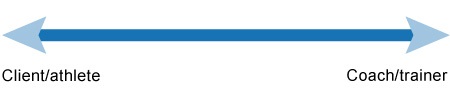
Consider the following relationships and think about who has the most power over decision making and behaviour. Place these at some point on the continuum below:
- child athlete of individual sport and the coach
- elite adult athlete of individual sport and the coach
- child athlete of team sport and the coach
- professional adult athlete of team sport and the coach
- personal trainer and wealthy client
- yoga teacher and client from adult class
- fitness instructor in gym and adult client
Comment
We felt that power was a feature in all relationships, although it was not a static entity but one that fluctuated depending upon the situation and context. In a child athlete-coach relationship we felt the coach held the power to influence the relationship but as the age of the athlete increases the power balance often begins to level out, and in cases involving elite adult athletes they often hold more power as they employ the coach. Within team sports there is the possibility that players/athletes will unite to increase their power within the relationship.
In a fitness context we felt a wealthy client employing a personal trainer had more power as the trainer may be reliant on the income. A yoga class teacher would need customers and so in this instance the client could hold more power; however, the teacher holds the skill and thus still holds a degree of power. It could be argued that in a class setting the teacher may hold more power than in one-to-one or coaching sessions because the content of the classes are likely to be less flexible. Interesting discussions arose over the fitness trainer and client in a gym and we felt that possibly the trainer may have more power as the individual would be reliant upon their knowledge and support.
In all cases where a financial exchange is involved, the client has the power to withhold payment or end the relationship if they don’t have the influence they want. Likewise, the trainer has the power to end a relationship but it is an issue of income for them that may keep them in the relationship. In all instances these are simply opinions and specific cases in each scenario may lend themselves to different power relations.
3.1 A case study approach
This next activity takes a closer look at the coach-athlete relationship and asks you to consider the balance of power within a case study.
Activity 4 Amy’s story
Now read the case study in Box 2 and then answer the following questions:
- How has Amy’s view of the relationship she should have with her coach changed over the years?
- What observations did Amy make regarding her success and the power within the coach-athlete relationship?
Box 2 Amy’s story
When I was a junior and first started competing in athletics I would never question anything the coach said. I always did exactly what she asked me to do in training and during competition, even if sometimes I didn’t always agree. It wasn’t really because I didn’t have the confidence to, I just thought that she must be right and as my performance was good it seemed the best thing not to rock the boat. I suppose at the back of my mind I did worry that if I questioned things then the coach may influence the team manager and I wouldn’t get selected for the squad. My coach at the time kept training me harder and harder and if I ever said I was in pain she just ignored it and told me it was hard work getting to the top. Looking back now, many of the exercises used in training were contraindicated and I was probably overtraining as well. When I moved away to university I joined a new athletics club and again the coach simply told me what to do and I did it. However throughout my time at university doing my sports science degree I began to apply this to my own training and this lead me to want to know why I was being asked to do things. This caused lots of problems as the coach felt I was being deliberately awkward and so our relationship wasn’t that great. This affected my enjoyment of athletics and I decided to put my efforts into a different sport. After a couple of years I really missed athletics and decided to return to competing again. However, I decided to look at a few clubs and speak to the coaches as I started to realise that I needed a coach I could disagree with or discuss training with rather than simply being told what to do. I wanted some input in my training and performance and this is what I found in James, my current coach. He explains things to me and justifies why he wants to change something and we discuss it together. Sometimes we disagree but we have a good enough relationship to be able to work it out. It’s funny because as my performance is getting better I am now being approached by coaches who want me to swap coaches and work with them! I guess that’s what happens! The higher up you get the more say you have. James and I always joke about me sacking him if I don’t make the British Team next season.
Comment
- When Amy was younger she simply accepted what her coach said and followed orders. Amy also voiced concerns about not being selected, and this would suggest that the coach held the power in this relationship. There are many reasons for this and being young and inexperienced may account for Amy feeling a lack of power within the relationship. At university, Amy’s knowledge of the subject began to develop, although asking for explanations from her coach at the time led to an ineffective relationship. This may be because the coach didn’t like their power being challenged or questioned. Amy interviewed coaches to find one that she felt would work best and it seems that Amy and James have a good power balance within the relationship. It is also important to note that some people are more comfortable with the coach holding all the power rather than sharing power and some may feel that if the coach has no power they have no faith in the coach’s abilities.
- Amy made an interesting observation that as she became more successful rather than her looking for a coach, coaches approached her and wanted to work with her. This would suggest that as athletes become more successful the athlete develops the power within the relationship. Think about Andy Murray sacking his coach Miles Maclagan in 2010 or Lee Westwood opting not to work with Pete Cowan in 2012. It would be interesting to investigate further when and how the balance of power changes.
4 Creating a power culture
An imbalance of power in a coach-athlete relationship can create a very controlling environment. In a study by Johns and Johns (2000) on the training and eating habits of middle distance runners, rhythmic gymnastics and wrestlers, the role of the coach in creating a culture of discipline and control was evident. One gymnast described how she had to conform to this culture:
‘One coach would weigh us four times a day. We had to weigh in before each practice and it made us really self-conscious. And then she would say, “You’re fat, why do you weigh more than you weighed this morning? What did you eat this afternoon that made you weigh more?” It was an interrogation and it was terrible.’
The culture created by the coach in the example above would not be considered as ethical or moral according to the codes of conduct reviewed in Activity 1. So why do athletes remain in a coaching environment that is not pleasant? Often this is because the athletes feel dependent on the coach to be able to succeed or because they see this culture as being ‘normal.’
The next activity involves reading a case review concerned with the culture created by coaches in a UK based gymnastics club. This shows the effects that the abuse of power may have on athletes, in this case a child athlete who develops Trichotillomania (recurrent pulling out of one’s own hair, resulting in noticeable hair loss):
Activity 5 Emotional abuse in sport
Read the clinical case report ‘Emotional Abuse in Sport: A Case Study of Trichotillomania in a Prepubescent Female Gymnast’ by Gervis and Godfrey (2013). Then answer the following questions:
- Referring back to the four principles stated in the sports coach UK Code of Conduct (Rights, Relationships, Responsibilities (personal standards) and Responsibilities (professional standards)), which of these have the coaches failed to adhere to?
- Do you think the example of coaching behaviour described in this case would be considered as ‘abuse’ when working with young athletes?
Comment
Rights – in this instance the behaviour of the coaches did not appear to be ‘guided by the best interests of the client.’
Relationships – the relationship between the coach and the athlete is not described as a balanced relationship and one could argue that ‘fairness and integrity’ were not used to guide the professional decisions and relationships within this case.
Responsibilities (personal standards) – professional image would appear to be compromised here as maintaining ‘appropriate professional boundaries’ would be questionable.
Responsibilities (professional standards) – lack of ‘education and training’ could be an issue here as the coaches did not seem to adopt good practice or possibly appreciate how this culture may impact the athletes involved. It could be questioned whether this was ‘a safe environment.’
- The case study describes ‘belittling, public humiliation, shouting and generally aggressive and intimidating behaviour’ by the coaches. The module team considered this to be a form of emotional abuse and contravening the codes of conduct set out by sports coach UK. Interestingly, the coaches felt that this was simply the culture of gymnastics and did not see an issue with their behaviour.
5 Power relationship: reflection and application
So far the discussions have focused on practitioners holding the power and athletes being submissive to this power relationship. However, this is not always the case. In a study of elite soccer coaches (Potrac et al., 2002) the power held by the players was evident as one of the coaches described:
‘They [the players] usually pump you with questions. They’ll say they’ve never done that before, and if I can’t say why I want it done that way, if I can’t give a good reason, then I’ve got trouble. You can’t afford to lose players. If they have no respect for your coaching ability then you’ve had it, you’ve lost respect and coaching sessions become very difficult.’
The coaches within this study also revealed that asking the players for their opinion was considered ‘risky’ and could be perceived as lacking knowledge or control. This links to literature discussing coaching as a performance and managing impressions, as to maintain power within the relationship the coach feels they must hide any behaviour that may be considered weak. This continual power struggle can often lead to conflict. Think how quickly a coach’s fate can turn, such as football coaches who bask in the glory of victory and then after a few poor results get cast aside.
Shogan (1999) describes how in some cases teams of ‘experts’ (e.g. coaches, biomechanists, nutritionists, etc.) all work together to decide what is best for the athlete with little input from the individual themselves. The athlete is treated almost as an object with little or no consideration for them as an individual and their own thoughts and feelings. This causes some athletes to become compliant whilst others rebel against or resist this power, which can be demonstrated in a number of ways. Think back to when you were a child. How many times did you pull a face behind someone’s back to protest against something?
Activity 6 Power imbalances
Consider some of the imbalances of power mentioned in this course so far and note down possible consequences of a power imbalance in the following three scenarios:
- A coach and a 14 year old swimmer; the coach provides only negative feedback and favours another squad member over them.
- A wealthy client employs a personal trainer but constantly changes the times/dates of sessions at the cost of the trainer having to cancel other commitments. However, she has also recommended the trainer to her friends so he is gaining lots of new business.
- An adult semi-professional football team has a new coach but the players are still disgruntled that their last coach was fired as they all liked and respected him. They do not feel the new coach has the experience and they do not like the fact that he has signed some new players to the club.
Now consider whether you think that an imbalance is always present within a relationship in a sport/fitness context? Do you think each party in a relationship can achieve equal power?
Comment
- The coach in this situation could be considered to be creating a negative culture and possibly being unfair to the individual. Favouring one participant above another and demonstrating this is not treating the participants equitably. We would need to know more about the nature of the coach’s behaviour to determine if there was any bullying or emotional abuse occurring here. This may have an impact on the individual’s enjoyment of their sport and could cause confidence and motivation problems. However, distributing too much positive feedback can also be detrimental. Interestingly, one of the module team discussed a school athletics coach who only provided positive feedback and a far more experienced club coach who provided only negative feedback. They felt this second coach was more effective/successful as they worked so much harder to try and impress him.
- The personal trainer is reliant upon this customer’s business and so the individual holds the power here. The personal trainer may also be worried that if he fails to keep this client happy the client’s friends may also withdraw their business. However, if this situation becomes unmanageable the trainer may have to start implementing the cancellation policy that they had signed as rescheduling other clients could also result in a loss of business.
- This scenario posed lots of questions as from one perspective the players could be seen to have the power and to unite in not following instructions. However the fact that the coach has signed new players may mean that the coach has the power to cast out any players that do not comply.
The final question is one that poses many different responses and Touraine (1981, p. 33) states ‘[a]ll social relations are relations of power.’ The module team felt that the important point is that power is not static within a relationship and can vary between situations and contexts and the life/duration of the relationship. Throughout a relationship the power is moving along the continuum and at some points the power can balance when both parties are working towards the same goal, such as using client-trainer agreements where both parties commit to certain actions to work towards the client’s goal.
6 Developing character and resilience
The previous section shows cases whereby the relationship between the individual and the practitioner can sometimes lead to unethical practices. This section focuses on the relationship between coach and athlete in a different way, considering the extent to which it is the coach’s job to include moral and ethical education within the coaching/instructing environment.
The first question is whether the coach has a responsibility to foster ethical and moral behaviour within participants. The next activity will discuss the role of the coach in developing character and developing athletes holistically.
Activity 7 Moral development
Now read ‘Sports coaching, virtue ethics and emulation’ by Hardman et al. (2010) and then answer the following questions:
- What are the authors trying to do in writing this article? Do you feel it is the coach’s role to influence participants’ moral values?
- What implications does this article have for coaching/instructing?
Comment
- The authors are making a point that sport provides a context for individuals to explore the moral dimension of their character, and so sports coaches have a responsibility to positively influence the development of morals within the individuals they coach.
- The article identifies some of the ways that coaching practice needs to change to utilise the moral influence of the coach. According to Hardman et al. (2010) ‘the coach controls and largely directs the ethical agenda and sets the moral outlook.’ Therefore the values, integrity and character of the coach are vital and to be upheld at all times. The coach must treat the athlete as an individual person and learn to understand their character to help understand and develop technical and tactical aspects. The coach will need to develop skills and specific practices to be able to achieve this. The implications of this for coach training are also evident.
7 Ethical dilemmas
The readings in Activities 4 and 5 illustrate the importance of maintaining professional boundaries within sport and fitness and adhering to relevant codes of conduct to develop an effective working relationship with the participants. Failing to adhere to these can lead to ethical challenges. Working closely with individuals in a sport and fitness environment can, as we have seen, create an imbalance of power between the coach/instructor and participant. Dependency can also arise where the participant relies heavily on the coach/instructor for help, and this can also be a problem if the practitioner does not identify this and encourage the client to make their own decisions and develop more resilience. Conversely, when practitioners are being paid for their services dependency of the client helps pay the bills and keep the client, whereas developing independency may mean that the practitioner loses their client (or they are needed less often). High levels of dependency can also make individuals vulnerable to exploitations (Burke, 2001). These are examples of issues that can occur and the next activity encourages you to think about potential ethical dilemmas that may arise within a particular sports or fitness context.
Activity 8 Ethical dilemmas
According to Loubert (1999), Makarowski (1999) and Ray et al. (1999), ethical dilemmas tend to fit into one of the following categories:
- confidentiality
- conflict of interest
- lack of training
- lack of resources
- lack of comfort
- relationship issues
- exploitation.
Think about an area of sport or fitness practice that you are familiar with and list any potential ethical dilemmas that may occur in each of these categories. Where possible, try and note down a possible solution or prevention.
Comment
The example you think of will be very specific to the area selected. However, the module team has drawn up a list of general dilemmas that may occur in a range of sport and fitness environments.
Confidentiality: practitioners often hold personal information about clients, so confidentiality must be adhered to. If sharing information with appropriate parties, it is important the client is informed. If a client divulges information that the practitioner is uncomfortable with, they may have to inform someone else. Loubert (1999) suggests this will be when there is an immediate danger to the client, to others or there is a legal requirement to pass this information on.
Conflict of interest: this may occur if individuals are performing two roles such as coaching their own child, or instructing a client that they also treat as a sports therapist and know them to be injured. Here conflict may arise and would need to be addressed between the two parties.
Lack of training: a client may have specific health needs that the practitioner has not been trained to prescribe exercise for or an athlete may ask the coach to look at an injury for them, which they have little knowledge of. In this instance it would be unethical for the coach/instructor to do anything they are not qualified to do.
Lack of resources: individuals should not agree to a role for which they may not have the resources (such as time and energy) to be able to fulfil, i.e. offering extra training sessions.
Lack of comfort: there may be situations that make the practitioner uncomfortable, such as personal training a client who they know uses enhancing supplements containing WADA banned substances, which may not sit within their own moral values.
Relationship issues: when working closely with people a sexual attraction may occur. This may be from either one or both parties. The sports coach UK Code of Conduct for Sports Coaches states that ‘coaches must avoid sexual intimacy with athletes either while coaching them or in the period of time immediately following the end of the coaching relationship’ (sports coach UK, 2009).
Exploitation: Loubert (1999) states this is when one person or group intentionally use(s) another person to achieve a selfish objective. Ethical issues involving exploitation often occur when there is an imbalance of power within the relationship and coaches and instructors abuse that power. An example of this would be sexual abuse of an athlete/client by a coach/instructor.
Weinberg and Gould (2007, p. 567) state that an individual’s moral reasoning and moral behaviour are linked by a moral action process that includes four stages:
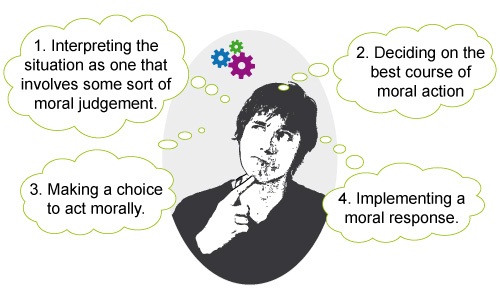
This may provide a useful framework for coaches/instructors to work through any future ethical dilemmas that arise (see Box 3).
Box 3 Dinner date dilemma
Carlo has been a personal trainer for 5 years now and has recently taken on a new female client, Emma. Emma is a friend of Carlo’s sister, although they hadn’t met each other until Carlo began training her. They formed a good working relationship and Carlo and Emma were pleased with her progress. The aim of Emma’s weekly training programme was to help her to lose 5 stone in weight as well as increasing her cardiovascular fitness and lowering her resting blood pressure. After each training session Carlo and Emma frequently had a coffee together to discuss how the training was going and if they needed to change anything. This gradually escalated into going out for dinner, and once they even went to the theatre. It was always Emma who asked Carlo as a thank you for helping her with her weight loss. Carlo felt this was simply an extension of his role in motivating Emma and keeping her on track for her goals. However, gradually Emma became more tactile with Carlo during training sessions and he began to feel a little uncomfortable. Then, one day over dinner, Emma asked him if he would like to go on holiday to a health spa with her. This is when Carlo realised he may have a moral dilemma to face.
Carlo’s four step action plan
- At this stage Carlo began to interpret the situation as one that involved some sort of moral judgement, as he felt the relationship was in danger of crossing a professional boundary.
- He decided that the best course of action was to discuss this with his mentor to establish a plan of action.
- Carlo discussed this with his mentor and reached the conclusion that he had to reinforce the professional boundaries of their relationship and that by addressing this situation and advising Emma that he would be unable to go with her on holiday he was to act morally.
- One evening after a training session Carlo discussed the issue with Emma, stating that he felt they had become friends but that due to professional boundaries he would have to refrain from any personal relationship wither her, including going to dinner and holidays. He explained that it was becoming harder for him to keep her focused on her training and goals and that she was becoming too relaxed in her training sessions. Although at first this was a difficult situation they were able to re-establish the professional boundaries within the relationship.
Conclusion
In this course you explored the external influence of adhering to ethical practice in coaching and instructing. The main learning points were:
- sport and fitness professionals are required to work within the codes of conduct set by the relevant organisations to ensure good practice standards.
- a relationship where the individual is fully compliant to the coach/instructor is one that can be seen to have an imbalance of power and control and can lead to exploitation of the individual.
- the coach or instructor is a central role in influencing morals in a range of environments where individuals, alongside the presence of the coach, develop and test the moral dimensions of their evolving characters.
- to consider potential ethical dilemmas that may arise within areas of sport and fitness practice and to develop possible solutions.
References
Acknowledgements
Except for third party materials and otherwise stated (see terms and conditions), this content is made available under a Creative Commons Attribution-NonCommercial-ShareAlike 4.0 Licence.
The material acknowledged below is Proprietary and used under licence (not subject to Creative Commons Licence). Grateful acknowledgement is made to the following sources for permission to reproduce material in this free course:
Course image: Colin Knowles in Flickr made available under Creative Commons Attribution-ShareAlike 2.0 Licence.
Every effort has been made to contact copyright owners. If any have been inadvertently overlooked, the publishers will be pleased to make the necessary arrangements at the first opportunity.
Don't miss out
If reading this text has inspired you to learn more, you may be interested in joining the millions of people who discover our free learning resources and qualifications by visiting The Open University – www.open.edu/ openlearn/ free-courses.