Physical activity: a family affair
Use 'Print preview' to check the number of pages and printer settings.
Print functionality varies between browsers.
Printable page generated Monday, 28 September 2026, 3:32 AM
Physical activity: a family affair
Introduction
For most athletes the journey to attaining expertise in sport frequently begins with an active childhood and taking an interest in sport from an early age. So what makes us sporty or active? Think back to your own early experiences of physical activity. Who played your first game of catch with you or taught you to ride your bike? The answer to these questions will most likely be a member of your family. There are many factors, psychological, social and biological, that shape who we are and what we do, and the family we are born into and grow up in is certainly one of these factors. This course aims to explore the effects that the family has on the amount and nature of physical activity a child participates in. The beliefs and behaviours of the family environment are the key psychosocial factors we investigate here.
This OpenLearn course is an adapted extract from the Open University course E313 Exploring psychological aspects of athletic development.
Learning outcomes
After studying this course, you should be able to:
summarise the main research evidence of family influence on a child’s level of physical activity participation
relate expectancy-value theory (Eccles, 1993; Eccles et al., 1983) to parental involvement in children’s sporting experience
understand how gender and parental gender stereotypes may affect parents’ support of children’s participation in sport.
1 What is the modern-day family unit?
There have been many changes in the way that families function in recent years, in particular to living arrangements in the developed world. The family unit now takes many different forms to the 20th century Western society construct of two parents and two children living in the family home.
Celia Brackenridge (2006) acknowledges these changes in her definition of the term ‘parent’:
Conventionally, the term ‘parent’ has been applied to the birth mother or father but it has become socially and politically diversified in recent years. Changes in demographic structures and patterns of family life mean that ‘parent’ is now applied to a wealth of living arrangements and adult responsibilities vis-à-vis children. For the purposes of this review ‘parent’ will be used as a generic term for any adult with de facto responsibility for the ongoing domestic care and welfare of the child but not to those ‘in loco parentis’ who take only a temporary or intermittent caring role.
This is the definition of the parent we will use for this free course along with the term ‘sibling’, which can be applied to any children living in the family home whether or not they have the same biological parents.
2 Socialisation into sport and physical activity
In an academic review of developing participation, Sports Coach UK states that ‘with the family identified as the first point of socialisation into sport (and ultimately into society) it is clear this is a key and underpinning aspect to the entire sport experience of young people’ (Bailey et al., 2010, p. 79).
There are many factors that contribute to when, if, and how a family socialises children into sport and physical activity, such as the amount of family time available to spend together, socio-economic status, parental interest in sport and physical activity, and the family structure. We will discuss some of these factors in more detail later in the course, however the overarching principle indicated by the Sports Coach UK Review is that ‘those who have family members involved in sport are more likely to be involved themselves’ (Bailey et al., 2010, p. 79).
Activity 1 Pinsent talks family
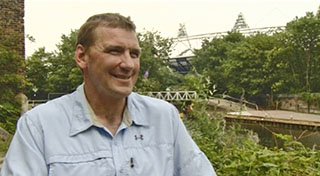
Watch the video clip of Matthew Pinsent discussing his family. What role did Matthew’s family play in his introduction to sport and exercise? How do your experiences compare to Matthew’s? For example, consider the amount of time spent together as a family, socio-economic status, parental interest in their own and the children’s sporting activities. You may also consider the family structure or your own position in the family.
Transcript: Matthew Pinsent on family influences
Matthew Pinsent video and transcript © The Open University
Discussion
Matthew Pinsent describes neither of his parents as being sporty, other than his dad playing ‘the occasional game of squash’. However, he does describe them as always being physically active and encouraging an active lifestyle. The support described by Matthew is both material (parents drive him round, pay for kit) and attitudinal (they support his decisions and encourage him to be active). Matthew also felt that being the youngest of three siblings impacted on his physical condition (early development). The combination of all these factors contributed to his positive disposition to sport. You may have related some of these to your own situation.
3 Are children becoming less active?
In an age of games consoles and internet chat rooms, the media has widely reported that modern-day children are becoming less active. Box 1 refers to a survey published by British Triathlon and Tata Steel (2011) that illustrates these concerns.
Box 1 2011 Survey on children and physical activity
In a 2011 survey conducted by British Triathlon and Tata Steel of 1,500 children aged six to fifteen, results found 10% cannot ride a bike, 15% cannot swim and 22% had never run a distance of 400m. One of the most interesting aspects was that a third of the children questioned said they did not own a bike, while three quarters (77%) had a games console. In the week before the poll was conducted in March 2011, just 46% had ridden their bikes and 34% had swum the length of a pool, but 73% had played a video game. 15% of the children said they had never played sport with their parents.
The statistics in Box 1 imply that in many families physical activity may not be considered a priority. However, should we accept these statistics as being accurate or should we look more deeply into this survey to question the information we are presented with? The next activity will help you begin to formulate a critical approach to evaluating research.
Activity 2 Statistics: the bigger picture
Read the online article ‘Bad news: are kids turning their backs on sports?’ (Merseyside Skeptics Society, 2011). What point is the author trying to make about statistics?
Discussion
The main point of this article is to stress that when faced with statistics, particularly those published by the media, it is important to question the source of such evidence, and the reliability and validity of data collection. Without having the full results available and viewing the precise data collection method, analysis proves difficult. Even when we are not in possession of the exact data, it is generally advisable to do some common-sense thinking about vested interests and alternative explanations, and the author does point out some ‘potential biases’.
4 Theoretical perspectives of participation
The majority of young children’s time is spent with family members, especially parents, and this is why the family is a vital social facilitator influencing the way a child thinks and behaves, and in particular the opportunities they are presented with. There are many groups and classes that young children can be introduced to but this is not a choice they are able to make themselves. It is the parents who decide whether they take their child to music classes, arts and crafts sessions or swimming lessons. It is the parents who decide whether the child is to stay indoors and watch television or be taken to the park for a more physical activity.
These decisions are informed by the parents’ own attitudes and beliefs, and it is these psychological factors that interest us most. Admittedly, social factors such as cost, local provision and proximity to amenities are also relevant; however, research in this area does indicate that the psychological climate created by parents influences a child’s participation in sport and physical activity, their experience of the activity and subsequently their continued participation (Partridge et al., 2008).
Activity 3 introduces you to the work of Jacquelynne Eccles. Eccles’ expectancy-value theory (Eccles et al., 1983; Eccles, 1993), which you will encounter in a moment, looks at parental influence on children’s motivation in achievement settings. Eccles’ theory is widely used in academic settings and has been applied to the sporting context to explain parental involvement.
Activity 3 Eccles’ expectancy-value theory
Read the article ‘Theoretical perspectives: Eccles’ expectancy-value theory’ (Partridge et al., 2008). Then answer the following questions.
- According to the expectancy-value theory, what are the different ways in which parents can influence their children’s participation in sport and physical activity?
- In particular, what is the relevance of gender to this discussion? Note that the latest gender research presented in the chapter dates from 2005. Do you feel that this research is still applicable today?
Discussion
- If a parent values sport as an important achievement domain then they will provide more frequent opportunities for their child to participate in sporting activities. Similarly, parents who believe that their child is likely to do well and achieve success in sport or who perceive their child to be competent at sport are more likely to provide support opportunities in that activity or domain. Children within the same family can be provided with different opportunities as parents can often form different beliefs about siblings.
- Research does indicate a ‘parental gender stereotype’, as parents are more likely to partake in sport and physical activity with their sons than their daughters, and are more likely to take their sons to sporting events. This can also be linked to parental beliefs of perceived competence, as often parents will view their sons as possessing a higher ability in sport. In addition, parents often attribute a higher value to participating in sport and physical activity for their sons than their daughters. As the latest research on gender cited by this article is dated 2005, it could be argued that with the progress of activities such as girls’ rugby and football, and with the Olympic medals won by female British athletes at the 2012 Olympic Games, that many of these stereotypical beliefs are starting to be re-shaped and that more recent research is needed.
Eccles’ theory explores the role of parents in providing opportunities for their children. In addition to Eccles’ work, Hellstedt (1987, 1995) looked at parental involvement in children’s sport participation, conceptualising involvement on a continuum from under-involved to over-involved. Hellstedt concluded that moderate parental involvement was in children’s best interest, emphasising fun and skills development. It is worth noting that neither theory considers the role that school sport may play in athletic development, and in some cases, even with minimal parental involvement or support, the school sport system may provide opportunities and support for athletic development.
5 How important is the family environment?
Activity 3 illustrates the potential influence that parents have over their child’s recreational activities, and we must therefore consider what factors contribute to parental beliefs and motivations as regards physical activity. To help answer this question we can look at research into family characteristics. Bailey and Morley (2006, p. 20) reviewed a range of literature in this area and found that particular family characteristics strongly support participation in youth sport. These are:
- Parents achieved high standards within sport;
- Parents are of relatively high socio-economic status;
- Parents possess the ability and willingness to support the child financially;
- Parents are willing to dedicate large amounts of their own time to support the child’s participation in an activity;
- The parents own a car;
- The family size is relatively small;
- There are two parents;
- The child attends an independent school.
This research suggests that although the parents’ willingness to invest time in their child’s activities is a contributor, there are other factors that may be beyond the parents’ control, such as owning a car or being able to offer financial support. In addition, Porter (2000) found that parents are more supportive of activities that are easy to access, a safe play environment, good ‘drop-off’ arrangements and where activities are available to other members of the family, therefore convenience may also play a part. The point regarding family size is interesting; consider how this impacts on parents’ time and money if they have five children all wanting to participate in different activities, as opposed to those parents who can invest all their time and money in one child. Studies in developed nations generally indicate that elite athletes are more likely to come from middle- or upper-class families (Fraser-Thomas and Côté, 2006).
Activity 4 uses a case study to which we can apply Bailey and Morley’s findings. In the video we meet two boys who go on to compete at the Irish Dancing World Championships. We will return to this video and the story of the two boys throughout this study topic.
Activity 4 The Great Irish Dance Off
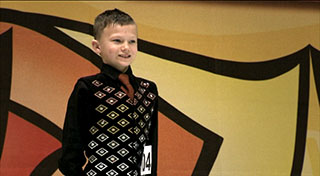
Watch the video clip ‘The Great Irish Dance Off’, which follows two Irish dancers on their journey to the World Championships, then answer the following questions.
- Compare the family characteristics of the two dancers to the eight characteristics listed above. Do they support Bailey and Morley’s findings?
- Do you feel that some of the eight criteria are more important than others? Go to the tutor group forum and rank the criteria you feel are the three most important, stating reasons for your answer.
Transcript: The Great Irish Dance Off
The Great Irish Dance Off video and transcript © Bankside Films
Discussion
- John’s circumstances meet some but not all of the criteria. John has achieved high standards, although his coach states that, ‘If John was in his class four or five times a week like the rest of his competitors probably are then he would be unbeatable, unfortunately he is one of five, they’re all playing football and going in different directions, and Irish dancing is expensive’. Joe’s family appear to fit more of the criteria. They are from a higher socio-economic background, as his dad used to own a successful medical practice. He is an only child and the sole focus of his parent’s time and money; they even moved country to boost his chances of success. These differences in family circumstances are influential as John’s larger family means that he is given less chance to participate than Joe. It will be interesting to see what effect, if any, this has in terms of their success later on.
- Although John’s family do not meet as many of the criteria as Joe’s family, the boys are equally successful. This would suggest that perhaps some factors are more predictive of participation than others. Through contributing to the tutor group forum and responding to other postings you should engage in an extended discussion around this topic.
Certain sports appear to attract certain family characteristics. More than a third (37%) of British medal winners at the London 2012 Olympic Games were privately educated, with athletes from private schools dominating in rowing and equestrian events (Vasagar, 2012). However, Activity 4 illustrates that research can only tell part of a story and that there will always be exceptions to statistics such as these. Many athletes come from backgrounds in which family resources are limited. This suggests that although environmental factors can be influential, there are other contributing factors that are sometimes more important, such as attitudes and beliefs. It is to these psychological factors that we now turn.
6 Gender differences
Interestingly, John and Joe do not have any sisters but if they did would the girls receive the same level of family support? In a review article Gustafson and Rhodes (2006) reviewed 34 studies. Twenty-seven of these studies examined gender differences related to parental influence on a child’s physical activity levels. Activity 5 will help you to gain a fuller appreciation of the research in this area.
Activity 5 Parental support and gender
Read the abstract and Section 6 ‘Sex Relations’ of the article ‘Parental correlates of physical activity in children and early adolescents’ (Gustafson and Rhodes, 2006) and answer the following questions.
- What are the authors trying to do in writing this article?
- What were the key findings from reviewing the existing research in this section of the article?
- What do you notice about the proportions of different research designs that feature in this review?
Discussion
- The aim of this article is to collate the existing research on parental influences on children’s physical activity behaviours in order to establish any gaps in the research and to identify the direction for future research. The overall aim of the research is to improve current child physical activity intervention programmes.
- The majority of studies found a strong sex difference in physical activity levels, with boys tending to be more active and receiving more parental support. There is some evidence for a correlation between mother–daughter physical activity but mother–son correlations were not as consistent. There is a strong correlation between father and child physical activity, particularly between father and son, with only one of the studies not finding a relationship.
- Twenty-two studies were cross-sectional and five longitudinal. Longitudinal research is valuable as it allows the researcher to view any changes to the population that occur over a period of time, however they are expensive. In addition, such studies are also exposed to subjects dropping out or withdrawing from the research. Interestingly, none of the studies reviewed used experimental designs.
7 Do active parents have active children?
Reinforcing the suggestion that active parents have active children, in an online interview Olympic triathlete Alistair Brownlee describes his childhood as extremely active. Both his mother and father were very sporty and involved both him and his brother (also an Olympic triathlete) in their active lifestyle, introducing them to running, swimming and cycling:
Your parents control everything really. They control whether they take you swimming, or running, or take you out on your bike or whatever.
In a longitudinal study by Moore et al. (1991) and which used an accelerometer (electronic device which measures the amount and intensity of movement) to assess physical activity levels in 100 4- to 7-year-olds and their parents, it was found that children of active mothers were twice as likely to be active as children of inactive mothers. Similarly, children of active fathers were 3.5 more times as likely to be active as those with inactive fathers. When both parents were active, the children were 5.8 times as likely to be active as children of two inactive parents. The study revealed that possible mechanisms for the relationship between parents’ and child’s activity levels included:
- the parents’ serving as role models
- sharing of activities by family members
- enhancement and support by active parents of their child’s participation in physical activity
- genetically determined factors that predispose the child to increased levels of physical activity.
The final point is an interesting one: research conducted by Wolfarth et al. (2005) identified potential genes for physical activity behaviours and characteristics. If we look at Alistair Brownlee, his parents appear to have implemented the first three mechanisms identified by Moore et al. (1991), although it is difficult to comment on the last point. Referring back to the data on gender, some studies have also indicated that parental participation is particularly important for daughters (Fredericks and Eccles, 2004).
Activity 6 An evening with the Murrays
Listen to the following radio programme in which Andy Murray, his mother Judy and brother Jamie discuss family life and sport, then answer the following questions.
- How can Eccles’ expectancy-value theory (discussed in Activity 3) be applied to Judy’s role in Andy and Jamie’s participation in tennis?
- In what way did Judy act as a role model for Andy and Jamie?
Transcript: An evening with the Murrays
Jonathan Overend:
So welcome back inside the grand gallery here at the National Museum of Scotland, our special guests Andy Murray, Jamie Murray, Judy Murray and anyone else called Murray is freely invited to join in as well, you meet the entry criteria. Matthew Syed alongside me for a little bit of variety. And for this part of the programme we’re going to start talking about the role of the family in sport, the introduction of kids to sport, the retention of them as the talent grows, the encouragement and support required from parents like Judy Murray sitting alongside me here. And to this end Judy, a couple of years ago you had a bit of a brainwave based on what you used to do with Andy and Jamie. Tell us about that.
Judy Murray:
Yeah, well we … I think because I’d been going a fair number of school visits trying to introduce tennis to kids in probably primary threes and primary fours. And I was becoming more and more aware that it seemed to me that less and less kids were co-ordinated when you actually tried to introduce them to, to playing tennis, and also that probably more than I’d been aware of before were a little bit overweight. But I know that there probably isn’t enough physical education or physical activity in schools now. And I know that the things that kids tend to play with that are cool and trendy are things where you sit down and you look at some sort of screen and play your games that way, and I started thinking back to a lot of the games that we kind of dreamed up playing together when the boys were growing up. And they’re all very, very simple, but we’d find literally anything that was lying around the house and create some kind of game out of it. And I started to sort of jot them down, and when I spoke with RBS about it who have sponsored the boys for a long, long time now and been very instrumental in their career. They came in to help us at time when we really needed some help with, when, you know, when Andy was going to Spain to train. And they were really keen to help to bring it to life. And we set up a website which you can download all the information and all the games free of charge. You can send for a free booklet. For me, I came from a sporty family. I grew up playing games with my brothers and my mum and dad, and I love sport, and I wanted my kids to enjoy sport. So for me to play with them in the garden or in the house with balls and balloons and, you know, anything that we could find was just pretty much like second nature. But I’m aware that, you know, parents have less time these days. And not everybody has that kind of sporty background. So to give ideas was great.
Jonathan Overend:
So give us an example. What sort of thing are we talking about?
Judy Murray:
Well yeah, one of the games that’s in the book that’s probably the easiest to explain is called Jumping the River where a couple of pieces of rope or skipping rope, and you set them may be a foot or so apart and there’s your river. You chuck a couple of toy sharks in it, and suddenly you’ve got shark-infested waters to jump over. And it becomes a bit more exciting jumping over this rope. So you can jump over it, hop over it, run over it and once you’ve jumped you just widen the ropes to make it bigger and bigger. Maybe you’ve got a tape measure, so you measure how far they have jumped. Maybe you stick a hoop at the other side so you’re jumping over the shark-infested waters and you’re landing in a boat or something. And then, you create a little story out of it and …
Jonathan Overend:
With the aim of developing at this stage, hand-eye co-ordination, balance, that sort of thing?
Judy Murray:
Well, with something like that, you know, even something as simple as leg strength. You know, jumping from a standing jump, dynamic balance, yes. And when you start to add in something that you’re throwing then it becomes tracking and receiving skills, yes, passing and catching, But the great thing about it is that the kids are learning these things and developing these things without even realising that they are, because they’re just playing.
Jonathan Overend:
Do you remember any of this, Jamie or is this all news to you?
Jamie Murray:
No a bit of a bit of jumping the river, always good on a Saturday night (laughter). We, I mean, we did lots of things. I mean, we, you know, we made stuff up ourselves between us and we were always sort of, we were very active as kids. You know, in our house we were living in at the time, in our hall we had sort of an archway and a door. So we had balloons, and we would try to score and pass one another and stuff and. I mean it’s just simple stuff that we made up.
Andy Murray:
As Jamie was saying it was always a killer when the balloon hit the radiator and burst and that. And that was the end of it, yeah.
Jamie:
That was the end of it yeah. But I mean it’s just loads of things that at the time, you know, we were just having fun playing with. But in reality we were probably learning a whole bunch of sort of skills that would then help us when we started to take up different sports.
Jonathan Overend:
And in terms of like the co-ordination aspect of it, Judy, all this was happening presumably before you introduced a tennis racket and balls to the house, was it?
Judy Murray:
Yeah. Well I think, I mean, doing all of these things you’re doing them as a parent. It’s not, I wasn’t a tennis coach at that point. I didn’t become a tennis coach until much later. So the boys would play as much mini cricket and mini golf, mini rugby, mini football as mini tennis. But yeah, they did have little mini tennis rackets from a young age. And we had swing ball in the garden. And I often look back at that swing ball in the garden and I remember quite clearly really that Andy was better at swing ball than me when he was about four, which was quite sad because I was an international tennis player. And the ball, I could miss it so many times and he would just stand there and give it this one. And even now when I watch him and he’s one of the best returners of serve in the world, and I wonder whether that had anything to do with it.
Andy Murray:
It didn’t. (It’s a good story.)
Jonathan Overend:
And they don’t make swing ball like they used to. I can tell you that from experience, my five-year-old broke one the other week. Matthew Syed’s here.
Matthew Syed:
It’s fascinating because I think there’s a mythology that has grown up around sport that either you’ve got it or you haven’t. You’ve either got hand eye co-ordination, agility, speed, instincts or you haven’t. And if you haven’t, you’re never going to get them. And this is terribly destructive because the reality is as Judy has articulated if you practice, if you do the right things, these are competencies that can be developed over time. The anatomy, the brain changes, the physicality changes if you’re learning in an effective way. And if you have an inspirational parent or coach who encourages and nurtures the motivation and the mindset that leads to learning, then almost everybody has the capacity to become an expert in almost any physical skill. And, and it’s great to see it in a family like this.
Jonathan Overend:
Because like you said Judy, you weren’t a tennis coach at that point. You were just trying to get your boys active. So, I mean, sometimes the image of you, you know, is betrayed as this sort of wanna be production line of two boys. You always had it in your mind that they were going to be world-beating tennis champions, but that couldn’t be further from the truth.
Judy Murray:
No, it absolutely wasn’t. I mean, when they were young they played every sport under the sun. They tried everything. And this is the whole thing about set for sport is that, you know, we kind of aimed at parents of kids aged between three and eight, because I reckon that by the time they were about seven and eight they had a better idea themselves of which sports they were going to enjoy.
I mean, I can remember taking them to mini rugby, and Jamie didn’t like mini rugby because he got dirty. And Andy wasn’t so keen on mini rugby after he, you know, went the first couple of times and then they played a little game and he ran after the ball as all kids do at that age, you know, there’s like twelve of them playing, they all run after the same ball, so they’re all in a heap and he gets the ball and runs, and he’s a very quick little runner, and he runs and he scores the try at the other end of the thing. And then somebody tells him he’s run in the wrong direction. And so he’s actually not getting his try and he didn’t want to go back after that, so.
But you know, they, they tried everything, but we lived close to the tennis club and I was doing a little, a little bit of coaching on a voluntary basis over there just for something to do, and they kind of got used to being around the tennis club.
An Evening with the Murrays –BBC radio 5 programme © BBC
Discussion
- Expectancy-value theory states that if a parent values sport as an important achievement domain then they will provide more frequent opportunities for their child to participate in sport activities. Judy came from a sporting family herself and grew up playing sport, therefore she valued sport as a domain and wanted her children to value and enjoy it too, and so provided lots of opportunities for them. This didn’t always involve organised sport and could be simply playing games with them in the house and garden to get them active.
- Judy Murray modelled a sporting environment for the boys, encouraging them to experience a range of activities. The Murrays lived close to a tennis club and Judy was a volunteer coach there so the boys got used to being around tennis. This could be seen as role modelling. We could take this a step further and look at sibling relationships with Jamie also acting as a role model for Andy.
8 Putting the pieces together
So far in this course we have examined a broad range of factors that contribute to the family’s socialisation of children into physical activity. Inevitably we are unable to analyse every study and paper relating to this topic as there are simply so many. However, the next activity guides you to consider a key journal article in this area. It is a cross-sectional study comprising a range of questionnaires designed to ascertain the influence of parental socialisation and children’s psychological characteristics upon their attraction to physical activity. It also refers back to Eccles’ expectancy-value theory introduced in Activity 3.
Activity 7 Parental influences on physical activity
Read the article by Brustad (1993) entitled ‘Who will go out and play? Parental and psychological influences on children’s attraction to physical activity’.
Then answer the following questions.
- What limitations do you notice from the sample used?
- Through what procedures was the parent data gathered? Do you think the research instruments used have any limitations?
- To what extent did the results support the proposed model of relationships among parental influences and children’s attraction to physical activity?
Discussion
- You may have questioned why approximately 95% of the children in the study were Caucasian and from an upper middle-class background. Therefore, can we apply the results of this study to the general population?
- The parental data was gathered using questionnaires. These were sent home to parents in a letter. Only one of each set of parents was asked to complete the questionnaire and so this does not necessarily reflect the other parents’ attitudes. The majority of questionnaires were completed by mothers. For measures of physical fitness the researchers were reliant upon the parents’ own assessment rather than a physical test. One PE teacher lost a sample of the parental questionnaires and so out of 231 children only 81 parental questionnaires were obtained, reducing the sample size considerably.
- The paper concluded that parental influences, children’s gender and children’s self-perception characteristics are all important in shaping a child’s attraction to physical activity.
9 Beliefs and values
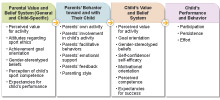
As we have learned, parents influence their child’s sporting experience in a variety of ways. Figure 1 below provides an illustration of the key features of Eccles’ expectancy-value theory and how parents’ values and beliefs influence behaviour towards their child, which in turn shapes the child’s own values and beliefs, and ultimately their performance and behaviour.
Conclusion
This free course has built on your own experience of socialisation into sport and explored the role of the family in this process. A number of social and psychological factors have been considered and it is important to acknowledge these do not exist in isolation but all work together to influence athletic development.
The main learning points of this course include the following:
- Families influence athletic development through providing opportunities for their children.
- More active parents are likely to have more active children. A study showed children of two active parents were 5.8 times as likely to be active as children of two inactive parents (Moore et al., 1991).
- Expectancy-value theory (Eccles, 1993; Eccles et al., 1983) states that if parents perceive sport to be an important achievement domain they will provide more frequent opportunities for their child to participate in sporting activities.
- Some studies indicate a ‘parental gender stereotype’ among parents as they are more likely to partake in sport and physical activity with their sons than their daughters and are more likely to take their sons to sporting events, although attitudes may have changed in more recent years.
- Certain family characteristics strongly support participation in youth sport. These include parents who achieved high standards within sport, are of relatively high socioeconomic status, support the child financially and dedicate time, and own a car, as well as there being two parents, a small family size, and children attending independent school.
References
Further reading
Acknowledgements
This free course was written by Jessica Pinchbeck.
Except for third party materials and otherwise stated (see terms and conditions), this content is made available under a Creative Commons Attribution-NonCommercial-ShareAlike 4.0 Licence.
The material acknowledged below is Proprietary and used under licence (not subject to Creative Commons Licence). Grateful acknowledgement is made to the following sources for permission to reproduce material in this free course:
Course image: Sabine van Erp / www.pixabay.com.
Text
Activity 3, adapted from: Partridge, J.A., Brustad, R.J. and Stellino, M.B. (2008) ‘Social influence in sport’ in Horn, T.S. (ed) Advances in Sport Psychology, 3rd edn, Champaign, Human Kinetics, pp. 269–292. © 2008 Human Kinetics Publishers Inc.
Activity 5 ‘Parental correlates of physical activity in children and early adolescents’ Sabrina L. Gustafson and Ryan E. Rhodes, University of Victoria, Victoria, British Columbia, Canada.Sports Med (2006), vol. 36, no. 1, pp. 79–97. © 2006 Adis DataInformation BV.
Activity 7 Brustad, R.J., Who will go out and play? Parental and psychological influences on children’s attraction to physical activity’ in Pediatric Exercise Science (1993) Human Kinetics Vol 5 pp 210-223 © 1993 Human Kinetics Publishers Inc.
Images
Figure 1: Horn, T. and Horn, J. (2007) ‘Chapter 31: Attachment and well-being: The mediating effects of psychological needs satisfaction within the coach-athlete and parent-athlete relational contexts’ in Tenenbaum, G. and Eklund, R. (eds) Handbook of Sport Psychology, 3rd edn, Canada, Wiley & Sons.
AV
Activity 1: Matthew Pinsent video and transcript © The Open University
Activity 4: The Great Irish Dance Off video and transcript © Bankside Films
Activity 6: An Evening with the Murrays –BBC radio 5 programme © BBC
Every effort has been made to contact copyright owners. If any have been inadvertently overlooked, the publishers will be pleased to make the necessary arrangements at the first opportunity.
Don't miss out
If reading this text has inspired you to learn more, you may be interested in joining the millions of people who discover our free learning resources and qualifications by visiting The Open University – www.open.edu/ openlearn/ free-courses.