Intermediate Italian: describing people
Use 'Print preview' to check the number of pages and printer settings.
Print functionality varies between browsers.
Printable page generated Friday, 15 May 2026, 3:26 PM
Intermediate Italian: describing people
Introduction
In this free course, Intermediate Italian: describing people, you will learn vocabulary relating to physical description and personality, and practise describing and comparing people. You will also find out about the Italian author Natalia Ginzburg and have the opportunity to read an extract from one of her novels. Listening to Italian speakers describing people will enable you to practise listening skills and improve your pronunciation.
This OpenLearn course is an adapted extract from the Open University course L150 Intermediate Italian: Vivace.
An activity in this course uses an audio-recording tool. This may not work correctly in the Safari browser on Apple Mac computers. Please try another browser such as Google Chrome to run this.
Learning outcomes
After studying this course, you should be able to:
describe people’s physical appearance and personality
make comparisons using come / quanto and più di / meno di
use reading skills in Italian
imagine a character and write a short description of them.
1 Physical appearance
In this section you will work on describing people’s physical appearance in Italian.
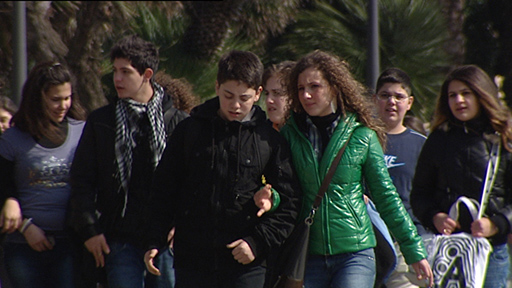
Describing people's faces
In this first activity you will work on the vocabulary and structures you will need to use in order to describe people.
Attività 1
Step 1
Listen and repeat.
Ascoltate e ripetete.
Transcript
Listen to the words used for features of the face and head.
1 la bocca
2 gli occhi
3 i capelli
4 il mento
5 la fronte
6 il sopracciglio
7 l’orecchio
8 il viso
9 i baffi
10 gli occhiali
Step 2
Match these words to the correct part of the face.
Abbinate le parole alla parte del viso a cui si riferiscono.
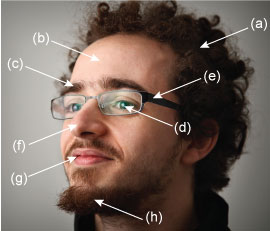
Two lists follow, match one item from the first with one item from the second. Each item can only be matched once. There are 8 items in each list.
i capelli
la fronte
il sopracciglio
gli occhi
gli occhiali
il naso
la bocca
la barba
Match each of the previous list items with an item from the following list:
a.(a)
b.(e)
c.(h)
d.(f)
e.(d)
f.(c)
g.(g)
h.(b)
- 1 = a,
- 2 = h,
- 3 = f,
- 4 = e,
- 5 = b,
- 6 = d,
- 7 = g,
- 8 = c
Describing physical characteristics
In this activity you will work on the vocabulary and structures you will need for describing people, and practise the vocabulary you have just learned.
Attività 2
a.
Vero
b.
Falso
c.
Forse
The correct answer is c.
a.
Vero
b.
Falso
c.
Forse
The correct answer is a.
a.
Vero
b.
Falso
c.
Forse
The correct answer is c.
a.
Vero
b.
Falso
c.
Forse
The correct answer is b.
a.
Vero
b.
Falso
c.
Forse
The correct answer is b.
a.
Vero
b.
Falso
c.
Forse
The correct answer is a.
a.
Vero
b.
Falso
c.
Forse
The correct answer is c.
Box 1 Describing physical characteristics
To describe someone’s physical characteristics, you generally use the verb essere with an appropriate adjective (or adjectives).
Marco è calvo.
Marco is bald.
Giovanni è grosso.
Giovanni is big.
Teresa è magra.
Teresa is slim.
Sara è attraente e sportiva.
Sara is attractive and sporty.
To describe someone’s physical characteristics you can also use avere followed by a noun.
Dario ha la barba e i baffi.
Dario has a beard and a moustache.
Stefania ha gli occhi castani.
Stefania has brown eyes.
Finally, to describe what someone is wearing, use portare followed by a noun.
Renzo porta spesso una giacca verde.
Renzo often wears a green jacket.
Dario porta gli occhiali.
Dario wears glasses.
Sofia porta sempre i capelli raccolti.
Sofia always has her hair tied back.
Understanding spoken physical descriptions
In this activity you will practise your listening skills.
Attività 3
Listen to the following audio clip, in which five students taking part in an online lesson describe themselves to the rest of the class. Match each person's name to the appropriate lettered drawing, according to the description given.
Ascoltate l’audio e abbinate ciascuna persona al disegno corrispondente.
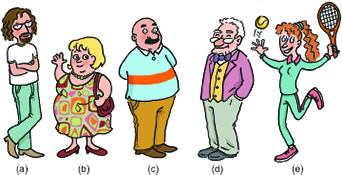
Transcript
Listen to the descriptions of these five people.
1 Mi chiamo Guido. Sono magro e piuttosto alto. Ho i capelli castani lunghi e la barba.
2 Ciao. Sono Luisella. Sono bionda e ho gli occhi neri. Sono una donna di mezza età, grassa e bassa.
3 Ciao. Mi chiamo Luca. Ho quarant’anni. Sono di altezza media, circa un metro e 70, e sono robusto. Sono calvo, ma ho i baffi neri.
4 Ciao a tutti. Mi chiamo Aldo. Sono anziano, ho settant’anni. Ho i capelli bianchi corti e porto gli occhiali.
5 Buonasera, mi chiamo Luciana. Ho trent’anni e sono molto sportiva, magra e forte. Ho i capelli rossi lunghi e ricci e gli occhi azzurri.
Two lists follow, match one item from the first with one item from the second. Each item can only be matched once. There are 5 items in each list.
Guido
Luisella
Luca
Aldo
Luciana
Match each of the previous list items with an item from the following list:
a.(a)
b.(d)
c.(c)
d.(b)
e.(e)
- 1 = a,
- 2 = d,
- 3 = c,
- 4 = b,
- 5 = e
In the next activity, you will continue working on useful vocabulary for describing physical appearance and will learn some colloquial expressions.
Attività 4
Marina is a tour guide, but today there is an extra person in her group of tourists, someone freeloading on the excursion! Read the descriptions of the participants and match them to the pictures to find which person is not described – that's the intruder!
Marina fa la guida turistica. Nel suo gruppo di turisti c’è una persona in più, un intruso! Leggete le descrizioni dei partecipanti alla visita turistica, abbinatele alle immagini corrispondenti e scoprite l’intruso.
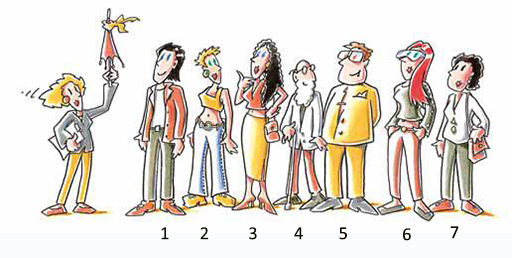
- a.È alta, magra e molto bella. Ha i capelli neri, lunghi e ricci e gli occhi azzurri.
- b.È alto, un po’ grasso, ha i capelli e gli occhi castani e porta gli occhiali. Non è molto giovane ed è sempre elegante.
- c.È giovane, abbastanza alta, né magra né grassa, ha i capelli corti, biondi e gli occhi verdi. Porta quasi sempre i jeans.
- d. È una persona anziana, bassa, magra e calva. Ha la barba e gli occhiali.
- e.Non è né alta né bassa, abbastanza magra, ha i capelli neri, non è più giovane, ma ancora molto sportiva.
- f.È alto, magro, sportivo e attraente. Ha i capelli neri non molto corti e gli occhi azzurri.
- g.Questo/questa dev’essere l’intruso/l’intrusa!
Two lists follow, match one item from the first with one item from the second. Each item can only be matched once. There are 7 items in each list.
(f)
(c)
(a)
(d)
(b)
(g)
(e)
Match each of the previous list items with an item from the following list:
a.1
b.3
c.7
d.5
e.6
f.4
g.2
- 1 = a,
- 2 = g,
- 3 = b,
- 4 = f,
- 5 = d,
- 6 = e,
- 7 = c
Who is the intruder?
Answer
As you can see from the corrected answers, the intruder is person number 6.
Vocabolario
calvo, -a bald
né... né neither ... nor
l'intruso, -a intruder
Now describe the intruder in a sentence.
Answer
Here is a possible answer: È alta, abbastanza magra, ha I capelli lunghi e rossi e porta gli occhiali.
Forming physical descriptions
In this activity you will continue practising vocabulary and structures you need for describing people.
Attività 5
a.
a. Marco porta
b.
b. Marco ha
c.
c. Maria è
d.
d. Maria fa
e.
e. Marco è
The correct answer is e.
a.
a. Marco indossa
b.
b. Maria è
c.
c. Marco è
d.
d. Maria fa
e.
e. Marco ha
The correct answer is e.
a.
a. Maria è
b.
b. Maria fa
c.
c. Marco è
d.
d. Marco porta
The correct answer is d.
a.
a. Marco è
b.
b. Marco ha
c.
c. Maria fa
d.
d. Marco porta
e.
e. Maria è
The correct answer is b.
a.
a. Maria è
b.
b. Marco è
c.
c. Marco porta
d.
d. Marco ha
e.
e. Maria fa
The correct answer is d.
a.
a. Maria fa
b.
b. Maria è
c.
c. Marco ha
d.
d. Marco porta
e.
e. Marco è
The correct answer is b.
a.
a. Maria è
b.
b. Maria fa
c.
c. Marco porta
d.
d. Marco è
e.
e. Marco ha
The correct answer is d.
a.
a. Marco indossa
b.
b. Marco ha
c.
c. Marco è
d.
d. Maria fa
e.
e. Maria è
The correct answer is b.
a.
a. Maria è
b.
b. Marco ha
c.
c. Marco porta
d.
d. Marco è
e.
e. Maria fa
The correct answer is a.
Practising describing people
In this activity you will practise your spoken and written skills.
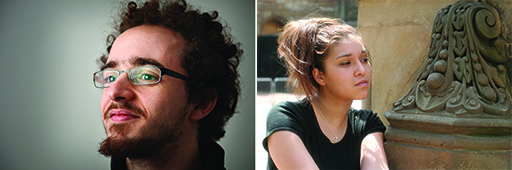
Attività 6
Look at the two images in Figure 6 and for each one write a short description. Record yourself saying it.
Guardate le due immagini e per ciascuna scrivete una breve descrizione, poi registratevi.
Answer
Here is a possible answer, to compare with your own:
Lei è giovane, ha i capelli castani, lunghi e lisci e porta la coda. Lui è giovane, ha i capelli neri, corti e ricci. Ha la barba e i baffi e porta gli occhiali.
Listening to descriptions
In this activity you will listen to two people describing someone else.
Attività 7
a.
He is lively, happy and has fair hair.
b.
He is tall and has fair hair.
c.
He is tall, lively, cheerful and has fair hair.
d.
He is tall, cheerful and has fair hair.
The correct answer is c.
2
a.
He is tall, thin and sporty.
b.
He is thin, lively and sporty.
c.
He is tall, lively and sporty.
The correct answer is c.
2 Comparing
In this section you learn how to compare people’s physical appearance.
Comparing people using più … di or meno … di
In this activity you will practise comparing two people using più … di or meno … di.
Attività 8
Look at each pair of photos and complete the statements using più or meno.
Guardate ogni paio di foto e completate le descrizioni utilizzando ‘più di’ o ‘meno di'.
a.
meno
b.
più
The correct answer is b.
a.
più
b.
meno
The correct answer is b.
a.
meno
b.
più
The correct answer is b.
a.
più
b.
meno
The correct answer is a.
a.
più
b.
meno
The correct answer is b.
a.
meno
b.
più
The correct answer is a.
a.
più
b.
meno
The correct answer is a.
a.
meno
b.
più
The correct answer is b.
a.
meno
b.
più
The correct answer is a.
Box 2 Making comparisons using più / meno di
To compare one person (or thing) with another, you can use più / meno with an adjective, followed by di.
Emma è più bionda di Giorgia.
Emma is blonder than Giorgia.
Dario è più alto di Luca.
Dario is taller than Luca.
Carlo è meno generoso di Ferdinando.
Carlo is less generous than Ferdinando.
I capelli di Giorgia sono più corti di quelli di Emma.
Giorgia's hair is shorter than Emma's.
Comparing two people using come or quanto
In this activity you continue practising comparing people, using the expressions come or quanto.
First read the following explanation.
Box 3 Making comparisons using come / quanto
To compare two objects or people of equal qualities, you can use come or quanto
Simone è alto come me.
Simone is as tall as me.
Questa gonna è stretta quanto l’altra.
This skirt is as tight as the other one.
To compare two adjectives referring to the same noun, you can use ‘tanto + adjective …
quanto + adjective’.
Questo vestito è tanto comodo quanto elegante.
This dress is as comfortable as it is elegant / smart.
(This is a rather literary way of saying ‘This dress is both comfortable and elegant / smart.’)
La notte era tanto oscura quanto silenziosa.
Valeria è tanto bella quanto antipatica!
The construction can also be used to compare two adverbs.
Carlo scrive tanto velocemente quanto accuratamente.
In this context, tanto and quanto are invariable (i.e. do not change their ending).
Attività 9
Scrivete due frasi per ogni coppia di personaggi come nell'esempio. Usate 'come' nella prima frase e 'quanto' nella seconda frase.
Write two sentences for each couple of characters as in the example. Use come in the first sentence and quanta in the second sentence.
Esempio
Carlos, organizzato
Elisa, organizzata
Carlos e organizzato come Elisa. or Carlos e organizzato quanto Elisa.
1
Aida, alta 1.63
Massimo, alto 1.63
Answer
Aida è alta quanto Massimo. or Aida è alta come Massimo.
2
Werner, magro
Luca, magro
Answer
Werner è magro quanto Luca. or Werner è magro come Luca.
3
Maria, bella
Fiorella, bella
Answer
Maria è bella come Fiorella. or Maria è bella quanto Fiorella.
4
Ionut, estroverso
Roberto, estroverso
Answer
Ionut è estroverso quanto Roberto. or Ionut è estroverso come Roberto.
5
Stella, intelligente
Umberto, intelligente
Answer
Stella è intelligente quanto Umberto. or Stella è intelligente come Umberto.
6
Katia, impaziente
Marta, impaziente
Answer
Katia è impaziente come Marta. or Katia è impaziente quanto Marta.
7
Alfonso, attraente
Matteo, attraente
Answer
Alfonso è attraente come Matteo. or Alfonso è attraente quanto Matteo..
Practising comparing people
In this activity you will practise your writing skills and continue practising comparing two people.
Attività 10
Look at the characters and compare them. In what ways are they similar? Write at least five sentences.
Guardate i sei personaggi e confrontateli: in che cosa sono simili? Scrivete almeno cinque frasi.
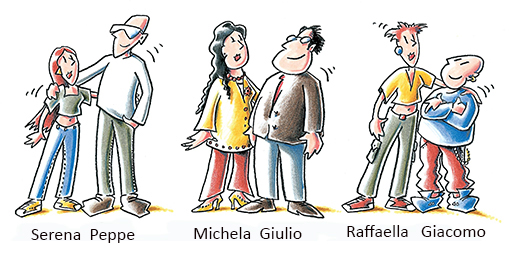
Esempio
Giulio è alto come Michela.
or
Giulio è alto quanto Michela.
Answer
Here are some possible sentences:
Serena è più piccola di Peppe.
Peppe è sportivo quanto / come Serena.
Michela è alta come / quanto Giulio.
Giacomo è meno alto di Raffaella.
Raffaella è più magra di Giacomo.
I capelli di Serena sono lunchi come / quanto quelli di Michela.
La maglietta di Raffaella è corta come / quanto quella di Serena.
Giulio è elegante quanto/come Michela.
3 Personality
How do say someone is lively or shy or clever...? In this section you will learn how to describe someone’s personality.
Listening to descriptions
In the following activity you will listen to someone talking about someone else.
Attività 11
a.
She is very intelligent, but a bit shy and too sensitive.
b.
She is very intelligent, but rather shy and too sensitive.
c.
She is rather intelligent, but too shy and a bit sensible.
The correct answer is a.
Describing someone’s personality
In this activity you will work on useful vocabulary and expressions to describe someone’s personality.
Attività 12
Match each word below within the definition it suits best.
Abbinate il testo sulla sinistra all’aggettivo corrispondente sulla destra.
Two lists follow, match one item from the first with one item from the second. Each item can only be matched once. There are 10 items in each list.
pettegolo/a
colto/a
dinamico/a
attento/a
estroverso/a
generoso/a
socievole
chiaccherone/a
curioso/a
disponibile
Match each of the previous list items with an item from the following list:
a.una persona che vuole sapere tutto di tutti
b.una persona che offre agli altri
c.una persona che ama parlare tanto
d.una persona che si concentra e fa le cose con cura
e.una persona che è molto aperta e comunicativa
f.una persona che è pronta ad aiutare
g.una persona molto attiva e sportiva
h.una persona che ha una grande cultura
i.una persona che ama stare in compagnia, ha molti amici e una vita sociale molto intensa
j.una persona che sa tutto di tutti e passa le giornate a parlare degli altri
- 1 = j,
- 2 = h,
- 3 = g,
- 4 = d,
- 5 = e,
- 6 = b,
- 7 = i,
- 8 = c,
- 9 = a,
- 10 = f
Understanding written descriptions
In this activity you will practise your reading skill with the help of some useful strategies.
Attività 13
Sara writes a diary entry every evening. Read the following page from her diary and answer the questions briefly in your own words.
Sara ogni sera scrive una pagina di diario. Leggete il seguente testo tratto dal suo diario e rispondete brevemente e con parole vostre alle domande.
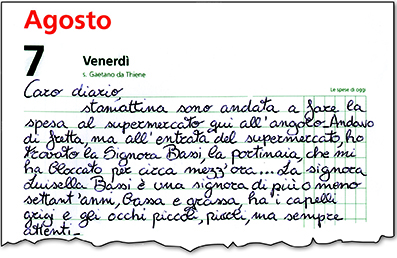
Caro diario,
Stamattina sono andata a fare la spesa al supermercato qui all’angolo. Andavo di fretta, ma all’entrata del supermercato, ho trovato la signora Bassi, la portinaia, che mi ha bloccato per circa mezz’ora… La signora Luisella Bassi è una signora di più o meno settant’anni, bassa e grassa, ha i capelli grigi e gli occhi piccoli, piccoli, ma sempre attenti.
È la pettegola del quartiere: sa tutto di tutti e passa le giornate in portineria a parlare degli altri. È terribilmente curiosa. Incontrarla quando si ha fretta è una tragedia perché parla per ore!
Lasciata la signora, ho fatto la spesa e ho passato l’intera giornata a cucinare. Domani vengono a cena dei carissimi amici: Alì e Federica con il piccolo Leo, Simone con il suo nuovo fidanzato Riccardo e mia sorella Clara. Ti ho mai parlato di loro, diario?
Alì è un ricercatore marocchino, ha fatto un dottorato in Italia dove ha conosciuto Federica, una mia amica d’infanzia. Vivono insieme da nove anni e hanno un bimbo di sei, Leo, che fa la prima elementare.
Sono simpatici, allegri, molto generosi e sempre disponibili. Simone, un altro amico d’infanzia, ci vuole presentare Riccardo; sono insieme da ormai quattro mesi. Simone dice che Riccardo è un ragazzo molto intelligente e socievole, fa il giornalista e ha sempre qualche aneddoto da raccontare… proprio come Simone!
Come descrivere mia sorella Clara… è una persona molto estroversa e dinamica. Fa mille sport, ha molti amici e una vita sociale molto intensa. Ha molti corteggiatori perché oltre ad essere interessante e colta, è anche molto bella.
Faccio una pasta alla carbonara come primo e un pollo arrosto con patate e verdure come secondo. Speriamo di non bruciare tutto!
Domani ti racconto com’è andata la cena.
Buona notte, diario.
Sara
1 Chi è la signora Bassi?
Answer
1 La signora Bassi è la portinaia di Sara.
2 Come viene descritta fisicamente e in quanto a carattere?
Answer
2 È bassa e grassa, ha i capelli grigi, gli occhi piccolissimi, ma attenti. Ha circa settant’anni. Parla troppo ed è molto curiosa. È una pettegola e parla sempre degli altri.
3 Chi sono Alì, Federica e Leo e che cosa fanno?
Answer
3 Alì, Federica e Leo sono amici di Sara. Alì è un ricercatore marocchino, ha conosciuto Federica, un’amica d’infanzia di Sara, mentre faceva il dottorato in Italia. Vivono insieme da nove anni. Leo è il loro figlio, ha sei anni e fa la prima elementare.
4 Come sono Alì e Federica?
Answer
4 Sono simpatici, allegri, disponibili e generosi.
5 Chi sono Simone e Riccardo?
Answer
5 Simone è un altro amico d’infanzia di Sara e Riccardo è il suo nuovo fidanzato.
6 Com’è Riccardo secondo Simone?
Answer
6 Intelligente e socievole.
7 Com’è Clara in termini di personalità e aspetto fisico?
Answer
7 Clara è estroversa, dinamica, interessante e colta. Ed è anche bella.
8 Che cosa ha fatto Sara oggi e che cosa fa domani?
Answer
8 Oggi Sara ha fatto la spesa e cucinato. Domani ha amici a cena.
Box 4 Similar-looking words in the two languages
When you read a text for the first time, it’s a good idea to start by focusing on the words you know and try and get the gist of the meaning. By looking closely you can often find clues to help work out words you have not come across before. 'Cognates' are a help: these are words which look similar to words in English. For example, in the text you have just read, supermercato means ‘supermarket’, generosi means ‘generous’ and aneddoto means ‘anecdote’. Many European languages have words with common origins which are similar in spelling and meaning.
You can't rely on these similar-looking words always meaning the same in both language, though. Occasionally you may be caught out by ‘false friends’ (falsi amici) – words that look similar but have different meanings. An example of one is the word argomento which means ‘subject’, 'matter' or 'topic', not ‘argument’, although it can mean an intellectual ‘argument’ or line of thought.
‘Library’ and libreria (‘bookshop’) are clearly false friends. You would be right, however, to assume that these words are related linguistically and share the same origin. So cognates might provide clues or links to the meaning but may not be a correct and usable translation.
Practising describing people
In this activity you will practise your writing and speaking skills.
Attività 14
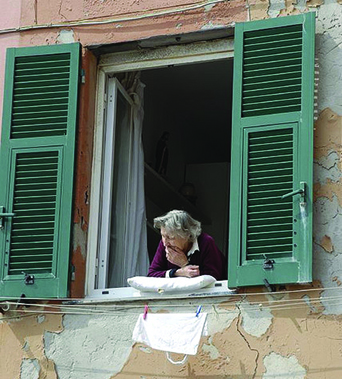
Mrs Bassi is a bit of a caricature. Imagine a busybody and chatterbox like her and describe his/ her physical aspect and personality. You might like to record yourself saying it, and listen to your recording. (About 100 words)
La signora Bassi è un po’ una caricatura. Immaginate una persona chiacchierona e pettegola come lei. Descrivete il suo aspetto fisico ed il suo carattere (aspetti positivi e negativi). (Massimo 100 parole)
Answer
Here is a possible answer:
La signorina Valli è una chiacchierona. È alta e magra. Ha i capelli biondi e lisci, gli occhi azzurri e un naso lunghissimo. Ha circa 50 anni e vive da sola con due gatti. Esce poco, ma passa le giornate alla finestra a guardare la gente che passa, che entra e che esce. Sa tutto di tutti e parla solo degli altri. È molto curiosa, ma è anche una persona buona e disponibile. Se succede qualcosa, corre subito in aiuto. È generosa e ogni anno aiuta ad organizzare la festa di paese.
Useful adjectives for describing people
In this activity, you will look at some useful adjectives.
Attività 15
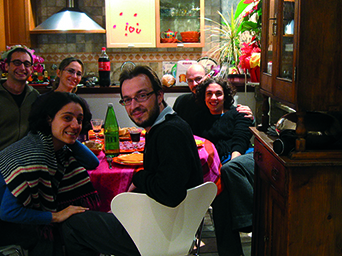
During the meal Sara has arranged, she and her friends talk about some mutual friends. Complete the sentences by giving the opposite of the adjectives in bold.
Durante la cena, Sara, Alì, Federica, Simone, Riccardo e Clara parlano di amici in comune. Completate le frasi con il contrario dell’aggettivo sottolineato.
4 Literary description
You now move on to more elaborate descriptions of people, as found in stories and novels.
Natalia Ginzburg
Description is an essential part of a narrative text, since it not only introduces the setting to the reader but also introduces characters and events. You will soon be reading a short descriptive extract from a literary text by Natalia Ginzburg.
Natalia Ginzburg
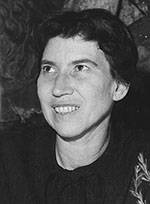
Natalia Ginzburg was born Natalia Levi in Palermo in 1916. Her father’s family was Jewish and her mother’s was Catholic, but she was brought up an atheist. In 1919 the family moved to Turin, where the Levi household became a meeting place for many intellectuals who opposed Mussolini. Natalia studied at the University of Turin. In 1938 she married the political activist Leone Ginzburg. The Ginzburgs spent some years in Abruzzo, where Leone was sent into exile for political reasons, though they both went to Rome secretly to edit an anti-Fascist newspaper. Ginzburg’s first novel was published under a pseudonym because of the race laws. Leone Ginzburg was arrested and killed by the Fascists in 1944 and in the 1950s Natalia remarried and returned to Rome, where she began her most prolific period of writing.
Among her best-known works are Lessico famigliare (1963), an account of her childhood through her family’s sayings and phrases, and the play Ti ho sposato per allegria (1965). Ginzburg wrote about her personal experiences in a fictionalised form and many of her works are based on memories of her childhood and youth in Turin. She died on 7 October 1991.
First of all, you can do some vocabulary work to prepare you for the reading activity coming up next.
Attività 16
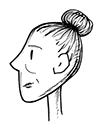
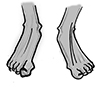
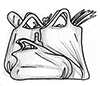
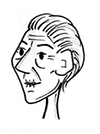
Read the following expressions (which occur in the next activity) and match them to the corresponding drawings.
Leggete le seguenti parole e abbinatele alle immagini corrispondenti.
Two lists follow, match one item from the first with one item from the second. Each item can only be matched once. There are 5 items in each list.
Ha un impermeabile finta tigre.
Con le occhiaie e le rughe.
La Zezé ha i piedi ossuti.
Con i capelli puntati in cima alla testa.
Le sacche della spesa.
Match each of the previous list items with an item from the following list:
a.
b.

c.
d.
e.
- 1 = b,
- 2 = e,
- 3 = c,
- 4 = a,
- 5 = d
Scan-reading a text
In this activity you will read an extract from Natalia Ginzburg's novel La città e la casa, looking for specific vocabulary or expressions used to describe people.
Attività 17
Scan-read the following text and complete the table below it using expressions you found in the text or other expressions you have learned.
Leggete il testo di nuovo e completate la tabella qui sotto usando parole tratte dal testo e altre parole che conoscete.
La Zezé è nera, panciuta, larga di fianchi e magra di spalle e di gambe, con dei piedi ossuti, larghi e piatti. È alta quasi quanto me e dice che io sono la più alta di tutte le signore che ha avuto. Arriva a mezzogiorno con le sacche della spesa. Quando piove ha un impermeabile finta tigre. Per fare le faccende si mette in testa un fazzoletto fatto a turbante. È nata nel Capo Verde, ma è cresciuta in casa di una zia a Torpignattara.
Non le piacciono le donne alte. Lei è alta ma ben proporzionata, ha le gambe sottili per sua fortuna, io non le ho tanto sottili per mia disgrazia. […] Trova che io mi pettino male. Così come mi pettino con i capelli tutti puntati in cima alla testa, si vede troppo la mia faccia magra, con le occhiaie e le rughe. Lei ha la faccia piena e non ha bisogno di nasconderla coi capelli. I suoi capelli sono ricci, crespi e gonfi, li taglia ben corti […]. Ha invece di capelli bianchi ne ho tanti, e chissà cosa aspetto a tingerli non si sa.
Io sul momento sono la sua sola signora. Prima di venire da me va in piazza San Cosimato, un’ora da Egisto, dove non c’è niente da fare perché Egisto è pulito e preciso, poi due ore al piano di sotto da Alberico e lì c’è un casino. Né da Egisto né da Alberico ci sono signore. […] Dopo che è stata da me va ancora a stirare da un architetto, e anche lì non ci sono signore. A lei piace il lavoro quando c’è almeno una signora.
Viene da me a mezzogiorno e se ne va alle quattro e mezzo. Alle quattro dovrebbe andare a prendere Vito all’asilo, ma non le va di andarci. Vito è troppo vivace e lei non ha voglia di corrergli dietro per strada. Non le piace portare a spasso bambini.
| Statura e corporatura | panciuta, … |
| Occhi | verdi, … |
| Capelli | tutti neri, … |
| Abbigliamento | jeans, … |
| Aspetto in generale | carino, … |
| Età | giovane, … |
| Carattere | vivace, … |
Answer
| Statura e corporatura | panciuta, larga di fianchi, magra di spalle e di gambe, alta, ben proporzionata, con gambe sottili, alta, magra, un po’ grasso |
| Occhi | verdi, azzurri, castani, piccoli, sempre attenti, porta gli occhiali |
| Capelli | tutti neri, ricci, crespi e gonfi, puntati in cima alla testa, bianchi, lunghi, castani, corti, biondi, grigi |
| Abbigliamento | jeans, un impermeabile finta tigre, un fazzoletto fatto a turbante, elegante |
| Aspetto in generale | carino, bello, brutto, attraente, sportivo |
| Età | giovane, anziano |
| Carattere | vivace, preciso, pettegola, curiosa, simpatici, allegri, generosi, disponibili, intelligente, socievole, estroversa, dinamica, interessante, colta, timida, noiosa, insopportabile |
Vocabolario
la statura height
la corporatura build
Box 5 Reading techniques: reading for gist and scanning
Reading for gist is about getting the general idea of what a particular text is about. Various clues such as the format, use of visuals or a specific style help the reader understand the genre and register of a text and grasp its overall meaning without needing to engage fully with grammar and syntax. This technique is also known as 'skimming' or 'reading for meaning'.
'Scan-reading' or 'scanning' is speed-reading a text to look for specific clues, such as numbers, names or other details that provide specific information.
Both skimming and scanning are useful preparatory reading techniques for familiarising yourself with a text before in-depth reading.
Checking meaning
In this activity you have an opportunity to read the extract again, this time looking for background information.
Attività 18
a.
True
b.
False
The correct answer is a.
a.
True
b.
False
The correct answer is a.
a.
False
b.
True
The correct answer is b.
a.
True
b.
False
The correct answer is a.
a.
False
b.
True
The correct answer is b.
a.
True
b.
False
The correct answer is a.
a.
True
b.
False
The correct answer is a.
Box 6 Using a bilingual dictionary
When reading longer or literary texts, you will probably need to use a bilingual dictionary. Remember that not all the parts or variations of the word will be listed as headword entries, so it helps to know what the ‘basic’ form of a word is.
• Verbs will be listed under their infinitive form, for example andare not vado.
• Nouns in the singular form, for example chiave not chiavi) .
• Adjectives in the masculine singular form , for example allegro not allegre) .
For reflexive verbs (also known as pronominal verbs), you will usually need to look up the basic verb without the reflexive pronoun. So, for example, alzarsi will be found as a subheading of the entry alzare, marked as v.pr. (verbo pronominale) or v.r. (verbo riflessivo).
Detailed reading
In this activity you will consolidate the vocabulary you have learned in the previous activities.
Attività 19
Complete the following sentences using the correct option.
Completate le frasi scegliendo l’opzione corretta.
La Zezé è nera, panciuta, larga di fianchi e magra di spalle e di gambe, con dei piedi ossuti, larghi e piatti. È alta quasi quanto me e dice che io sono la più alta di tutte le signore che ha avuto. Arriva a mezzogiorno con le sacche della spesa. Quando piove ha un impermeabile finta tigre. Per fare le faccende si mette in testa un fazzoletto fatto a turbante. È nata a Capo Verde, ma è cresciuta in casa d'una zia a Torpignattara.
Non le piacciono le donne alte. Lei è alta ma ben proporzionata, ha le gambe sottili per sua fortuna, io non le ho tanto sottili per mia disgrazia. (...) Trova che io mi pettino male. Così come mi pettino con i capelli tutti puntati in cima alla testa, si vede troppo la mia faccia magra, con le occhiaie e le rughe. Lei ha la faccia piena e non ha bisogno di nasconderla coi capelli. I suoi capelli sono ricci, crespi e gonfi, li taglia ben corti (...). Ha i capelli ancora tutti neri per sua fortuna. Io invece di capelli bianchi ne ho tanti, e chissà cosa aspetto a tingerli, non si sa.
a.
a. non è molto alta
b.
b. ha la pancia
c.
c. è molto magra
The correct answer is b.
a.
a. alta come la signora.
b.
b. più alta della signora
c.
c. più bassa della signora
The correct answer is a.
a.
a. lisci e corti
b.
b. bianchi e sempre raccolti
c.
c. neri e ricci
The correct answer is c.
a.
a. magra
b.
b. piena
c.
c. triste
The correct answer is b.
a.
a. quando va a funzioni religiose
b.
b. quando pulisce
c.
c. quando esce
The correct answer is b.
a.
a. non ha le gambe sottili
b.
b. ha le gambe sottili ma non come quelle della signora
c.
c. ha le gambe sottili
The correct answer is c.
Opposites
In this activity you will expand your vocabulary by looking at words with opposite meanings.
Attività 20
Find the opposite of the following adjectives in the text.
Cercate nel testo il contrario dei seguenti aggettivi.
La Zezé è nera, panciuta, larga di fianchi e magra di spalle e di gambe, con dei piedi ossuti, larghi e piatti. È alta quasi quanto me e dice che io sono la più alta di tutte le signore che ha avuto. Arriva a mezzogiorno con le sacche della spesa. Quando piove ha un impermeabile finta tigre. Per fare le faccende si mette in testa un fazzoletto fatto a turbante. È nata a Capo Verde, ma è cresciuta in casa d'una zia a Torpignattara.
Non le piacciono le donne alte. Lei è alta ma ben proporzionata, ha le gambe sottili per sua fortuna, io non le ho tanto sottili per mia disgrazia. (...) Trova che io mi pettino male. Così come mi pettino con i capelli tutti puntati in cima alla testa, si vede troppo la mia faccia magra, con le occhiaie e le rughe. Lei ha la faccia piena e non ha bisogno di nasconderla coi capelli. I suoi capelli sono ricci, crespi e gonfi, li taglia ben corti (...). Ha i capelli ancora tutti neri per sua fortuna. Io invece di capelli bianchi ne ho tanti, e chissà cosa aspetto a tingerli, non si sa.
1 stretto,-a
Answer
largo
2 sproporzionato,-a
Answer
(ben) proporzionato
3 liscio,-a
Answer
riccio
4 sporco,-a
Answer
pulito
5 impreciso,-a
Answer
preciso
6 tranquillo,-a
Answer
vivace
Writing a description yourself
In this round-up activity you will have the chance to consolidate what you have learned in this course. You will practise writing a text using your imagination.
Attività 21
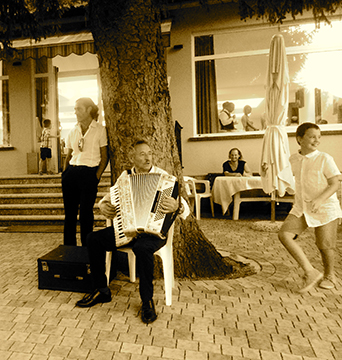
Look at the people depicted in the picture below. What do you think the relationship between them is? Describe their appearance and imagine what type of person they are. You may want to use the following table (which is the same as the one you used in Attività 17) to help gather the information to put in your piece of writing.
Guardate le persone nella foto e descrivete sia il loro aspetto che la loro personalità.
| Statura e corporatura | |
| Occhi | |
| Capelli | |
| Abbigliamento | |
| Aspetto in generale | |
| Età | |
| Carattere |
Here is a possible answer:
Answer
Giovanni ha circa sessantacinque anni, ha i capelli corti e grigi e porta i baffi. Lui è molto romantico e sensibile. Gli piace la musica tradizionale italiana e suona la fisarmonica. Qui è con suo figlio Andrea. Andrea è sempre molto elegante e affascinante; è un latin lover! È ancora abbastanza giovane, ha circa quarant’anni, è alto e porta i capelli lunghi come i calciatori o gli attori. Gli piace andare in palestra e in discoteca. Federico, ha 11 anni, non è né alto né basso per la sua età, è un po’ cicciottello ed è molto simpatico. Gli piace stare con i suoi amici e andare alle feste.
Conclusion
We hope you have enjoyed this free course, Intermediate Italian: describing people. You have learned how to describe both people’s physical appearance and their personality in Italian. You have also learned how to make comparisons and how to speed-read a text looking for meaning or specific information.
Finally you have been introduced to the work of the Italian author Natalia Ginzburg and have attempted to write your first literary text in Italian.
We hope you will now take the opportunity to use the language you have learned. Why don’t you find out about Italian communities near where you live?
Take the next step

If you enjoyed this course, why not explore the subject further with our paid-for short course, Beginners Italian 3: stai andando bene!?
References
Acknowledgements
This free course was written by Anna Motzo.
Except for third party materials and otherwise stated (see terms and conditions), this content is made available under a Creative Commons Attribution-NonCommercial-ShareAlike 4.0 Licence.
The material acknowledged below is Proprietary and used under licence (not subject to Creative Commons Licence). Grateful acknowledgement is made to the following sources for permission to reproduce material in this free course:
Every effort has been made to contact copyright owners. If any have been inadvertently overlooked, the publishers will be pleased to make the necessary arrangements at the first opportunity.
Text
Extracts from: La città e la casa, by Natalia Ginzburg, Einaudi, 1984.
Images
Course image: © Hans F Meier/iStock
Figure 1: © The Open University
Figure 2: Ravi Tahilramani/iStockphoto.com
Figure 6: left: Ravi Tahilramani/iStockphoto.com
Figure 6: right: Keith Reicher/iStockphoto.com
Figure 7: © Anna Motzo
Figure 8: © Anna Motzo
Figure 9: Anna Motzo
Figure 13: © Davidaola in Flickr https://creativecommons.org/ licenses/ by-nc-nd/ 2.0/
Figure 14: Natalia Ginsburg/Getty Images
Figure 15: © Anna Motzo
Don't miss out
If reading this text has inspired you to learn more, you may be interested in joining the millions of people who discover our free learning resources and qualifications by visiting The Open University – www.open.edu/ openlearn/ free-courses.