Learning to teach: An introduction to classroom research
Use 'Print preview' to check the number of pages and printer settings.
Print functionality varies between browsers.
Printable page generated Wednesday, 1 April 2026, 4:28 AM
Learning to teach: An introduction to classroom research
Introduction
Reflection point: What is your view of educational research? Can you think of a significant project that has influenced your work as a student teacher, teacher, or pupil (e.g. phonics, Nuffield Science)?
In the reflection above, you may have thought of something in your subject such as ‘Children’s learning in Science Project (CLISP)’ (Driver, 1994) or ‘Cognitive Acceleration through Mathematics Education (CAME)’, or something generic like the ‘Thinking Together’ project about language as a tool for learning and problem solving. You may have struggled to come up with a specific project, but the chances are that you know about and understand some important ideas, such as Assessment for Learning, which emerged from research and have now become embedded as part of the accepted professional knowledge that all teachers need to have.
Despite these contributions, teaching is not perceived to be an evidence-based profession and is subject to interventions from politicians, based on ideology rather than on evidence. Ben Goldacre (2013) argues that teaching should be an evidence-based profession and that this would lead to better outcomes for children. In particular, he suggests that:
- a change in culture is needed, in which teachers and politicians recognise that we don’t necessarily ‘know’ what works best – we need evidence that something works
- teachers need better access to the outcomes of research
- teachers need to understand how research works so that they can become critical consumers
- teachers need access to networks where they can engage with others who are interested in research.
Goldacre advocates a particular approach to educational research. He believes that randomised trials (or ‘fair tests’), of the type that are used in medicine, are required. These randomised trials are generally large scale and compare interventions against each other in a systematic, controlled manner.
There is a debate to be had about the transferability of the notion of ‘randomised controlled trails’ from medicine to education. However, the assumption of this unit is that the evidence-based practice is a good thing and that the changes advocated by Goldacre can be achieved through teachers researching their own practice. Indeed, research practices are embedded in an increasing number of schools and there is a recognition that this can contribute to school improvement.
The Open University offers a number of modules and qualifications in postgraduate education studies.
Learning outcomes
After studying this unit, you should be able to:
understand what makes something ‘research’ rather than reflective practice
know how to approach the design of a piece of research
understand two particular methodologies: case study and action research
understand some of the issues around collecting and analysing data
consider how best to disseminate your work.
1 When does ‘good practice’ become ‘research’?
A good teacher will evaluate their own practice and reflect on how they can improve. That evaluation will almost certainly involve analysing data, and assessing the work students produce. It may also involve talking to students about what they enjoyed, or found difficult, or asking them to complete a short questionnaire. It may involve asking a colleague to observe you teach, or you observing someone else’s lesson. The results of the evaluations will influence your planning and hopefully, will encourage you to try new things. So when does ‘good practice’ become ‘research’? And what are the advantages of engaging in research?
‘Research’ is defined by the Chambers dictionary as: ‘systematic investigation towards increasing the sum of knowledge’. This definition provides some clues. It is suggested that a piece of enquiry, evaluation or development work becomes ‘research’ when the following apply:
- the work involves capturing data
Conversations or lessons might be recorded so that they can be used outside the context in which the events took place. Students’ work might also be used as evidence.
- participants are being asked to do something out of the ordinary
You might ask people to take part in a focus group, or an interview that disrupts their normal routine in some way.
- the output is public
If the output is public then it can contribute to the ‘sum of knowledge’. However, if the results of the piece of work are to be made public, people need to be confident that this new knowledge is based on reliable evidence, that the conclusions are valid and that the research has been carried out properly.
The advantage of conducting research is that it is systematic and contributes knowledge to the field, which in this is case is ‘education’. The ‘knowledge’ is based on evidence, can be defended and explained, and is therefore likely to be taken more seriously than accounts of personal experience. A piece of research is also likely to take place over a significant period of time, and if conducted properly will help you to consider what works and also provide insights into why it works.
If these conditions apply, then the work that you are undertaking does constitute ‘research’. This has further implications:
- The work should take account of other studies in the field. Studying the literature will also give you some ideas about how you might tackle the issue that you are concerned about.
- The work should be systematic and purposeful. It should be underpinned by a clear philosophy and set of beliefs. There should be specific research questions and an ethical design that will give reliable results that are likely to be considered to be valid, by others.
The activities in this unit will help you to think about how to design good research – starting with thinking about what you might research.
Activity 1: Thinking about research questions
Choose an areas of particular interest to you and answer the following questions:
- What do you want to find out more about and why?
- What could you focus a piece of research on?
- Suggest a working title for your study.
- Write down two or three specific research questions.
Discussion
A piece of research is a relatively long-term undertaking so it needs to be something you really care about so that you keep motivated. It might be something related to one of the classes you teach – or it might be a whole school issue or problem that you feel needs investigating. At this stage, it might be helpful to complete Activity 1 for more than one topic.
Activity 2: Starting research
Spend about 30 minutes searching the internet for material related to your chosen area or topic and begin to explore other work in the field. The aim is to become familiar with the field as this might affect the questions you want to consider.
Discussion
The extent to which you need to consider other work in the field will depend on the exact nature of your study. For a small-scale study that you might be undertaking with colleagues, with colleagues in your own school, then the information available on the internet or in books that you have, will be sufficient. If you want your work to have credibility, and you are hoping to publish the findings – perhaps in your subject association journal – then you do need to consider what is already known and a brief review of the recent literature is needed.
If you are considering undertaking a Masters degree or a PhD then you will need to do a more extensive review of the literature, drawing on journals available through a university library.
2 Designing your research
One of the ways in which a study becomes a research project, rather than a classroom evaluation, is through the design of the study. Underpinning that design will be a set of beliefs that you hold about the nature of knowledge and the ways of studying knowledge. Those beliefs will bring coherence to the study. For example, if you believe that knowledge in this context is subjective, context dependent and socially constructed, then your methodology should reflect that and your findings should be reported in such a way that the context in which the study was carried out is clear. If you believe that knowledge is objective, that there is a ‘truth’ out there waiting to be discovered, then you would need to conduct a study in which variables are tightly controlled and the findings would be presented as facts.
Methodology describes a set of ideas about how the research study should be designed. There should be coherence between your theoretical perspective and your methodology.
Ben Goldacre (2013) advocates the use of randomised trials in educational research. The assumption behind these is that the research will tell us ‘what works’ the implication being that this will be a ‘fact’. This sort of research is designed as an experiment and the underlying philosophy is positivist.
For the sort of small-scale studies often undertaken by teachers in their classrooms, the assumption is usually that the knowledge produced will be subjective and context dependent and that a case study or action research approach is likely to be the most appropriate. The underlying philosophy is ‘interpretivist’ rather than ‘positivist’ (Wilson, 2013).
Activity 3: Positivism and interpretivism
Read Two competing paradigms on positivism and interpretivism from the OpenLearn unit Engaging with Educational Research. Then:
- Make a note of the key assumptions and beliefs that underpin each paradigm.
- Summarise the sorts of research methods that are appropriate for each paradigm.
- Think about your own idea in terms of these two philosophical approaches:
- Which approach fits best with your own beliefs and values?
- Which approach is most suitable for your area of study?
Discussion
The interpretivist view of the world, is underpinned by the belief that we all see things from different perspectives and that knowledge is constructed through social interaction. A positivist on the other hand sees the world as a set of ‘objects’, independent of our perspective, and believes that knowledge is accumulated through by conducting experiments in which variables are controlled.
Interpretivists are more likely to conduct interviews and focus groups, make use of reflective journals and observe situations of interest. A positivist is more likely to try to measure things using surveys, or test scores.
Those coming to research for the first time, sometimes take the view that research carried out in the interpretivist paradigm is subjective and therefore not rigorous. They need convincing that it can be worthwhile and trustworthy. Activity 6 in the OpenLearn unit ‘Engaging with Educational Research’ illustrates how these alternative view points might influence how research is carried out.
2.1 Ethics and research design
A research project in an educational setting will involve collecting data and it will almost certainly involve other people as participants. How these people are treated matters, which means that there will be ethical issues to consider. The issues are not usually difficult to resolve, but may emerge and change as the research proceeds.
Ethics is about how you behave; it is about honesty, integrity and sticking to the rules. However, it is also about the integrity of the research process; ensuring that you have enough, reliable data from which to draw conclusions, reporting the evidence accurately and being open about your assumptions and the limitations of your conclusions.
Ethics is complicated as the issues are often linked. For example, you plan a set of in-depth semi-structured interviews with some teachers, lasting for about an hour. It may become apparent that this is considered to be an imposition (teachers are busy people!). You may act in a way to avoid this imposition and settle for shorter, more structured interviews. However, this will subsequently affect the quality of the evidence that you can collect and you may have to find some alternative data.
Universities often produce lists of principles or ‘ethical guidelines’ that researchers are supposed to follow (for example, see the BERA guidelines, 2011). However, the issues are often interconnected and it is difficult to be confident that you have thought of everything.
In the next activity, you will be introduced to a structured way of thinking about the ethical issues. The analysis will help you to decide how to behave, but it will also support your research design. It will highlight the issues you need to think about. Applying the framework will help you to anticipate problems and therefore identify actions that will help you to avoid difficulties and improve the quality of your research (Stutchbury and Fox, 2009).
2.2 Ethical framework
The ethical framework invites you to analyse a project from four different perspectives.
- External considerations – This is a set of questions that focus on the wider implications of what you are doing.
- Consequences – This set of questions helps you to think about the consequences of doing this work for all those concerned: the researcher, the participants, the institution, and society as a whole.
- Doing you duty – This set of questions helps you to focus on how to behave. You are encouraged to think about doing your duty and avoiding harm to anyone involved.
- Relationships – This set of questions helps you to focus on the relationships at the heart of the research. Whose support to you need? How can you establish trust?
Activity 4: Ethical framework
To help you understand how the ethical framework works, you are going to apply it to an incident that occurred in 2013.
A Lecturer at London School of Economics (LSE) arranged a trip for a group of undergraduates to North Korea – one of the most repressive and secretive regimes in the world. A BBC reporter and cameraman joined the trip. The students were told that a journalist would be joining them and were given the chance to withdraw on the basis of that information. At Bejing airport, en route for North Korea, they were also told that a cameraman was with them and that secret filming would be taking place, for a BBC documentary.
The trip took place, a film was made and everyone returned safely. The film was subsequently shown, revealing shocking social conditions and a regime that does not care for its citizens. But on their return, some of the students expressed their annoyance about having been deceived by the journalists.
Use the Ethical framework, designed to assess your own research, to analyse this situation. Go through the questions in each box and answer them as best you can for this incident.
Having done that, reflect on your answers. Do you think the actions of the BBC and the trip organiser were justified? Why do you think this?
Discussion
- External – From the point of view of the BBC investigative journalists, covert research is acceptable, as a way of exposing unreasonable or dishonest behaviour.
The trip was planned anyway, so this was an efficient use of resources. Exposing the cruelty of this repressive regime could also considered to be morally justified. However, considerable risks were attached to what they did, for the students, the North Koreans who were acting as their hosts and for the prospect of other trips in the future.
- Consequences – The possible consequences for the students were very serious. If the group had been caught and detained, it could have been very dangerous. Likewise for the people acting as hosts.
The consequences for the journalists were the prospect of a ground breaking film, that had not be achieved before. It might be argued that by drawing international attention to the details of what is going on in North Korea, international pressure might result in improvements for the citizens of that country.
- Duty – The journalists were not honest with the students. It could be argued that they were given the right to withdraw, but by leaving it until Bejing to fully inform them, this was less likely to happen.
In the event, no one came to any harm (as far as we know), but they could have done, if the filming had been discovered. LSE have a ‘duty of care’ for students on a university organised trip but the person organising the trip went to great lengths to explain that this was not an official ‘university’ trip.
- Relationships – It was important for the journalists to win the trust of the students, which they seem to have done (although when the group returned, some of the students complained). Building a good relationship with the hosts was also vital and they probably took steps to do this.
This analysis highlights the issues and dilemmas and provides a rational basis for making a decision. The journalists decided that the risks and covert actions were acceptable in the interests of the exposing a corrupt and repressive regime. The parents of the students concerned might have argued that the risks were unacceptable.
There is no right answer to this, or to any ethical dilemmas, but this framework provides a basis on which sensible discussions can take place.
Activity 5: Applying the framework in your own research
Think about your idea for a project from Activity 1 and 2 in the light of the Ethical framework. Make some notes against each question.
You will not be able to answer all the questions until you have a more detailed research design, but the framework will highlight some of the things you need to think about.
3 Doing your research
As a teacher undertaking a study in your own classroom, it is likely that it will be relatively small-scale and short-term. The methodologies that will be of most use to you are case studies and action research.
3.1 Case study
There are many definitions of case studies in the literature, and many different types of case study (Yin, 2003; Stake, 1995; Gillham, 2000; Bassey, 1999). However, they all have the following features:
- they are ‘bounded’ in space and time
- the research takes place in the natural context and draws on multiple methods of collecting data
- the purpose is to inform practitioners, policy makers or theoreticians.
A case study might be designed to find out more about a situation; it might be designed to test a particular theory or it might be designed to try and explain an observed phenomenon.
The main criticism of case studies is that the findings cannot be generalised. This can be addressed by making the context clear to the reader in a detailed report; it is then up to the reader to take from the study information and ideas that might apply to their own situation.
Activity 6: Case study 1
Read the account of Lucy’s project.
Answer these questions:
- What was the ‘case’?
- What were the main ethical issues facing Lucy? Use the ethical checklist from the Activity 4. How might these have affected her methodology?
- Work out how Lucy’s data will help her to answer the questions in the table, see below.
| Research question/sub-question | Data source |
|---|---|
| What attitudes to students have towards science? | |
| Can targeted activities designed to support scientific literacy improve student attitudes to science? | |
| How can I improve students’ writing in science? | |
| Can targeted activities designed to support scientific literacy improve students’ learning of scientific concepts? |
- Summarise what Lucy found out as a result of her work.
Discussion
In this case, the ‘case’ was Lucy’s class. A case could be a group of children, within a class, a year group or children involved in a particular activity.
She would need permission to record children, she would need to think about how to select the children to interview and the effect that this might have on others.
When to interview children is also an issue – both taking them out of lessons and imposing on their leisure time could be considered to be problematic. This is an important issue and involving a colleague in her research was a good way of increasing the impact of her work.
3.2 Action research
Action research is best considered to be a strategy rather than a specific method (McNiff and Whitehead, 2011; Wilson, 2013). It involves practitioners systematically investigating their own practice, with a view to improving it. Action research involves the following steps:
- Identify a problem that you want to solve in your classroom This might be something quite specific such as why certain pupils do not answer questions or find an aspect of your subject hard or de-motivating, or it might be something more general like how to organise group work effectively.
- Define the purpose and clarify what form the intervention might take. This will involve consulting the literature and finding out what is already known about this issue.
- Plan an intervention designed to tackle the issue.
- Collect empirical data and analyse it
- Plan another intervention This will be based on what you find and will be designed to further understand the issue that you have identified.
Action research is a cyclical process. Through repeated intervention and analysis, you will come to understand the issue or problem and hopefully to do something about it.
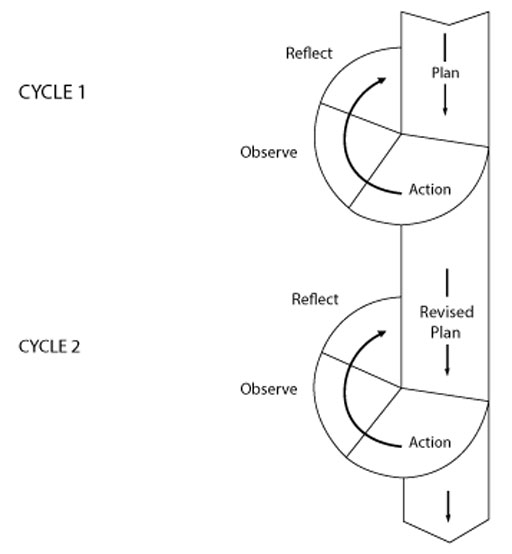
Action research suffers from some of the same criticisms as case studies: can the results be generalised? Rigour in this case comes from the careful planning and clear reporting. The findings will be ‘believable’ if the researchers explain what they hope to achieve and how the intended actions link specifically to the problem. The process needs to be explicit, and underpinned by a clear framework of ideas against which the findings will be judged (Kemmis, 1993).
Activity 7: Case study 2
Read through Ben’s case study and think about the questions.
Use the ethical checklist to identify the ethical issues in Ben’s project.
- What might he have needed to do before starting his project and how might the ethical issues have affected his research design?
- Summarise his sources of data.
- How do you think this work might have affected his teaching in the future?
- Is there anything he could have done to ensure that his work had a wider impact?
Discussion
This is a typical action research project: a series of interventions, with the evidence from one intervention, influencing the next. As a result of this ‘cycle’ there is a good chance that Ben will have learnt a great deal about teaching mixed ability groups.
He could have increased the ‘impact’ by involving others in his project. As in Lucy’s case, he would need to inform the class about what he was doing and seek permission to film in the classroom. Securing the support of the Head of Department would be sensible and might lead to offers of help. Selecting the children to interview and making the time to conduct the focus groups might also be an issue.
4 Collecting data
Having decided on the questions you would like to answer and the approach you wish take, you will need to collect some data that will enable you to answer the questions. There are three broad ways in which you can collect data, you can:
- observe people at work
- ask questions (either through survey’s or by talking to people)
- analyse documents.
The diagram in Figure 2 provides an overview of different data collection methods. Each one has implications that you will need to consider, but that is beyond the scope of this unit. The reading list at the end of this unit provides more information about collecting data and how to analyse it.
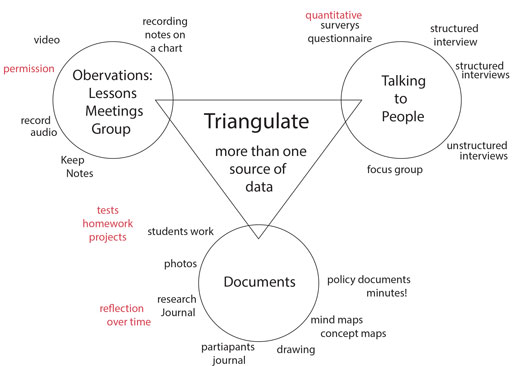
You will need evidence from several sources of data in order to be confident in your findings. Each method will have advantages and limitations; you need to make sure that you act in such away as to minimise the limitations.
Reflection point: Look at the diagram from Figure 2 and your research questions. What methods of collecting data might be appropriate?
5 Reliability and validity
What counts as good quality work varies between approaches. We will concentrate on what validity and reliability might mean within an interpretivist paradigm.
Validity
If something is valid then that suggests that it is true. For small-scale, qualitative research then clearly the knowledge produced cannot to be tested to see if it is true, but this does not mean that qualitative research is not worthwhile. We have to think about the concept of ‘validity’ in a different way. Bassey (1999) suggests that trustworthiness can be considered to be a measure of validity. These are some of the things we need to consider (Cohen et al, 2003).
- Can the results be generalised? Someone who hears about or reads about your research might decide that, based on their experience then it is authentic and seems sensible.
- Does the data support the conclusions? This is more likely if there is more than one source of data collected over a period of time or if the findings have been checked with the participants.
- Do the questionnaire or interview questions relate clearly to the research questions?
Reliability
Reliability is a difficult concept when applied to qualitative research, as it is to do with repeatability and replicability. Clearly, two people carrying out the sorts of projects described in this unit are unlikely to produce exactly the same results.
Reliability in qualitative settings includes fidelity to real life, authenticity and meaningfulness to the respondents. Cohen et al. (2003) suggest that the notion of reliability in naturalistic settings should be construed as ‘dependability’ and achieving dependability relies on many of the ideas already discussed, such as collecting enough data, checking your findings with the participants, and looking for evidence of the same idea from more than one data source.
Activity 8: Valid and reliable findings
Think about how you will ensure that the findings from your research are valid and reliable.
Make a checklist for yourself that takes into account what you have read.
6 Disseminating your research
Classrooms can be private places in which a teacher and the class get on with the business of teaching and learning. If you undertake a piece of research in your classroom and discover something exciting then your instinct will be to tell people and to perhaps do a presentation at a departmental meeting. People might listen with interest, but it will not necessarily change their behaviour.
David Frost (2006) argues that you have to plan for impact. An effective way to do this is to work collaboratively from the outset. Involve colleagues in your plans, invite them into your classroom and engage them in discussion about aspects of your project. In this way your department will become a ‘learning community’ and you are likely to get some help with your work.
Activity 9: Disseminating your research
Go back to your research plan and think about how you might involve a colleague, or your department or someone else in your school.
- Who do you need to influence?
- What might they do to help?
- What will the benefits be?
Conclusion
This unit assumes that carrying out educational research is a good thing. Basing decisions about how to teach on evidence from previous teaching will lead to improvements. Ideally teachers should work in groups to design research and collect evidence so that their work has more impact.
The purpose of this unit has been to provide an introduction to research – how to design a project, how to think about the ethical issues and what the sources of data might be. The emphasis has been on the design; the reading list below will provide more information on the details surrounding data collect and analysis.
Further reading
School-Based Research: A guide for Education Students, edited by Elaine Wilson. Published by Sage, 2013. This is a text-book for students undertaking a Masters in Education degree.
Research Methods in Education, Louis Cohen, Lawrence Manion and Keith Morrisson. Published by RoutledgeFarmer, 2000. This is a comprehensive guide to educational research, covering a range of different approaches and has a detailed consideration of strategies for collecting data.
The Good Research Guide: for small scale social research projects, Martyn Denscombe. Published by The Open University Press, 2004. This provides a basic introduction to all aspects of research in social settings. Of particular interest to classroom researchers are summaries of the advantages and disadvantages of the different approaches.
References
Acknowledgements
Except for third party materials and otherwise stated (see terms and conditions), this content is made available under a Creative Commons Attribution-NonCommercial-ShareAlike 2.0 Licence.
The material acknowledged below is Proprietary and used under licence (not subject to Creative Commons Licence). Grateful acknowledgement is made to the following sources for permission to reproduce material in this unit:
Unit image: © edstock/istockphoto.com
Every effort has been made to contact copyright owners. If any have been inadvertently overlooked, the publishers will be pleased to make the necessary arrangements at the first opportunity.
Don't miss out:
1. Join over 200,000 students, currently studying with The Open University [http://www.open.ac.uk/ choose/ ou/ open-content]
2. Enjoyed this? Find out more about this topic or browse all our free course materials on OpenLearn [http://www.open.edu/ openlearn/]
3. Outside the UK? We have students in over a hundred countries studying online qualifications [http://www.openuniversity.edu/] including an MBA at our triple accredited Business School.