Week 6: Creating strong job applications
Use 'Print preview' to check the number of pages and printer settings.
Print functionality varies between browsers.
Printable page generated Wednesday, 19 August 2026, 9:11 AM
Week 6: Creating strong job applications
Introduction
Developing your career will involve applying for the work you want to do. This might be with your existing employer, with a new employer, voluntary work, short-term contracts or work experience. Whichever option you decide to pursue, you will need to be able to match yourself to the work and the expectations of the employer. This week the focus is on helping you to do that successfully.
The first step is to analyse what is needed for a particular job. In Week 3 you learned how to research the requirements of types of work or employer. The process here is similar, though your focus will be on a specific opportunity. However, you still need to find out what is needed and then present yourself in the best way.
In the first part of this week you will consider how to do this in response to advertised jobs. In the second half of the week, you will create a CV which allows you to respond effectively to more formal opportunities which arise.
Watch Wendy introduce Week 6:

Transcript
By the end of this week, you will be able to:
- review a job advert
- consider what makes a good job application
- explore why it is important to have a current curriculum vitae
- create or update your curriculum vitae (CV).
1 What to look for in job advertisements

Your analysis should begin with understanding what any job advertisement is telling you.
Below is an advert and sample analysis. It is a general advert for graduates to work in the Scottish Health Service, rather than for a specific job. The advert is for someone who has already graduated from university, but it has been chosen because it contains the kind of information which is useful for demonstrating how close reading can tell you a lot about an employer’s needs.
The bracketed numbers and bold text in the advert indicate points that were considered important to understand, or remember, by the person considering applying for the post. Read the text through first without looking at the notes, then read it again noting what the applicant thought was important.
Graduate opportunities
Greater Glasgow Health Board serves a population of 1 million people, [1] treating over 21,000 in-patients and dealing with 2.25 million out-patient attendances annually. As one of the UK's largest Health Authorities we regard our on-going [2] commitment to the training of graduates as crucial to our future success.
- Management Trainees
- Salary to £19,426
You will be a graduate with a [3] relevant degree, be [4] able to communicate effectively both orally and in writing and possess good interpersonal, statistical and analytical skills. You will also be able to demonstrate the potential to manage physical and human resources in the pursuit of achieving the [5] Board's Organisational Goals.
For our part we will give you a comprehensive two year training in [6] one of the most progressive and innovative organisations in the country which will emphasize 'hands-on' management experience and the [7] application of sound business techniques in the delivery of Health Care. There will also be an opportunity to develop a special interest in [8] Supplies Management. You will be supervised personally by one of the Board's Unit General Managers, and will be assisted with [9] further study, tailored to suit your needs.
If you have the capacity and ability to make a success of the training we are offering, write for further details to the Appointments Section, Greater Glasgow Health Board, 112 Ingram Street, Glasgow G1 1ET.
[10] Great Glasgow Health Board (presented within a Charles Rennie Mackintosh motif).
[11] Our business is health.
Greater Glasgow job advert notes
[1] Proud of being a part of large organisation, I should reflect on this when I say why GGHB appeals to me.
[2] Find out about their training programme and mention this as a further attraction.
[3] What do they have in mind and why? Any degree could be relevant. Demonstrate relevance of mine.
[4] Give good evidence of my skills.
[5] Find out about these.
[6] What do they mean?
[7] Note changed view of NHS as a business. Any relevant Department of Health publications that might put this into context?
[8] What does this mean? What skills are required? Info that I have on them.
[9] What might this involve? Will my degree qualify me for any exemptions?
[10] Greater Glasgow Health Board is enclosed in a Charles Rennie Mackintosh type motif. Subliminal messages in the use of this motif, new image for NHS, proud to be in Glasgow.
[11] A significant statement about change in NHS; as (7) above. What connections should I be making with regard to the NHS as a whole or Department of Health initiatives and management styles?
One way of learning something new is to observe what someone else does. You have seen the way someone analysed a particular advert and, whether or not the job opportunity feels relevant to you or your life, you will have noticed some general things that the person doing the analysis drew out from their reading. Such as, noting the general information about the NHS, the qualification required for the position, the additional training provided and the general skills required.
It doesn’t matter what kind of job advert you are looking at, it is this kind of detail that you need to concentrate on.
1.1 Picking out the details from a job advert
Many employers will supply a job description and a person specification. The job description tells you about the job and the person specification what abilities, qualities and qualifications are required. Job adverts will usually be based on these two documents and present the most important aspects of them.
The job advertisement you’ve already looked at has both these elements, so provides good practice in analysing what is expected of you.
This activity helps you to ‘spot’ useful information in an advert and to interpret what it asks of you.
Activity 1 The NHS advert: what does it tell you?
Read back through the NHS advert. Note in the box below, what descriptions of the work you find, and then what descriptions of the person specification it contains. You don’t need to do this in your notebook, unless you would like a record of the activity.
Comment
How easy did you find it? Some ‘reading between’ the lines was probably necessary. Look at the answer below and compare it with your own.
Description of work
- the potential to manage physical and human resources in the pursuit of achieving the Board's Organisational Goals – though you don’t know the goals you can deduce that you would be managing either people or things required for health care.
Person specification
- relevant degree – you need a degree but you need find out which ones are relevant. Able to communicate effectively both orally and in writing and posses good interpersonal statistical and analytical skills – these are clear skills that you would need to show you had.
Description of work
- ‘hands-on’ management training – this implies ‘doing’ some management rather than just learning the theory.
Person specification
- application of sound business techniques in the delivery of Health Care – it doesn’t say which techniques, but it suggests thinking of health care as a business. Supplies Management – this is a specific area of activity and expertise that could be developed.
Description of work
- demonstrate the potential to manage physical and human resources – the key word is ‘potential’ here. You need to provide of an ability of manage people, whatever the context.
Person specification
- the capacity and ability to make a success of the training – here you are being asked to demonstrate that you can learn and put this into practice.
The next section will provide you with nine key areas to look for in any job advert.
2 The key areas in a job advert

As well as reading between the lines on the specific requirements included in a job advertisement, this will also tell you something about the kind of workplace it might be and whether or not it would suit your interests and needs. To do all this though, it helps to look out for nine key areas. This will give the best chance of matching yourself to an employer’s needs.
1 Style and language
Look at the advert. Does how it looks, suggest anything to you? What kind of language is used to describe the organisation? It might use factual language like ‘multinational’ or more emotional language like ‘dynamic’ or ‘nurturing’. This tells you something about how the organisation sees itself. If you pay attention to the tone and feel of the advert, you can evaluate whether or not you feel comfortable with its choice of words and whether your personality or values might fit or conflict with those of the organisation.
2 Brief job description
Look out for the job description and remember to tease out what it is telling you about the role. Does the work genuinely interest you? Even if it does, it must still meet your current needs. For example, it may involve shift work which may not appeal to you. What are the main tasks and the kind of skills they need? Think about the evidence you can provide for these. Remember this doesn’t need to be from a work context. Are there some aspects which are unclear and you would want to find out about, during the recruitment process?
3 Qualifications
Look out for specific qualification requirements and whether or not they are preferred or essential.
4 Experience
Sometimes advertisements state that certain experience is needed. Note what this is and consider how you can demonstrate the requirement from different aspects of your life.
5 Qualities
Look at the kind of language used to describe the ideal applicant. If an advertisement for a job asked for a ‘committed self-starter,’ it could imply that there will be little supervision. You would need to find out what a phrase like this means in practice, and then compare it honestly to what you know about your own personality and needs.
6 Location and geographical mobility
These are more obvious pieces of information to spot. You will need to consider if it is practical and cost effective for you to travel to the advertised workplace.
7 Prospects
You might be looking for work which gives you promotion opportunities, so look for any indications on this. Assess whether the employer is looking for evidence that you want to and can progress. Even if the opportunities seem limited, the job could still help to develop your skills and experience.
8 Salary
Where this is stated, it is often a good guide to the level of qualifications and experience you might be expected to offer. You need to compare the salary both with the going rate for that kind of work, and with your own needs.
9 Named contact
Sometimes advertisements give a name to contact for further information. It is a good idea to follow this up. Be prepared when you do make contact because the person will form an impression of you from the very beginning. Rehearse your introduction, and know what you want to ask. Be ready to say something about yourself, as well.
The best way to understand and develop your skill at this process is to give it a go with a real advert. You’ll do this in the next activity.
Activity 2 Real life practice
Find an advert for a job that interests you. As you are working online, the easiest adverts to find may be on company or organisation websites. However, if you prefer, you can look in local newspapers.
Work through the nine key areas and write down your thoughts on each in your notebook.
Also make a note of where the job was advertised and the date, in case you want to look back at it in the future.
Comment
This activity may well have been a little easier than looking through our first example, as it was probably more relevant to you and you’ve had some practice already. However you found it, try and always bear the nine key areas in mind when you consider a job advert.
In the next section you’ll learn more about the specific language used in job adverts, job descriptions and person specifications and what it means.
3 What do they mean?
View the document ‘Skills that employers want and how they can be developed’ in the Resource pack. This shows the types of skills employers may want, the way they might describe them, and provides an opportunity to illustrate how you might develop these through work, education or your interests. It will also act as a useful tool when completing a job application.
You will see from this that there are four clusters of skills
- self-reliance
- people skills
- general skills
- specialist skills.
The middle column details specific skills or qualities, and lists the words used to describe them. Of course, different employers might mean different things by them. So, ask questions if you can within your network or the named contact for the job advert.
Column 3 gives examples of how you might have already developed or be able to develop some of these generic skills. The examples could act as prompts for you when completing a job advert.
The next activity has some similarities with the approach you took in Week 2 when you considered your experiences, the abilities you developed from them and evidence for these. The next step is to learn to do this in relation to a specific job and the next activity gives you this opportunity.
Activity 3 Showing how you meet the job requirements
Revisit the advert you considered in Activity 2.
Write down the six most important characteristics and requirements of the job, leaving space to note down evidence of your suitability against each point. Remember to do this in your notebook.
You might find it useful to look back at your notes from Week 2.
Comment
Think back to the first week of the course – do you feel more confident that you can match the requirements in a job advert to your abilities and also show an employer how your past experience fits with their needs?
Once you’ve decided that a job advert is relevant to you, then the next step is to present yourself to the employer for the vacancy. In the next section you consider how to strengthen your new skills with job applications still further.
4 How to present yourself to an employer

Many employers are moving towards a competency-based assessment of candidates.
Competencies are a set of knowledge, skills, abilities and behaviours. When you apply for a job an employer will ask for a range of these and you need to show how you can meet these by providing evidence.
The basic idea behind competency-based recruitment is that if you can demonstrate you did something in the past, you can do it in the future.
So, if you come across this it means you have to adopt a particular approach to be successful. Fortunately, there are techniques that greatly increase the chances of success.
Activity 3 will have refreshed your skill in using ‘evidence’ of what you have done in the past to show what you are capable of now. You can now enhance this by learning to use a technique that is very useful for answering competency based questions you might find on an application form.
It is a widely used technique known as ‘STAR’.
When using this technique, you think about a specific piece of experience you want to offer up and describe it in the following way.
- Situation – Think about a specific situation and when it happened.
- Task – Was a task required in that situation and what were you supposed to achieve by completing it?
- Action – What action(s) did you take to complete the task?
- Result – Think about the outcome of the actions you took.
This really helps you to organise your thoughts. However, this technique alone may not keep you entirely on track, so it can be used in combination with another known as ‘RAPPAS’. This translates as:
- Relevant – The skill you put forward needs to be relevant to what is being asked for.
- Action –Include what you actually did (rather than what you might do if in a hypothetical situation), or something you learned.
- Personal – Focus on what you personally did, rather than what other people did or what happened generally. Don’t say what ‘we’ did, say what ‘I’ did.
- Positive – Use a situation with a good outcome, even if everything was not achieved as planned.
- Appropriate – You need to feel comfortable to talk about the situation, so choose examples which would allow this.
- Specific – Give one example, not a mixture of different examples.
It is easier to understand this when you see it in practice, so in the next activity you’ll review someone else’s attempt before trying it with yourself.
Activity 4 Suzy’s competency evidence
Read the following case study and then consider whether Suzy has followed STAR and RAPPAS to enable her to present the strongest evidence of her ability to manage conflict. Concentrate on the six points of RAPPAS and write your thoughts in the box provided.
Case Study
Suzy has applied for the job of production shift leader in the manufacturing plant where she currently works as a materials buyer. One of the skills listed in the person specification is handling conflict and the application form asks the candidate to:
Please describe a conflict which you have had to manage and say how you approached the issue and what resolution was achieved?
Suzy’s response is as follows:
I volunteer on Saturdays at a local retail charity shop. There is an official manager for the shop, but everyone else is a volunteer. The manager only works every other Saturday, but we can contact her for advice by telephone if there is a problem. Mostly, on Saturdays, there will be three volunteers because it is a busy day, but not always the same three. Most of us get along ok but there is one woman, Tricia, who tends to act as if she were in charge when the manager is not around. For example, she is always telling us what needs to be done, when we know for ourselves.
Last Saturday, we had a new volunteer working with us who was asked by a customer to put something by for them for a day or two until they got paid. She didn’t know if this was allowed or not, and started to ask me, but Tricia butted in and, in front of the customer, started saying that it was not allowed because we couldn’t show favouritism amongst customers. The customer was embarrassed, said it didn’t matter, handed the item back and started to leave the shop. Our new volunteer was upset and said that she didn’t think Tricia had a right to tell her off in front of the customer like that.
Tricia said she had every right, if she was about to make a mistake. I tried to cut in and say I’d been helping, but she just talked over me.
I was really angry but there didn’t seem to be much that I could do at the time. On Monday when our manager was back in, I explained to her what had happened and said that I was not happy with working on Saturdays if Tricia was also scheduled to work. She agreed that she would keep us on different working weeks in future, so I was glad I had raised the issue then because it resolved the problem of possible conflict between us.
Comment
Relevance – Not strong, because it shows how the manager of the shop chose to deal with a member of staff who found it difficult to work with another. It did not showcase Suzy’s own ability to find a solution to the problem between her and her colleague.
Action – Meets this criteria because it says what actually happened.
Personal – Meets this criteria because it is clear what Suzy did for herself.
Positive – Not strong, because it avoids rather than resolves the issue. Although the manager arranges for Suzy not to work with Tricia, the actual conflict was between Tricia and the new volunteer and this could happen again.
Appropriate – Yes, this is probably ok, in that it is not too personal or emotive an example, provided that Suzy does not get angry all over again if asked about it in interview.
Specific – Meets this criteria because it is an example of one incident.
Practising with someone else’s example is a good way to get a feel for what works, and what does not. However, it is always better to use your own example, so if you have time you might want to revisit Activity 4 now. This is not essential though because you will revisit the technique in Week 7.
So far this week, you have considered the need to:
- find out about the work and what skills are needed
- make of the most of the main skills you have that are required to do the job and provide examples that show these skills.
Next you need to think about how to complete an application form and make sure you do yourself justice.
5 Completing application forms

Making a strong application takes time. Getting it right is important because most candidates are screened out from their application forms. Employers often receive far more applications for a job than they can interview. This means they will read quickly through applications, maybe looking for key words and phrases. It is therefore vital that your form shows you are a clear match to their needs. So think carefully about how you describe your activities and skills to match those you’ve identified from the advert.
This can sometimes apply to voluntary work as well, due to the competition for highly sought after roles. Your objective needs to be to persuade the employer that you are worth interviewing because you seem to be a suitable candidate for the job. Your chance of doing this is higher if you submit an application form which is convincing and interesting.
Often, the information in your application form is all the employer will have about you. Put your best foot forward. Be positive about what you have to offer, and leave them to spot any potential negatives for themselves. Showing that you match their needs is important but remember that good presentation is also vital. Use the guidance below to ensure that your application is the best representation of you.
Application check-list
- You won’t get your application spot on first time, so make some photocopies of the original form for drafts, or save your drafts on a PC.
- Do what the form asks you to do – for example, use block capitals or black ink if these are the requirements. Don’t send a CV unless you are asked for one.
- Make sure that you complete all the sections. If some sections do not seem to apply, write ‘not applicable’.
- If there is insufficient space for factual details, such as dates and addresses of previous employers, add a separate sheet of paper, labelled clearly with all relevant details. Check before doing this, that this is permitted.
- Prioritise what you include. For instance, if there is not enough space to do justice to general interest information, choose those which best illustrate something relevant to the employer.
- Watch out for questions which have more than one element and make sure you respond to each part of the question.
- Avoid unexplained gaps in your employment record. If you have been unemployed, say so, but point out any voluntary work, or other projects, you did during that period.
- Use active word to describe yourself, like 'organised', 'responsible' or 'managed'. These create a more confident and competent impression.
- Finally, remember to compare what you have written with the analysis you did of the skills needed in the job advert.
- Before you send it off, do a last check:
- Visual impression – is it neat and easy to read?
- Accuracy – have you put the right information in the right places? Are all your dates right?
- Spelling and grammar – are there any mistakes you need to correct?
Always keep a copy. It might be some time before the interview, when you will need to reread it.
This section has considered how to best present yourself when a job has been advertised and the recruitment process requires you to complete an application form. Sometimes, however, the employer might ask you to submit a curriculum vitae (CV) rather than an application form.
So, this is the topic for the next section.
6 What is a curriculum vitae and why do I need one?

The words ‘curriculum vitae’ are Latin and translate as ‘course of life’. In practice a CV has become a brief account of your education, qualifications and previous occupations used in support of a job application. Depending on when you are writing it, you may have more or less to include in it, or you may want to emphasise some things more than others. Even if you already have a CV, it is wise to regularly review and update it, so that the content still fits with your career goals. For instance, if you want to make a change from one career path to another, you might need to emphasise different aspects of your experience.
Activity 5 Assessing the value of CVs
This activity will familiarise you with some of the benefits of writing and maintaining a CV.
Watch the following short video clip in which people describe their personal experiences of creating a CV and what they see as the benefits.

Transcript
Jot down the main points made, if you find them helpful.
So, now you’ve considered why CVs are useful, let’s look at what you should include, in the next section.
6.1 What should be included in a CV?

Whether you are updating an existing CV or creating a new one, you need to know what to include and exclude.
Any CV should include:
- your contact details
- a ‘personal profile’, which summarises your main skills and career aims
- your education and qualifications you have gained including dates and grades
- any work experience stating your responsibilities and main achievements
- your main skills
- relevant interests or activities, such as languages, IT or sports captaincy
- your references. Give the names of two people who have agreed to provide a reference, or say that you can provide details on request.
You don’t need to include your nationality (unless you need a work permit), age, marital status or health.
Now you need to understand the different ways in which this information can be presented in a CV. You will explore two types of CVs in the next section.
6.2 The main types of CV and when to use them

There are different ways of writing a CV and you need to choose the one which works best in your situation and helps you succeed in getting interviews.
Most employers do not specify which kind of CV to use, so it will be your decision to make. However, some job areas do expect a particular kind of CV. So, make sure you find this out before sending yours in. In the next sections you will be introduced to two basic types of CV, the chronological CV and the functional CV.
6.3 Chronological CV

This is the most commonly used form of CV and gives information about your work in date order. It shows where you worked, for how long, the kind of work you did and your main achievements. If you are writing your CV for the first time, this is the most useful type to create.
Have a look at the example of Derek’s CV in the Resource pack. Note that any periods of unemployment are included.
Derek’s example shows some of the advantages this kind of CV offers. For example:
- it shows potential recruiters or employers the story of Derek’s employment so far
- it allows him to highlight key skills and to show progress made
- it is easy to produce.
However, it works less effectively where there are gaps in employment. Derek chose to be clear about his unemployment and to show how he is acquiring new skills.
It can be problematic too, if you have changed jobs very frequently, or had long periods of time out of the workplace. This might need some explanation. It does not need to be done on the CV, but you might send an accompanying letter which gives more information. For instance, had Derek’s period of unemployment been because he had served a short prison sentence, he might have left a gap in his CV, but explained the gap in a covering letter.
The other problem you might have noticed is that it is not easy to pick out key achievements or skills, because they are listed by individual jobs. You will learn later on how to create a strong personal profile statement, which summarises your achievements and skills to help to counter this risk. There are limitations to this type of CV, as it may not convey a sense of you as a person very clearly.
The second type of CV handles this aspect better, as you will see in the next section.
6.4 Functional CVs

A functional CV is one which focuses on you and your skills, rather than your work history. It allows you to say more about your ability and the things you have achieved in your life. This is because it presents the information according to the type of work you have done and the responsibilities you have had, rather than by individual jobs.
Look at Sandra’s example CV in the Resource pack.
As you can see, this highlights skills rather than job changes. Therefore it can be useful if the job you are applying for is different from those you have done previously. The functional CV allows you to emphasise strengths and skills developed in different situations. For example, Sandra draws attention to the fact that her gap year of travelling helped her to develop better planning skills.
It is generally easier to group skills together and you can use the four skills clusters from ‘Skills that employers want and how they can be developed’ to do this. You might have noticed that this example makes an attempt at that. The disadvantage with this type of CV is that, it is less ‘standard’ than the chronological type. You have to think about how you want to prepare it, to ensure that is it clearly relevant to the job. Any gaps in employment are likely to be less prominent but assume that employers will notice this and you should be prepared to explain them at the interview.
If you already have a CV in the chronological style, you might want to write a second functional one as a way of clarifying what skills you have to offer.
Either of these types of CV would be suitable for making a speculative approach to an organisation or via a network contact, as well as part of a job application, where a CV is required. In this case, though, you would need to tailor it to reflect the specific job.
The place to begin though is to create a basic CV which you can later tailor to different situations. The next section offers some general guidance on how to do this.
6.5 Preparing a CV

It is very useful to always have a good basic CV to hand. Even if you are not immediately seeking work, you never know when one of your contacts might spot an opportunity and open a door for you. So, you need to have one you can update or tailor quickly.
Your CV both gives facts and creates an impression of the kind of employee you would be. Just like an application form, it needs to be accurate, clearly presented, easy to read, and not too long. Remember though to include brief specific examples that demonstrate your skills and achievements to make your CV persuasive.
Whereas an application form tells you what the employer wants to know, for a CV you have to decide that for yourself. So use your earlier research about the job.
Be concise. Aim for a CV no longer than two sides of A4 paper. This means including only key relevant information. The examples show you how this can be done by the use of headings and bullet points.
Make your CV distinctive by including activities or achievements that may be unconnected to your work but that still demonstrate specific abilities that may interest an employer. You might be relieved at this point to learn that you do not necessarily have to do all the work on CVs yourself. There are online tools which can help. If you would like more information visit the Open University Careers Advisory Service website.
In the next section you’ll get the chance to put into practice everything you’ve learned about CVs this week.
6.6 Bringing your CV to your network

With the uptake of social media, such as LinkedIn, by large companies and recruitment agencies to search for potential employees, it is useful to have both a traditional and online CV.
Your final activity for this week is to use a template to help you to create both.
It is a slightly longer activity than others, but you do not need to do it all in one go. Just remember to keep saving the work you do as you go along.
Activity 6 Creating your CV
In the Resource pack pack you'll find a template for a chronological CV. Complete it with the help of the information that you have gathered in your notebook so far. You may also find it useful to look back at Derek’s CV from earlier in the week.
Once you have completed your CV, you can also use it to create a profile in LinkedIn that can be viewed by potential employers. Here are some tips to help you create a strong profile:
- Add a photograph. With one, you are apparently seven times more likely to be found on LinkedIn. Remember to choose one which sends an appropriate message.
- Keep your summary to about three or four paragraphs. It works best if it is written in the first person, (i.e. I am).
- You may want to show off a portfolio of work by including videos, documents, and links. If you do this, be careful to copyright the ideas you share.
- Ask people who know your work to recommend you on LinkedIn.
- Lastly, ask your network contacts to check your profile, they may be able to see gaps that you can’t. Helpfully, LinkedIn automatically suggests how you can improve your profile.
If this feels daunting, remember that you do not need a perfect profile from the start. It is very easy to change or update your LinkedIn profile at any stage. So, start with a basic one and build it up as you become clearer what you want to share and more confident about how to do it.
Once you have a version of your profile you are happy to go public with, you can convert it to a CV.
Comment
Well done for completing this last activity of the week. You should feel proud that you now have a CV to work with. What an achievement.
That was your final activity of this week packed with information to help you understand job adverts, and write relevant and solid job applications and CVs. You can check your understanding in this week’s quiz. There was a lot of information to take on board this week, so remember that you can use your notes or go back to the study material, if you want to check an answer.
7 This week’s quiz
Well done, you’ve just completed the last of the activities in this week’s study before the weekly quiz.
Go to:
Open the quiz in a new tab or window (by holding ctrl [or cmd on a Mac] when you click the link).
8 Summary
You have come a long way since the beginning of the course. Remember the career planning model reproduced here? Well, you are on the brink now of moving into the action phase – you should pat yourself on the back for reaching this stage.
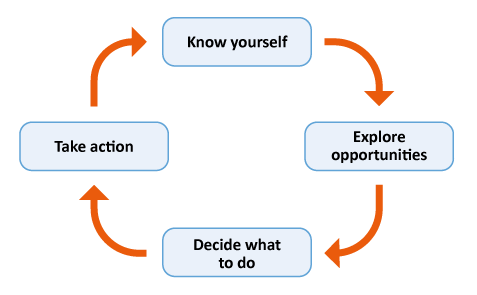
This week you have started to bring together ideas about your working life that you can use in a practical way.
Some of you will want to do this almost immediately. Others may still be planning when and how to use the knowledge and skills you have developed in creating applications and CVs. Just remember to be ready for those opportunities which are unexpected, that come at a time which never feels quite right, but might be just the right next step for you.
Next week you will move onto the next stage in the process – the interview. See you there.
You should now feel that you can:
- review a job advert
- consider what makes a good job application
- explore why it is important to have a current curriculum vitae
- create or update your curriculum vitae (CV).
You can now go to Week 7.
References
The Open University (2015) Analysing job advertisements [Online]. Available at http://www2.open.ac.uk/students/careers/applying-for-jobs/analysing-job-advertisements (Accessed 20 May 2015).
Acknowledgements
This course was written by Maria Townsend and Gill Gustar.
Some of the material in this course is based on material originally available on the Open University Careers Advisory Service website.
Except for third party materials and otherwise stated in the acknowledgements section, this content is made available under a Creative Commons Attribution-NonCommercial-ShareAlike 4.0 Licence.
The material acknowledged below is Proprietary and used under licence (not subject to Creative Commons Licence). Grateful acknowledgement is made to the following sources for permission to reproduce material in this unit:
Images
Figure 1: Shutterstock © PPILIPPOU
Figure 4: © sampsyseeds/iStockphoto.com
Figure 5: Shutterstock © Brian A Jackson
Figure 6: © pagadesign/iStockphoto.com
Figure 7: Shutterstock © wavebreakmedia
Figure 8: © Kutaytanir/iStockphoto.com
Figure 10: © andresr/Dreamstime.com
Table
Table 1: HECSU/AGCAS (2011) ‘Skills that employers want, how they can be developed’, What Do Graduates Do?, © HECSU/AGCAS.
Every effort has been made to contact copyright owners. If any have been inadvertently overlooked, the publishers will be pleased to make the necessary arrangements at the first opportunity.
Don't miss out:
1. Join over 200,000 students, currently studying with The Open University – http://www.open.ac.uk/ choose/ ou/ open-content
2. Enjoyed this? Find out more about this topic or browse all our free course materials on OpenLearn – http://www.open.edu/ openlearn/
3. Outside the UK? We have students in over a hundred countries studying online qualifications – http://www.openuniversity.edu/ – including an MBA at our triple accredited Business School.