Week 6: Power, engagement and empowerment
Use 'Print preview' to check the number of pages and printer settings.
Print functionality varies between browsers.
Printable page generated Sunday, 8 March 2026, 3:41 AM
Week 6: Power, engagement and empowerment
Introduction
Charities and voluntary organisations are established to benefit the public in some way. Yet many of those who benefit do not hold much power and are less able to participate in voluntary organisations.
In Week 5, you were introduced to the role of stakeholders and how groups hold different amounts of power and influence in organisations. You also considered different methods of communication with stakeholders. This week you will build on this work by examining the sources of power in organisations. In particular you will consider the role of one large stakeholder group: beneficiaries. Ensuring you have an accurate picture of beneficiaries is important in the context of understanding power and empowerment, particularly in terms of whose voice is not being heard or represented in organisations.
You will explore how beneficiaries can be engaged and ‘empowered’ to participate more in the decision making and other activities of voluntary organisations. Empowerment is a much-used term and so its various meanings will be examined. You will look at the ways in which service users in particular can be encouraged to contribute more to organisations and how their services are run. This is of particular concern to organisations in health and social care but the principles of empowerment can also be applied more widely.
This week begins with an overview of what constitutes power and a consideration of how these elements relate to your own experience.
In the following video, Julie introduces you to Week 6.
Transcript
[MUSIC PLAYING]
By the end of this week, you should be able to:
- identify different sources of power
- describe the beneficiaries of an organisation
- explain engagement and empowerment and why they matter
- describe ways of improving beneficiary involvement and expanding it more widely
- apply ideas and methods of empowerment to an organisation you are familiar with.
1 What is power?

As you saw in Week 5, stakeholders hold varying amounts of power in organisations. Power is a complex term and usually refers to influence, control or domination. Power is the potential to influence, which may or may not be exercised. For example, a police officer has a number of powers but whether these are exercised and how they are exercised depends on circumstances. Power can be perceived as both positive and negative, depending on how that power is used – power can be harnessed for good! It is useful to think initially about power in society before examining power within organisations.
Activity 1 Who has power in society?
Look at the following images and note what they make you think about in terms of power: does the person have power? Is the image a negative or a positive depiction of power?

Comment
Some people would see the image of the politician as doing good – others would have a different view. People working in banks or other major corporations are often perceived as having too much power. Bill Gates has enormous power derived from his wealth and commercial success. Yet he and Melinda Gates are also philanthropists. Having established a major grant-giving foundation, they use their power and wealth for good causes. People without work or homes probably feel they have no power in society due to their
Activity 1 starts to illustrate that power is one of those controversial topics that frequently evokes strong views and feelings. It also raises many awkward questions, such as:
- Is it acceptable to have power or does power corrupt?
- Is power just a question of what position you occupy?
- Does everyone have some power or is it just the preserve of a few?
- What, if any, power do I have?
- Can power be exercised responsibly?
Bear these questions in mind as you work through this week.
1.1 Defining power
Power involves degrees of influence and authority. These concepts can be defined as follows:
- Power is the potential or capacity of a person or a group to influence other people or groups.
- Influence occurs when a person or a group affects what another person or group does or thinks.
- Authority is a particular kind of power. It is the power that is formally given to an individual or to a group because of the position or role that they occupy within an organisation. For example, managers will have certain authority over their groups or departments; a management committee will have authority to make certain decisions for its organisation.
There are many different sources of power or ‘power bases’, as they are commonly called in organisations. This week’s focus is on the following sources of power.
Position power
The position or role that a person holds in an organisation entitles them to do certain things, such as giving instructions to others, authorising expenditure, organising work or calling certain meetings. Ultimately, position power is backed up by the rules, regulations and resources of an organisation. It confers on an individual or a group the authority to undertake certain delegated responsibilities with the formal support of the organisation.
Resource power
All organisations depend for their continued existence on an adequate supply of resources, such as money, personnel, materials, technology and clients. Control over any of these resources, particularly if they are scarce, can be an important source of power both within and between organisations. If you depend on another person for a particular scarce resource, then that person can probably exert considerable influence over you. If the resource is not scarce and you can obtain it elsewhere, then the other person’s power is diminished.
Money is a key resource so it is not surprising that so much of organisational politics revolves around budgeting and the allocation of financial resources. People are another vital resource. If you control how people are deployed this provides some power, but you also have some power because of your ability to control your own labour. For example, you might seek to influence a colleague by threatening not to cooperate with them, or by giving only the minimum of effort.
Expert power
Expert power depends in particular on the relationship between the parties involved and on the context of their relationship. A person’s claim to expertise is only ‘legitimate’ when it is recognised by those over whom it is exercised. The recognition of expertise is often a matter of reputation and demonstration. If you go into a group with a good reputation, or if you have developed one in the group, your expertise is more likely to be recognised. If you are new to a group, then recognition will probably grow if you can demonstrate that you know what you are talking about. Of course, it is usually best to stick to things you do actually know about! Furthermore, you may influence what other people or groups believe or do when they perceive you to be more expert than they are.
Information power
Without some degree of expertise you cannot judge what information is relevant or important. Access to information is often a result of a person’s position and their wider connections. A person’s position may give them access to important committees and other meetings. People who occupy key positions in the information networks of organisations are often called ‘
1.2 Your own sources of power
You have just considered the following sources of power:
- position
- resources
- expertise
- information.
In Activity 2, you will consider how these sources of power relate to your own experience.
Activity 2 What power do you have?
Power varies depending on the context: for example, your expertise may be recognised in one situation but not another. Consider your own sources of power (as listed above) in the following situations (if applicable) and make notes on each aspect.
- Situation A – a group or an individual over whose work (paid or unpaid) you have some formal authority.
- Situation B – a manager, group or management committee that has some formal authority over your work (paid or unpaid).
For each situation rate your different sources of power on a scale from one to five, where one is low and five is high. Compare the two situations. What differences do you notice?
Comment
One key issue to remember is that your sources of power will vary according to the different situations you face. If you were able to explore situation A, you probably found that your position and control of resources were more important in situation A than in situation B. You will be more likely to be in a position to control information flowing down the organisation in situation A, and up in situation B.
If you do not work as a manager, you may feel that you do not have a large amount of power and authority, but you may have identified one or two areas where you do feel you have some power (or
Not everybody has formal power in their work or volunteering – or wants it. From examining these interrelated sources of power, hopefully you will see that there may be situations where you do have power, perhaps through your knowledge or control of information. The following activity should help you think more broadly about power and the issues raised in Activity 2.
Activity 3 Does power corrupt?
Make some notes in answer to the following questions:
- Does everyone in organisations have some power or just a privileged few?
- Do you think that power corrupts (and what does this mean) or can it be exercised responsibly?
- Are some forms of power more acceptable than others?
- What power do you have?
Comment
- Everyone has some power even if it is just the power that comes from other people’s dependence on your goodwill or labour, which you may withhold. Of course, power does vary greatly between people and some are definitely more powerful than others.
- This generalisation is too sweeping. A more accurate version might be ‘high concentrations of power tend to corrupt’ – it is very tempting to get your own way without carrying people with you. Alternatively, if the responsible use of power involves accountability, another version would be ‘power without accountability corrupts’. Of course, some people with high concentrations of power do also empower others to do positive things.
- The forms of power and influence that are regarded as acceptable will vary depending on the values and norms that are held within a particular group or organisation. People often view expertise and persuasion strategies as legitimate forms of power and influence.
- The power that you have will vary depending on who it is you are trying to influence and the context of your relationship. The tasks in this activity should have helped you recognise the sources of power you may have beyond authority or position power.
2 Who are beneficiaries?

You have focused so far on different sources of power and started to think about these in the context of the degree of power and authority you have in your own work or volunteering. You will now look at beneficiaries and the power and influence they might have.
As Week 5 suggested, power tends to be limited for service users. Consequently there has been a growing interest in the voluntary sector (and public services more widely) to ‘empower’ beneficiaries to take a bigger role in their organisations. So this section starts by looking at who beneficiaries are and your experience of working with them or being a beneficiary yourself.
What do we mean by beneficiaries? Generally speaking, these are the people who benefit from or use organisations but, as you will see, this is not confined to the people who use services directly. In health care, for example, beneficiaries might also include the families of patients with health problems.
Activity 4 Problems of definition
Read the definition below. Note this definition refers to charities but the discussion could be applied to a range of voluntary and community organisations.
Using this definition, identify the beneficiaries of an organisation you are familiar with.
Defining beneficiaries and service user
[A beneficiary is] anyone who uses or benefits from a charity’s services or facilities, whether provided by the charity on a voluntary basis or as a contractual service, perhaps on behalf of a body like a local authority. ‘User’ will mean different things to different charities, and a number of people around the person directly receiving a service will also often benefit from the service. For instance, in a charity that undertakes research into a particular medical condition, the ‘user’ could be the person with that condition, his or her carers, medical and educational professionals offering advice on the condition and so on. Even if support is not provided directly to relatives, guardians or carers, they might have a clear and direct interest in how the charity is run because of their relationship and responsibility, sometimes financial or legal, for the actual users.
Comment
This definition encompasses people beyond the actual person directly receiving the service. Other examples could include:
- employers, if you are involved with an organisation that helps people find work
- the local or wider community that benefits if your organisation works on wildlife, environmental, faith, heritage or regeneration issues
- political campaigning organisations could also include citizens and communities
- a sports club run for local children – the relatives could be seen as beneficiaries as they benefit from having healthier children.
For charities working in overseas aid, beneficiaries include:
- those benefiting directly from the funding or help
- those who should have benefited but were not reached
- the health professionals and civil servants in the countries affected who receive training
- the communities benefiting from the training.
An issue that may also have arisen as you worked through Activity 4 is the term you used for the person directly receiving the service. Terms used may include patient, service user, mental health survivor, client, customer, consumer, member, resident, citizen and so on. In health and social care, the use of language to define the direct users of services has become quite a contested terrain and people have objected to being labelled in a particular way by professionals.
Peter Beresford (2004, 2010) is a long-term user of mental health services and has written extensively about the problems of terminology around beneficiaries, for example, the term ‘service user’. He is concerned about how thinking about people in terms of their use of services might not be how they would define themselves. Other terms such as ‘the blind’ or ‘the disabled’ are also controversial. This is important because ‘labelling’ a person often has negative connotations.
Beneficiaries are increasingly acknowledged as having extensive knowledge about services because they are on the receiving end of them, so therefore they can make a contribution to service improvement. The success of many services is also often dependent on how the service user responds to the service. In health, for example, the success of a treatment will depend not only on the skill of the doctor but also on how well the patient follows the treatment. The service is therefore co-produced by the doctor (and other health professional staff) and the patient.
Having identified who beneficiaries are, you will next look at how organisations seek to give them more power. This is done through engaging and empowering them.
3 Engaging and empowering

Engaging and empowering employees, volunteers, communities and beneficiaries is seen to be a ‘good thing’. Although the two processes are interrelated, engaging generally refers to getting people interested or ‘on board’ and providing information and encouragement. Empowering is the next step whereby people can be enabled to have a voice. Furthermore, empowerment is embedded in wider views of the world and theoretical ideas about citizenship, rights and responsibilities, democracy, political participation and creating a better society. Crucially, though, the term means different things to different people. For example:
- ‘Send your staff on our course to empower them to meet your objectives’ proclaims a leaflet advertising a high-powered course.
- A volunteer coordinator says, ‘empowerment has changed how we work and we’ve seen people really grow’.
- An activist committee member says, ‘we are not true to our principles unless our service users are empowered and given a voice on the committee’.
Even these few quotes illustrate how the same word is used with quite different meanings. The Collins Online Dictionary (n.d.) defines the verb ‘to empower’ as follows:
To give or delegate power or authority to
To give ability to; enable or permit.
This definition contains an ambiguity often present in discussing empowerment – that is, it is not clear whether power is transferred absolutely or is simply ‘on loan’ and can be taken back.
A definition from an advocacy organisation gives a greater sense of how the term can be used in voluntary organisations:
Empower – we will work in an empowering way that enables people to develop their skills and confidence, stand up for their rights and regain control – creating a culture of enablement not dependency.
In this context, the term ‘dependency’ is about not being dependent on professionals. This differs from how it is often used by politicians to mean dependency on the state. Empowerment is not necessarily a straightforward process and involves various challenges as illustrated by Activity 5.
Activity 5 What are the challenges?
Read the case study below and make notes on the challenges for empowerment.
Case study: Challenges of empowerment
A UK arts centre has members, who pay an annual subscription and elect half of the management committee and users, who include all paying customers and also patrons of rehearsal facilities and the coffee bar. The arts centre’s Memorandum of Association states that its objective is to benefit the public (i.e. its beneficiaries) of a specific geographical community, regardless of age, gender, race or religion. The social and demographic profile of the centre’s beneficiaries differs sharply from that of its members or users. In addition to these three groups, there are the public and private funders of the arts centre, and its staff. Within each of these five groups of stakeholders, there are opposing views on what the arts centre should be doing, and many who have no strong view.
The arts centre’s new director was committed, politically and philosophically, to the concept of empowerment: he believed those without power should gain it at the expense of establishment elites, who he perceived as holding power in society. He saw the arts centre in the same terms.
However, he found it very difficult to put these beliefs into practice. Public grant funders wanted to retain their say in what the centre put on and what it charged. Some private financiers threatened to end their support if they lost certain controls: they wished to consider the centre’s programme before they consented to adding their logos.
The wider population’s views about and interest in the centre proved difficult to ascertain without expensive survey work and long-term community arts development projects. Users’ power seemed to lie in their purses: if they thought the programme and the facilities represented good value, they came. If not, they didn’t.
The results of a members’ questionnaire proved very different from the views expressed by the majority of members who attended an open meeting: the meeting proposed that elected member representatives should have an overall majority of places on the management committee. This would have been at the expense of 50 per cent of the committee places reserved for trusts and staff.
After six months of turmoil, the new director quietly dropped his interest in empowerment. He then spent much of his time rebuilding relationships of trust with members of various stakeholder groups.
Comment
The challenge thrown up by this case study is about empowering internal and external stakeholders. Different people place different emphases on who is to be empowered. Some may understand empowerment primarily as internal empowerment, and may be concerned about the skills, abilities and enthusiasm of staff, and about what say they have in their jobs and in the running of the organisation. Others may be more concerned about external empowerment – that is, the power of those whom the organisation is supposed to serve.
In this example of the arts centre, the issue of internal empowerment is a relatively small aspect of a much bigger and very complicated arena for the question of empowerment to be addressed. The experience of empowerment was negative in this case, but this should not persuade us that empowerment is unachievable. Different ways of going about things, and building more on what was there with a longer time frame in mind, may have produced much more positive results.
4 Empowering service users

If we accept the premise that empowerment is ‘a good thing’ and that empowering service users can improve quality of life for service users and add value to an organisation, then it is important to think about how organisations can engage with the process. Clearly, empowerment should not be perceived as a process that is top-down – that is, a method is decided by the organisation and then imposed on service users. It should be regarded as two-way, participative, nurturing and ‘co-produced’: empowerment is not something that is ‘done’ to people.
4.1 Arnstein’s ladder of participation
One much-cited approach to understanding empowerment is Arnstein’s ladder of participation (Arnstein, 1969), which highlights the different forms that empowerment can take. Although originally designed to describe a wider form of participation than empowering service users in organisations, it can still be applied in this context. Box 1 contains an extract from an article in which Arnstein describes how the ladder of participation works.
Box 1 Extract from ‘A ladder of participation in the USA’ by S. Arnstein
2 Types of participation and “nonparticipation”
A typology of eight levels of participation may help in analysis of this confused issue. For illustrative purposes the eight types are arranged in a ladder pattern with each rung corresponding to the extent of citizens’ power in determining the end product. (See Figure 2.)
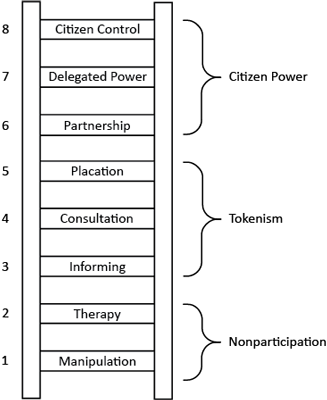
The bottom rungs of the ladder are (1) Manipulation and (2) Therapy. These two rungs describe levels of “non-participation” that have been contrived by some to substitute for genuine participation. Their real objective is not to enable people to participate in planning or conducting programs, but to enable powerholders to “educate” or “cure” the participants. Rungs 3 and 4 progress to levels of “tokenism” that allow the have-nots to hear and to have a voice: (3) Informing and (4) Consultation. When they are proffered by powerholders as the total extent of participation, citizens may indeed hear and be heard. But under these conditions they lack the power to insure that their views will be heeded by the powerful. When participation is restricted to these levels, there is no follow-through, no “muscle,” hence no assurance of changing the status quo. Rung (5) Placation is simply a higher level tokenism because the ground rules allow have-nots to advise, but retain for the powerholders the continued right to decide.
Further up the ladder are levels of citizen power with increasing degrees of decision-making clout. Citizens can enter into a (6) Partnership that enables them to negotiate and engage in trade-offs with traditional power holders. At the topmost rungs, (7) Delegated Power and (8) Citizen Control, have-not citizens obtain the majority of decision-making seats, or full managerial power.
Obviously, the eight-rung ladder is a simplification, but it helps to illustrate the point that so many have missed – that there are significant gradations of citizen participation. Knowing these gradations makes it possible to cut through the hyperbole to understand the increasingly strident demands for participation from the have-nots as well as the gamut of confusing responses from the powerholders.
Though the typology uses examples from federal programs such as urban renewal, anti-poverty, and Model Cities, it could just as easily be illustrated in the church, currently facing demands for power from priests and laymen who seek to change its mission; colleges and universities which in some cases have become literal battlegrounds over the issue of student power; or public schools, city halls, and police departments (or big business which is likely to be next on the expanding list of targets). The underlying issues are essentially the same – “nobodies” in several arenas are trying to become “somebodies” with enough power to make the target institutions responsive to their views, aspirations, and needs.
2.1. Limitations of the Typology
The ladder juxtaposes powerless citizens with the powerful in order to highlight the fundamental divisions between them. In actuality, neither the have-nots nor the powerholders are homogeneous blocs. Each group encompasses a host of divergent points of view, significant cleavages, competing vested interests, and splintered subgroups. The justification for using such simplistic abstractions is that in most cases the have-nots really do perceive the powerful as a monolithic “system,” and powerholders actually do view the have-nots as a sea of “those people,” with little comprehension of the class and caste differences among them.
It should be noted that the typology does not include an analysis of the most significant roadblocks to achieving genuine levels of participation. These roadblocks lie on both sides of the simplistic fence. On the powerholders’ side, they include racism, paternalism, and resistance to power redistribution. On the have-nots’ side, they include inadequacies of the poor community’s political socioeconomic infrastructure and knowledge-base, plus difficulties of organizing a representative and accountable citizens’ group in the face of futility, alienation, and distrust.
Another caution about the eight separate rungs on the ladder: In the real world of people and programs, there might be 150 rungs with less sharp and “pure” distinctions among them. Furthermore, some of the characteristics used to illustrate each of the eight types might be applicable to other rungs. For example, employment of the have-nots in a program or on a planning staff could occur at any of the eight rungs and could represent either a legitimate or illegitimate characteristic of citizen participation. Depending on their motives, powerholders can hire poor people to co-opt them, to placate them, or to utilize the have-nots’ special skills and insights. Some mayors, in private, actually boast of their strategy in hiring militant black leaders to muzzle them while destroying their credibility in the black community.
Activity 6 Ladder of participation
Bearing in mind what you have just read about Arnstein’s ladder of participation, make notes on how this relates to the ‘methods’ of empowerment used by an organisation you are familiar with and how useful you found the model.
Comment
The ladder is, of course, a relatively straightforward framework for understanding empowerment and participation but it can be a useful starting point for thinking about how your organisation works with service users. One useful distinction to consider is between passive and active methods of involvement rather than a linear/ladder model. Methods such as attendance at meetings, consultation, monitoring, evaluation and so on are often regarded as ‘passive’ and may not lead to full empowerment. However, much depends on whether or not the consultee, for example, makes a contribution to meetings. Furthermore, if the consultee makes comments that are not acted upon, this is also not passive.
4.2 Real-world examples
The ladder of participation provides a theoretical framework but some real-world examples are needed. The following activities will help you to experience and understand some of these.
Activity 7 Empowerment in practice
The following is a list of practices and arrangements that can all be seen as empowering individuals or groups in one way or another. Consider these practices and note one or two concerns you might have about each one.
- The introduction of service users onto the management committee in an arts organisation for disabled people.
- The production of a set of service standards that any service user can expect of the organisation and a means of redress if these standards are not achieved.
- A campaign to improve the conditions and rights of people in prison.
- Involving young people on interview panels for staff in a children’s charity.
Comment
Your answers will depend on your understanding of what empowerment is.
- A concern might be the extent to which this is a true empowerment – that control of resources and power by service users is real rather than apparent. Also, to what extent can a few service users represent or reflect the views of all service users?
- This should clarify what is expected of staff as well. One view could be that this is more of a formal contract relationship than a form of empowerment. Also, who defines the standards and do service users have an input into the process?
- This appears to empower (depending on the amount of input by prisoners and their families) but requires a major effort and campaign to influence change.
- This would not always be appropriate but has been used with some success in schools and would be empowering for young people to have that degree of involvement in decision making.
Activity 8 An empowering example
Read Polly Mehta’s experience, from The Guardian website (2014), of being empowered by Shift.ms. This organisation helps people with multiple sclerosis (MS) talk to experts. (Tip: open the article in a new tab or window by holding Ctrl [or cmd on a Mac] when you click the link.)
Make notes on:
- how Polly felt empowered and why
- how this approach compares with an organisation you are familiar with.
Comment
Polly clearly found the process very positive. She found she was more proactive and less of a passive recipient of information. She felt less of a victim. She also praised the organisation for opening itself up to interaction with its service users and ‘handing back power’.
You probably have various examples of how service users and other beneficiaries are involved in your organisation. For example, perhaps your organisation identified a need for greater understanding about how one part of your service worked so you consulted service users or beneficiaries; or your organisation wanted to change a service and it was considered crucial to ask service users how this would affect them.
A key issue to consider: empowerment is a process as well as an outcome. For example, you can introduce a means by which service users are consulted or invited to participate in meetings but that does not mean they have been empowered. For this to happen, service users may need to build confidence and skills in order to engage with the organisation effectively. The organisation needs to take notice of what the service users say and demonstrate that they have acted on their input or explain why they have not.
Achieving empowerment is not always plain sailing: there can be barriers and resistance. Some people may respond to the issues raised this week by saying: ‘but they don’t want to be empowered’. The danger with such a response is that it saves us examining our own fears and anxieties about intervening and seeking to change relationships towards empowerment.
Activity 9 Barriers
Read the short example below and list what you feel might be the barriers to empowerment in this situation:
A day centre for single homeless people introduced consultation meetings for service users and staff. It was six months before the meetings became regularly attended by service users.
Comment
The service users probably first had to develop trust that staff would listen, respond to and, where possible, implement their suggestions. People often expect ‘tokenism’ when power is ‘given away’. Service users had to find out that staff were really open to influence. However, some service users may have felt they did not have the confidence, expertise, skills or time to participate. Some may also have not been interested. Investing resources in developing volunteers’ capacity to participate is extremely important if empowerment is to work.
Wider issues about resistance may include:
- Previous experience where empowerment has been a ruse by which people have been asked to take on more work and responsibility with no extra support or reward.
- There might be a difference between the management team’s and an individual’s views about the goals of the organisation.
- The empowerment on offer might be seen as tokenism. People may recognise the limitations of empowerment on the basis of increased representation and may choose not to collaborate in something that they perceive has little real effect on the way power is exercised. It may take time for people to recognise that an empowerment initiative is genuine. People need support, training, help and reassurance if they are going to be able to take and use power effectively.
- For some people, the issue they are being asked about may not be important or they may not have time to be involved. It is not possible to participate in everything.
5 This week’s quiz
You’ve nearly reached the end of another week of study. Now it’s time for the weekly quiz. This week’s quiz won’t count towards your badge, so only has five questions.
Open the quiz in a new tab or window (by holding Ctrl [or cmd on a Mac] when you click the link).
6 Summary
This week covered a range of issues relating to power and empowerment. Empowerment does not take place in isolation from the wider environment; for example, government policy can encourage (or perhaps, hinder) it. Whatever your organisation’s intentions, there are forces, constraints and uses of power in your external environment that may limit any empowerment towards which you may be working. However, the examples this week – and your own work reflecting on your organisation’s attempts at empowering beneficiaries – should help you in understanding the possibilities for real involvement and empowerment, which go beyond tokenism.
In Week 6 you have learned:
- what power is and whether it is a ‘good’ thing
- how to distinguish between different sources of power
- to explore who has power – and how it is used – in an organisation you are familiar with
- how to identify the beneficiaries of a voluntary organisation – including your own
- what the different methods of empowerment are
- what the challenges are in empowering service users.
You can now go to Week 7.
References
Acknowledgements
Except for third party materials and otherwise stated (see terms and conditions), this content is made available under a Creative Commons Attribution-NonCommercial-ShareAlike 4.0 Licence.
The material acknowledged below is Proprietary and used under licence (not subject to Creative Commons Licence). For the avoidance of doubt: All third party videos credited below, and those which link you to Youtube for viewing, are not subject to Creative Commons licensing. Grateful acknowledgement is made to the following sources for permission to reproduce material in this unit:
Course image: © Katie Hetrick in Flickr https://creativecommons.org/ licenses/ by/ 2.0/.
Figure 1: VIKTOR88/Shutterstock.com.
Figure 2: Top left: Getty Images; Top right: Getty Images; Bottom left: Patti McConville/Getty Images; bottom right: WPA Pool/Getty Images.
Figure 3: Lana Rinck/Shutterstock.com.
Figure 4: Yury Zap/Shutterstock.com.
Figure 5: Aysezqic meli/Shutterstock.com.
Box 1: extract adapted from: Arnstein, S. (1969) ‘A ladder of participation in the USA’, Journal of the American Institute of Planners, vol. 35, no. 4, pp. 216–2.
Every effort has been made to contact copyright owners. If any have been inadvertently overlooked, the publishers will be pleased to make the necessary arrangements at the first opportunity.
Don’t miss out
If reading this text has inspired you to learn more, you may be interested in joining the millions of people who discover our free learning resources and qualifications by visiting The Open University – www.open.edu/ openlearn/ free-courses.