Week 2: Pianists and piano scores
Use 'Print preview' to check the number of pages and printer settings.
Print functionality varies between browsers.
Printable page generated Saturday, 4 April 2026, 6:36 PM
Week 2: Pianists and piano scores
Introduction
Last week, you learned a little bit about the history of Western music notation and you looked at melodies written on a single staff, listening and comparing different elements of the music.
You are now going to start combining staves and working towards understanding a typical piano score. You are also going to explore how to follow more than two lines of music at once, whether those lines are both to be played on the piano or by combinations of instruments.
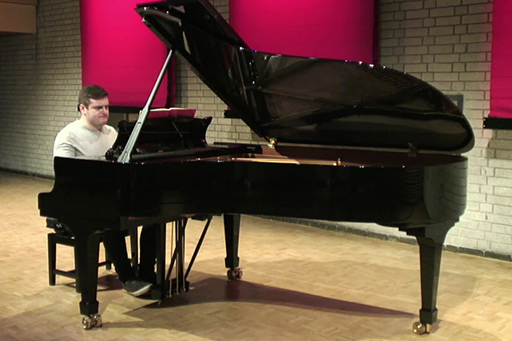
In the following video, pianist Alexander Panfilov performs the first six variations of Mozart’s Twelve Variations on ‘Ah, vous dirai-je, Maman’. If you have spotify, you can hear a complete performance of the piece on the course Spotify playlist and download a copy of the score as a PDF.
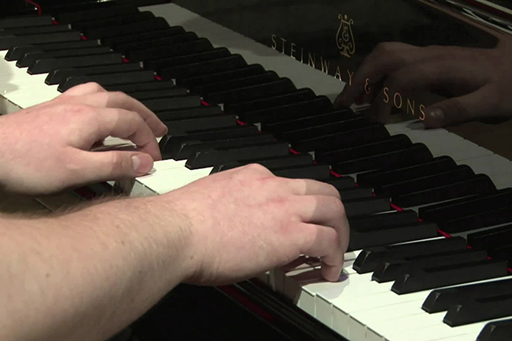
Alexander is a graduate of the Royal Northern College of Music where this video was filmed. He won the Arcangelo Speranzo Piano competition in 2013, the Hastings International Piano competition in 2015 and took part in the 2015 Leeds International piano competition and reached the semi-finals.
2.1 Variations on a theme

We’re sure you recognised the melody in the piano piece in the video in the previous section. We know it as Twinkle, Twinkle, Little Star, but it exists in slightly different forms in several European folk traditions. The French call it Ah, vous dirai-je, Maman and the Germans know it as a Christmas song, Morgen kommt der Weihnachtsmann.
We’re going to use this set of variations by Mozart to demonstrate how a piano score works and to guide you towards understanding how several simultaneous lines of music look and sound.
The principle of variation form is that a simple theme, often a well-known melody, generates more and more complex music, culminating in an exciting finale, but at every point along the way, some element of the original theme is present and recognisable. A set of variations is a good starting point when learning about piano scores because there will always be something – often the melody – which is familiar in each variation, which may be used as a point of reference while listening and following the score. This is similar to a series of art prints, where the image is recognisably the same, but has difference in colour, orientation, detail and so on. So, the melody might be spread out over lots of fast notes, there might be a whole range of different rhythms, or the melody might be hidden inside several parts all weaving together, but you should be able to find something familiar in each variation.
2.1.1 Getting started with piano scores
A piano score will always have two lines of music, one for the right hand and one for the left, and generally uses the treble clef for the right hand and bass clef for the left. When following a piece of music that has more than one line, remember that the staves that are played together are joined by a brace that looks like a curly bracket. The notes that sound simultaneously will line up vertically on the staves contained by the brace.
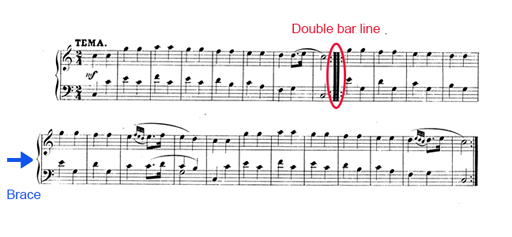
Before you move on, you need to be able to identify some other important signs in the notation – first, the double bar line and second, the repeat mark. If you look at the score right from the beginning, you will see that the first line of music is separated in the middle by two thicker bar lines. There is a similar sign at the end of the second line of music. These are called double bar lines and they are used to indicate the end of a piece of music or the end of a section. Here, they also have two dots placed on either side of the middle line of the staff. This is called a repeat mark and indicates that the player must go back to the beginning or to the previous double bar and play it again. Double bars and repeat marks are important ‘landmarks’ to look out for in a score as they will help your orientation. You may remember from last week, that repetition is important in creating structure in melodies, but also it is an important element in creating larger structures. Knowing how repetition works will help your understanding of a score.
2.2 Melody and harmony

The ‘tema’ or theme of this set of variations gives us a very simple presentation of the tune and an accompaniment. Hopefully, you will have been able to follow the treble clef part quite easily having practised doing this last week. Now, the problem with following two lines of music at once is that usually they are not the same, especially when that music is for piano. So, let’s take a closer look at how this works.
Sometimes when trying to follow a piece of music, with or without a score, we need our ears to tell us which part of the music is the melody and which part is less important or accompanying. The melody is usually in the right hand or upper staff and the accompaniment in the left hand or lower staff. The ‘tema’ uses an accompaniment that is a single line of music that, on its own, is quite simple to follow. Put it together with the melody and you can see that the notes are vertically aligned with the treble clef part, showing that they both move at the same speed – and the pitches of the two lines sound good together, or in other words, they are in harmony. With two lines of music that move at the same speed like this, your eye can keep pace with both together.
Can you think of types of music where the melody and accompaniment move together at exactly the same pace?
2.2.1 Texture
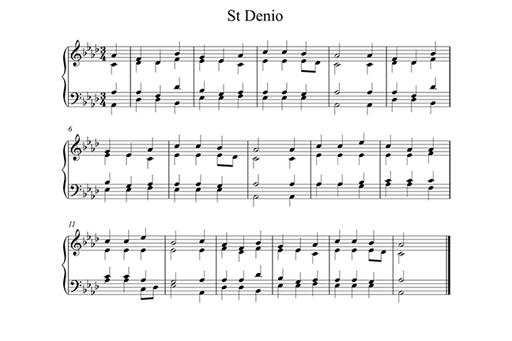
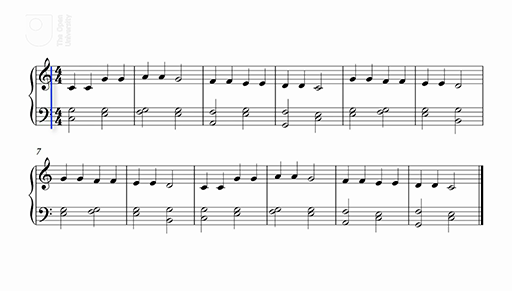
Hymns are a common type of music in which melody and accompaniment move at the same pace. In a hymn tune, like the one shown in Figure 4, most of the notes will move at the same time in blocks, so following both left and right hand parts together is much easier than following parts where they do different things. Listen to this example and follow the score.
Harmony, by definition, uses two or more notes simultaneously. Notice that in this example there are two notes occurring at the same time on each staff, so four notes at the same time in total. Piling up notes vertically in this way, meaning they are struck together by the player, creates chords, which sound much richer than the ‘tema’ you looked at in the previous section.
Notice how both treble and bass parts have notes of similar lengths and move simultaneously. When musicians talk about the relationship between a melody and what accompanies it, they use the term texture. This type of texture we could call ‘block chords’ because all the elements move together in block-like chunks. You could almost draw a picture of it that might look like a line of bricks or blocks. Sometimes when following a large score, identifying sections of block chords that look like chunks of notes moving together can help you keep track.
2.2.2 Texture in big band jazz
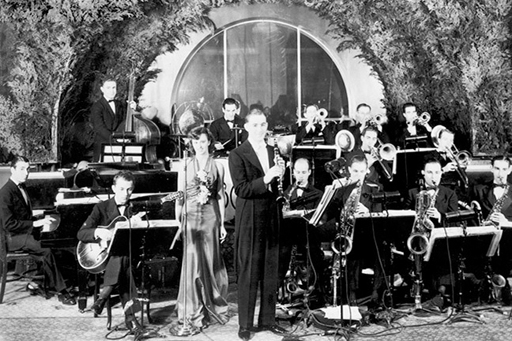
A texture using block chords is also a common feature in jazz. Music for big bands often features ‘blocks’ of sound, with each instrument within the saxophone, trumpet and trombone sections having similar material. There is one further group of instruments (piano, bass, guitar and drums) that each have slightly different things to play. Collectively, this group is known as the ‘rhythm section’ and can be compared to the engine in a car, driving the music along and coordinating the other elements.
This strong sense of the band being divided into four sections makes following a score of a classic big band piece, which might involve around 20 musicians, not quite as tricky as it might first appear. Sometimes, for an even more powerful effect, the saxophones, trumpet and trombones are all scored to play in block chords – a great example of this can be found in Fletcher Henderson’s arrangement of Irving Berlin’s Blue Skies for Benny Goodman’s orchestra. Henderson’s arrangement presents a series of variations based on the melody and harmony of Berlin’s original song. Listen to a short section of this number now. You’ll be looking at this in a bit more detail next week.
2.2.3 Discussing Mozart
Now you have worked through the basics of how melodies work with accompaniments and how textures are created, watch the following video to learn more about how pianist Alexander Panfilov works with the score to discover more about textures and structures as he prepares for performance.
You may find it helpful to have the score that you downloaded in the introduction to hand as you watch.
Transcript
Alexander mentions the Viennese Classical style. By this, he means the music written by the composers of the late eighteenth and early nineteenth century, such as Mozart, Haydn and Beethoven.
2.2.4 Comparing notes: the kaleidoscope of piano textures
To learn a little more about the technical aspects of texture and to help you follow them in a score, we are now going to explore a few short examples in a little more detail. This will help you appreciate the range of possibilities open to a composer when working with more than one strand of music, and how those different strands may interact with each other.
The following video demonstrates how the relationship between different sounds can be developed in many different ways. There are a few more symbols in musical scores that can alert us to how the various lines interact. You may have noticed Alexander referring to rests in the video in the previous section. We are now going to expand on how these work.
Transcript
2.3 Some new symbols
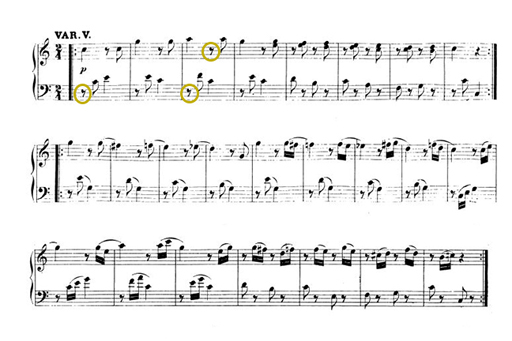
Mozart’s fifth variation introduces some things that we have not yet come across in this course.
First, there is a sign right at the start that looks like a small lowercase ‘p’ in italics. This is called a dynamic marking and it tells the performer to play this section quietly. Dynamic markings are abbreviations of Italian words for quiet (piano) and loud (forte). These two basic indicators may be modified to indicate extremes such as ppp (very, very quiet) or a moderate middle of the road volume (mf or mp – moderately loud or moderately quiet). Dynamics are also good landmarks to watch out for in a score, as you can very easily hear where music changes volume.
The other signs we need to consider are highlighted in the music shown here but are not notes – they are called rests and show moments of silence.

All music has components of silence. In an orchestra or group, an instrument or a group of instruments may drop out of the action for a short while, or there may be a moment where only one hand is needed at the piano, or it can be in the form of an expressive break in the flow of musical sounds. The length of the silence depends on the shape of the rest sign, much like note shapes. As you get more and more instruments and lines in a score, you will see quite a lot of rests where one or more instruments are silent.
Why is silence important in music?
2.3.1 Fitting sound and silence together
The interplay between sound and silence has been an important trend in art music since the mid-twentieth century and much has been written about the philosophy and psychology of silence in music.
These small silences articulate the musical space, so you need to be able to identify rests and places in large scores where instruments are silent in order to understand what is happening and to follow them through. Essentially, you will need to move your eye to the active lines of music not the resting ones.

Listen to Mozart’s fifth variation. Here, Mozart breaks up our now familiar melody between the left and right hands, and where one is busy, there is a rest in the other. You may find the movement from one clef to the other tricky to follow at first, but once you get used to seeing how they fit together, it becomes easier to follow both staves together than to separate them. Notice that Alexander observes the first repeat mark, but not the second one.
2.3.2 Visualising textures in a score
Hopefully, you are starting to see how the different lines of music relate to each other on the page when listening, and you are starting to relate different types of sound to different visual patterns and shapes.
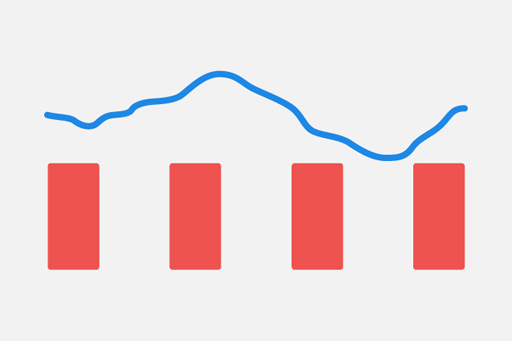
Block chords look different to combinations of fast and slow notes, or to melodies weaving together. Identifying these textures will help you understand the construction of the music and how it is written down and represented in the score. Figure 9 shows how someone might imagine what a melody with chords might look like. Your vision might be different, but some kind of visualisation will help you understand how textures work.
How would you visualise a round or a piece of music with interweaving melodies? Think of a piece of music you know and try to visualise what the texture might look like.
2.3.3 Practising your skills
You probably realise that there is no right or wrong answer about visualising textures. It is simply a way of helping you understand a musical score by visual analogy. Now you have worked through parts of a piano score based on a familiar melody, you will move onto a piece of music that is not built up from a familiar tune in order to practise your skills.
Now you will listen to a piece of music written on what should now be a familiar two stave score. Before you start listening, look at the music, which begins at No. 4 on this PDF of the music, and see if you can identify ‘landmarks’.
- Are there double bars and repeat marks?
- Can you identify different types of texture that will help you follow the music?
Once you have scanned through the music, play the audio and follow the score. Remember to tap the beat as you go, and allow your eyes to follow in time with the beat. You might find using your finger to keep your place in the score helps. If there are rests, allow your eyes to follow the active part of the music. You may need to do this a couple of times so that, as the music becomes more familiar, you can find your way around the score more easily.
2.3.4 Fitting it all together
You should now practise following the score of the Mozart variations, which you saw in the video at the start of the week.
Download the PDF of this score, before playing the video. Practise following the score as far as you can. Hopefully you will understand how the melodies work in the context of the score, and that you are becoming more confident at following the music. Note that Alexander observes only the first repeat mark in each variation, but other performers may do it differently.
You can listen to a full recording of all twelve variations on our Spotify playlist or on YouTube.
Next week you will be using scores that use more lines, so keep on practising, following as much music as you can to develop your skills.
2.4 Week 2 quiz
This quiz allows you to test and apply your knowledge of the course so far.
Complete the Week 2 quiz now.
Open the quiz in a new window or tab then come back here when you are done.
2.5 Week 2 summary
This week you have heard a pianist describe how he works with a musical score and how it helps him understand the structure of a piece and to prepare for a performance. You have learned about how piano music is represented in a score, how variation structures work, what texture, rests and dynamics are, and seen them all brought together in an example by Mozart.
Next week you will be meeting a group of five musicians who play together in a quintet, and looking more closely at how jazz bands use scores.
Acknowledgements
This free course was written by Catherine Tackley and Naomi Barker.
Except for third party materials and otherwise stated (see terms and conditions), this content is made available under a Creative Commons Attribution-NonCommercial-ShareAlike 4.0 Licence.
The material acknowledged below is Proprietary and used under licence (not subject to Creative Commons Licence). Grateful acknowledgement is made to the following sources for permission to reproduce material in this free course:
Images
Figure 5 © Chicago History Museum
Audio/video
© The Open University
Every effort has been made to contact copyright owners. If any have been inadvertently overlooked, the publishers will be pleased to make the necessary arrangements at the first opportunity.
Don’t miss out
If reading this text has inspired you to learn more, you may be interested in joining the millions of people who discover our free learning resources and qualifications by visiting The Open University – www.open.edu/ openlearn/ free-courses.