Week 5: Professional networking
Use 'Print preview' to check the number of pages and printer settings.
Print functionality varies between browsers.
Printable page generated Sunday, 5 April 2026, 2:19 AM
Week 5: Professional networking
Introduction
First of all, congratulations for getting to the second half of this course – you have done well to reach this stage!
Over the first four weeks of the course, you have investigated your sector from several perspectives and identified how to research it and access information, advice and support in doing so. You are now halfway through this process and should understand that the more you know about your particular job in its wider business, industrial and economic context, the better prepared you are for making changes and furthering your career.
This week, you will be looking at professional networking and considering the practical steps that you can take to make the most of the contacts that you establish so that they become active networks of support for your career goals.
Watch Lynne Johnson as she introduces Week 5.

Transcript
As you have done in previous weeks, use your notebook or the Toolkit to jot down your thoughts and responses to the activities.
By the end of this week, you will be able to:
- define networks and networking, identify the networks that you already have around you and how networking can help you understand your sector better
- describe what can help to make your networking more effective, including the importance of establishing a good relationship
- explain good networking practice, including preparation and follow-up, the ability to open conversations and the elevator pitch
- outline the importance of managing your online profile and explain how to use professional networking sites, such as LinkedIn, productively.
1 What are networks?

When we talk about a network, what do we mean? It’s easy when referring to physical things – such as computers – that are connected and might communicate with each other, but in this context we are talking about people. Which of the following would you consider to be a network?
- A department in a company
- A five-a-side football team
- A reading group
- A group of conference delegates
- A family
- A research group in a university
Oxford Dictionaries defines a network simply as ‘a group or system of interconnected people or things’ (Oxford Dictionaries, 2016). So, by this definition, all the above are networks of some kind. This definition neatly reflects the sense of a network as a group of people who are connected in some way.
Networks are nothing new and, in essence, have existed almost since people could communicate. All human networks are basically social networks; think about the role of families, tribes and churches, and later, of guilds, clubs, societies, etc. It is only more recently that we have begun to identify their uses for business, career and personal development.
Activity 1 Mapping your network
Create a map of the various contexts in which you meet and interact with groups of people: work, social, interests, family, academic, etc. Try to be as specific as possible; there may be more than one group in your workplace, for example. The Toolkit has a Mapping your network tool to help you with this activity. Alternatively, you can draw your network in your notebook if you prefer.
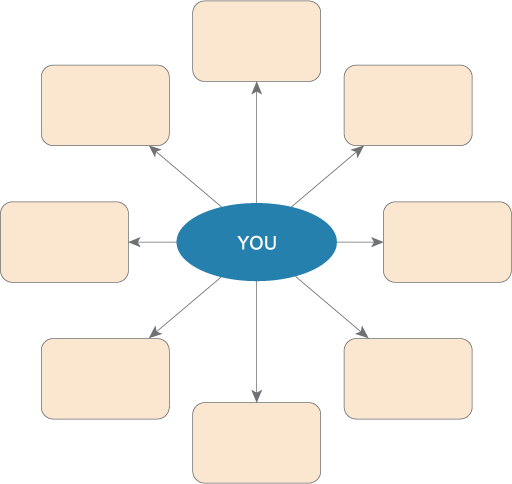
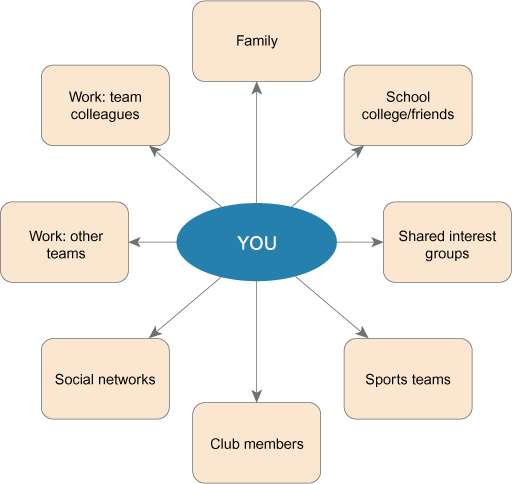
When you start to think about this, you will probably find that you already belong to more networks than you might have thought. Not all of these will be useful for work or career purposes, however, but you may not know this until you begin to look at them more closely.
1.1 What is networking?
All the networks you identified in Section 1 also have the potential to be useful in finding out about your sector. This is captured in a further definition of a network, from the same source, as ‘a group of people who exchange information and contacts for professional or social purposes’ (Oxford Dictionaries, 2021). The kind of network that you will be considering in this section must have a purpose, and that purpose is one that you must define.
Networks can be used for many different purposes in developing your career, for example:
- to find out more about what a particular job or career involves on a day-to-day basis
- to find out about how someone’s career has developed over time
- to receive early notice about possible future vacancies
- to see if you can arrange a work placement or visit to a workplace.
These are just a few purposes and you may be able to think of more. In short, using networks can be a powerful way of researching your sector and of widening your knowledge about opportunities within it, giving you access to other people’s experience and perspectives.
Now you have defined networks, what is networking? Oxford Dictionaries says that to network is ‘the action or process of interacting with others to exchange information and develop professional or social contacts’ (Oxford Dictionaries, 2021), meaning that networking is a very deliberate and conscious act; it does not happen by accident. It also means that networking is not about selfishly looking after your own interests and pursuing your own agenda. The definition above uses the word ‘exchange’ carefully; good networking is a two-way process and is as much about answering the question ‘How can I help?’ as it is about ‘What can I get?’
Networking sometimes has negative connotations reflecting suspicion about the motives behind it. You may have heard people make comments such as ‘It’s not what you know, it’s who you know’ and ‘the old boys’ network’. These express the doubts that some people have about networking and its role in merely extending privilege. This may well be the case but, even if we accept this, there are many reasons for networking. Listed below are a few to think about.
- Networking increases the number of people you know and who know you.
- You can turn to more people for help and advice.
- Networking keeps you in touch with opportunities.
- Networking may be very useful at the start of your career when you are less well connected.
- Effective networkers are more likely to be offered opportunities.
- Networking allows you to contribute something to others – the principle of reciprocity.
In the next section, you will investigate how to network successfully.
2 Effective networking

When you think about people networking, do any of the following kinds of behaviour spring to mind?
- Enthusiastically accosting strangers at a conference
- Mechanically repeating a ‘summary of my career to date’
- Forcing a business card into people’s hands
- Asking people for favours
- Bombarding people with emails
- Ruthless self-promotion
You will not be surprised to hear that these fall into the category of practices to avoid. In his book Never Eat Alone, Keith Ferrazzi, an expert in professional relationship development, talks about ‘using the power of human relationships for mutual benefit’ to demonstrate that effective networking starts with thinking about the needs of other people rather than selfishly pursuing your own agenda (Ferrazzi, 2014).
Activity 2 Two approaches to networking
The following short case studies illustrate two different approaches to networking. Which do you think has more chance of being successful? Make a note of your thoughts, either in the box below or in the Notes tool in the Toolkit.
Selina
Selina is at a business conference where she would like to find some new clients for her fledgling company selling kitchen appliances. She starts by approaching everyone in the room and trying to give them all the sales pitch that she has specially prepared for the day. This lasts five minutes, at the end of which she then quickly moves on to the next person. Realising that she is running out of time to meet everyone, she dashes round those she hasn’t spoken to and thrusts a copy of her product brochure into their hand.
John
John is at a conference on care for the elderly. He is keen to move into this type of work but feels he needs to get some advice first. He does some homework on who else is attending the conference so that he can focus on those people with the right kind of experience. He then approaches them and gently asks them about themselves and their work before telling them something about himself. After the short conversation, he asks if they would mind exchanging email addresses for further contact.
Comment
John shows greater sensitivity towards the needs of others and has worked out exactly who he wants to speak to, so is more likely to get a sympathetic response. He also gets them to talk about themselves first rather than bombarding them with information about himself that they may not want to hear. Selina, conversely, has done no preparation and thought only about what she wants to get out of the relationship. Her approach appears to lack empathy and foresight.
Good practice in networking relies upon a few key principles:
- thinking of what you have to offer others
- identifying the best person to talk to
- thinking about what you want from the relationship
- being prepared to listen to others
- being generous with your time and attention
- taking a risk sometimes
- going outside your comfort zone
- following up connections made.
The important principle here is that, until you actually establish a relationship with another person, it is very difficult to work out what you might be able to provide for each other. Moreover, it is very difficult to establish a relationship with someone unless you listen to them and find out what makes them tick. This implies taking time over the early stages of a relationship and risking that this might be ‘wasted’ because it leads nowhere.
Bear in mind that some people are probably natural networkers; they are more socially at ease with people they do not know and welcome the opportunity to begin conversations with – and ask questions of – strangers. Some people with an extrovert personality, for example, can need a high level of stimulus in their lives and may act swiftly without too much forethought. They may also show more of their personality more readily and can be energised by interacting with others, having a wide range of interests and personal networks.
Those of a more introverted nature, by contrast, may prefer less crowded environments, like to think before they act and can appear self-contained and even reserved. They may tire more easily of too much interaction with others and prefer fewer but deeper interests and a smaller group of friends and acquaintances. Other personality traits, neurodiversity, cultural background or disability may also have an influence on people’s confidence, and approach to, networking.
What might this mean for your approach to networking?
2.1 Networking concepts
It is worth considering a couple of concepts in relation to networking: psychological distance and an emotional bank account.
Psychological distance
The concept of psychological distance suggests that it is easier to establish relationships with people we regard as similar to us and, conversely, more difficult with people we perceive to be unlike us. Moreover, we may make more allowances for those closer to us while adopting more stereotyped views of those further away.
The implication of this is that you will need to take more time and put more effort into nurturing relationships with people who are socially more remote. However, this hard work might ultimately be more rewarding, as such people might have something new or different to tell you. For example, sticking close to friends and family for networking purposes will probably be simpler than contacting people outside your immediate circle, but this might just reinforce the ideas that you currently have rather than help you to think more creatively.
Emotional bank account
The concept of an ‘emotional bank account’ was first put forward by Dr Stephen Covey (2009), an American educator, author and thinker. In this context, it refers to how, when we first establish relationships with other people, we can make deposits into and draw on a notional ‘bank account’ of emotions. Being polite, smiling, remembering names and personal details, and sharing information are all the equivalent of making deposits, while being rude, interrupting, sharing too much, and demanding leads and information are the equivalent of withdrawals.
Dr Covey argued that this concept underpins all human relationships and that we need to be clear about what deposits and withdrawals we are making at any time. Perhaps, as financial advisers might argue, we should always make deposits before we seek to make withdrawals!
Activity 3 Reflecting on your experience
Think about a recent occasion when you met somebody for the first time and found the experience challenging or unrewarding.
- Why do you think this was the case?
- Does it suggest anything about you in terms of your being more introvert or extrovert?
- Was it a reflection of psychological distance?
- Could you have handled the encounter in a different way?
- Does the concept of the emotional bank account help to explain why it was such a challenge and would building up ‘deposits’ first have helped?
Using these questions as a guide, record your thoughts about this encounter in your notebook or the Notes tool in the Toolkit.
Comment
This is not an activity with a right or wrong answer but it will hopefully have helped you to think about the nature of networking, and how forethought and some basic emotional intelligence can make these encounters more fruitful. In the case of the encounter that you have just considered, try to think about what you might do in a similar situation in the future.
Having looked closely at the concept of networking and what makes networking more or less effective, you will now think about how you might approach networking in a practical and productive way.
3 Practical networking

So, how do people actually go about networking? The first thing to say, in this context, is that networking really needn’t be very different from what you are probably doing already. It just takes a bit more forethought and effort, plus a more conscious decision on your part that you are going to introduce networking into your armoury of strategies. You’ve looked already at what makes networking effective, so you’ll now investigate this process in more detail concentrating on three key areas:
- preparation and follow-up
- introductions and getting a conversation going
- the elevator pitch.
3.1 Preparation and follow-up
It will be no surprise that, as with many things in life, preparation and follow-up is often the key to success. If you are about to attend an event, say a conference, a work meeting or even a social gathering, it’s worth spending some time anticipating who will be there and whether you feel that they might be a useful contact for you. This might be a senior manager from your organisation or, perhaps, a conference speaker that you have read about who has interesting views or experience. Alternatively, it might simply be someone from your own organisation, or another similar business, able to offer you a different perspective on your sector and opportunities within it. Think this through first, and work out a strategy, to ensure that you use your time effectively when at the event itself. This might possibly involve contacting such people beforehand in order to set up a meeting.
While at the event, you should also leave time for chance encounters; after all, you can’t prepare for everything! If it’s a face to face event, you may want to plan to attend meals and social events, if these are included, so that you can meet new people. Try not to spend all your time with colleagues or people that you know well – tempting though this might be – and make sure that you leave space for just chatting and seeing where the conversation goes.
When you meet new people and strike up a relationship, remember to pass on your contact details and to record theirs so that you can follow them up later. If you promise to get in touch afterwards, then make sure that you keep your pledge. It can be very wasteful of time and effort, and destructive of a fledgling relationship, not to keep in touch if you have agreed to do so!
Remember also to make some notes on anything that you pick up during these conversations that you think might be useful either immediately or in the future. You should also think carefully about where you are going to store this information – in a notebook or device, for example – so that you can easily access it later.
3.2 Introductions and getting a conversation going
Let’s think about introductions and getting a conversation going. How do you go about starting to talk to someone you don’t already know or have only just been introduced to, say at a conference or business meeting, or even at a party or other social event?
As mentioned in Section 2, networking is not just about finding out information from other people but about offering something in exchange, so the best way to begin is probably by providing some information about yourself:
‘Hi, I’m Yasmina. I’ve travelled down from Leicester today. How far have you come?’
This short opening is not very original, certainly, but it combines information about you with interest in the other person. It also invites them to offer up information about themselves in a non-threatening context and gets the conversation going, possibly as follows:
‘It’s nice to meet you. My name’s Pamela. I’ve come down from Glasgow so I had to stay over last night. I couldn’t get a wink of sleep as the hotel was so noisy.’
Once the conversation has started, you need to think about how you will keep it going, at least until areas of mutual interest emerge and the process becomes more natural and less self-conscious. This is where the concept of small talk comes in. Oxford Dictionaries defines this as ‘polite conversation about unimportant or uncontroversial matters, especially as engaged in on social occasions’ (Oxford Dictionaries, 2021).
Small talk gets a bad press because it is associated with mindless and inane chatter but it need not be so. Importantly, it allows you to get to know the other person and for you both to establish a relationship based on some mutual trust. It doesn’t have to be tedious by any means and can focus on the news, interests, travel or anything that makes sense in that context.
Moreover, there are skills to small talk that you can learn. Here are a few suggestions:
- Use open questions that invite a longer answer rather than merely ‘Yes’ or ‘No’, for example:
‘What are you working on at the moment?’
‘Why did you decide to come to the conference today?’
- Practise active listening to show that you are engaged; for example, by nodding, smiling appreciatively, standing openly rather than shrinking or backing away, and giving small verbal cues such as ‘Aha’, ‘Uhuh’, etc. that demonstrate you are listening and that will prompt people to say more.
- Reflect back what the person says using their own words. This acknowledges that you have heard them but also implicitly encourages them to continue talking. For example:
Them: ‘I have been with the company for about five years following a few years at Smith and Co.’
You: ‘Smith and Co.?’
Them: ‘Yes, I was a junior manager there working in sales.’
- Listen for the meaning and emotion in what people say, rather than just the words, so that you can pick up on topics that are more important to them. People will often reflect how important a subject is to them by the emotion in their voice or animation in their face. In this way, you can steer the conversation into areas that interest them and about which they will say more.
These are just a few tactics to practise in order to get the conversation going. Clearly these need to be used with some care so that it is not obvious what you are doing, but it is surprising exactly how much of this you are probably already doing without really thinking about it!
Once you have begun talking with someone and feel that you have made some progress in establishing a relationship, then you can move the conversation into particular areas of interest or, perhaps, agree to exchange contact details and talk further later.
Activity 4 Preparing for an event
Think ahead to an event that you are planning to attend where you might be able to do some networking. Remember that social events and chance meetings with others can also provide opportunities to network. This is particularly important if you are not currently working, and therefore have fewer work events to go to.
Use either your notebook or the Toolkit to note any preparation that you might want to do in order to get the most out of networking. If you can, think about the people you want to meet and why. An example has been provided to guide you.
| Event | Preparation required | People to talk to | Why |
|---|---|---|---|
| Regional training day |
|
|
|
Comment
This may seem very contrived but it need not be so. It is merely a way of making the most of the opportunities that occur when you meet people who might be able to provide you with useful information about your organisation or sector, or helpful ideas about the future. Some of this information may not be immediately valuable to you but store it away anyway.
3.3 The elevator pitch
The practical tips outlined in Sections 3.1 and 3.2 will provide you with useful ideas about making the most of situations where you might be able to do some networking.
Imagine this scenario, however:
You find yourself in a lift whose only other occupant is Sir Richard Branson, someone you admire for their entrepreneurial spirit and success. You are keen to start your own business but also know that you have two minutes before he will get out of the lift.
How do you use this time as effectively as possible to impress him and establish a relationship that might be professionally valuable to you?
This is the concept known as the ‘elevator pitch’, which, as the name implies, comes from the USA. It is based on the notion that you have a short space of time in which to make an impression on someone who might be able to help you. The idea is that you should always have a short piece about yourself – that encapsulates and sells you – ready to bring out at short notice if the occasion demands. It shouldn’t look rehearsed or be delivered in a formal way, but it should say something about you with important facts that you want people to remember.
The key principles of an elevator pitch are:
- keep it short – no more than a minute or so
- have a hook – get their attention by telling them something interesting about yourself
- target it appropriately – think about your audience and what they will find arresting
- practice makes perfect – make sure that you know the details by heart so that you don’t stumble.
Essentially you should be telling people:
- why they should listen to you
- why they should believe you
- what special knowledge/expertise you have that will interest them.
An elevator pitch is a technique to use sparingly in situations where you have limited time and with people whom you need to impress quickly. It is not something that you would trot out on every occasion when you are networking, as it would not be appropriate in many situations and would be as likely to repel people as to attract them. Remember that the aim of this technique is to capture the attention of a particular person with a view to securing more of their time, either immediately or at some point in the future.
The following is an example of an elevator pitch that takes about 30 seconds to deliver, but which would hopefully grab the attention of its intended audience.
Hi, my name is Eleanor Podmore and I am a client manager at Impact Marketing Solutions. I have ten years’ experience of working with commercial clients to identify their needs and to create exciting and memorable campaigns for them. You may have seen the TV adverts we designed for Big Panda sportswear and FiveaDay fruit smoothies that boosted their sales by over 30 per cent each. I am looking to develop my career by starting a social enterprise focused on helping recycling companies to market themselves more effectively. I wondered if I could have five minutes of your time to talk through a few ideas.
Activity 5 The elevator pitch
Spend 10 minutes devising a short personal elevator pitch. The following list indicates the type of information you might include, although you should try not to include too much detail:
- your name
- something interesting about you that is relevant to them
- the last project/assignment/job, etc. that you worked on and its results
- the impact of your work on others – colleagues, clients, customers, etc.
- why you are a good person to know/work with/employ
- what you want from your audience.
Try to reduce your pitch to something that can be delivered in about 30 seconds to 1 minute; any longer and you will lose your audience’s attention.
Practise your pitch on someone you know well until it becomes something that you don’t need to think too hard about.
Comment
As indicated earlier, an elevator pitch should be used in very specific circumstances. It is also a technique that doesn’t come easily to many people as it seems rather egocentric. Try to devise a set of words that seem natural and will appear unrehearsed. In this way, you will be more likely to come across to your audience as sincere and compelling.
With practice, these techniques should enable you to be more effective when networking. So far, the discussion has assumed that your networking would be face to face and, of course, this is very often the case. Increasingly, however, people are networking online and the next section deals with some of the issues related to this growing area.
4 Using social media and presenting yourself online

Have you ever googled yourself just to see what comes up? Unless you are frequently in the news, it’s likely that if you are a user of Facebook, LinkedIn or Twitter it is these references that will be top of the list. Your use of social media will be reflected in your digital footprint. This means that people who don’t know you might be able to find you fairly quickly online through just a few searches.
There are a couple of important implications of this. Firstly, you will also be able to find many other people by using the same techniques, including people with whom you might wish to network. Secondly, if people do locate your online profile, you should consider exactly what they will think of this. Does your Facebook page give the right impression about you or does it let you down in some way?
Most social media work on the basis of connections. You may have heard of the concept of ‘six degrees of separation’ (Wikipedia, 2021), which reflects the notion that anyone on the planet can be connected to anyone else through six or fewer personal connections. Whether or not this is true, it remains the case that social media connect us in ways that would have astonished previous generations.
In early 2016, Facebook calculated that its users were separated by an average of 3.57 steps. On Twitter the average is slightly more at 4.67 steps. The professional networking site, LinkedIn, describes its members’ connections as:
- 1st-degree – People you’re directly connected to because you’ve accepted their invitation to connect, or they’ve accepted your invitation.
- 2nd-degree – People who are connected to your 1st-degree connections.
- 3rd-degree – People who are connected to your 2nd-degree connections.
This all means that the people you need to know might be closer than you think!
We’d like you to concentrate on LinkedIn, as this is a dedicated professional network with than 770 million users rather than a social network like Facebook. At its most basic, you can use LinkedIn to connect with other people that you know professionally and to keep in touch with them, but it is worth exploring whether it has any other uses that would allow you to network more proactively.
At the root of the system are the many millions of personal profiles that users have placed on the system about their jobs and careers, their qualifications, their skills and interests, and their colleagues’ endorsements and recommendations. These provide the bedrock of the system and your professional presence online is one that you can control and update whenever you wish. The profiles are the reason why employers are also interested in having a presence on LinkedIn; it allows them to keep in touch with many potential employees, clients and customers.
LinkedIn can also help you to research career paths by joining professional interest groups where you can post comments and discuss topics of mutual interest with others. By doing so, you will establish a professional presence on LinkedIn that may gain you credibility with other users. This will help you if you then decide that you would like to connect with these people for networking purposes. Many of these groups are connected to, or even organised by, the kind of professional and vocational bodies that you looked at in Week 4.
In addition, LinkedIn allows you to find out about companies that you are interested in. By searching on a company name, you can access statistics and other useful information including job vacancies, and by following a particular company, you can receive updates including job notifications. Conversely, employers, job agencies and headhunters can use LinkedIn to search for suitable applicants for their job vacancies.
LinkedIn also has a news feature that allows you to keep up with the latest developments within your industry or sector. These often take the form of emails from LinkedIn containing news about the contacts and companies that you might be following. You have control over these features so you can manage the type and frequency of these messages. There are new features and functions being added to the platform all the time so it’s worth keeping up to date with these.
Activity 6 Exploring LinkedIn
If you are not already using LinkedIn, spend a few minutes thinking about the potential uses of the following features that it contains. If you are a user, then consider how you might use it more effectively. When was the last time you updated your profile, for example?
| LinkedIn feature | Potential use/more effective use |
|---|---|
Professional profile |
|
Connections |
|
Professional groups/networks |
|
Company profiles |
|
News updates |
Comment
If you are not already using LinkedIn, then why not try it out to explore how it might help you to connect with others in the interests of your career progression? If you are already a member, then think carefully about how you can use such social media more proactively in order to get the most out of it.
While LinkedIn is not the only network available, it is the biggest professional network specifically designed for career planning and progression purposes. Other platforms such as Facebook, Twitter and Instagram can be used, to some extent, in a similar way to make connections, to follow people or organisations, or to keep up to date with news and developments.
On these sites, however, it is important that you manage your online presence and reputation. In particular, as so much of the information you put online is publicly available, you should think twice before posting material, photographs for example, that you would hesitate to share with an employer. You may argue that your private and professional lives are separate but others may not see things this way and may judge you on this basis.
There is research to indicate that many employers use social media to check applicants’ profiles before making job offers. So you should ensure that nothing that exists online about you – those fun photos from your last holiday in Ibiza, perhaps – is likely to make an employer reconsider their decision. This is equally important if you are contacting an employer for information or seeking advice from someone. Make sure that there are no skeletons in the online cupboard!
5 This week’s quiz
Well done – you have reached the end of Week 5 and can now take the weekly quiz to test your understanding.
Open the quiz in a new tab or window (by holding ctrl [or cmd on a Mac] when you click the link).
6 Summary
This week you have looked at the ways in which you can use networking to find out more about your sector. You considered the nature of networks and identified the networks that you already have. Following this, you investigated how you can make your networking effective and listed some practical tips for networking. As part of this, you looked at the concepts of psychological distance and the emotional bank account, and practised devising an elevator pitch. Finally, you thought about online networking through the professional platform of LinkedIn and managing your online profile on social media sites.
You should now feel that you can:
- define networks and networking, identify the networks that you already have around you and how networking can help you understand your sector better
- describe what can help to make your networking more effective, including the importance of establishing a good relationship
- explain good networking practice, including preparation and follow-up, the ability to open conversations and the elevator pitch
- outline the importance of managing your online profile and explain how to use professional networking sites, such as LinkedIn, productively.
Next week you will be looking more closely at different types of job market and how they work, providing insights into the different ways in which employers advertise vacancies and recruit staff.
You can now go to Week 6.
References
Acknowledgements
This free course was written by Martin Pennington.
Except for third party materials and otherwise stated (see terms and conditions), this content is made available under a Creative Commons Attribution-NonCommercial-ShareAlike 4.0 Licence.
The material acknowledged below is Proprietary and used under licence (not subject to Creative Commons Licence). Grateful acknowledgement is made to the following sources for permission to reproduce material in this free course:
Images
Figure 1: © tfl.gov.uk
Figure 4: ©Getty. Picture by 10,000 Hours.
Figure 5: BIBA Broker in Flickr made available under Creative Commons Attribution 2.0 Licence.
Figure 6: Smartphone in Flickr made available under Creative Commons Attribution-ShareAlike 2.0 Licence.
Text
4. extract from: LinkedIn (2016) Your Network and Degrees of Connection Available at www.linkedin.com/ help/ linkedin/ answer/ 110/ your-network-and-degrees-of-connection?lang=en
Every effort has been made to contact copyright owners. If any have been inadvertently overlooked, the publishers will be pleased to make the necessary arrangements at the first opportunity.
Don't miss out
If reading this text has inspired you to learn more, you may be interested in joining the millions of people who discover our free learning resources and qualifications by visiting The Open University – www.open.edu/ openlearn/ free-courses.