Working mathematically
Use 'Print preview' to check the number of pages and printer settings.
Print functionality varies between browsers.
Printable page generated Monday, 9 March 2026, 4:03 PM
Working mathematically
Introduction
In this course you will explore a number of major issues in mathematics education. For example, when you think about mathematics, do you see it mainly as a collection of topics (mathematical content) or as a way of thinking (mathematical process)? Later in the course you will be asked to consider further the distinction between content and process in mathematics. You will also be asked to consider a particular organising framework for thinking about your teaching. It is referred to as the do–talk–record (DTR) framework. You will also be asked to work on some mathematics yourself and then reflect on what you have done. The mathematical context used in this course is Möbius strips. This context has been chosen to give you the opportunity to work on some mathematics at your own level. After you have completed several mathematical activities relating to Möbius strips, you will be expected to select parts of these activities, adapting them as necessary, to try out with your learners (or others). This work with learners will give you the opportunity to apply the DTR framework to your own teaching.
But first, take a little time to reflect on your own feelings about your aims for this course. What do you want to work on with regard to the learning and teaching of mathematics and what is of most concern to you? Activity 1 will help you engage with these and related questions.
Activity 1 Hopes and fears
In your notebook, complete the following sentences. You may have one overwhelming response to each prompt or it may be appropriate to list three or four responses to each.
- I expect this course to include work on …
- I personally would like to work on …
- An anxiety that I have about the course is …
Comment
Clearly the degree of flexibility of this course is limited by the fixed nature of the course materials. It is important to stress that what you bring to the course is at least as important as the course materials. Awareness of your needs and hopes will help you choose which activities to focus on and which personal examples of your own to stress as you progress through the units.
This OpenLearn course is an adapted extract from the Open University course ME620 Mathematical thinking in schools.
Learning outcomes
After studying this course, you should be able to:
understand some current issues in mathematics education, such as the relationship of mathematics content to mathematics processes
understand the use of pedagogical frameworks used in teaching mathematics such as do–talk–record
approach mathematical problems and activities in a flexible way
recognise a personal way of working on mathematics activities.
1 Experiences of learning mathematics
You will come to this course with many memories of mathematics, both as a teacher and a learner. It may help if you start by recalling memories of learning mathematics and making a record of them in your notebook. Studying the course will add to your personal store of material, either through undertaking mathematical activity yourself or by introducing mathematical activities to learners.
When you work on an activity, get into the habit of having your notebook to hand to record your thinking. Use the notebook in any way that helps you to think about the work you have done. Some people find it helpful to divide a page into two columns using the left-hand side to record memories and descriptions of incidents, and the right-hand side for reflection and commentary.
1.1 Memories of learning
Activity2 Memories of learning
Review your most vivid memories concerned with learning mathematics. In particular, try to recall the following.
- Your own learning of mathematics as a learner in school – what were your perceptions and emotions as you participated in those lessons? Does any specific classroom incident come to mind?
- Your experiences of learning mathematics that happened outside the classroom.
- Your observation of children learning mathematics – try to recall a moment when you were aware of a particular learner and their engagement, or lack of engagement, with the mathematics.
Make brief notes in your notebook that will help you recall any of the incidents invoked above.
Comment
One teacher recalled how things frequently practised in early childhood could become automated without one realising it. She wrote:
As a small child I used to count out loud the stairs in our house when I went up and down. There were fourteen every time. This habit has stuck with me and I do it subconsciously now. Most houses (so I’ve found) have fourteen stairs. When we moved to our current house I didn’t realise I was counting the stairs but the very first time I climbed them I said, ‘My goodness, how odd, there are fifteen stairs’. I checked. There were! I still count them now.
Having thought about your personal experiences of learning mathematics the next activity will provide you with an opportunity to think about the way you view the learning of mathematics.
1.2 Describing learning
Activity 3 Describing learning
Complete one or more of the following prompts.
- Learning mathematics is like …
- I enjoy learning mathematics when …
- I dislike learning mathematics when …
Comment
Many teachers offer their personal metaphors and images such as:
Learning mathematics is like …
- using common sense
- learning the rules of the game
- opening curtains
- a voyage of discovery.
Some have commented that it seems like different things at different times and that their responses vary. The changes might depend on the kind of mathematics being worked on or on how well things were going. So, for one teacher learning mathematics was like ‘climbing a wall: sometimes easy, sometimes very hard’.
Personal images are also invoked when teachers try to say what they like or dislike about learning mathematics. Here are some examples.
I enjoy learning mathematics when …
- I reach the light at the end of the tunnel.
- I seem to be discovering the truth, unravelling a mystery.
- I get completely absorbed and forget about the time.
- Somebody says something about a topic I thought I knew and it gives me a new way of looking at it.
Responses to ‘I dislike learning mathematics when …’ are sometimes related to the mathematics itself:
- I can’t see why anybody might be interested in ‘the answer’;
sometimes to the social context of learning:
- I’m in a group and everyone around seems to be better at it than I am;
and sometimes to both:
- I get completely stuck and there is no one around to ask.
Often memories of a change from a positive state to a negative one – or negative to positive – are reported, and some learners have found that this change of state can happen several times in a lesson or study session.
One minute you are jogging along happily thinking you can see just what is going on and then you grind to a halt and decide that you must be really stupid. When you are on a high it’s very difficult to remember what it’s like to be low, and vice versa. I am just beginning to realise that this happens to almost everyone – and that must include the children!
Clarifying what has worked well or badly for you in helping learners to learn mathematics successfully can all be a useful starting point in planning effective activities that you offer learners. Meanwhile it could be very useful to your planning and teaching to ask your learners (or friends or colleagues) what their responses are to the prompts about learning mathematics given in Activity 3.
1.3 Describing teaching
Activity 4 Describing teaching
Now try to write down some of your beliefs about teaching mathematics.
Complete the following prompts.
- Teaching mathematics is like …
- What I like most about teaching mathematics is …
- What I like least about teaching mathematics is …
Comment
As with learning, metaphors for teaching may be very personal and may vary, even for an individual at different times. Some of these that have been reported include the following.
Teaching mathematics is like …
- pushing water uphill (sometimes downhill)
- learning something new every day
- banging one’s head against a wall
- juggling balls in the air
- opening up new vistas for learners
- a roller coaster
- helping learners to climb a hill – sometimes a steep one.
Ways of completing the prompt ‘What I like most about teaching mathematics is …’ often mention enjoyment and achievement, the latter especially after a struggle. Thus, responses from teachers include:
- the ‘aha’ factor
- a sense of achievement
- trying to make the subject enjoyable
- watching the penny drop and seeing learners’ pleasure at mastering a new skill
- when someone has been struggling and they suddenly discover they can understand and they can do it
- when I’ve taught a difficult subject and learners think it is easy
- seeing learners enjoy themselves
- I’ve always enjoyed doing mathematics
- the sense of fulfilment when a problem clicks for a learner.
Dislikes with respect to mathematics teaching are frequently related to pressures: sometimes from external sources, and sometimes intrinsic to any mathematics teaching situation. Thus:
What I like least about teaching mathematics is …
- having to deal with large classes that lack motivation
- lack of time needed to present the subject in such a way that even the weakest learners can appreciate some of the fun, pattern and power
- heavy marking load
- record-keeping
- having to teach learners who spoil, or attempt to spoil, the learning experience for others in the class
- when too much pressure is put on learners (often from parents) to excel, and as a result they achieve less.
It is worth remembering that much of what teachers do is adapted, consciously or unconsciously, from what they have seen other teachers do. Your sense of yourself as a teacher may be coloured by how closely you come to achieving what you have admired or responded to in others – or it may depend on the extent to which you have found the ‘better way’ you were sure must exist.
You have now examined some of your beliefs about learning and teaching mathematics. But what are your beliefs about the nature of mathematics itself? One of the key ways in which your perception of the nature of mathematics has developed is through your own experience of learning and doing mathematics. This experience will also have a bearing on your notions of how mathematics is learned and on your perceptions of the roles of teachers and learners in mathematics classrooms. You may also experience strong feelings and emotions relating to your own work on mathematical activities. Don’t be afraid to consider your feelings as you reflect on the nature of mathematics and its role in schools.
1.4 The nature of mathematics
Activity 5 The nature of mathematics
Complete the following prompts:
- Mathematical ideas come from …
- Mathematics is important in schools because …
Comment
The first prompt is often answered in terms of where mathematical ideas in the classroom come from:
- books (used in classroom), magazines, colleagues, my brain
- teachers, parents, TV, environment
- surroundings, books, everyday life
- human activity, the world around us.
Other answers are more global, such as:
- within
- people
- experience
- life, anywhere and everywhere.
Reasons given for the importance of mathematics (prompt 2) often portray a more personal view of what mathematics is ‘about’. They include:
- its beauty and the support it gives to other disciplines
- it gives a different perspective on things
- it is cross-curricular and, in general, learners will need some mathematics in the world of work
- it promotes logical thought and approaches
- it is involved in so many areas of life
- it is a type of thinking not experienced in many other subjects, as well as a tool for some
- it is a language used across the curriculum and it trains disciplined thinking.
Other reasons are more instrumental. Mathematics is important in schools because:
- it is seen as a measure of academic ability
- a qualification in mathematics is normally a requirement to enter tertiary education.
When you considered your learning of mathematics, did you see it predominantly as a collection of topics (mathematical content) or as a way of thinking (mathematical process)?
2 Mathematics: to know or to do?
The so-called ‘content/process’ debate in mathematics involves discussion of the relative importance of content and process in mathematics. It originated as part of a discussion about the nature of mathematics, particularly of school mathematics, and of the purposes for which mathematics is learned. Identifying content and process in mathematics draws attention to the idea that mathematics is a human activity.
As a teacher of mathematics, you are faced with a national curriculum and, at the school level, a scheme of work with short-, medium- and long-term plans. Your aim may be to help learners use mathematics to ‘make sense of their world’ and, to this end, you may wish to see them equipped with mathematical skills. But are these content skills (what mathematics they should know), or process skills (being able to tackle and solve problems), or both?
Activity 6 Content or process
Think about the distinction between the content skills and the process skills involved in learning mathematics.
Make two lists of mathematical skills: one headed ‘mathematical content’ and the other ‘mathematical process’.
What skills might each list contain?
Is it easier to write down the content skills or the process skills?
Comment
Many teachers find it easier to write down the content list because they are used to working with documents that relate to a national, regional or school curriculum.
2.1 Content
School mathematics curricula have traditionally focused on lists of content objectives in areas like number, arithmetic, statistics, measurement, geometry, trigonometry, and algebra. A typical list of content objectives might contain over one hundred objectives to be introduced or revisited and learned each year. These can be seen as hierarchical in nature but many textbooks do not attempt to organise the objectives in ways that enable the bigger underpinning ideas to become apparent to the learners. In addition, the order of the listing has often resulted in applications of concepts being viewed as end-of-topic activities rather than being valued as providing meaningful and motivating contexts for learning.
2.2 Process
Mathematical processes are different from content in that they overarch the subject and are not thought of as hierarchical. You may find that once you have identified and clarified in your mind the key mathematical processes, you are then ready to make the shift from mathematical content to mathematical thinking. A list of processes could contain:
- problem solving (including investigating)
- mathematical modelling
- reasoning
- communicating
- making connections (including applying mathematics)
- using tools.
Each of the six processes listed here represents a wide range of component skills that usefully contribute to a learner’s mathematical thinking as well as to their general thinking skills. In the activity that follows, you are invited first to spend some time thinking of examples of the different processes. You will then be able to consider in more detail what the component skills for each process might be.
Activity 7 Putting processes under the microscope
- For each of the six processes listed above, write down two or three examples.
- Turn to the Appendix: processes uncovered and read a detailed listing of the possible components for these processes provided by Andy Begg (Begg, 1994).
Comment
One teacher found part 1 of this activity difficult to do (he was particularly stuck on the ‘modelling’ process) until it was suggested that he might find it helpful to think about classroom situations where his learners were engaged in modelling. He was then able to come up with several graphical examples of modelling based on a recent data handling investigation that his learners had carried out.
There is no unique or universal set of processes in mathematics. The following five mathematical processes have been mentioned in various reports (for example, NCTM, 1989). They partially overlap with the six you have just been thinking about in Activity 7, and are similar to the key processes listed in the National Curriculum in England (Qualifications and Curriculum Authority, 2007):
- information processing skills
- enquiry skills
- creative thinking skills
- reasoning skills
- evaluation skills.
As you will see in the next section, these general skills can be cross-matched with the mathematical content normally taught in school and this is something that you are asked to do in Section 4.
3 Designing alternative programmes and curricula
Assuming that both the content of mathematics and the processes need to be included in programmes and curricula, the problem becomes one of how a suitable curriculum can be structured. One possibility is to construct a very specific curriculum with clearly defined objectives for both content and processes separately, and possibly with suggested learning activities. However, content and process are two complementary ways of viewing the subject.
An alternative is to see the curriculum in a two-dimensional array with content areas drawn against processes; to use a weaving metaphor, one can be thought of as the weft and the other the warp. The five major content areas (number, algebra, measurement, geometry, statistics) and the six key processes (problem solving, mathematical modelling, reasoning, communicating, making connections, using tools) would therefore form the thirty combinations indicated in the matrix in Figure 1.
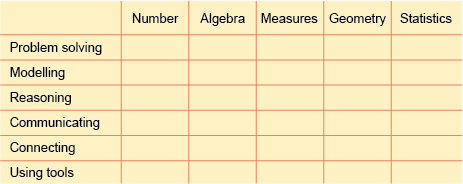
Activity 8 Using a content/process matrix
What is your initial response to the matrix in Figure 1?
Think of a mathematics lesson. What was the content of that lesson? Can you identify any mathematical processes that the learners used during the lesson (you will need to look again at the Appendix: processes uncovered to remind yourself of the detail of these processes)?
Comment
Some teachers (and learners) find it difficult to identify mathematical processes, particularly modelling and connecting. This course is designed to help you become aware of a range of mathematical processes and to consider how they can be used to encourage learning.
It may help you to look back at the Appendix when you are working on later activities in this course. Try to be aware of the mathematical processes you are using as well as the more obvious areas of mathematical content involved.
Activity 9 Reading
Read the short story Appendix: Paul Bunyan versus the conveyor belt (Upson, 1964). While you are reading, note down your reactions to it.
Comment
The article shows a clear link between mathematics and the procedure of solving an everyday problem. But it is this link between school mathematics and everyday life that many learners find problematic. Articles like this one can be a useful catalyst for motivating learners and encouraging classroom discussion and investigation.
When you were reading the article you might have also been aware of how you could use it with your learners. If you felt it inappropriate to read the article in full to your learners you could summarise the story. Using articles and stories in this way can provide useful examples of the links between everyday life and mathematics.
Activity 10 Process
Look back at the article and work out what processes Bunyan used when working on the conveyor belt problem. List them in your notebook; you will need these later.
So far you have read an article – that is, you have done something. You have also recorded some notes about what you read. You may also have talked to yourself or with a colleague in order to understand the article more clearly. As you will see in the final section of this course, these three elements form a useful framework for helping you to think about learner learning. It will be referred to as the DTR triad.
3.1 The Möbius band
Simply reading words on a page does not mean that you have necessarily engaged with the mathematical ideas or done any mathematical thinking. In order to help you work on the ideas in a ‘hands-on’ way, you are asked to model the conveyor belt problem using a physical model.
Activity 11 The Möbius band
Take a long thin strip of paper (preferably squared or graph paper) about 30 cm by 3 cm. Give one end a half twist and then tape it together. This is a Möbius band as shown in Figure 2.

Check that the Möbius band has just one face by using a pencil to mark down the centre of the strip – it meets up with itself!
Look at the band and imagine cutting down the middle of it, along the pencil line. Can you see what is going to happen? Make the cut.
Repeat this process for a second cut down the (new) centre of the strip.
Comment
Since you have already read the article, it may have been obvious to you what would happen. But many adults and children actually need to see it happen in order to believe it. After the first cut, you should have a band that was twice as long as the original and half the width. The second cut produces two connected bands of the same length but half the width – a less obvious result.
A useful general strategy for stimulating pupils’ curiosity and channelling the energy that results is to invite them to pose ‘what if?’ questions. As an illustration, when you worked on the Möbius band in Activity 11, some suggestions were provided in these activities for things to try. A more open-ended (and in many ways more satisfactory) version of this activity would be to ask you to pose a series of ‘what if…’ questions for yourself. For example, what if I used two half twists/three half twists, and so on. Would you have welcomed more openness in this activity? For example, were you simply following the instructions or did you start to feel that there was evidence of a ‘what if?’ energy taking hold within you? If this is the sort of energy that you wish to encourage in your classroom, it is worth considering how it might be fostered?
You have now tried out the basic idea of a Möbius strip but it can be expanded further and this involves more cutting and sticking (doing), and more talking and recording … but not always in that order.
The Möbius band was discovered, in the nineteenth century, by the German mathematician and astronomer Augustus Ferdinand Möbius (1790–1868). The Möbius band is a standard problem type in an area of mathematics called topology – a branch of geometry concerned with the properties of a figure that remain unaffected when a shape is distorted in some way (perhaps when stretched or knotted). Topology has applications in contexts that involve surfaces and this includes crystallography, biochemistry (for example, in work with DNA), and electronics.
As you work on the activity, make notes about how you work on it and the discoveries you make. Note down any predictions or conjectures you make and remember to record your findings. Also think about the processes you have used and how you might present the activity to someone else.
Activity 12 Return of the Möbius band
Make some more Möbius bands but this time make one with two half twists, one with three half twists and one with four half twists. It is a good idea to label them at this stage or perhaps use strips of different colour.
Note down how many faces each band has and then cut each one down the centre line.
Before you cut, remember to predict what you think will happen.
While you work on the activity, explain to yourself or to someone else what you are doing and what you are thinking.
Record your predictions and results.
How did you feel when you were doing this activity? Both adults and children often report being very excited by the results but also pretty baffled. It is sometimes difficult to see what is happening with some mathematical problems, and even trickier to predict what is going to happen. Many people record their findings and conjectures in a fairly haphazard way but even so they can usually retrace what they did. When working on an investigation it is common for people to make jottings rather than organised notes. The advantage of this form of note taking is that it does not slow down the investigation.
However, if you wanted to explain your findings to someone else you might reorganise your notes in a way that someone else could follow. Too often, learners can get caught up with the presentation of the work rather than the exploration of the mathematics. This can result in a loss of creativity and of a sense of purpose and enjoyment. It also is easier for some learners to explain their findings verbally rather than having to write them down, while others find it easier to do annotated drawings.
Activity 13 Recording
Look back at the way you recorded your findings. Was it ordered, apparently haphazard, neat and tidy? What was the purpose of your recording?
Comment
The purpose of your recording was at least threefold. The first was that you had been asked to do it and this recording could form part of a TMA. The second was that recording may have helped you to keep track of what you were doing. The third possibility is that the notes you made, and the way you recorded them, may have helped refine your predictions and conjectures.
As a teacher it is important not only to reflect on why you are offering a particular activity to learners but also how you are asking them to record their findings. The content/process matrix may help you do this.
Activity 14 Content and process
Look back at the content/process matrix (Figure 1). If you were using the Möbius band activity with learners, which cells do you think you could fill in? You may find the list of mathematical processes useful. You may also wish to refer to the list of processes you identified in Activity 10.
Now try the Möbius band activity with someone else; it does not have to be a learner. Watch what the person does when they are working on the activity and ask them to explain their thinking as they work. Pay particular attention to the process skills that they draw on.
Look back at the matrix and see if you can fill in any more of the cells.
Comment
The processes involved in working on the Möbius band included problem solving, modelling, reasoning, communicating, connecting and using tools. It is a rich mathematical activity because it involves a variety of processes.
When you consider using an activity with learners it may help you to consider whether it has a limited number of purposes or it could be used in a wide variety of ways. An activity that has a variety of purposes was described by Ahmed (1987) as a ‘rich mathematical activity’ being one which:
- must be accessible to everyone at the start;
- needs to allow further challenges and be extendible;
- should invite children to make decisions;
- should involve children in speculating, hypothesis making and testing, proving or explaining, reflecting, interpreting;
- should not restrict learners from searching in other directions;
- should promote discussion and communication;
- should encourage originality/invention;
- should encourage ‘what if’ and ‘what if not’ questions;
- should have an element of surprise;
- should be enjoyable.
(Ahmed, 1987, p. 20)
You may find this to be a useful checklist when you are considering using a new activity with learners. The Möbius strip activity can be used in a way that fulfils many of these criteria. You are now asked to explore the second criterion in Ahmed’s list by extending the initial activity and making it more challenging.
Activity 15 Stretching the Möbius band
- Before reading on, think about how the Möbius band activity might be extended.
- Look at your results so far from Activities 11 and 12. Construct a table similar to Table 1 in which you can put your results from Activities 11 and 12. Using these results, can you predict what will happen with five half twists, and so on?
| Number of half twists | Expected result | Actual result |
|---|---|---|
| 0 | 2 strips, same length as original, half the width | |
| 1 | 1 strip, twice the length of original, half the width | |
| 2 | 2 linked strips, same length as original, half the width | |
| 3 | 1 strip, twice the length of original, half the width | |
| 4 | 2 linked strips, same length as original, half the width |
Comment
- One possible extension of the Möbius band is to consider what might happen with five half twists, ten half twists, 37 half twists? However, there are clearly problems that might emerge in continuing to do this as a practical activity.
- You need to be able to predict what will happen rather than continuing to make and cut the bands. In general, setting out results in the form of a table is a useful way of investigating patterns in your results.
The layout of the table can sometimes help you to see the pattern, or the general case. From the comments on this table it looks like the strips with an odd number of twists behave in a different way from those with an even number.
Activity 16 The revenge of the Möbius band
By using your own ‘what if…?’ question, can you think of another extension of the Möbius band activity?
Comment
Another extension of the Möbius band activity might be to ask what might happen if you make the cut along a different parallel other than down the middle of the strip. Alternatively, you could investigate what happens when you make the cut one-third of the way along each band.
Before you make each cut, take time to predict what will happen. Make your conjecture and record it. Also record any surprises or questions that you have.
Can you predict what will happen with ten half twists or 37 half twists?
While you were working on these activities, you were asked to do some activity, talk about it and record your conjectures and findings. This triad of DTR is a useful device for seeing what is going on in mathematics classrooms and is the subject of the final section of this course.
4 Do–talk–record triad
The DTR triad is a description of what is likely to take place in collaborative mathematics classrooms. It is concerned with observable events, and with the learner rather than the teacher, though many teaching insights flow from it. Although the order of the triad suggests that it should be followed in a particular sequence, this is not necessarily the case. Sometimes talking comes before doing or recording before talking. It also takes time for a learner to move from doing and talking to recording and back to doing again. At each stage the learner needs time to think and reflect on their work and results.
In a classroom where DTR is in use, you are likely to see learners who are prepared:
- to think for themselves
- not to be afraid to communicate their thinking for fear it may be wrong
- to accept that wrong answers can be helpful
- to listen to their peers for comments in their own words
- to question their peers’ ideas asking for justification, examples, or proof.
In the classroom, teaching with an emphasis on DTR would look like the framework in Figure 3.
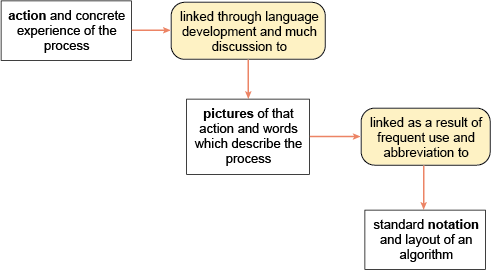
This framework links with ideas of going from the concrete to the abstract, and with notions of the importance of practical, kinaesthetic, or enactive experience on which to build understanding. It emphasises too the importance of language in learning, both the learners’ own language and the language of mathematics.
The ideas implicit in this DTR framework are set out in Table 2.
| Form of activity | Learners should … | |
|---|---|---|
| Do | Action and concrete experience in multiple embodiments | … work with particular examples of a more general idea. |
| Talk | Language patterns injected, explored, listened to, developed | … talk about their work with these particular examples in their own terms. |
| Record | Stories written in pictures and words, successive ‘short-handing’, ultimately leading to standard notations | … be encouraged to make their own written record of such activities. Initial records might well be in the form of pictures or words. |
In many mathematics classrooms, it is common for doing and recording to take priority over talking. But it is the act of verbalising a problem that can often be of most help. Teachers can help with this verbalisation by the use of prompts such as the following:
- Explain the question to me.
- What do you know?
- What are you trying to find out?
- What have you done so far?
Often it is the act of verbalisation and the hearing of the words that provides a key to moving forward. It may be the case that hearing the words in your head is not enough, in which case say them out loud, even if you are not talking to anyone.
You have worked on the Möbius band problems yourself so now it is time to work with learners. The way you approached the activity may be different from that of your learners. Remember to note down any differences or similarities.
Activity 17 The Möbius band meets the learners
- Think about how you might introduce the Möbius band to a group of learners. What would you like the learners to do in terms of doing, talking and recording? Think about what you hope the learners will get out of working on this activity?
- Try out your ideas by introducing the Möbius band to a group of learners. Look for evidence of the learners doing, talking and recording.
Before you proceed further think about the activity you have just completed, the mathematics involved, and the strategies you used. Were you surprised by some of the results? Jot down any further reflections in your notebook.
Conclusion
In this course you have thought about the difference between mathematical content and processes. Finally, you have worked on the DTR framework.
Appendix: processes uncovered
The following listing provides possible components for the six processes (Source: Begg, 1994, pp. 183–92).
Problem solving (including investigating)
(i) plan
| (ii) strategies
|
Mathematical modelling
(i) general
| (ii) translating
|
Reasoning
(i) classification and description
| (iv) proving
|
Communicating
(i) personal
| (iv) reading and writing
|
Making connections
(i) within mathematics
| (iii) everyday life
|
Using tools
(i) instruments
| (iii) computers
|
Appendix: Paul Bunyan versus the conveyor belt
Here’s a story about the legendary Paul Bunyan that shows how the Möbius strip has some ‘practical’ applications.
Paul Bunyan versus the Conveyor Belt
by William Hazlett Upson
One of Paul Bunyan’s most brilliant successes came about not because of brilliant thinking, but because of Paul’s caution and carefulness. This was the famous affair of the conveyor belt.
Paul and his mechanic, Ford Fordsen, had started to work a uranium mine in Colorado. The ore was brought out on an endless belt which ran half a mile going into the mine and another half mile coming out – giving it a total length of one mile. It was four feet wide. It ran on a series of rollers, and was driven by a pulley mounted on the transmission of Paul’s big blue truck ‘Babe’. The manufacturers of the belt had made it all in one piece, without any splice or lacing, and they had put a half-twist in the return part so that the wear would be the same on both sides.
After several months’ operation, the mine gallery had become twice as long, but the amount of material coming out was less. Paul decided he needed a belt twice as long and half as wide. He told Ford Fordsen to take his chain saw and cut the belt in two lengthwise.
‘That will give us two belts,’ said Ford Fordsen. ‘We’ll have to cut them in two crosswise and splice them together. That means I’ll have to go to town and buy the materials for two splices.’
‘No,’ said Paul. ‘This belt has a half-twist – which makes it what is known in geometry as a Möbius strip.’
‘What difference does that make?’ asked Ford Fordsen.
‘A Möbius strip,’ said Paul Bunyan, ‘has only one side, and one edge, and if we cut it in two lengthwise, it will still be in one piece. We’ll have one belt twice as long and half as wide.’
‘How can you cut something in two and have it still in one piece?’ asked Ford Fordsen.
Paul was modest. He was never opinionated. ‘Let’s try this thing out,’ he said.
They went into Paul’s office. Paul took a strip of gummed paper about two inches wide and a yard long. He laid it on his desk with the gummed side up. He lifted the two ends and brought them together in front of him with the gummed sides down. Then he turned one of the ends over, licked it, slid it under the other end, and stuck the two gummed sides together. He had made himself an endless paper belt with a half-twist in it just like the big belt on the conveyor.
‘This,’ said Paul, ‘is a Möbius strip. It will perform just the way I said – I hope.’
Paul took a pair of scissors, dug the point in the centre of the paper and cut the paper strip in two lengthwise. And when he had finished – sure enough – he had one strip twice as long, half as wide, and with a double twist in it.
Ford Fordsen was convinced. He went out and started cutting the big belt in two. And, at this point, a man called Loud Mouth Johnson arrived to see how Paul’s enterprise was coming along, and to offer any destructive criticism that might occur to him. Loud Mouth Johnson, being Public Blow-Hard Number One, found plenty to find fault with.
‘If you cut that belt in two lengthwise, you will end up with two belts, each the same length as the original belt, but only half as wide.’
‘No,’ said Ford Fordsen, ‘this is a very special belt known as a Möbius strip. If I cut it in two lengthwise, I will end up with one belt twice as long and half as wide.’
‘Want to bet?’ said Loud Mouth Johnson. ‘Sure,’ said Ford Fordsen.
They bet a thousand dollars. And, of course, Ford Fordsen won. Loud Mouth Johnson was so astounded that he slunk off and stayed away for six months. When he finally came back he found Paul Bunyan just starting to cut the belt in two lengthwise for the second time.
‘What’s the idea?’ asked Loud Mouth Johnson.
Paul Bunyan said, ‘The tunnel has progressed much farther and the material coming out is not as bulky as it was. So I am lengthening the belt again and making it narrower.’
‘Where is Ford Fordsen?’
Paul Bunyan said, ‘I have sent him to town to get some materials to splice the belt. When I get through cutting it in two lengthwise I will have two belts of the same length but only half the width of this one. So I will have to do some splicing.’
Loud Mouth Johnson could hardly believe his ears. Here was a chance to get his thousand dollars back and show up Paul Bunyan as a boob besides. ‘Listen,’ said Loud Mouth Johnson, ‘when you get through you will have only one belt twice as long and half as wide.’
‘Want to bet?’
‘Sure.’
So they bet a thousand dollars and, of course, Loud Mouth Johnson lost again. It wasn’t so much that Paul Bunyan was brilliant. It was just that he was methodical. He had tried it out with that strip of gummed paper, and he knew that the second time you slice a Möbius strip you get two pieces – linked together like an old fashioned watch chain.
© Hazlett W. Upson (1960) ‘Paul Bunyan versus the conveyor belt’, John Murray Publishers
References
Acknowledgements
This course was written by Barbara Allen and Alan Graham.
Except for third party materials and otherwise stated (see terms and conditions), this content is made available under a Creative Commons Attribution-NonCommercial-ShareAlike 4.0 Licence.
The material acknowledged below is Proprietary and used under licence (not subject to Creative Commons Licence). Grateful acknowledgement is made to the following sources for permission to reproduce material in this course:
Course image: Rob Deutscher in Flickr made available under Creative Commons Attribution 2.0 Licence.
Extract from Upson, W.H. (1960) ‘Bunyan Versus the conveyor belt’, John Murray Publishers.
Every effort has been made to contact copyright owners. If any have been inadvertently overlooked, the publishers will be pleased to make the necessary arrangements at the first opportunity.
Don't miss out:
If reading this text has inspired you to learn more, you may be interested in joining the millions of people who discover our free learning resources and qualifications by visiting The Open University - www.open.edu/ openlearn/ free-courses