Discovering development management
Use 'Print preview' to check the number of pages and printer settings.
Print functionality varies between browsers.
Printable page generated Tuesday, 19 May 2026, 11:53 AM
Discovering development management
Introduction
This free course, Discovering development management, features the phrase ‘good development management’. As you discover development management, you should all the time be making judgements about the ‘goodness’ – or otherwise – of the development management you encounter. ‘Good’ can be judged from a number of perspectives, including ones that are:
- practical (How well does it work? Has it achieved what was intended?)
- political (Who gains? Who loses?)
- ethical (Is it right? Or wrong?).
I want you to ask, and find answers to, these sorts of questions about the ‘goodness’ of development management. This is because the ‘goodness’ – or otherwise – of development management matters. It matters, in some cases, in terms of life and death. But it matters always in terms of the wellbeing of those touched by it. So the questions are worth asking. And the quest to discover ‘good’ development management is one that is worth undertaking.
This OpenLearn course is an adapted extract from the Open University course T878 Capacities for managing development.
Learning outcomes
After studying this course, you should be able to:
write a working definition of development management
apply the complexity, emergence, difference (CoDE) framework to selected cases of development management
develop some initial judgements of ‘good’ development management.
1 Starting your exploration
Copestake and Williams (2014, p. 149) state that:
Development management is in reality less a form of intervention than a process of interaction and discovery.
What they are suggesting here is that development management cannot be confined within the boundaries of a particular defined intervention, such as a development project or programme. Much of development is designed and delivered in the form of projects and programmes, so Copestake and Williams are presenting a significant challenge to the orthodoxy of development and development.
They are also suggesting that what development management does, or gives rise to, cannot be known in advance: it will emerge, and be discovered, through the interactions between all those who are involved in the process. This again constitutes something of a significant challenge to the way development management is understood and undertaken. Typically, there is an emphasis on planning: indeed, more forcefully, a requirement to be clear about what will happen over the lifetime of a project or programme, what it will ‘deliver’. In this course I want you to go beyond this ‘typical’ understanding of development management and see it precisely as what Copestake and Williams say it is: ‘a process of interaction and discovery’.
You will gather that I’m ‘with’ Copestake and Williams. However, I think they would have done better to have said:
Development management can be seen both as a form of intervention and as a process of interaction and discovery.
Development management has emerged and is practised around the idea of ‘intervention’: what development managers do is ‘intervene’. It makes sense to acknowledge and work with that understanding.
In making reference to ‘interaction and discovery’ Copestake and Williams open up development management, suggesting we should not simply accept the terms in which development management typically presents itself.
In this process of interaction and discovery, capacities that are essential for anyone interested and engaged in development management include:
- the capacity to see development management for what it is, in its myriad forms and its messiness
- the capacity to formulate judgements about development management, and in particular judgements about what might make ‘good’ development management
- the capacity to communicate judgements.
2 Opening up development management
In his 1996 paper, ‘What is development management?’ Alan Thomas was concerned to establish whether or not there is a distinctive field that can be labelled ‘development management’. To achieve this he looked at the two terms – ‘development’ and ‘management’ – and subjected them to critical scrutiny.
In particular, he asked what if anything was distinctive about what he called ‘development tasks’ that might require a type of management that was different from ‘conventional’ management, which he (somewhat crudely) characterised as being based on ‘the simple idea of getting the work [of an organisation] done by the best means available’ (p. 101). The extract reviewed in Activity 1 is where his thinking took him.
Activity 1 Identifying development management
Read the following extract from ‘What is development management?’ (Thomas, 1996, pp. 101–3).
- a.Does Thomas’s account leave you feeling that development management does, indeed, exist as a distinct professional and academic field?
- b.What would you remove from his account? What would you add?
- c.How does it relate to the ways in which you may be ‘doing development’?
Discussion
What you have just read can quite justifiably be seen as the origin, the source, of our postgraduate development management qualifications. In a little over 1000 words, Thomas presents what has emerged, and still holds good, I judge, as a statement of the orthodoxy of development management as a professional and academic field.
From his scrutiny of the nature of ‘development tasks’, and how they need to be undertaken, Thomas suggested that development management might be characterised in these terms:
the management of deliberate efforts at progress on the part of one of a number of agencies, the management of intervention in the process of social change in the context of conflicts of goals, values and interests … a process or an activity that can take place anywhere, not just in developing countries.
3 A conceptual framework
Thomas’s definition of development management as ‘the management of intervention in the process of social change in the context of conflicts of goals, values and interests’ (1996, p. 106) can be used as a conceptual framework for exploring development management in ways that certainly include (but are not restricted to) those undertaken by ‘managers’ in development agencies.
By ‘conceptual framework’, I mean a set of concepts that can be connected with each other, and that make it possible to look at something – in this case, development management – in a disciplined and powerful fashion. Here the concepts that need to be brought into play are:
- intervention
- process of social change
- conflicts of goals, values and interests.
However, I also recognise that there is nothing simple about this development management. We need to find a way of looking at it that recognises this; a way that enables us to discover the richness of development management, whoever is undertaking it. With this in mind, I am proposing three more concepts that I judge point to key qualities of the process of development management. These three concepts are:
- complexity
- difference
- emergence.
Each of these concepts on its own can tell us something about the nature of development management. What does each of them point us to? To start with, I would suggest the following.
Complexity
This quality is rooted – as, in fact, are ‘difference’ and ‘emergence’ – in the reality that any development management intervention involves many interested parties (some of whom, but not all, may be development agencies and their staff), whose relationships make up a complex web. I think that we can see this complexity in terms of at least the following, each of which are connected and inter-connected:
- multiple interested parties (e.g. public, private, civil society; organisations, individuals)
- multiple fields (e.g. social, political, economic: employment, health, education, environment)
- multiple levels (e.g. local, national, global; micro, meso, macro).
Difference
This quality is rooted in the reality that all of the interested parties come with their own specific identities, arising out of – and contributing to – their own specific histories (within broader histories involving different mixes of interested parties). These differences include:
- interests
- values
- agendas
- cultures.
Another difference relates to power. I’ve set this apart from the other factors; this is partly to signal the significance of power in any process of development management (though that is not to devalue the other factors), but more to do with an understanding of power as a dimension of the relationships between the parties, rather than just a property (or possession) of any of the parties.
Emergence
This is rooted in the reality that development management emerges from the interactions between the interested parties, which constantly change the state of play in ways which can never be fully anticipated or predicted; and the reality that new parties might enter the process at any point in time, setting in motion new dynamics such as the following:
- uncertainty, which has to be lived with
- unintended consequences, which may be variously judged good or bad
- unevenness, which reflects the specificities of different contexts.
Complexity, difference, emergence (CoDE)
Each of the three concepts thus can, on its own, generate insights into development management. However, together, the concepts form a powerful ‘CoDE’ (Figure 1) through which we can break down some of the difficulty that is inevitably experienced in a quest to understand an ‘interesting’ and ‘unclear’ (Crewe and Axelby, 2013) phenomenon such as development management.
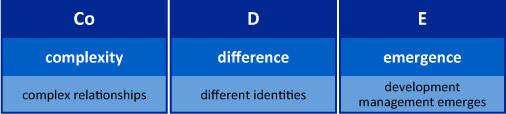
Connected with Thomas’s abstract definition, CoDE offers a rich conceptual framework for conducting a successful process of discovery. This conceptual framework will enable you both to identify (discover) development management you don’t know and to question the development management you do know.
4 Expect the unexpected
I was fascinated by the case in Activity 2 – not least by the various characters who feature in it, whom I spent some time investigating. There can be little doubt that this case, which refers to work in South Sudan in particular, presents an account of development management.
Activity 2 Questioning development management
Read ‘“Expect the unexpected”: starting successful partnerships in fragile states’ (George, 2014) using the conceptual framework presented in the previous section, with its six basic elements:
- intervention
- process of social change
- conflicts of goals, values and interests
- complexity
- difference
- emergence.
You will perhaps note that the heading, ‘Expect the unexpected’, directly brings into play the last of these features, emergence. I can assure you that all six features, not just emergence, are there to be discovered, as well as comments that might be taken as referring to good development management.
- Consider how exploring this account of development management by means of the conceptual framework affects your own understanding of development management.
- Identify anything you consider might make good development management.
This raises a number of opportunities for personal exploration. You could, for example, search to find out more about one or two of the interested parties, the individuals and their agencies. (They are all online.)
5 Promoting the values of development at all levels
In an article that was the starting point for the focus on good development management in this course, Thomas (1999) says:
The clearest examples of good development management will be those which use the enabling and empowerment mode of management to achieve development goals for the relatively powerless. However, the majority of cases will be more ambiguous, with value-based conflicts, contestation over the definition of development itself, and power struggles. Development management will often remain an ideal rather than a description of what takes place.
However, his argument is more sweeping, as the abstract of the article makes clear:
In a previous paper published in 1996, the author gave two views of development management. One was management in the context of development as historical change. The other was the management of deliberate efforts at progress, of development tasks. This paper adds a third: a style of management with a development orientation, that is, an orientation towards progressive change. It is argued that this third view allows for a normative definition of development management. Thus a distinctive notion of what is good development management is that it should consistently promote the values of development at all levels, even if this is not the most straightforward way of getting particular development tasks done successfully.
This ‘distinctive notion of what is good development management is that it should consistently promote the values of development at all levels’ is wonderfully open. Making sense of it will require you to be clear about your vision of ‘development’ and the meaning that you put on the term. And putting it into practice will require you to work with an adequate conceptual framework of development management, such as CoDE.
Conclusion
This free course, Discovering development management, began by defining ‘good’ development management as that which is judged to be practical, political and ethical. The course then went on to emphasise that development management should be thought of as about ‘interaction and discovery’ rather than intervention, and that development management is a process of social change involving conflicts of goals, values and interests. This led to a particular way to frame development management – a ‘CoDE’ – using the concepts of complexity, difference and emergence. This CoDE can be helpful in the generation of insights into development management processes.
Complexity recognises that in development management there are often mutiple and interacting parties (e.g. public, private, individuals, groups), fields (e.g. social, political, health, environment) and levels (e.g. local, national, global).
Difference refers to interested parties coming to development management with their own histories that diverge on the basis of their interests, values, agendas, cultures and access to power.
Emergence refers to the way development management emerges from interactions between interested parties in often unpredictable, uncertain and uneven ways, which can lead to unintended consequences. As a result, development managers need to expect the unexpected!
This short course has aimed to show that development management is important, challenging and exciting work. If it has piqued your interest in studying development management in greater detail, you may like to study T878 Capacities for managing development or other related courses and qualifications offered by The Open University.
References
Acknowledgements
This free course was written by Richard Pinder.
Except for third party materials and otherwise stated (see terms and conditions), this content is made available under a Creative Commons Attribution-NonCommercial-ShareAlike 4.0 Licence.
The material acknowledged below is Proprietary and used under licence (not subject to Creative Commons Licence). Grateful acknowledgement is made to the following sources for permission to reproduce material in this free course:
Text
Activity 1: extract (pp. 101–3) from Thomas, A. (1996) ‘What is development management?’, Journal of International Development, vol. 8, no. 1, pp. 95–110, John Wiley & Sons, Inc.
Activity 2: George, S. (2014) ‘“Expect the unexpected”: starting successful partnerships in fragile states’, Guardian, 2 October.
Images
Course image: courtesy Kerstin Danert
Figure 2: Paula Bronstein/Getty Images
Figure 3: Getty Images
Every effort has been made to contact copyright owners. If any have been inadvertently overlooked, the publishers will be pleased to make the necessary arrangements at the first opportunity.
Don't miss out
If reading this text has inspired you to learn more, you may be interested in joining the millions of people who discover our free learning resources and qualifications by visiting The Open University – www.open.edu/ openlearn/ free-courses.