Managing virtual project teams
Use 'Print preview' to check the number of pages and printer settings.
Print functionality varies between browsers.
Printable page generated Wednesday, 1 April 2026, 4:53 PM
Managing virtual project teams
Introduction
There are important differences between projects and operations, and managing and leading people within projects is different from managing and leading people within operations.
The project manager uses communication skills to provide leadership, and needs to understand the dynamics of team development to resolve conflict within the team. The manager cannot micromanage the project and so must delegate effectively. The manager must also master negotiation and influencing skills to maintain the commitment of all the stakeholders in the project. (APM, 2012).
The project manager might be in a position to create or change a team structure to suit the needs of the project, but the possibility of doing so in itself depends on the constraints imposed by the organisation running the project or by the client who has commissioned the project. Another major factor in how the project team works together is whether they are collocated or not. Virtual teams are increasingly common, where either some or all of the team members are at a distance geographically or, even if some are collocated, there may be variations in working times, so that the work on the project can proceed in different times and at different places.
This free course, Managing virtual project teams, considers how project teams should be established and then considers the techniques needed to manage teams that are not collocated.
This OpenLearn course is an extract from the Open University course M815 Project Management. You might also be interested in the OpenLearn course Project governance and Project Management Office (PMO), which looks at the roles and responsibilities in effective project governance and how this can be supported by a project management office.
Learning outcomes
After studying this course, you should be able to:
consider the types of skills needed within a project team and the implications for writing a person specification
be aware of social and task behaviours that can support an effective team
understand a responsibility assignment matrix
identify the difference in awareness between team members in a collocated team and between team members in a virtual team
be aware of the approaches and techniques needed for a virtual team to be successful.
1 Building the team
The project manager may be able to select some or all of the members of the team, or at least influence and negotiate with those who do provide the human resources for the project (managing up and across) to secure the personnel identified by the project manager as most suitable.
Motivation and commitment to the project can be strengthened by creating a feeling of ownership of the project and its tasks by team members, and this sense of ownership can be enhanced by involving all team members in planning and, in particular, in human resource planning. In addition, it is a good use of the expertise of the group to involve everyone in the role and task assignment process. This is an example of participatory management.
1.1 Technical skills
The team must have members who, together, have the skills to complete the project. The necessary team roles should be evident from analysis of the project definition documentation, for example in a work breakdown structure. Understanding of the work tasks to be completed will be the basis for assigning responsibilities according to competencies. The elements of the tasks can be mapped to project participant roles using a responsibility matrix, also known as a linear assignment matrix. Thus, given the work that needs to be done and the roles that need to be performed to do it, the most suitable individuals to perform those roles can be selected.
1.2 Responsibility assignment matrix
The work of a project needs to be divided and allocated to people, and there needs to be a comprehensive and unambiguous understanding by everyone concerned of their own roles and responsibilities and of the roles and responsibilities of the others. One tool that can be used to first arrive at and then document roles and responsibilities is a responsibility assignment matrix (RAM), of which there are different types. The RAM is a grid, where the work that has to be done is listed in the left-hand column, with participant roles (performed by team members or groups) listed in the first row.
The cells of the grid that are intersections of the first column and first row are used, at different levels of detail, to show a connection between the work and the team member or team group. This connection is a type of participation by the person or organisational unit for an element of work in the project. In this way, all the people connected to each element of work and all the work connected to each person are displayed in one place.
For larger projects, the elements of work can be considered at different levels of detail, in different matrices for the same project. These different matrices would show the responsibilities at different levels of decomposition of the project tasks, from deliverables to specific sub-tasks.
One popular type of RAM is a RACI (responsible, accountable, consulted and informed) chart. Here the participation types are subdivided to show the following for each task:
- Who is responsible (R): the people who carry out the task
- Who is accountable (A): the single person who is answerable for the correct completion of the task
- Who is consulted (C): the people who need to be consulted in the carrying out of the task, who have a say in how it is carried out or who are expert in the subject area
- Who is informed (I): the people who need to be informed about the task and its progress.
| RACI chart | Person | ||||
|---|---|---|---|---|---|
| Activity | Ann | Ben | Carlos | Dina | Ed |
| Create charter | A | R | I | I | I |
| Collect requirements | I | A | R | C | C |
| Submit change request | I | A | R | R | C |
| Develop test plan | A | C | I | I | R |
| R = responsible A = accountable C = consult I = inform | |||||
The RACI matrix is useful in different respects, for example:
- It is a tool that can be used in team selection where the participant roles are known but not the specific people who will perform them. It can be used to fit skills to tasks and balance workload.
- It can be used as a basis for gap analysis to highlight project needs that are not met by the skill sets of existing team members and so to identify recruitment or training requirements.
- It encourages and assists the delegation of work.
- It shows all the interested parties the division of labour within tasks and projects as a whole and the unambiguous ownership of tasks.
- It encourages communication between those with the different participant roles by setting up the expectations of the nature of communication and who is to be involved in communications.
- It can be used as a starting point to consider the lines of communication and suitable methods of communication, including reporting.
- It can be used by the project manager as a tool for monitoring project work.
- It can feed into other formats for documenting team members’ roles and responsibilities, such as detailed textual role descriptions.
There are many variants to the RACI matrix that use the same acronym with different participation functions or introduce additional types of participation beyond the four characters of RACI. For example, in a RASCI matrix the participation function ‘Support’ is added. Those designated as ‘S’ assist the ‘R’s in their work. The different participant functions imply different aspects of the person management role of the project manager. As well as identifying which role is required to meet the needs of each element of the WBS, and thereby playing a part in team selection, the project manager needs to ensure that the ‘I’s are informed, the ‘C’s consulted and so on.
Activity 1
Why is it important that all participants know which type of RACI matrix is being used?
Discussion
The RACI is part of the shared language of communication of the project. If there is not a common understanding of its meaning, responsibilities and divisions of labour will also not be understood and any ambiguity can easily lead to serious problems. For example, if team colleagues are not doing what other team members think they are meant to be doing the atmosphere of trust that is needed in an effective team can be lost.
1.3 Group working functions
The skills the project manager needs to consider in the team members are not just the required technical ones, but also the ability to carry out functions supporting group working and the team itself. This (1974) described these team and group working support functions as task and maintenance functions. People usually take on a number of roles during the life of a team and these can be placed under these task and maintenance headings, both of which are necessary for the team to achieve what it sets out to do. Task functions help to get the job done and will have an influence upon product quality by doing such things as initiating action, seeking information and opinions, clarifying and summarising. Maintenance functions hold the team together and keep good relations going between its members by such activities as encouraging, harmonising and setting standards.
Levi (2007) argues that, to function effectively, groups perform two basic types of behaviours: task and social behaviours, with the latter focusing on the social and emotional needs of group members. He cites the work of Benne and Sheets (1948) in a table of types of group behaviours.
| Behaviour | Function |
|---|---|
| Task behaviours | |
| Initiator/contributor | Proposes new ideas or new ways for the group to act |
| Information giver | Provides data and facts for decision making |
| Information seeker | Requests more information to help in making decisions |
| Opinion giver | Provides opinions, values and feelings |
| Opinion seeker | Requests the opinions of others in making decisions |
| Coordinator | Shows relationships of ideas to organise the discussion |
| Energiser | Stimulates the group to continue working |
| Evaluator/critic | Questions the group’s ideas and procedures |
| Social behaviours | |
| Encourager | Supports and rewards others |
| Harmoniser | Mediates conflicts among members |
| Compromiser | Shifts their position in order to reduce conflict |
| Expediter | Facilitates communications from others |
| Standard setter | Evaluates the quality of the group’s interactions |
| Follower | Accepts ideas of others |
| Group process observer | Observes and comments on the group’s processes |
1.4 Interpersonal skills
Interpersonal skills include:
- communication skills
- emotional intelligence
- conflict resolution
- negotiation
- influence.
‘Soft skills’, such as these, are important attributes of a project manager but, in turn, the project manager will also look for a mix of interpersonal skills in prospective team members with a view to influencing the group dynamics of the team.
1.5 Person specification
To assemble a team with the right work skills and the optimum personality mix, the project manager can draw up specifications for the people required for the team. Even where the project manager has little direct involvement in team selection, the act of drawing up a specification at least gives a clear picture of the discrepancies between the ideal person and the individual who will actually fill the post. A person specification should contain requirements relating to areas such as:
- educational and professional qualifications and licences
- relevant experience
- communication and numeracy
- personal characteristics, e.g. physical characteristics if they are required for the job
- willingness to travel
- team-building or administrative skills.
Job descriptions and person specifications can be used for job advertisements, interviews and any other recruitment and selection procedures that might be used (for example, psychometric testing).
Activity 2
Where the project manager has had little or no involvement in the selection of the team, what considerations or actions might be needed?
Discussion
- Find out why each person was selected.
- Meet separately with each team member and find out what their aspirations are.
- Ask the sponsor or senior management for extra staff on the project if there is some key skill missing and funds for training to raise skill levels where these are weak.
- Look for any member of the team who may be more destructive than constructive (for example, someone who is unduly aggressive with others); if any are found, talk privately and constructively to the person involved about the problem.
- Try to get the team to set the detailed objectives, plans or schedules collectively (their ownership of what they are going to do is important).
- Try to find a quick win for the team (e.g. an extra person, more resources, extra time) to gain the team’s confidence and establish a position of leadership.
- Use all the team-building skills and techniques possible.
- Evaluate the gap between the team they have been given and the ideal team (which would be fully capable of all the required project tasks and roles); determine how to manage these gaps.
Virtual team selection
When selecting members for virtual teams there is a tendency to select computer-literate individuals and those who are comfortable sharing information electronically. However, as we have seen, functional and team roles are also important, so that selecting team members with other skills is required for project success. It is clearly important to select team members to create a balanced team and training needs to be provided to improve team members’ skills. In fact, Kirkman et al. (2002) suggest that interpersonal skills may be more important in a virtual team because electronic communication is not as rich as face-to-face interactions.
2 Managing virtual teams
The ability to work together at a distance makes it possible to carry out some projects that could not otherwise be carried out, and to involve some team members who could not otherwise have been involved. It could be argued that in the present day nearly all teams are, to some extent, virtual teams. Virtual project team work has the potential to provide great benefits and opportunities. There are, however, also disadvantages and challenges that need to be addressed. The study of the difficulties of collaboration at a distance involves the comparison of such work with collaboration that takes place between team members physically located in the same space, or nearby, and present for at least some of the same working time, known as collocated working. Thus as we learn more about working at a distance, we are also gaining insights that apply to working in the same place and that can inform the management of collocated projects.
An important theme of research into the difficulties presented by distance working can be summed up by the word ‘understanding’. A key role of the project manager is to promote understanding amongst team members, and in a virtual team this becomes harder to achieve. A level of mutual understanding is necessary to allow effective collaboration to take place and the project to progress. Mutual understanding can be fostered by the use of suitable collaboration and communication tools, and therefore the evaluation and choice of the most appropriate available tools is an important activity for the virtual project team manager. To allow evaluation and choice of tools, a project manager needs to be familiar with the array of tools currently available and has to keep abreast of a fast-changing area of technology. The project manager also needs to be aware of the problems and challenges of working at a distance, and an appreciation of some of the theory of understanding in teams can assist in making the right choices.
2.1 Awareness
Project team members need to gain awareness of each other: to know what each has done, is doing and is going to do, and have an understanding of the current status of the work that they share.
A person working alone on a task has ‘situation awareness’ of the task. For example, a person working on a document is aware of what it is they are writing, what its purpose is, what form it should finally take, the place they are within it, when it needs to be completed and whether that timescale can be achieved. They are aware of the tools they are using and their physical environment, the workspace. They are also aware of their own level of commitment to the overall task, and have a sense of their own capability to carry out the task successfully. These different aspects of awareness allow the author to make decisions about what needs to be done next, enabling the task to proceed.
Awareness in collocated team working
When people work together on a task, another dimension is added. The collaboration itself is a task, and each person’s share of the work is to some extent dependent on the work of others. So, the individual situation awareness has to grow to include both the original task and the collaboration, and becomes a shared situation awareness.
Collaborators who are collocated are likely to have a natural awareness of each other, each other’s work and the workspace where the task and the team are located. Such awareness, or shared understanding, is achieved by conscious and unconscious observation, by verbal communication and by non-verbal cues. The resultant understanding of who is present and what they are doing provides the context for each participant’s own activity. This context is used to evaluate individual actions against group goals and allows the management of collaborative work (Dourish and Bellotti, 1992).
In addition, familiarity engendered by awareness can make possible the creation of mutual confidence, trust and group identity. In the same way that self-awareness provides an individual with an understanding of their own commitment, mood and capability, shared awareness provides the same awareness of their team colleagues.
Awareness in remote team working
Where collaboration takes place at a distance, the different aspects of awareness discussed above become problematic. The ability of the participants to obtain the information they need is limited by their distance and the capabilities of their means of communication. It therefore becomes necessary to decide what information to make available and how to present that information to allow collaborators the awareness that they need. In doing this the need for awareness needs to be balanced with the need for a level of privacy for each individual. One way of allowing for this level of privacy (which is likely to differ from individual to individual) is to allow users some control over the amount of information about themselves that is made available to others.
Awareness of the workspace is not confined to the current context of work, where the workspace is the meeting itself and any shared artefact, such as a whiteboard, that is used in that meeting. Collaborators need to make use of existing knowledge and information to carry out their work. They also often need to preserve the knowledge and information that they generate to lead to more knowledge and information and completion of work. To do this they must share a persistent workspace, a knowledge repository, which may be a directory of files that holds the work to date and data that supports that work, possibly held in databases. A knowledge repository is part of the ‘organisational memory’ of the group, and the management of that memory requires a recording and archiving of work, data, knowledge and experience to allow the development of a project over time. Team members must have a shared awareness of the knowledge repositories they intend to use, and a common understanding of the meaning of the stored data and the relationships that participants have with parts of that data. For instance, they might need to know who generated it, who can change it, who is working on it, and who has access to it.
An example of the problem of lack of awareness can be found in the ownership of a shared resource, such as a wiki. Does the fact that people work together on a document mean that they all have equal ownership of that document and can do what they like with it, such as change it? Or are there levels of ownership, with some people having read-only access and others having write-access, for example, and how does everyone know what these ownership rules are? This example relates to the self-confidence of team members and their perception of their own influence and importance within the project. The project manager can influence effective teamwork by being conscious of levels of awareness and of the ways that team members perceive their position and, where necessary, bolster their perceptions or provide missing information.
2.2 Social presence and information richness
Two related factors that affect the levels of awareness in collaboration are social presence and information richness.
Social presence is the degree to which an approach to communication helps people feel a personal connection with others (Wilson and Edward, 2004). The more social presence that exists in team communications in general, the more the personal relationships between team members can develop. A face-to-face meeting has a high level of social presence, and email usually much less. Synchronous communications tend to have more social presence than asynchronous ones (Duarte and Snyder, 2006). A large element of social presence lies in the immediacy, warmth and spontaneity of communication: the back-and-forth exchanges of normal conversation. Thus an email exchange where two team members are both online at the same time and send messages to and fro might have more social presence than a single asynchronous exchange. In the synchronous email exchange, both team members have the feeling that the other is really there. The usefulness of social presence depends on what a group or individual is trying to achieve at any particular time. Sometimes it can be better to have less social presence. For example, interpersonal connection, while being useful for some aspects of team work, such as the building of trust, might be time consuming and interfere with tasks which require clear and sustained concentration such as analytical tasks .
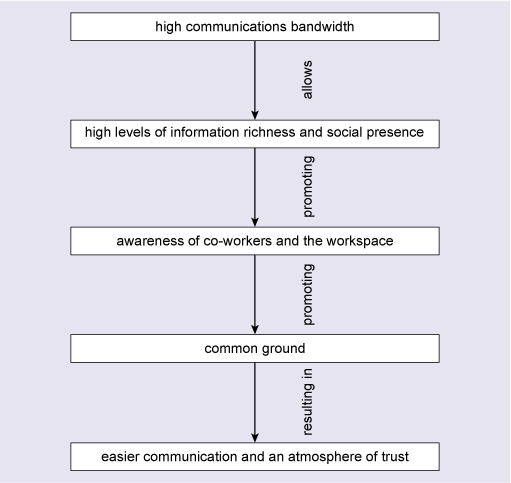
Information richness is the amount and variety of information flowing through a communication medium. High levels of information richness enable the transfer of clues to the meaning of communication through the reproduction of gestures, body language, facial expressions and emotions. This richness helps to avoid confusion and misunderstanding (Duarte and Snyder, 2006). To allow high levels of information to flow, communication mediums with high bandwidth are needed. That is to say, the communication channels that are used must be capable of high rates of data transfer.
Virtual project team managers can evaluate the suitability of different technological approaches by assessing the amount of social presence and information richness required in different situations and provided by different approaches. They then need to evaluate the effectiveness of the approaches by assessing the bandwidth that is required by each of them and that is available to different team members.
2.3 Common ground
A consequence of the natural awareness that collocated team members enjoy, or the provision of software mechanisms that promote awareness, is common ground. Common ground refers to the knowledge that collaborators have in common and are aware that they have in common. Common ground is established by shared knowledge of the object of the work itself, the background and context of collaborators (whether, for example, they are even present), what artefacts they share, and knowledge gained from their appearance and behaviour during interaction. The establishment of common ground is itself often a collaborative process where participants mutually establish what they know to allow a conversation to proceed (Olson and Olson, 2000). The field studies of Olson and Olson demonstrated that it is relatively easy for collocated teams, in contrast to virtual teams, to establish common ground. This is because they share a local and cultural context and knowledge of who is doing what and what remains to be done at any time. The participants are both aware of each other and familiar with each other: communication is easier and an atmosphere of trust is engendered.
The relationship between technological infrastructure, different aspects of awareness and successful team work is illustrated in Figure 1.
2.4 Successful virtual team work
As well as having an understanding of the technologies and tools for collaboration and the challenges of distance working, the project manager can study successful project teams at work to identify common factors that allow success.
Virtual teams can be remarkably successful, even outperforming collocated teams, argue Majchrzak et al. (2004) in their article ‘Can absence make a team grow stronger?’ This article, co-written with the authors, Lipnack and Stamps (2000), of a popular book on virtual teams, describes a survey of successful virtual teams undertaken in the early 2000s. In this article, the authors describe several case studies of successful virtual teams and they identify three rules that were instrumental to the success of the virtual teams they surveyed.
Activity 3
Read through the article ‘Can absence make a team grow stronger?’ by Majchrzak et al. (2004) and briefly summarise the three rules that the authors highlight. (Note: for technical reasons this link goes to the top-level of the journal and further navigation will be required to find the paper. Right click the link above to the journal and choose to open it in a new window or tab. You will need to first select the year (2004), followed by the volume and issue (Vol.82, Issue 5 March/April). Finally scroll down to locate article 20 called ‘Can Absence Make a Team Grow Stronger?’)
Discussion
Majchrzak et al. (2004) identify three rules as important to the success of the virtual teams they surveyed. Briefly stated, these rules are: exploit diversity, use technology to simulate reality, and hold the team together. These rules are summarised below.
-
Exploit diversity within the team
In successful teams, team members with different perspectives and backgrounds worked together to devise innovative and creative solutions to problems. Individual members did this by capitalising upon their differences within the team, rather than seeing their differences as a barrier that had to be overcome. Differences of opinion, which almost inevitably arose because of the team’s diversity, were channelled so they generated solutions to problems rather than acrimony between team members. This is captured in the simple phrase ‘light, not heat’.
-
Use technology to simulate reality
In other words, use information technology to bring people together in the virtual realm. In the teams surveyed by Majchrzak et al., many teams found email and video conferencing to be poor ways to communicate and collaborate. Instead, most teams used conference calls and shared websites. It is possible that the findings regarding video conferencing would be different today, with improved hardware and software and in particular great advances in available bandwidth. Note that the article did not use the term ‘wiki’, but a wiki is an example of a shared website. Conference calls tended to be used for discussion (particularly to discuss areas of disagreement) whereas shared websites were used to record team decisions and remind members of their commitments. In other words, the shared websites were used as virtual noticeboards or team rooms.
Hold the team together
Communicate frequently to keep the team together. This is required to prevent some of the hazards of teamwork from arising: mistrust between team members, clique formation, and the distraction of other activities unrelated to the team’s activities. The team leader has an important role to play in keeping in touch with each team member and in holding the team together. Strategies such as asking team members to work in ad hoc pairs for short periods provide an effective way of helping team members to get to know each other better, and to discourage the formation of cliques. In summary, frequent, effective communication is a critical success factor for a virtual team.
Conclusion
This free course, Managing virtual project teams, has introduced you to the approaches needed to effectively establish the project team.
Where a project team is virtual, with some or all of team members at a distance in time or space, the project manager needs additional skills and techniques to manage the team. The skills we have highlighted for leading virtual project teams can be adapted for many different situations and you may be able to identify approaches already used in your workplace or suggest some which could be usefully considered to improve team interactions and project success.
References
Acknowledgements
This course was written by Kay S. Bromley based on material produced by Matthew Nelson.
Except for third party materials and otherwise stated in the acknowledgements section, this content is made available under a Creative Commons Attribution-NonCommercial-ShareAlike 4.0 Licence.
The material acknowledged below is Proprietary and used under licence (not subject to Creative Commons Licence). Grateful acknowledgement is made to the following sources for permission to reproduce material in this course:
Course Image © Rawpixel/iStockphoto.com
Table 1: ‘A Guide to the Project Management Body of Knowledge (PMBOK (r) Guide)’, Fifth Edition, Project Management Institution.
Table 2: adapted from: Levi, D. (2007) Group Dynamics For Teams, 2nd edition, Sage Publications.
Every effort has been made to contact copyright owners. If any have been inadvertently overlooked, the publishers will be pleased to make the necessary arrangements at the first opportunity.
Don't miss out:
1. Join over 200,000 students, currently studying with The Open University – http://www.open.ac.uk/ choose/ ou/ open-content
2. Enjoyed this? Find out more about this topic or browse all our free course materials on OpenLearn – http://www.open.edu/ openlearn/
3. Outside the UK? We have students in over a hundred countries studying online qualifications – http://www.openuniversity.edu/ – including an MBA at our triple accredited Business School.