School activities: Evolutionary tree of mammals
Use 'Print preview' to check the number of pages and printer settings.
Print functionality varies between browsers.
Printable page generated Tuesday, 19 May 2026, 11:42 AM
School activities: Evolutionary tree of mammals
Introduction
This course provides an introduction to the evolution of mammals.
We will be considering Darwin's observations on a great many mammals, and how he noticed that species fell into natural groups. We take as an example the evolution of one particularly interesting mammal, the whale, and look at evidence both from fossils and from DNA to see which other mammals are most closely related to whales. We see how the evidence from these two very different sources points to the same relationship and that this therefore provides overwhelming evidence that the conclusions must be correct.
This OpenLearn course provides a sample of Level 1 study in Arts and Humanities.
Learning outcomes
After studying this course, you should be able to:
develop an appreciation of the huge variety of different mammals that exist on Earth today
see how fossil evidence can help us to understand evolutionary history
understand how the structure of DNA can help us to detect differences between different species
apply the techniques of DNA analysis to work out which mammals are most closely related to each other
appreciate the importance of bringing together evidence from different sources.
1 Natural groups
Darwin made extensive observations on a great many creatures, including mammals, and noticed that species fell into natural groups, e.g. lions, tigers and leopards have many similarities, and resemble cats. On the basis of his observations, he was able to place mammals in distinct groups.
His work has continued, and we now recognise that mammals have evolved from a common ancestor, and have branched into many different groups, or ‘Orders’. Figure 1 shows the different Orders of mammals.
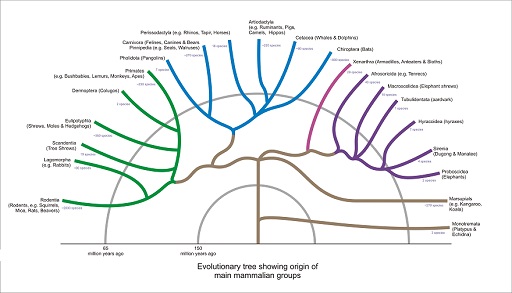
What does an evolutionary tree like this really show?
To understand what the tree shows, we need to look at the different branches on the tree, and how long ago they had their origins.
It shows that Monotremes are on a separate branch of the tree, and that they branched off from the branch which led to other mammals more than 100 million years ago.
Marsupials are on a separate branch which originated between 60 and 100 million years ago.
All other mammals fall into four main groups, shown in Figure 1 in purple, red, blue and green, and all the main Orders of mammals were already present by 60 million years ago.
2 Odd one out
The image below shows models of four mammals:
Rhinoceros
Whale
Elephant
Hippopotamus
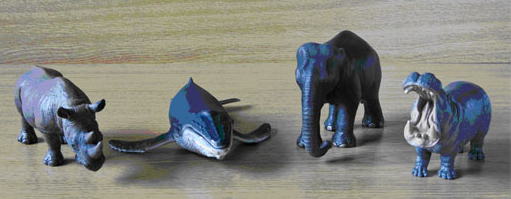
Which of these four do you think is the ‘odd one out’? To help you to think about the differences, try answering the following two questions.
Note to facilitators if using this as a hands-on activity.
This activity is more popular if model animals can be used.
SAQ 1
Question 1: Which one is most different from the others in its appearance?
Answer
The whale is the most different in outward appearance, because it has no legs whereas all the others do and it has a different body shape.
SAQ 2
Question 2: Which one lives in the most different habitat?
Answer
The whale lives in the most different habitat, as it lives in the sea and the others live on land.
You may alternatively suggest that the rhino is the ‘odd one out’ as it is the most endangered, or the elephant as it has a trunk. There can be a good argument for any answer. However, to find out which one is the most different from the others in evolutionary terms, look again at the evolutionary tree. See which branch each is on, and which one branched off first.
SAQ 3
Question 3: So, which is the odd one out in evolutionary terms?
Answer
It is the elephant which is the most different from the others in its ancestry, as it has a different evolutionary origin from the other three. (It is in the purple group in the evolutionary tree whereas the rhino, hippo and whale are all in the blue group.) The whale is more closely related to the hippo than the hippo is to the elephant, or even the rhino.
Now we will look at some fossil evidence.
Figure 3 provides a summary of the evolutionary origin of whales and dolphins.
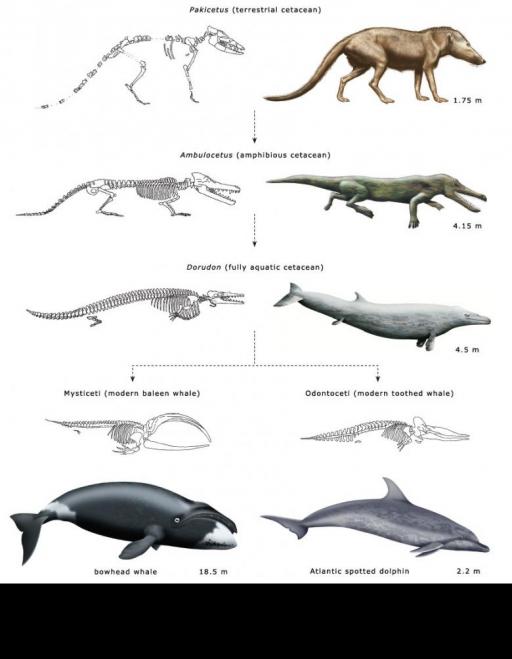
Click on the link for a printable version of Figure 3
If you look closely at the skeletons of modern whales shown in Figure 3, you can see that the residual ankle bone is just still visible there.
SAQ 4
Question 4: What does this tell us?
Answer
It shows that whales evolved from creatures that did have legs. They evolved from land creatures with four legs, and gradually lost their legs and became more streamlined as they adapted to life in the sea.
Here we have seen that animals which look most similar are not necessarily the most closely related and that fossil evidence can give us clues about an animal's ancestry.
3 DNA: Spot the difference
Here we look at DNA, the molecule which contains the instructions for making each living creature. It is contained within the genes of every individual living thing on Earth. Closely related creatures have DNA that is very similar, and distantly related creatures have DNA that is very different. By looking at how similar or different their DNA molecules are, we can see how closely related two species are.
Activity 1
We'll start by looking at the models of two short DNA molecules shown below. Each model resembles a twisted ladder or ‘double helix’ and the rungs of the ladder are made of pairs of bases, here shown in colours green, yellow, red and blue, and you will see that the green one always pairs with the yellow one and that the red one always pairs with the blue one. It is the order, or ‘sequence’ of these coloured bases which is crucial. There is one difference between the molecules represented here. Can you spot it?
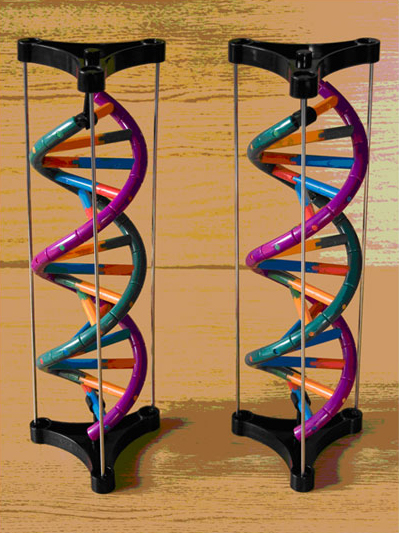
Click on the link below for a printable version of the sequence of coloured bases in the model.
In the diagram it is as if the model had been untwisted, so that the rungs of the ladder can be seen more clearly. Here the bases are shown not only in colour but also using the letters by which they are commonly known.
You will see that  (adenine) always pairs with
  (thymine) and that
  (cytosine) always pairs with
  (guanine).
SAQ 5
Question 5: Can you spot the difference between the two DNA molecules?
Answer
Fourth base pair from the top, is - in the left hand molecule and - in the right hand molecule.
A difference like this represents a mutation. Such differences accumulate over time, so creatures which are on different branches of an evolutionary tree have more differences in their DNA than creatures on the same branch, which are more closely related.
This means that if we look at the similarities and differences between the DNA of different creatures, we can tell which ones are most closely related.
Activity 2 DNA sequence evidence
Here we look at some short DNA sequences from different mammals. The sequences are from a very small section of just one gene, and it is the gene for a protein called casein which is one of the constituents of mammalian milk.
Click on the following link to see the DNA sequences.
There are sequences from two different species of whale, and from a variety of other mammal species. The sequences are colour coded as in Activity 1 but here we have simplified the task and you are only looking at one of the halves of the double helix of the DNA.
You will see that some of these sequences look very similar.
The table shows the DNA sequences from part of the casein gene of selected mammals. This is a short 50 base sequence taken from a much longer sequence of DNA. The bases are A (adenine), C (cytosine), G (guanine) and T (thymine).
To compare two of these sequences, print out the sequences in colour, and cut them into strips. Lie them next to each other to compare them.
Note to facilitators if using this as a hands-on activity
This activity is more effective if the sequences are presented as strings of coloured beads, as it is then easy to lay different sequences next to each other to make comparisons. It would not be necessary to present the sequence of every species listed here, and a suitable subset would be whale, hippo, cow, camel, sheep, pig, zebra, human, rabbit. It would be advisable to choose the same colour scheme used in Activity 1, with four colours, one for each of the four bases A, C, G and T.
SAQ 6
Question 6: Can you find two mammals which have the same DNA sequence? Write down the names of the mammals with the same sequence.
Answer
Any of the pairs of mammals listed below is a correct answer here
Sheep and goat
Toothed whale and baleen whale
Zebra and tapir
SAQ 7
Question 7: What does this tell us about this pair of mammals?
Answer
They are closely related.
SAQ 8
Question 8: How many pairs of mammals have the same sequence for this stretch of DNA? Which mammals are they?
Answer
Three pairs: sheep and goat; toothed whale and baleen whale; zebra and tapir.
SAQ 9
Question 9: Which mammals have a sequence similar to the whale?
Answer
Any of the following is correct – hippo, cow, camel, giraffe, sheep, goat, deer.
SAQ 10
Question 10: What does this tell us about the closest relatives to the whales?
Answer
Whales are closely related to the mammals in the Order Artiodactyla, e.g. hippo, cow, camel, giraffe, sheep, goat, deer.
SAQ 11
Question 11: This evidence here comes from DNA sequences, and shows us that whales have origins similar to the four-legged land mammals in the Order Artiodactyla. What other source of evidence suggests that whales are related to land mammals which have legs?
Answer
Fossil evidence, as shown in Figure 3.
Activity 3
If you would like to take a more detailed look at what the DNA evidence can tell us, try counting the differences between the whale sequence and each of the other sequences.
Click on the link below to find a table you can print out to enter your answers on.
SAQ 12
Question 12: Which three of the mammals listed here have DNA which is most different from the whale DNA?
Answer
Human, rabbit and mouse.
SAQ 13
Question 13: What does this tell us?
Answer
They are more distantly related to the whale than the other mammals.
Now look back at the evolutionary tree of mammals. You will see that the whale, the mammals in the Order Artiodactyla (hippo, camel, cow, giraffe, etc.) and the zebra and tapir are all in the ‘blue’ group.
SAQ 14
Question 14: Which group on the evolutionary tree are the human, rabbit and mouse in?
Answer
Green group.
The mouse is a rodent, in the Order Rodentia, the rabbit is in the Order Lagomorpha, and the human is in the Order of Primates. All these are in the green group, and have a more distant evolutionary origin from those in the blue group. Therefore it is not surprising that their DNA is more different from the whale than the others.
Here we have seen that whales are closely related to four-legged land mammals such as the hippo, camel, cow and giraffe. The evidence for this comes from both DNA sequences and from fossils. These are two very different sources of evidence, and both point to the same conclusions, which means that the evidence for these conclusions is overwhelmingly strong.
Conclusion
This free course provided an introduction to studying the arts and humanities. It took you through a series of exercises designed to develop your approach to study and learning at a distance and helped to improve your confidence as an independent learner.
Acknowledgements
Except for third party materials and otherwise stated (see terms and conditions), this content is made available under a Creative Commons Attribution-NonCommercial-ShareAlike 4.0 Licence.
The material acknowledged below is Proprietary and used under licence (not subject to Creative Commons Licence). Grateful acknowledgement is made to the following sources for permission to reproduce material in this free course:
- The Evolutionary Tree was adapted by Janet Haresnape from a figure from: What is a Mammal? in The New Encyclopedia of Mammals, edited by David MacDonald which forms part of the S182 course ‘Studying Mammals’, and the Graphic version of this was created by Martin Scott and Linda Hurst.
- Haresnape J. M. Darwin and evolution: a set of activities based on the evolution of mammals, School Science Review 91 (337), 2010, 75-86. Published by the Association for Science Education (ASE).
- DNA Sequences: from Gatesy, J., Hayashi, C., Cronin., M.A. and Arctander, P. (1996) Evidence from milk casein genes that cetaceans are close relatives of hippopotamid actiodactyls. Molecular Biology and Evolution, 13, 954-963.
Every effort has been made to contact copyright owners. If any have been inadvertently overlooked, the publishers will be pleased to make the necessary arrangements at the first opportunity.
Don't miss out
If reading this text has inspired you to learn more, you may be interested in joining the millions of people who discover our free learning resources and qualifications by visiting The Open University – www.open.edu/ openlearn/ free-courses.