Week 4: Considering work experience and voluntary work
Use 'Print preview' to check the number of pages and printer settings.
Print functionality varies between browsers.
Printable page generated Tuesday, 20 October 2026, 12:58 PM
Week 4: Considering work experience and voluntary work
Introduction
Last week you began to match your interests and aspirations with the employment market. Your discoveries will have been very personal to you. For instance, you might have found reassurance that it is likely to be a straightforward journey from where you are now to the work you would like to do. It is more likely, however, that you have discovered that you need to gain skills or experiences which you currently lack and have begun to think about how you could acquire these.
This week you will focus on how work experience and voluntary work can help you gain some of these skills and experiences. Even if you have a clear career path, and defined aims for what you want to achieve, you can still benefit from considering how work experience and voluntary work might help you.
Since the nature of work experience and voluntary work differ, these are treated separately this week. This may mean that parts of this week will be more relevant to you than others. You’ll start by considering work experience.
Watch Wendy introduce Week 4:

Transcript
By the end of this week, you will be able to:
- understand the benefits of both work experience and voluntary work
- explore work experience and voluntary work options to support your career development
- understand how to approach a work experience or voluntary work opportunity
- identify what you have discovered from the first half of the course.
1 What is meant by ‘work experience’?

Work experience includes work you do before starting on a career path, or as part of enhancing your existing career. It can be part of a formal work experience scheme or from the work you have done, or are currently doing. Whatever form it takes, work experience can be useful whether you are:
- trying to join the workforce for the first time
- aiming to make a change in your current career direction
- building up to taking on work after a break from it
- looking to progress or develop your existing career.
Work experience can take several forms:
- previous or current employment – the experience you get from being employed
- work placement – a period of work experience, paid or unpaid, which forms part of a period of study
- internship – a short-term placement in an organisation, often unpaid
- work-based project – a specific set of assessed activities carried out on the employer’s premises. This might be your own employer, of course, but in a different field of work than you usually do
- work shadowing – observing someone do the work you want to do, in order to understand the nature of their role and responsibilities.
Voluntary work is a particular kind of work experience, with different features and benefits, so this is considered in latter part of this week.
The first activity this week will help you to update your skills profile from Week 2 by identifying past work experience.
Activity 1 My past work experience
In Week 2, you considered the work experiences you have already, and the skills you gained from them. The definition and examples above may have reminded you about work experience you might so far have overlooked. For example:
- Did you undertake any work experience placements whilst you were at school?
- Were you ever part of a project team at your place of work?
- Have you taken a course of study in which you were given a work placement?
- Have you ever observed the work of someone who was already an experienced practitioner as part of your training?
Find your notes on work experience from Week 2 and add any other experiences you may have missed. Remember to include any skills that you've gained.
Comment
You may well not have needed to add anything to your previous notes, if you have already covered all your previous work experience. Or you may find that something pops into your mind later in the week, when least expected – if so, remember to go back to your notebook and update this section then.
So, let’s think about what the benefits of work experience are.
2 What are the benefits of work experience?

You may have noticed that some of the options identified in the previous section could involve taking on work in addition to existing commitments, such as a project on top of your ‘day job’. Others involve working without pay. You might be unsure about the benefits of doing this. If so you are not alone. Only you can decide whether you have the energy and motivation to invest in gaining work experience which may put you under pressure in other aspects of your life. However, the short video in this next activity may help you to see the benefits of doing work experience.
Activity 2 Why is work experience useful?
Watch the following video in which two Open University students explain the value of work experience. Make notes below on what arguments they put forward for gaining work experience.

Transcript
Answer
- It is the best way of understanding a particular career path
- It allows you to see many different routes within a career path
- It might challenge some of your ideas about a career path – for example, that engineering is always dirty work
- Employers would consider you more favourably if you had gone to the trouble of getting work experience
- It is important for you to find out more about what the work entails before you take a paid job.
Discussion
Most employers look favourably on applicants who have work experience that enhances their application. It might, therefore, help you to get the work you want to do but that is not the only reason to do it. It may also benefit your personally.
- You can show that you have developed a range of transferable skills
- When these skills match what an employer is looking for, they make you a more attractive proposition
- The fact that you have sought out work which gives you insight into the career you want to pursue, helps persuade employers that you are committed and understand what the job requires
- It makes a positive impression, shows that you can initiate and follow through on things independently
- You will develop a number of useful contacts.
So, work experience is both pleasing to a prospective employer, as well as helping you to achieve your goals, whether that is in your current employment or a new direction. It can also test out whether some of the ideas on your ‘what next’ list are really would be as enjoyable as you imagine.
Whatever your reason for wanting to gain new work experiences, the obvious next question to ask yourself is ‘where might I find them?’
3 Ways to find work experience opportunities

With imagination and planning it is possible to find useful opportunities for work experience whatever your circumstances. Taking the following three-pronged approach to considering your options is useful:
- Exploit opportunities in your current work situation.
- Use your contacts.
- Do your own research.
Let’s look at each of these in turn in the next sections.
3.1 Exploit opportunities

If you are already working, you may find you can volunteer or do work experience in a different role with your current employer. Many organisations have schemes for their employees and some may pay for employees to undertake work experience elsewhere. If your organisation has a Human Resources department, they might be the best people to tell you if such a scheme exists. If not, your immediate manager may be able to advise you.
Work shadowing
You might want to consider work shadowing other members of staff whose roles appeal to you. You will get a more realistic idea of the responsibilities, skills and challenges of the posts. How you arrange this might depend on the support of your manager, so opening up a conversation with him or her about the possibility is a good first step.
Job swap
Job swapping within your existing organisation might be a good way to get a ‘taste’ of different types of work. For instance, if you normally work on the shop floor of a retail organisation, could you ask to swap with a colleague in the store room for a short period?
3.2 Use your contacts

If you are not working at the moment, do you still have contacts from any past workplaces that could open up opportunities for you? For example, if you used to work for a local authority which organises summer festivals or sports events using volunteer helpers, could you ask someone if you could be involved? Do you know anyone who volunteers at a local charity who might be able to let you know when new opportunities come up?
Perhaps you have been a student until recently and are looking for your first job. Check out whether any of your fellow ex-students have already found work and might be able to make suggestions or introduce you to their colleagues.
You may be returning to the workforce after, for example, a period of absence due to illness, or serving a custodial sentence, or travelling abroad and so have more limited work-based contacts. If so, do not ignore the obvious potential places to start, such as, friends, family, job centres, voluntary organisations or careers advisers.
3.3 Do your own research

Work experience can be found in all sorts of organisations, but there is likely to be competition for work experience placements at the bigger, well-known organisations, so you need to plan ahead. For instance, are any careers and placements fairs coming up which you could attend, so that you can talk to employers directly about their work experience opportunities?
In Week 3 you practised the skill of researching the kinds of jobs available. Now you can take it a step further. Look at the websites of organisations which interest you. Can you see anything about work experience? Is there a contact you could approach to ask if the organisation takes people on work experience placements? You may find phoning is more productive than an email. Remember that small local businesses may be in a position to help, as well.
Before moving onto the next section, take some time to think about how or if each of these approaches would work for you.
Activity 3How would you use each prong?
Think about each of the three prongs from this section and jot down any ideas in your notebook about how you could use these in your own situation to find work experience.
Comment
As usual your answer to this activity will depend entirely on your own situation but it should give you some ideas for how you could find some valuable work experience.
Whichever approach you take, you need to be realistic about the work experience options that are open to you. The next section will ask you to do just that.
4 The practicalities of work experience for you

Finding the right work experience might involve you working in your spare time. If you want to teach, for example, it is important to spend time in a classroom before applying for teacher training. If you already have a full time job, you may have to consider using part of your annual leave.
You need to be creative but realistic in assessing options. Organise work experience that suits you and your career plans. Your time is precious, so use it constructively and be realistic about what you can take on. However, work experience need not be full time or even long term. It might be occasional, regular, or even home-based. Local or home-based work experience also has the advantage of requiring little or no travel, so you can have the added benefit of requiring less time and money to undertake it.
Whatever your personal circumstances, for most people making initial approaches can feel daunting, so it can be very helpful to rehearse how you might do this. The next activity is designed to help you with this.
Activity 4 Approaching people about work experience opportunities
Imagine that you want to approach an employer, about finding work experience you think would be helpful to you. It is useful to have a particular employer or contact person in mind because this helps you to think about:
- Should I email them or write?
- Should I telephone or speak face-to-face?
- What should I say to them about why I have approached them?
- What questions should I ask, about what they have to offer?
In your notebook write down how you would introduce the topic of work experience and what questions you might want to ask them in a first conversation. You may never send the specific email you write here, or say the exact words you write down, but just the act of writing them down prepares you for a real approach.
4.1 Making the most of your work experience

Once you have found some work experience, how can you ensure that you make the most of it? After all, it is a big commitment on both sides and you want to be sure that you can reap the benefits. The following points can act as a kind of checklist for you.
- Have clear aims – set goals you can reasonably achieve in that period.
- Understand your needs – they should fit with the organisation that is offering you work experience.
- Find support – ask for a named person who is responsible for helping to make your work experience successful.
- Get feedback – ask whether you have shown aptitude for the work or demonstrated learning of the skills needed.
- Build your contacts – look for opportunities to make contacts, remembering chats during coffee or lunch breaks can be perfect for this.
- Review what you have done – what did I learn about the work, the employer or myself from this experience?
This last point is probably the one that gets overlooked, especially if you are particularly busy, but it is perhaps the most important to spend some time on. Asking this simple question and making notes can help you when writing job applications, in interviews and with the important task of deciding on your career path.
Hopefully, you now feel you understand the potential value work experience can offer you personally. You may have concluded that it is just what you need and it will form part of your action plan at the end of the course. You may, on the other hand, still be actively searching for alternatives. Voluntary work is one such alternative and is covered in the next part of this week’s study.
5 What is ‘voluntary work’?

Voluntary work is unpaid work, usually carried out in your own time. Some volunteer organisations may pay expenses, but you give your time and skills for free. It differs from work experience in that it usually offers many more options for patterns of work. Whereas, work experience may be a full time commitment for a defined period of time, such as a week or a month, voluntary work is more often part-time and can be a long-term commitment on both sides.
It is important to remember that getting involved as a volunteer is a commitment as your colleagues will rely on you. So, even if the work is unpaid, you should expect to take your responsibilities seriously.
There are many reasons why people choose to take on voluntary work. Sometimes it is out of a desire to help others and a belief that you get most out of life when you are involved with and contributing to society. This is not the only reason to consider volunteering. For some, volunteering will be about gaining something personally to help achieve their career aims.
You’ll see what the benefits of volunteering are in the next section.
6 Voluntary work and career development

On this course, the focus is primarily on how voluntary work might help you to explore and pursue your preferred career path. Firstly though it is worth considering some of the benefits of volunteering.
They include:
- the chance to enhance existing skills and develop new ones, by doing different work than you may have done before
- the experience of working in a new environment
- a way to learn more about yourself, and your abilities, as well as to gain more self-confidence. You may be exposed to issues, situations and people you would not normally encounter
- the potential to gain relevant vocational training which could lead to a recognised qualification. Some charities require you to undergo training which they provide
- developing new contacts and friends
- a real sense of what it is like to do a particular kind of work in an organisation
- the satisfaction of contributing to something which you find worthwhile
- a place to feel valued and respected for your efforts
- gaining experiences which you will be able to use in future job applications.
It is easy to claim that certain benefits are possible, but it is more persuasive to hear from people who have experienced them. For instance, this is what several Open University students who tried out voluntary work had to say about their experiences:
What OU students say
- An inside view
‘I volunteered two days a week for the charity, Action for Sustainable Living. This gave me an inside knowledge of the charity and I built a strong relationship with staff members. When paid roles were made available, I had a clear advantage over other applicants.'
- A boost for the CV
‘I’m a treasurer of a youth football team, which I find very rewarding as well as tiring and time consuming. Trying to fit in my job, my OU course and this voluntary work is really stretching me! I would recommend anyone looking for work experience to try volunteering as a means of adding depth to your CV.’
- A gateway to new roles
‘Although I am now paid, I started my career as a volunteer advocate while working as a computer programmer. This facilitated a change into the world of social care and gave me the disability awareness I needed to change roles.’
(The Open University, 2014)
So, volunteering can be rewarding in many ways but it can also be challenging. However, as with all challenges, overcoming them helps you to acquire the skills and confidence for the future. Just think carefully about what kind of voluntary work is right for you, at this point in your life.
The next section will help you to decide what might suit you.
7 What voluntary work might suit me?
Remember that voluntary work requires commitment, just like a paid job. Therefore, you need to be realistic about how much of a contribution you can offer alongside your existing work and personal commitments. It might be that the occasional ‘one off’ event or a short-term project best suits the time you have available. Alternatively, you might find a regular, more long-term but contained commitment, like an hour each week, easier to sustain.
Some voluntary work is less easily accessible. For instance, voluntary opportunities which involve working with potentially vulnerable people, such as counselling, advice work or advocacy, often have rigorous requirements. The selection process may involve providing references and applying for a Disclosure and Barring Service (DBS) check in England, Wales and Northern Ireland or a Disclosure check in Scotland. You may also need to commit time to do appropriate training before you begin.
It is important, therefore, that you consider:
- what voluntary work offers you
- what you can bring to it
- your motivations
- what you can do
- what constraints you might have.
The next activity will help do just that.
Activity 5 Identifying what you could offer as a volunteer
This exercise will help you to explore what type of voluntary work you might be suited to do. Do not start by asking yourself whether or not you want to do voluntary work, instead begin by thinking about what you could offer.
Use the questions below to prompt your thinking. Do not think about it too much. Just write down your first thoughts in your notebook. You will have the chance to revisit this in more depth, if you wish to do so later in the course.
- Why might you be interested in volunteering?
- What causes would you see as worthwhile?
- Do you have any specialist skills or expertise, you are willing to share with others? (To help you to answer this, look again at the skills audit you did in Week 2 in your notebook or the Resource pack.)
- Are there any particular personal qualities which you feel suit you to working as a volunteer, such as the ability to make others feel comfortable, or to empathise with them and their situation? Or are you good at practical problem-solving?
- Would you want to work with a particular client group such as elderly people, children, or adults with learning difficulties? Or in a particular field such as the environment, homelessness or adult literacy?
- How much time could you realistically offer, and are you looking for a short or a longer term commitment?
- Would you need to cover your basic expenses in order for you to get involved as a volunteer?
- How far are you prepared to travel to undertake the work?
- What kind of fulfilment do you want to gain from voluntary work?
- What do you think you might find most challenging about voluntary work?
Comment
Doing this activity helps you to see what you could offer if you do pursue voluntary work and gives you some clues on the kind of volunteer work which might be attractive.
In the next section you’ll consider whether or not volunteering would be a good choice for you in your life right now.
7.1 Is it the right time to volunteer?
This activity asks you to assess how well voluntary work fits with your needs and objectives.
Activity 6 Voluntary work ‘fit’ for me
Part 1
Take a few moments to reflect on the information in this last section.
On a scale of 1 to 10 (where 10 is ‘this is the perfect option for me’ and 1 is ‘cannot see how this helps me at all’) where do you score yourself in relation to volunteering now?
Comment
If you have scored below 5 ask yourself whether or not your answer might be different in the future. Does your answer depend on practicalities which might change over time, or do you just not see this as something which appeals to you at all? If you score 5 or above, then you might want to think about what actions you can take to explore voluntary work options.
If you did score more than 5 for volunteering try Part 2 of this activity.
Part 2
In your notebook answer the following questions about volunteering and any actions you might need to take to do this.
- In what time frame might I consider voluntary work?
- What kind of voluntary work might I apply to do?
- I am keen to consider voluntary work, what research do I need to do?
- What do I want to do in the next month?
- What do I want to do after this course ends?
Comment
Voluntary work may not be for everybody but it can be very rewarding on a personal level, as well as having the added benefit of helping with your career development. Whatever you decide to do, it should be what you feel reasonably comfortable with undertaking. Think about starting small, with a local charity and working your way up.
This week has focused on how work experience or voluntary work might help you to develop the kind of career you want, now or in the future.
It adds to the understanding you have developed over the past four weeks about:
- your motivations
- the contributions you can make (and want to make).
You may be feeling impatient to move on to actively pursuing work options. The second half of the course focuses on this but, before you move on, it is important to reflect on your conclusions, so far. The final section in this week provides a structure for doing this.
8 Pausing on the journey
This week represents the half-way point in the course. Pause and congratulate yourself on coming this far! On any learning journey, your motivation and energy will fluctuate. Sometimes you can lose sight of why you began in the first place. Now is a good point, therefore, at which to stand back and consider what you have already learned and what you still want to explore.
The final activity this week is a longer reflective exercise designed to help you to collate your insights and decide on your focus for the next four weeks.
Activity 7 My half-way learning review
Let’s work with the idea that the course is a journey. Imagine that you have been climbing a steep hill. You were keen to see the view from the top and were ready for the challenge of the climb. You have been climbing steadily, sometimes with mist obscuring your view, and at other times with gaps, which allow you to glimpse new horizons.
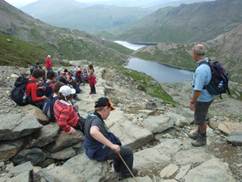
About now, you may feel that the top is still a long way off. It is a good point to stop, catch your breath, look back at how far you have climbed and refocus your motivation for the last bit of the climb.
Over the past four weeks, you have been encouraged to keep a record of your journey in your notebook. You may have done this more fully in some weeks than others, and you will almost certainly have made discoveries along the way.
You will find it useful to scan back over your entries, so far, before answering some of the questions. If you have not been recording your thoughts so far, you will still find it useful to do so now.
Reflect on the questions below and write your answers in your notebook.
- What motivated you to begin this course?
- Has your motivation changed at all during the last four weeks?
- What have you concluded, so far, about the kind of work you want to do?
- What have you discovered about being able to access that kind of work for yourself?
- What decisions have you made about the action you need to take to pursue your aspirations?
- How confident do you feel about achieving the kind of career you want for yourself?
- What would make you feel more confident?
- What do you want to achieve, and learn, in the remaining four weeks of the course?
- Think back to the idea, from Week 1, of a career being like a train journey. Now take a moment or two, to visualise success in your career at some point in the future. Choose a time not too far away. Where would you be on your train journey? What would you be doing? Who else might be there? How would you feel?
Top tip – you might find it easier to draw than to write this. If so, do this by hand separately.
Comment
This activity acts as a useful summary of what you have discovered so far on this course, and some of the actions that you should be thinking of taking now. Over the next four weeks of the course, you may find it helpful to remind yourself now and then of this summary.
Now all that is left for you to complete this week is the first badge quiz.
9 This week’s quiz
Now it’s time to complete the Week 4 badge quiz. It is similar to previous quizzes, but this time, instead of answering five questions there will be 15.
Go to:
Open the quiz in a new tab or window (by holding ctrl [or cmd on a Mac] when you click the link).
10 Summary
Congratulations on reaching the end of Week 4 of Succeed in the workplace. This is a great achievement in itself. Hopefully, you also feel that you have made good progress in the career planning process. Over the last four weeks you have thought about yourself and started to explore opportunities. This week you have made a start on ‘deciding what to do’; as you’ve looked at possible work experience and volunteering that will help you achieve your aspirations.
In Week 5, you will turn your attention to making the most of the people around you and expanding your contacts – otherwise known, as your network. See you there.
You should now feel that you can:
- understand the benefits of both work experience and voluntary work
- explore work experience and voluntary work options to support your career development
- understand how to approach a work experience or voluntary work opportunity
- identify what you have discovered from the first half of the course.
You are now half way through the course. The Open University would really appreciate your feedback and suggestions for future improvement in our optional end-of-course survey, which you will also have an opportunity to complete at the end of Week 8. Participation will be completely confidential and we will not pass on your details to others.
You can now go to Week 5.
References
Acknowledgements
This course was written by Maria Townsend and Gill Gustar.
Some of the material in this course is based on material originally available on the Open University Careers Advisory Service website.
Except for third party materials and otherwise stated in the acknowledgements section, this content is made available under a Creative Commons Attribution-NonCommercial-ShareAlike 4.0 Licence.
The material acknowledged below is Proprietary and used under licence (not subject to Creative Commons Licence). Grateful acknowledgement is made to the following sources for permission to reproduce material in this unit:
Images
Figure 1: © Revensis/Dreamstime.com; Figure 2: © Ron Chapple/Dreamstime.com; Figure 3: © Jenny Hill/iStockphoto.com; Figure 4: © filo/iStockphoto.com; Figure 5: © Studiovision/iStockphoto.com; Figure 6: © ineskoleva/iStockphoto.com; Figure 7: © unknown; Figure 8: PA Photos http://www.paimages.co.uk; Figure 9: © unknown; Figure 10: © koun/iStockphoto.com; Figure 11: Courtesy of Pendine Outdoors www.pendineoutdoors.co.uk.
Every effort has been made to contact copyright owners. If any have been inadvertently overlooked, the publishers will be pleased to make the necessary arrangements at the first opportunity.
Don't miss out:
1. Join over 200,000 students, currently studying with The Open University – http://www.open.ac.uk/ choose/ ou/ open-content
2. Enjoyed this? Find out more about this topic or browse all our free course materials on OpenLearn – http://www.open.edu/ openlearn/
3. Outside the UK? We have students in over a hundred countries studying online qualifications – http://www.openuniversity.edu/ – including an MBA at our triple accredited Business School.