Week 3: Exploring available opportunities
Use 'Print preview' to check the number of pages and printer settings.
Print functionality varies between browsers.
Printable page generated Monday, 7 September 2026, 6:28 PM
Week 3: Exploring available opportunities
Introduction
In Weeks 1 and 2 of Succeed in the workplace you concentrated on the first step in the careers planning process – knowing yourself. This gives you a solid foundation to work from for the next steps you’ll take, specifically exploring opportunities. You’ll do this in conjunction with the aspirations that you identified in Week 1.
Whatever your personal starting point, the extent to which you can fulfil your aspirations depends, in part, on being able to identify and access the opportunities open to you.
This week you will focus on exploring new opportunities or looking again at ones that are already there, but which you may not be using as fully as possible. Whether you are interested in paid or voluntary work, or both, you need to be able to map out the options available and evaluate which might suit you best.
Now watch Wendy introduce Week 3:

Transcript
By the end of this week, you will be able to:
- evaluate the opportunities available to you in developing your career
- identify sources of information on finding work
- consider alternative options to full-time employment
- think of ways to keep motivated.
1 The career planning process – where am I now?
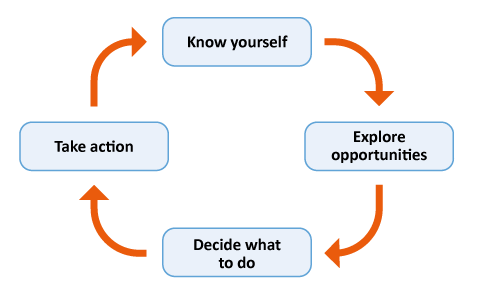
Here’s a quick reminder of where you are in the careers planning process. You’ve already completed step one, ‘know yourself’, and are moving on to ‘explore opportunities’ now. You’re already a quarter of the way through the process – well done for sticking with it.
Now you need to match what you know about yourself to the opportunities available.
You’ll learn about the importance of this next step in the first activity of the week.
Activity 1 Why explore opportunities?
Watch this short video in which a careers adviser explains the importance of this step in the career planning process.

Transcript
Although the adviser talks specifically about paid work, the point she is making holds true for unpaid work. It is becoming rare that you can find unpaid work without the same kind of search for opportunities that you do for paid work. You may agree with some of the points made in the video, especially if they reflect your own experiences. You might disagree with some too, for the same reason. Take a few minutes to note down in your notebook your reactions to the following questions.
- How far do you agree with what the careers adviser says – do you have any personal experiences that suggest she has a good point?
- How do you feel about taking a structured approach to pursuing your aspirations?
- What challenges might adopting this approach present for you? Who might support or help you in meeting such a challenge?
Comment
As with most of the activities in this course, what you will have written down will reflect your own personal experiences. Try not to think of any challenges as obstacles, but rather as problems to be solved. In that way you can start to take control of them.
A structured approach can really help, whether you are absolutely certain of what work you want to do, or uncertain. You are fortunate if you have a very clear idea, as most people won’t be in this position. Identifying where your ideas fall in this range of possibilities is a good place to start when exploring opportunities and you’ll consider this in the next section.
2 How clear are you about what you want?

As you watched the video, you might have wondered how clear you need to be about the kind of work you want, before you start exploring opportunities. One way of thinking about this is to use a scale from 1 to 10, where 1 is ‘I have no idea what I want to do’ and 10 is ‘I know exactly what I want to do’. You will have the opportunity to try out this approach, but sometimes thinking about another person’s situation can be a good way into thinking about your own. Try this in the next activity.
Activity 2 Are Christopher’s thoughts clear?
The case study below offers a brief example, which might spark your own thoughts.
Case study: Christopher
Christopher is 35 and has been unemployed for 12 months. His last job was as a pizza delivery driver for a small local company, which closed down. He has since lost his driving licence due to a succession of speeding fines.
Christopher marked himself as '3' on the ‘clear about work’ continuum. His notes explained his mark as follows:
I am saying '3' because really I would like to go back to driving, but I do not think I can in the short-term. I might have wanted to do taxi work. I know what I do not want to do – work in construction or in a shop – and that is all that seems to be on offer in my local job centre. I have thought about working as a car mechanic, because I am pretty handy at that kind of thing, but I do not know if you have to have qualifications. Perhaps I need to ask around and find out about what I need to be a mechanic. I am not an exams kind of person so that might rule me out if you need to do that.
What do you notice about Christopher’s case? Jot down a few ideas. (Do not worry about recording these ideas in your notebook as your comments here are not about you.)
Comment
Perhaps the first thing you noticed is that Christopher’s career was disrupted when the company he worked for closed down. That’s something he had no control over. However, you might think Christopher did have control over getting the speeding fines, which led to the loss of his licence. Although you might feel differently if you discovered that most of those fines were incurred doing the delivery job.
You might also notice that Christopher considers, but dismisses, other types of driving work, at least for now. Instead, he identifies something different but related. He thinks he might be interested in, and suited to, working as a mechanic but he has gaps in his knowledge – and is able to identify a key question he needs to try to answer before he can assess if it is a viable opportunity for him.
Now think in a similar way about your own situation.
Activity 3 Are you clear about your aspirations?
This activity helps you to decide how clear you are about what you want to do, using a scale of 1 to 10, and to sort out what kind of questions you might need to be asking.
1 – represents feeling very confused about what work you want to find.
10 – represents absolute certainty.
Try to choose the number which best represents how you feel at the moment and make a note in your notebook.
Now you have made this judgement, use the questions below to help you to see why you might have rated your level of clarity in the way you did. Write your answers in your notebook.
- I chose number ( ) because …
- What I know now about the kind of work I want to do is …
- What I would like to find out about work opportunities is …
Comment
Hopefully, you found that you had some ideas of the kind of work you would like to do, based on your work in Weeks 1 and 2. If you found yourself saying that you have no idea at all, be cautious. Is it really that you do not know? Or are you ruling yourself out of some things that might appeal to you? If you really are unsure, have a look the OU Careers Advisory Service website to get some more help.
Whether you are absolutely clear about what you want to do, or just have a vague idea with lots of doubts, you need to do some testing of what opportunities are available and what they might demand of you before you can start to pursue the work of your choice.
Remember, at this stage, you are not committing yourself to anything. You are just exploring the options. You can afford a bit of uncertainty. You can also afford to change your mind if your discoveries show that your initial ideas are not your best ones.
You’ve now got an idea or ideas to work on. Your next task is to refine these further.
3 Refining your ideas: where to get information

However clear you feel about your preferred work options, it is useful to test how well they match you as a person, your current circumstances and your life plans. In this section, you are invited to find out more about one type of work and what it would demand of you.
The two-step process that follows is designed to help you to do some early testing of your ideas. It will work best if you identify a particular type of work or career path that has so far emerged as one that interests you. For instance, you might have identified a career in the retail sector as something you feel would suit you. Alternatively, you might be interested in voluntary work and feel that working at a food bank, or other charity helping people, would be rewarding. Whatever your thoughts, you need to do a bit of finding out or ‘research’ on what the opportunities for this type of work are in practice.
To do this you need to know where to look, and help may not always come from the most obvious place. So, here’s a list of possible people or organisations that you could use, and what information you could find out from them.
| Source | Description of information |
|---|---|
| Business columns of newspapers | May include features forecasting which employment sectors will be recruiting or are in decline. |
| Your local contacts | May hear of local jobs and, if they know you are looking, mention it to you. |
| National Careers Service website | A government website that includes information about training and apprenticeship opportunities. |
| Job Centre Plus | As well as paid job vacancies, they have information on volunteer work and your rights in relation to seeking work. |
| Friends and family | They may have direct knowledge of the type of work you want to do, know if their organisations are recruiting or making people redundant in some areas, or may have good contacts to whom they can introduce you. |
| Jobs pages of local newspapers | Gives a good idea of what employers are looking for in certain types of work, and a sense of how frequently those jobs are advertised. |
| Professional institute magazines | Advertise jobs specific to their profession and this can give you a good idea of specialisms within the field. |
| Professional institute websites | Explain the knowledge and skills requirements for the type of work and the training available. |
| Organisation’s own websites | Many have a ‘careers’ or ‘working with us’ section that tells you what kind of work environment they offer and the types of job for which they recruit. |
| Office of National Statistics | Provides information on jobs in the public and private sectors, and gives an analysis of the UK workforce jobs by sector. It also looks at industry changes. |
| Social media networks | A new and developing source of information about jobs and companies. |
| Radio programmes | Local programmes might report on site closures or new businesses starting up in the area, for example. |
| Community notice boards | They will occasionally carry job advertisements for local jobs, such as acting as clerk to the council. |
| Local Chamber of Commerce | Through the people you meet via this network, you may hear of jobs that are not advertised. This is true of many professional networks. |
For the purposes of these next activities, you will need to select three of these potential sources of information that you can use now. This will vary depending on where you are located but may mean that you are limited currently to searching on the internet. You can explore other useful sources at another time.
Activity 4 Who would you ask?
Spend a few moments thinking about which three sources you want to consult and why. Write your choices and reasons in your notebook.
For instance, you might be interested in a retail career and decide to look at supermarket or department store websites. You might also want to check if there is a specialist magazine for the retail sector and, if there is, to visit your local library to look at a few copies.
Comment
As you completed this activity, you might have found that your reason for choosing certain sources was simple curiosity because they directly relate to the type of work you are interested in, or they are easy or practical, or enjoyable for you in some way. You might also have had reasons that hint at what you would like to find out. For example, if you are interested in combining your work as a counsellor with your love of education, you might want to find out if your local college or university uses counsellors.
Before going to your sources for information it is vital to start out knowing what you want to find out. You’ll be helped with how to organise your thoughts on this in the next section.
3.1 Types of question to ask
If you don’t know what you want to know, you will have no way of starting your research into different job opportunities. You just won’t know where to begin.
So the next activity is designed to help you to identify a few questions that you want answers to.
At this stage, these sorts of question might be useful:
- What is the availability of a particular kind of work?
- What is the nature of a particular kind of work?
- Is the work associated with a specific type of organisation?
- What are the practicalities, such as pay, working patterns or location?
Which of these questions are most important to you right now?
Your answer might depend on how clear you are about the type of work you want, your motivations for pursuing the work and the time frames you have in mind. For example, if you are already in work but short of money, you might want to look for additional work that fits around your existing job. In this scenario you would be more concerned with the availability of work and with the practicalities, such as weekend or evening working options. If, however, you are already on a career path but considering a different employment sector, you might have questions about organisation types and availability in your geographical area.
To help you decide what questions to ask, you’re going to look again at Christopher’s situation from Activity 2.
Activity 5 Identifying Christopher’s questions
Imagine that Christopher is your friend. He tells you he has decided that he wants to pursue his idea of becoming a car mechanic but wants to test the possibility. What questions do you think he needs to ask, which are related to:
- availability of the work
- nature of the work
- types of organisation
- practicalities of the work.
Write the questions you think would be useful for him to research below. As this information is not about you, there is no need to write it in your notebook.
Comment
This is not a full set of the questions that could be asked, but it illustrates how using the different question categories can help you to identify useful questions to explore.
- How many garages are there in my town? (Availability)
- How many advertisements for mechanics are there at the moment/have there been over the past six months? (Availability)
- What qualifications do you need to be a mechanic? (Practicalities)
- What does a car mechanic spend most time doing? (Nature of the work)
- Does a car mechanic spend all his/her time fixing cars or are there other tasks they have to do? (Nature of the work)
- Is there a difference between working for a chain of garages (like Quick Fit) and an independent garage (Organisation type)?
- How much could I expect to earn as a mechanic? (Practicalities)
- How long would it take me to train as a mechanic? (Practicalities)
Use these ideas for questions when you think about your own situation in the next section.
3.2 Identifying your questions
This section will help you to apply your learning about how to create useful research questions for your own needs.
Remember the four different categories are:
- availability of the work
- nature of the work
- types of organisation
- practicalities of the work.
Activity 6 What do I want to know?
Remind yourself of the three sources of information you wrote down for Activity 4, and identify three questions you think might be helpful for you to answer. Use the types of question listed above to prompt your thinking. For example, you might have listed ‘National Office of Statistics’ as one of the sources you will consider. If so, your questions could be:
- What is the trend for software engineering in the UK – are the numbers of employed workers going up or down?
- In which industry sectors do most software engineers tend to be employed?
- How up to date are the figures on the current website? Do I need to check elsewhere too?
You will see that the questions here are largely about availability. However, the type of question you ask will be related to the source that you are consulting. So, consider this carefully when constructing your own questions.
Now write down in your notebook the information sources you chose and the questions you think will guide your research. The table below provides an example of how to organise your thoughts.
| Information source | My three questions |
|---|---|
| Food bank website | Are there any food banks close to my home? Is it possible to get to them by bus? What kinds of work do they ask volunteers to do? |
Comment
Your ideas are refining as you work through this process. At this point you should be feeling pleased with your progress. You already have:
- an idea of the kind of work you want to find out about
- three information sources you are going to consult
- some questions to guide you as you go to the information sources.
Now you have a list of questions you can start to research what you want to know.
3.3 Finding your answers
The next step is to find the answers to your questions. In other words, do your research. This is the kind of activity that, before you know it, you’ve spent a few hours on. That’s fine if you have the time to spare; if not, keep an eye on the clock and try to spend no more than half an hour on your research. If you don’t manage to get answers to all your questions now, come back to the activity at another time to finish it off. You will have plenty of time in the final week to look over what you have done, and to decide whether there is anything more you could do that would strengthen your action plan.
Activity 7 Research in action
This activity is designed to give you practical experience in finding the information you need, and in evaluating how well your work aspirations match what is available.
First, look for answers to the questions you identified in Activity 6. Spend the same amount of time on the three information sources you identified as useful.
Remember to write down in your notebook any information you find. You should also make a note of the source of the information, in case you want to find it again.
When you’ve done this, organise the information in your notebook under the question categories of:
- availability of the work
- nature of the work
- types of organisation
- practicalities of the work
Comment
If any of the four categories are empty, this might be an indication of the kind of information you still need to seek so make a note of these too. You can return to the questions later.
Now you’ve had a chance to do some research into one kind of work you are interested in, bear these processes in mind for any other work opportunities you have identified to consider in the future.
It’s time to think more about the information that you uncovered.
4 Matching you and the work

Your research in the last section may well have uncovered practical issues that you might face, if you want to do a specific kind of work. For example, your preferred work options may not be widely available in your area. Or, you may have discovered that the type of volunteer work you want to do is restricted to the organisation’s head office, which is too far away for you. Before you let issues like these dominate your thinking, consider your timescales for finding this kind of work.
Ask yourself these questions:
- How long are you prepared to take, to develop your career and obtain the job you want?
- Do you have a time limit for entry into the job of your choice?
- Have you got time to study for any necessary qualifications?
- Do you have any other options?
- Are there other ways into the job?
You may not feel the need to answer these questions now and that is fine. Alternatively, if you have concerns, you might want to jot down your immediate thoughts in your notebook. This allows you to ‘park’ the problems for now and move on. You can always return to these questions and your reflections later.
In Weeks 1 and 2 you considered your preferences based on your interests, values, skills and personal constraints. It is usually only when you start to look at what is available that you discover that it might not be so easy to find job opportunities that match your preferences. Try not to become despondent. You may be able to retrain or find similar jobs that you can apply for. You may just need to think more flexibly, to take advantage of what is available. The next section encourages you to do this.
5 Broader options
It is easy, when thinking about the word ‘job’, to associate it with a full-time commitment to one organisation over a sustained period of time. As already noted in Week 1, increasingly, this is not the only way of working, and one way of thinking flexibly about the kind of work you want to do is to consider different work patterns. Some of these might combine well with your existing commitments. Others might be a stepping stone towards the work you want.
In this section you will learn about a broader range of options than full-time jobs. As you work through it, ask yourself if any of these options might work for you.
Some of the terms used are legal or technical ones, which are important to understand, so these are described for you.
Option 1: Part-time work
Part-time work involves working for fewer hours a week than the equivalent full-time job. Such jobs normally have a set working pattern, such as every morning, or three specified days of the week.
Part-time work has many advantages but can be particularly useful in enabling you to continue to build skills and experience while fulfilling other commitments.
Option 2: Temporary and contract work
Temporary and contract work is most often a job that has an end date, unlike a permanent job which has an open-ended contract.
This can give you experience and valuable contacts in a variety of environments. It can be a valuable opportunity to ‘taste’ a range of jobs and help you to be clearer on what work best suits you. Another benefit of this is that you get a foot in the door of an organisation that interests you. It might then be possible to apply for permanent roles.
Option 3: Home-based employee
This is someone employed by an organisation but works from home for all or part of their working week.
Option 4: Self-employment
Self-employment means working as a freelancer, for yourself, or running your own business, rather than working for an employer. Self-employment presents both opportunities and risks. It is an increasingly common form of work, and one which may or may not suit you.
Option 5: Flexible working
If you are already in employment, and have worked for your employer continuously for the last 26 weeks, you can apply for flexible working arrangements. This can take different forms but can mean:
- Flexitime – choosing when to start and end work within agreed limits
- Annualised hours – working a certain number of hours over a year but having some flexibility about when you work.
Option 6: Portfolio working
Portfolio working usually refers to work that involves earning your income from a variety of sources. For example, you might work on freelance contracts or as a part-time employee for several organisations and, perhaps, also run a business.
Option 7: Working in another country
This is exactly what it says on the tin and can be a very attractive option if you are at a stage in your life when you feel free to live and work away from your home country. Perhaps you have the travel bug and would like to see as many different countries as you can. It could be that you think that work experience abroad will help you to obtain your chosen job when you return, or that improving your language skills might be important to your long-term plans.
Having learned about the potential work options, you need now to think about which ones might work for you and the next section focuses on this.
6 Making choices and keeping going

At this point you may be feeling overwhelmed by all the potential work options. This is natural. The kind of work and thinking you are doing can feel challenging at times. As well as this, the world of work and developing a career is very complex. You may feel at the moment as if there are too many options, which may be making you feel unsettled. Although uncomfortable, these kinds of feeling are not necessarily a bad thing. They are a sign that you are making progress with the changes you want.
So, if you find yourself feeling daunted or lacking motivation to continue exploring the options, some of the following tips might help:
- Prioritise only the options that you think you could make happen within the next 3–6 months
- Do a numerical ratings exercise on the options – give them three points if they feel really attractive, two points if they have some attraction and only one point if they do not appeal to you. Then concentrate your thinking only on the one or two top-scoring options.
Then, before moving on to the final activity this week, remind yourself of how much you have already achieved. Focus only on the things you have done, not the ones you might have left to one side. Whatever you are able to do on this course is great. It still takes you forward. Remember that you will have your notebook to return to at any stage in the future. You can pick up any loose threads when you feel ready and able to do that.
Before leaving this week behind though, pause to think about which of the work options may have appeal or merit to you, now or in the future.
Activity 8 Work options and patterns
First, read back through the research in your notebook for the kind of work you want to find. Next think about whether any of the seven options included in Section 5 open up ways of working that you had not previously considered. For example, can you combine two forms of part-time work? Could you set up a small business from home, alongside your existing job if necessary? Would it be practical for you to do temporary work, as a way of finding out more about the types of work and employer that appeal to you?
Makes some notes in your notebook in answer to the following questions.
- What work pattern options had you not previously considered?
- Do any of them appeal to you? If so, why?
- Do any of them seem to have the potential to provide a ‘bridge’ or ‘stepping stone’ to the work you want?
- What research question(s) does this raise for you? What might you need to find out to test the viability of your new ideas?
Comment
As with many of the activities in the course, your answer will be personal to you. Whatever these are, they represent real progress in the career planning process, so well done.
7 This week’s quiz
Well done, you’ve just completed the last of the activities in this week’s study before the weekly quiz.
Go to:
Open the quiz in a new tab or window (by holding ctrl [or cmd on a Mac] when you click the link).
8 Summary
This week you’ve had the chance to look further into the work that interests you and to consider different ways of working, which may enable you to progress with your goals. You may well find that instead of having fewer questions now, you have more. This is to be expected when you start digging into a new area of work, so see this as a positive step in your career planning process.
Next week you’ll be looking at the value of different types of work experience.
You should now feel that you can:
- evaluate the opportunities available to you in developing your career
- identify sources of information on finding work
- consider alternative options to full-time employment
- think of ways to keep motivated.
You can now go to Week 4.
Acknowledgements
This course was written by Maria Townsend and Gill Gustar.
Some of the material in this course is based on material originally available on the Open University Careers Advisory Service website.
Except for third party materials and otherwise stated in the acknowledgements section, this content is made available under a Creative Commons Attribution-NonCommercial-ShareAlike 4.0 Licence.
The material acknowledged below is Proprietary and used under licence (not subject to Creative Commons Licence). Grateful acknowledgement is made to the following sources for permission to reproduce material in this unit:
Images
Figure 2: © hddigital/Istockphoto.com; Figure 3: © xefstock/iStockphoto.com; Figure 4: © unknown; Figure 5: Shutterstock © pavelk.
Every effort has been made to contact copyright owners. If any have been inadvertently overlooked, the publishers will be pleased to make the necessary arrangements at the first opportunity.
Don't miss out:
1. Join over 200,000 students, currently studying with The Open University – http://www.open.ac.uk/ choose/ ou/ open-content
2. Enjoyed this? Find out more about this topic or browse all our free course materials on OpenLearn – http://www.open.edu/ openlearn/
3. Outside the UK? We have students in over a hundred countries studying online qualifications – http://www.openuniversity.edu/ – including an MBA at our triple accredited Business School.