Week 1: Starting to write fiction
Use 'Print preview' to check the number of pages and printer settings.
Print functionality varies between browsers.
Printable page generated Sunday, 5 April 2026, 9:55 AM
Week 1: Starting to write fiction
Introduction
Welcome to this free course, Start writing fiction: characters and stories. Start by watching the introductory video from course author, Derek Neale.
Transcript
Start writing fiction: characters and stories focuses on a skill which is central to the writing of all stories and novels – creating characters. You’ll hear from a variety of writers talking about how they started and how they created their stories and characters. You’ll learn the benefits of using a writer’s notebook or journal, how to read like a writer and how to edit, as you start writing your own stories.
Derek Neale is your guide through the course. A novelist and short story writer – his latest novel is The Book of Guardians – Derek has recorded many interviews with novelists, playwrights and biographers about their approach to writing. He’ll introduce each week, reminding you of what you’ve learned and mentioning the highlights of the week ahead. The course map gives an overview of the course.
Each week’s work is designed to take about three hours – but if you want to develop your skills as a writer you may well spend longer than this. Even just a short paragraph can take a while to get right – though sometimes, of course it can work more or less immediately. How long you spend on the writing exercises is up to you – but you will develop best as a writer if you recognise that writing can’t usually be done quickly, it’s something you need to live with and return to again and again. This course is designed with that in mind.
Here’s a run-down of features that have been developed to help you study. The course is designed to run on desktops, tablets and mobile devices; however, some of the material is quite detailed and using a larger screen will enhance your experience. Materials are best viewed running the most up-to-date software available for your device and using the most recent version of the web browser.
Downloads
From time to time you’ll see downloadable PDFs as links within the text. These are provided to help your learning. They include extracts and information sheets that you may want to save for future reference.
Quizzes
Some of the weeks include a quiz about an extract you will have just read. The final week has a quiz to help you review your learning.
Sharing your work
This course previously incorporated a forum where you were able to share your writing, and evaluate the writing of others. Following changes in 2018 to data protection regulations, it has been decided to remove this forum from the course. But it is still highly beneficial for a writer to share their work with peers, to receive feedback, and to evaluate others' work. You might consider finding somebody you can engage with on this level, maybe a friend or colleague or family member who would like to read your work and give you their thoughts. Perhaps you already know some other writers you can exchange ideas with. There might be a local writing group in your area, or otherwise an online group set up for this purpose. Finding some fellow writers and sharing work can be an invaluable exercise, both for obtaining some feedback on your writing, and for practising your critical skills by evaluating the writing of others.
At times in this course you are encouraged to make use of your memory and experience in transformative ways. It can be exhilarating to make use of personal observations and history in writing your fiction. But it is sensible not to share writings that are deeply personal during the course unless you are certain that you will not mind them being discussed impersonally and evaluated as artistic products rather than as slices of your life.
In your writing and any online discussion it is important not to reveal personal details about yourself that might place you at risk.
1.1 What is fiction?

Transcript
Fiction is all about characters. Make the best of everything you already have and know – your unique ‘material’ and ‘equipment’ for creating characters:
- your experiences (including your reading experiences)
- your memories and personal history
- your feelings and desires
- your language, imagination, observations and ideas.
1.1.1 Fact and fiction

Trying to write both fact and fiction can help you realise the relationship between the two.
Activity 1.1 Can you tell fact from fiction?
- Write a paragraph (50 to 100 words) containing one fact and three fictitious elements. You can write about yourself, about your interests, about history – about anything you like. Then try the reverse – write a paragraph containing three facts and one fictitious element.
- Try this exercise with any other writers you know, and swap your paragraphs. Can you spot where the fictions are and where the facts are? Ask these questions:
- Is there anything that distinguishes the fictitious elements?
- Are there common elements that you and your fellow writers write about as ‘facts’?
- Do any of these passages suggest stories to you?
1.1.2 What can you see?

Fiction thrives on elements that are factual or seem factual; it traditionally contains much information which appears real and normal.
What did you find from writing the fact and fiction paragraphs, and from reading any others?
You may have seen or heard game shows with a similar premise – panel members talk imaginatively and often comically about themselves, or an object or a moment from history, trying to smuggle through facts that the other panellists don’t notice. The fun thing is that the truthful things are often the elements that sound most invented. But common factual details are of use in stories too.
Writing what you know is all important to the would-be fiction writer. Your source material doesn’t have to be exotic, or fantastical. The most mundane details from everyday lives can provide the most fruitful source for stories. And sometimes the mundane mixed with the fantastical can be amusing too.
1.2 Creating your own space

Start a ‘writer’s notebook’ to collect facts and fictions, observations from everyday life and things you imagine.
Your notebook, or journal, should be with you at all times so that you can jot down anything that strikes you as interesting or unusual, and anything you might want to remember to come back to later.
Your notebook will become a secret testing ground, for trying out ideas, phrases, mini-stories and scenes, bits of dialogue – all in complete freedom, with the knowledge that if things don’t work, no one sees these trial runs but you. Over time, your notebook will prove invaluable. It’s especially useful for noting down characters that you might want to develop later.
Make notes in a way that suits you, so that you can do it wherever you are – on trains, buses, in cafés, at home or work. Make your notebook a place you like going. You might use:
- a traditional school exercise book
- a hardback notebook with plain paper
- lined paper collected and ordered in a file
- your tablet, smart phone or laptop.
The only rule is to use whatever works best for you. You’ll return to your writer’s notebook in greater detail later, but start to use it right away.
1.2.1 Keeping track of useful details
Taking note of details of the appearance of people who take your interest should become a habit – people you see on the street, or in other venues.
Write down, in your notebook or journal, any interesting and unusual details that strike you about any of the characters from the following video. (Please note that there is no speech in this video.)

These notes may help you to create characters you will be imagining and writing about in the weeks to come. They may, at some point, form the basis for a short story.
1.2.2 Reviewing your notes
It’s important to review the details and ideas you collect in your notebook.
Read the notes you made after watching the video. Did you concentrate on physical details? Did you note any details of clothing or expression?
Now open all your senses, and take notice of things around you in everyday life. Concentrate not only on what you see but also on sounds, smells and touch.
This should become a habit – a way of seeing the world. Always reflect on the notes you have taken in your journal.
Did you note things you heard – the way people speak or a squeaky or breathy voice?
Did you note any smells – like a distinctive perfume, or the smell of fried fish on someone’s clothes?
When reflecting on your notes, highlight any details you find especially interesting and to which you might want to return, to work on in more detail later.
1.3 Why writers write

There are all sorts of reasons why people start to write. Throughout this course you will listen to established writers speaking about their work.
Here are a number of novelists talking about how they began to write. You will hear Alex Garland, Michèle Roberts, Tim Pears, Abdulrazak Gurnah, Monique Roffey and Louis de Bernières.
Transcript
As you are listening, consider:
- How did these writers come to write?
- Why did they start to write?
- Were there any similarities in their respective journeys towards writing?
You’ll reflect on your thoughts in the next section.
1.4 The writing journey starts

It’s helpful to listen to what other writers have to say about the wish to write, but it is also important to listen to yourself too.
Activity 1.2 Why write?
Does any of what the novelists say in Why writers write resonate with your own feelings and experiences of why you want to write?
Note down some of their responses in relation to your own motivations and reasons for wanting to write. Ask yourself:
- What were the similarities in their respective journeys towards writing?
- How much did fact mix with fiction in the way their own life experience and personal circumstance influenced them as writers?
- What elements of your life experience and personal circumstance do you think might influence your writing?
1.4.1 Developing a character from your notebook
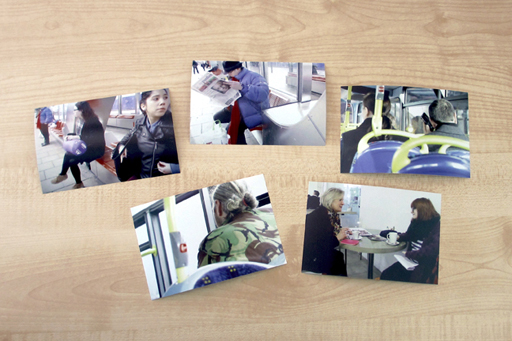
Review the notes you’ve collected in your notebook to find a character to develop further.
Activity 1.3 Writing a character sketch
Pick a character. If you’ve collected, in your notebook, details about people you’ve spotted or spoken to during this week, pick one of these characters. Alternatively, you can pick one of the characters from the opening video, Keeping track of useful details.
Write a short character sketch – no more than 200 words – in which you concentrate on appearance and any particular mannerisms you noted.
You will come back to this later so save a copy on your computer or device.
1.4.2 Reading characters
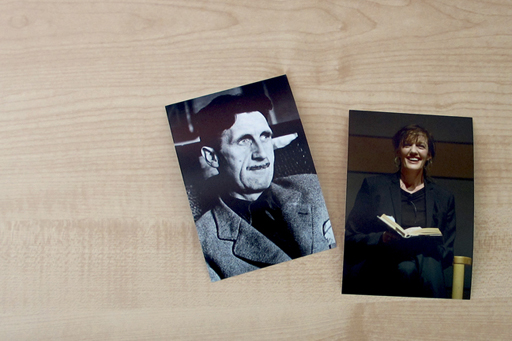
Reading other novels and stories to see how characters appear is one of the most essential preparations you can undertake.
Take a look at these character sketches from George Orwell’s Burmese Days and Zoë Heller’s Notes on a Scandal. Note down how you think the writers are managing to portray character. The extracts are also available as a PDF for your convenience.
The first thing that one noticed in Flory was a hideous birthmark stretching in a ragged crescent down his left cheek, from the eye to the corner of the mouth. Seen from the left side his face had a battered, woe-begone look, as though the birthmark had been a bruise – for it was a dark blue in colour. He was quite aware of its hideousness. And at all times, when he was not alone, there was a sidelongness about his movements, as he manoeuvred constantly to keep the birthmark out of sight.
The first time I ever saw Sheba was on a Monday morning, early in the winter term of 1996. I was standing in the St George’s car park, getting books out of the back of my car when she came through the gates on a bicycle – an old-fashioned, butcher-boy model with a basket in the front. Her hair was arranged in one of those artfully dishevelled up-dos: a lot of stray tendrils framing her jaw, and something like a chopstick piercing a rough bun at the back. It was the sort of hairstyle that film actresses wear when they’re playing sexy lady doctors. I can’t recall exactly what she had on. Sheba’s outfits tend to be very complicated – lots of floaty layers. I know she was wearing purple shoes. And there was definitely a long skirt involved, because I remember thinking that it was in imminent danger of becoming entangled in her spokes. When she dismounted – with a lithe, rather irritating, little skip – I saw that the skirt was made of some diaphanous material. Fey was the word that swam into my mind. Fey person, I thought. Then I locked my car and walked away.
My formal introduction to Sheba took place later the same day when Ted Mawson, the deputy head, brought her into the staffroom at afternoon break for a ‘meet and greet’.
I was off in a far corner when Mawson ushered Sheba in, so I was able to watch their slow progress around the room for several minutes, before having to mould my face into the appropriate smile.
Sheba’s hair had become more chaotic since the morning. The loose tendrils had graduated to hanks and where it was meant to be smooth and pulled back, tiny, fuzzy sprigs had reared up, creating a sort of corona around her scalp. She was a very thin woman, I saw now. As she bent to shake the hands of seated staff members, her body seemed to fold in half at the waist like a piece of paper.
‘Our new pottery teacher!’ Mr Mawson was bellowing with his customary, chilling good spirits, as he and Sheba loomed over Antonia Robinson, one of our Eng Lit women. Sheba smiled and patted her hair.
Pottery. I repeated the word quietly to myself. It was too perfect: I pictured her, the dreamy maiden poised at her wheel, massaging tastefully mottled milk jugs into being.
1.4.3 Week 1 quiz
The following quiz will encourage you to think further about developing characters, but it will also encourage you to read as a writer.
Complete the Week 1 quiz now.
Open the quiz in a new window or tab then come back here when you’ve finished.
1.4.4 Comparing your characters
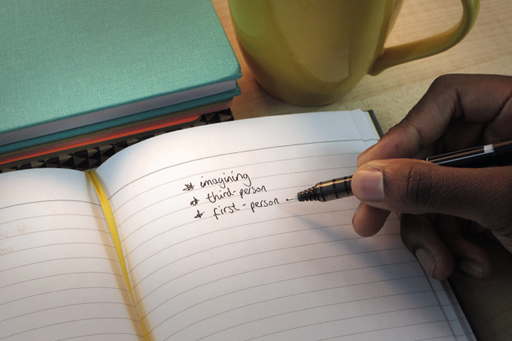
Can you use any of these methods in your stories and with your characters?
Having looked at the characters and ways of revealing characters in the passages from Burmese Days and Notes on a Scandal, go back to your character sketch and add any elements – for instance, details of appearance or behaviour – which you think might bring the character to life for your reader.
- Consider the ways in which your reader might be getting involved in the invention and imagining of your characters.
- Orwell uses third-person narration, and focuses on one physical aspect of Flory to create a picture of his psychological state.
- Heller uses first-person narration, which means we are dealing with two characters – the character being described, and the character doing the observing and describing. This adds an intrigue about the relationship between the two characters.
- Neither method is better than the other – they are just different approaches. Check whether you are using third or first person narration.
- Remember that your reader will always have to participate in the imagining of your characters.
1.5 Summary of Week 1
At the end of the first week of Start writing fiction, you’ve explored the differences between fact and fiction, begun to look at how characters are developed and heard from some successful writers on how they started to write.
You’ve also started your own notebook – hopefully you’ve already experienced how keeping a notebook can help your development as a writer.
In Week 2, you’ll think about what inspires you to write, what you can learn from other writers and how to start writing. You can move on to Week 2 now.
If studying this week of Start writing fiction has inspired you, take a look at the area specifically created for you to explore more about writing fiction on OpenLearn.
References
Acknowledgements
This course was written by Derek Neale.
Except for third party materials and otherwise stated in the acknowledgements section, this content is made available under a Creative Commons Attribution-NonCommercial-ShareAlike 4.0 Licence.
The material acknowledged below is Proprietary and used under licence (not subject to Creative Commons Licence). Grateful acknowledgement is made to the following sources for permission to reproduce material in this unit:
Figures
Figure 5 © The Open University/J Vespa (Garland)/Jeremy Sutton-Hibbert (Roberts)/David Levenson (Gurnah). Ben Stansall (Roffey)/Ulf Andersen (de Bernières) - all via Getty Images/Rory Carnegie (Pears)
Figure 8 © The Open University/Getty Images/Popperfoto (Orwell)/Amy Graves (Heller)
AV
Why writers write © The Open University/Alex Garland/Michèle Roberts/Tim Pears/Abdulrazak Gurnah/Monique Roffey/Louis de Bernières.