Week 3: Writing is editing
Use 'Print preview' to check the number of pages and printer settings.
Print functionality varies between browsers.
Printable page generated Tuesday, 14 July 2026, 2:39 AM
Week 3: Writing is editing
Introduction
Transcript
Editing is all important. Most writers spend as much, or more, time editing and redrafting as they do writing first drafts. But you can’t edit without first of all getting that first draft down.
Once you have a first draft, you have something to improve on. This is where you can rethink what you’ve done. Change whatever you like. Say things differently, or clarify where necessary. You can improve your writing.
3.1 Reviewing and redrafting

Rereading, reviewing and rewriting your work are crucial and often ongoing activities.
Reread the story that you wrote in Activity 2.5 at the end of Week 2, prompted by something heard on the radio, and check what you’ve written. Try reading it aloud, as that can help you to become aware of things in the writing, such as its rhythm, elements that you don’t notice when you are reading it silently.
Can you see ways in which you could bring the character (or characters) more to life? Rewrite the story incorporating your new ideas.
Ask yourself the following questions:
- Do the characters come across vividly?
- Is any of your word usage surprising? Does it help the reader to ‘see’ the characters?
- Now that you look at it again do you think any of the descriptions are predictable and dull?
- Are any of the words and phrases you have used too familiar?
3.1.1 Reading work in progress

Remember that you can get your ideas for future stories from all sorts of sources.
For example:
- the radio, as you’ve done with your recent story
- a newspaper article or headline
- a fragment of speech overheard
- a childhood memory
- a smell
- an image
- story prompts from the Prompt cloud PDF.
Reflect on the following questions, with regard to your radio story:
- Did you think what you wrote was a story?
- What made it a story?
- Did it have a structure?
- How did you go about portraying characters?
We will talk more about what makes up a story, but for now think of it as a narrative with a beginning, middle and end.
3.2 What is editing?
Editing is an important part of the creative process. You will learn some hints and tips for editing your work: when to look at the big picture, when to look at the detail, and when to share your edited writing.
A writer is simply a word for a person who writes. That’s all it takes to ‘qualify’ as a ‘writer’. But remember, published stories and novels very seldom emerge fully formed, or perfect, as if by magic. They have undergone many transformations before they reach the shelves. They are rarely, if ever, the raw expression of a writer’s output.
The short story writer V.S. Pritchett habitually wrote first drafts that ran to ten times the length of his final draft. This underlines the integral role that editing plays in the business of writing. A draft is just that, and can be revised up until the moment it is ready for publication.
To start writing fiction also means to develop your faculty of self-criticism. A great part of writing fiction is knowing how, why and when you should edit your own work. This is just one of the points at which honesty enters the equation of writing. The more ruthless you can be about your own work, the better it will be.
3.2.1 Editing is your friend

So, what counts as editing and when should you do it?
It’s important to balance ‘editing’ against ‘self-censorship’. To write in perfect freedom – to express yourself without self-censorship – is one of the most important aspects of writing fiction. Your aim is to tell a story as you think it should be told, to the best of your ability. Editing, once that piece of work is done, is simply a way of clarifying that intention, of saying more clearly what you mean to say.
For example, you write what you think, at first, is a wonderful opening paragraph. You are very proud of it, understandably so: it is a fine piece of writing. But by the time you’ve finished the piece, something doesn’t ‘ring true’ about those opening lines. ‘But they’re so good!’ You can’t bear to part with them. Ask:
- Do they belong in that story, for sure?
- Are they really what you meant to say, or do you just like the way they sound?
Be ruthlessly self-critical and scrupulously honest at moments such as this. You will develop the ability to say what you mean (and not just like what you say: ‘showy’ writing is much easier to achieve than good writing).
Remember, editing is your friend! An average piece of writing can become a good piece, with good editing.
3.2.2 Editing practice
Editing is a practical activity and its benefits are only fully appreciated when you undertake it.
To demonstrate the importance of clarity, focus and the role of editing as part of writing, try the next activity.
Activity 3.1 Have a go at editing
Edit the following passage down to no more than two lines:
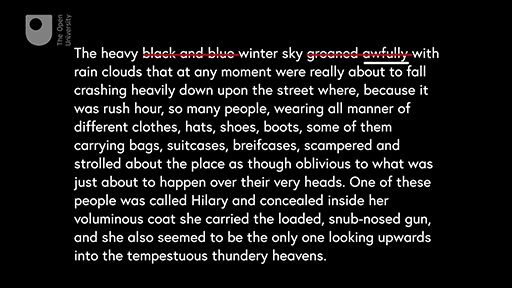
The heavy black and blue winter sky groaned awfully with rain clouds that at any moment were really about to fall crashing heavily down upon the street where, because it was rush hour, so many people, wearing all manner of different clothes, hats, shoes, boots, some of them carrying bags, suitcases, briefcases, scampered and strolled about the place as though oblivious to what was just about to happen over their very heads. One of these people was called Hilary and concealed inside her voluminous coat she carried the loaded, snub-nosed gun, and she also seemed to be the only one looking upwards into the tempestuous thundery heavens.
Remember to ask:
- What really matters about this scene?
- What ‘adds’ something to the scene?
- What merely adds confusion, detracting from the main point?
Discussion
Considering what other writers might cut or keep can help you to understand the core meaning in the passage and the editing process. This is one suggested edited version. It gives you an idea of what might be considered the core content of the passage:
The winter sky was heavy with rain. It was rush hour. Hilary concealed the loaded gun inside her coat.
Your version may not be quite the same. Ours is very short. Compare it with yours to see whether you decided to retain anything that we have cut, and think about the effect of either leaving that element in or taking it out. Think about why we might have cut out some of the elements, and consider how much stronger the short version is.
Remember that editing often occurs at the level of the sentence and is concerned with word order and punctuation, but also at the level of the whole scene, and even chapter. It is important to cut any overuse of words such as ‘quite’ and ‘really’, to be aware of any passages that are overwritten, and to ensure clarity of meaning. And then there are such aesthetic considerations as style, voice and rhythm. This brief illustration is focused more on the issues of overwriting, redundant words, and clarity of meaning.
There are two different but equally important skills that a writer needs to develop, skills that sometimes seem contrary: the skill to observe details that can bring a story to life and the skill to cut out extraneous details, elements that don’t add to or improve the story.
3.2.3 Editing – big decisions
Editing is a process of decision making. Every writer will make different choices and have different reasons for their choices.
This is the process we followed to cut down the passage.
Transcript
3.2.4 Editing summary
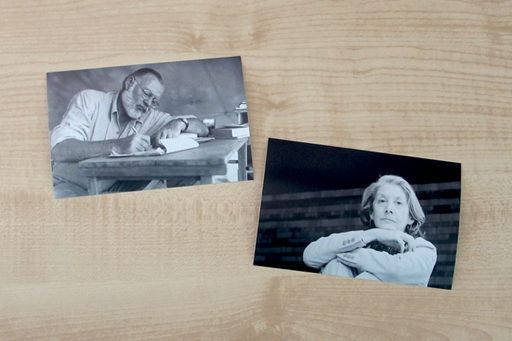
Ernest Hemingway said he could tell he’d had a really great day’s writing when even the work he threw away was good. The South African writer Nadine Gordimer describes how she ‘used to write three times as much as the work one finally reads.’
Have the courage to edit your own work, even when you might have spent time and energy in producing it. It’s better to have written ten drafts of a story and end up with something you are proud of, than to have had a great idea for a story, but let it go to waste by being nervous about setting it down in case it wasn’t perfect first time, or by thinking you need certain skills before you attempt it, or by ‘talking it away’.
Remember you don’t need to wait to be inspired. You can find all sorts of ways to begin writing, and you can then reflect on what you have written later and start to do the work of selecting what to keep and what to edit out.
After you have written a first draft, interrogate your writing using this editing checklist. Remember that the aim in editing is in many ways the aim in writing: clarity of expression.
Editing checklist
- Is it what you meant to say, really?
- Have you found the best way to convey it?
- Would a particular event really have happened that way?
- Would a particular character definitely use that expression or turn of phrase?
- Does an idea or scene really belong where you’ve put it, or would the piece be better if that element was cut? Could it be used elsewhere, or on another occasion?
- What’s missing from your story? Details or background information?
- Is there enough to engage your reader?
- Do events occur in the best order and are significant events given enough weight, or are they lost beneath less important things? If so, is that what you intended?
- Does it read too slow, or too fast?
- Overall, does the writing convey the right tone – does it create the mood you hoped for?
3.3 Learn through writing

If you don’t start to write, you won’t write. It sounds like advice which is too obvious to repeat but many people talk a good story or book. Comparatively few begin.
It’s important to be bold, to start. Sometimes stories ‘keep’ – only you know when something is ready to be written. But often stories can be lost by waiting for the ideal moment to write them down.
Remember, unlike many other kinds of work, writing is your training. A doctor trains for years before qualifying; a writer’s training is the writing itself. Without writing, a person can’t ‘become’ a writer. To say that a person has ‘a great book inside them’ might be true, but it isn’t saying anything more than that there are great stories everywhere, in everything, wherever you look, just waiting to be told. The trick is to tell them. Only that way do they ever become ‘stories’.
Become your own best judge: the aim is to discover your kind of writing.
3.3.1 Generate and share something new
Beginning a new project should be made easier if you have been using your writer’s notebook frequently and wisely.
In this section you will generate a new story and share it with others.
Activity 3.2: Generating a new story
Part 1
Look through your notebook to see whether there are any ideas there you might be ready to use for a story. If there are, remind yourself of the things we have already said about getting started. Try to start something new – different from the character sketch and the story prompted by the radio.
If you don’t have an idea in your journal you want to develop, try looking at newspaper headlines to see if something sparks off an idea. If you still don’t have something that grabs you, try the Prompt cloud PDF.
Remember that stories are about characters, so once you have an idea for a story make sure you have a strong impression of the characters that will be at the centre of the story.
There is no specific target to meet here. Just start writing and see where it takes you. It might become a story that you want to develop further, and you might carry on working on it. It might be something where you write the first paragraph or two and then decide you don’t want to proceed further, and you’d rather try another idea. That’s up to you. Try to write at least 200 words, up to a maximum of 350 words.
Something you work on now could become the basis for a longer story later in the course.
Part 2
Share the start of the story that you wrote in Part 1 with others. It may not be as polished as you would like but getting feedback on your work helps you to improve your writing. Other people will read your work and offer helpful comments.
Remember: if your writing contains graphic material, you should warn people about this.
Guidelines for your posting
You should consider the following aspects when writing, and ask reviewers to read with these points in mind too:
- How was the central character portrayed and was this portrayal clear and interesting?
- What made you think this piece was a story and did you want to read on?
- What were the most, and least, successful aspects of the writing?
In the next section, you will be invited to exchange feedback with other writers.
3.3.2 Commenting on work

Reading the work of other writers who are trying the same tasks as you can be invaluable. It will speed up the development of your editorial skills.
Activity 3.3: Reading fellow writers’ work
Now, if you exchanged your writing, read work by your fellow writers and give some feedback.
- Use the writing guidelines from the previous activity as headings for your comments. These are:
- How was the central character portrayed and was this portrayal clear and interesting?
- What made you think this piece was a story and did you want to read on?
- What were the most, and least, successful aspects of the writing?
- Ensure that you make at least one positive comment and at least one critical comment about each piece.
- Give reasons for your comments, don’t just say ‘I liked this’ or ‘I didn’t like that’.
- Check the guidance in the Feedback guidance PDF on giving and receiving review comments.
Exchanging work not only accelerates your writing and editing development but puts you in the privileged position of having a reader pay attention to your work. They will have a reciprocal interest in the work and they will be well-placed to offer objective feedback.
Reading reviews on your own writing
In feedback on your own writing, you will probably have received comments about:
- sentence-level editing, changing word order and using different words
- the portrayal of character, and whether the reader has been able to see the character
- structure and whether the passage works as a story with a beginning, a middle and an end.
Remember the guidance in the Feedback guidance PDF – always pause on any feedback that you receive. Don’t plunge straight into editing and rewriting.
If there are several comments about the same element then it usually means there is an issue there. If you want to resist some suggestions and observations, you may well be right – but make sure your reasoning is sound.
3.4 Summary of Week 3

This week you have submitted a story for review and hopefully received feedback on that story. You may also have given feedback to others. Are there any common aspects that you noted in others’ work and which reviewers noted in your writing?
The process may have felt quite daunting at first but hopefully it will have encouraged you in your own writing and given you confidence in giving feedback. There'll be another opportunity to take part in this peer review process in Week 5.
Next week, you’ll think more about character and developing your plot line. You’ll also explore where to find ideas for stories. You can move on to Week 4 now.
If studying this week of Start writing fiction has inspired you, take a look at the area specifically created for you to explore more about writing fiction on OpenLearn.
Acknowledgements
This course was written by Derek Neale.
Except for third party materials and otherwise stated in the acknowledgements section, this content is made available under a Creative Commons Attribution-NonCommercial-ShareAlike 4.0 Licence.
The material acknowledged below is Proprietary and used under licence (not subject to Creative Commons Licence). Grateful acknowledgement is made to the following sources for permission to reproduce material in this unit:
Figures
Figure 6 The Open University/Getty Images: Earl Theisen Collection (Hemingway)/Corbis Images: Sophie Bassouls/Sygma (Gordimer)