Week 3: Learning to think in a digital age
Use 'Print preview' to check the number of pages and printer settings.
Print functionality varies between browsers.
Printable page generated Wednesday, 1 April 2026, 3:50 AM
Week 3: Learning to think in a digital age
Introduction
You will now move on from the social world of children to the potential influence of digital technology on children’s learning.
This short video introduces you to some of the key ideas about how we learn. It is not a simple case of inputting knowledge and experiences into the brain; getting to grips with the different ways in which we learn is the starting point for understanding development.
Transcript
This week you’ll consider in particular how children might be processing new information differently with and without technology. How does digital technology help to mould the learning mind? How do the social and other experiences it offers influence our ability to learn or to retain new information, and do these experiences actually affect how we think, feel and develop?
1 A pyramid of digital engagement?
Young children learn about the world in a number of different ways. Sometimes they think through a problem and work it out, sometimes they try out different solutions until they find something that works, sometimes they learn best by watching and imitating others and sometimes by talking with the people around them, who can guide and support them.
One way of thinking about children’s learning in the digital world is to consider their actual engagement with it. How is this different from traditional ways of learning information?
Wheeler’s ‘engagement pyramid’ of digital learning (Wheeler, 2013) suggests that the majority of screen activities online involve a similar progression to those offline, from passive activities of watching, ‘lurking’ and reading to more active processes of making and collaborating. We could argue that all learning follows a similar pattern, whether online or offline. Children start to learn initially by simply watching and listening to absorb what’s going on, followed by internalisation of the process to the point where it can be used creatively. Language, maths, science, philosophy – they typically need a passive phase followed eventually by creativity and finally by ‘curating’ the individual’s own ideas.
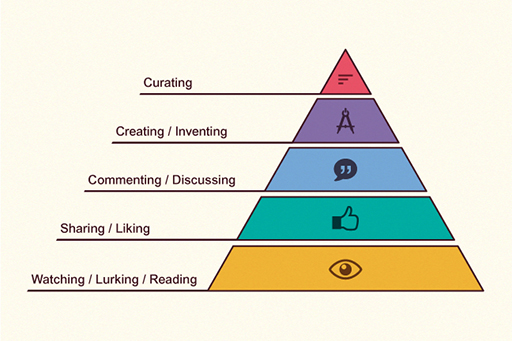
If you consider Wheeler’s pyramid, this pattern becomes clear. The wide base of the engagement pyramid suggests that a great deal of children’s digital engagement is fairly passive. For example, simply ‘watching’ or ‘lurking’ in the background. Children in this category are primarily absorbing content, like blogs, videos, podcasts or status updates, by observing others. They gather information in order to take decisions or to learn from others; or else they are looking solely for entertainment; or they want to be part of the social space where learning occurs.
Now consider the upper layers of the engagement pyramid (commenting/discussing and creating/inventing). It is only here that children actively engage with their online environment in ways that can expand their thinking, through creating, editing and communicating ideas. Children who respond to others’ content, for instance through comments on blogs, news stories, status updates or reviews, are actively participating by giving support or contributing ideas. They are also actively creating or inventing by writing and publishing their own content, for example on blogs or sharing sites such as YouTube or Tumblr. These platforms are not only about learning but also about generating revenue through placed advertisements, both for the platform owners and the content creators. The so-called ‘kid influencers’ or ‘kid YouTubers’ generate considerable amounts of money by promoting toys or clothing on their social media accounts. One might argue that their online persona diversify the family income (or significantly boost it) but one might also argue that from an extremely young age, these children are thrown into a world where success and achievement are measured by dollars and the number of views and followers. What is your view on this? Discuss or write down your answers.
1.1 Learning through communication
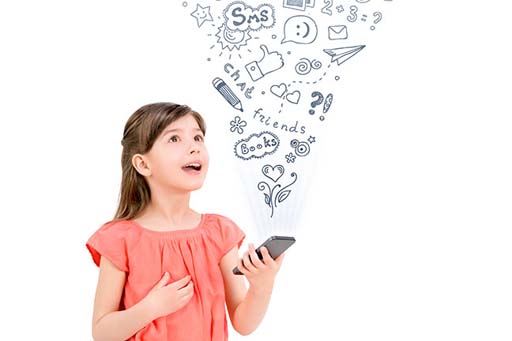
Children learn a huge amount from the people around them through interacting and exchanging ideas. Very often we learn new facts and information by talking, speaking and interacting socially, and this is most evident in text messages and smartphone applications such as social networking or instant messaging.
A new way of writing and speaking has evolved through text messaging on mobile devices. In some ways, children are learning by creating and inventing new modes of communication.
Children are basically learning a new kind of language that is still evolving, and converting spoken to written language in interesting ways. The use of text message abbreviations is often referred to as ‘text speak’ or ‘textisms’ (Underwood and Farrington-Flint, 2015). While some people consider text as a method of communication can convey derogatory messages (Kleinman, 2010), the advantages of text speak are its speed and immediacy, particularly in creating newer versions of our written English. Consider these examples, where children were asked to translate text abbreviations into standard written English:
4got 2 call k8 2nite bcs i woz studyin, i h8 xamz
LO! How R u? I havnt cn U 4 ages
hi m8 u k?-sry i 4gt 2 call u lst nyt-y dnt we go c film 2moz. hav U dn yor h/w?
Im goin out w my bro & my best frNd tomorrow
Do U wnt 2 cum along?
How easy was it to decipher the meaning of these text messages? For many children it’s easy, although for others it can seem like a completely new language.
Optimists view text message abbreviations as playful, inventive and creative features, but pessimists feel that they threaten more traditional standards of written English, leading to a generation of ‘linguistic ruin’ (Cingel and Sundar, 2012). For the slightly older age groups there are similar arguments about the use of Twitter, suggesting that abbreviations found in tweets are often shorthand forms that reflect nothing more than examples of poor grammar (Grosseck and Holotescu, 2008). However, the sheer popularity of texting among children prompts us to question whether these academic critiques are in fact correct.
And not all academics share the same opinion, as you’ll see in the next section.
1.2 Texting is killing language
In this fascinating talk, John McWhorter, a linguist and political commentator, argues that texting is not such a negative phenomenon. He views it as ‘miraculous’ – not just energetic, but a highly creative activity. He suggests that there’s much more to texting, linguistically and culturally, than there might seem. In relation to learning, the video demonstrates that children learn through ‘creating’ and ‘inventing’ new ways of communicating and exchanging ideas.

Transcript
Do you think McWhorter feels that texting has a positive or negative influence on children’s language? As he says, there are cognitive benefits; now we can write the way we talk, and texting should be seen more like ‘casual speech’ than actual writing.
A further worry from the pessimists is that text messaging and using different kinds of technology might not be helpful to children’s learning but in fact act simply as a distraction.
Activity 1
Having listened to the opinions of John McWhorter, consider in what ways you feel that digital technology is shaping children’s learning through communication. Think about the following questions.
- Are there any advantages for children learning to use text abbreviations as a way of communicating with friends? Are they really as ‘miraculous’ as John McWhorter suggests?
- Is there a risk that knowing and using text abbreviations may have a detrimental effect on children’s traditional written language skills?
Make some notes about your views.
1.3 Ebooks are killing reading
It is not just writing that is being sharped by new ways of content sharing. Reading on and with screens has changed what it means to read for pleasure and for learning. When it comes to reading textbooks or online information, the access to digital texts has been harnessed by many schools worldwide. Unlike print textbooks, learning material accessed on the computer can be connected to teachers’ online environments where they can check on their individual dashboard as well as the whole classroom’s progress, provide personalised feedback and access ready made or tailored content. When students access information online for learning purposes, they need to develop critical literacy skills to differentiate what is real and what is fake information, and how to trust sources. The iFuCO project involved research groups from three Finnish and two Chilean universities, led by the University of Turku in Finland. It focused on 11–13-year-olds in Finland and explicit teaching of online enquiry skills. The students were taught how to search for information, how to evaluate and how to synthesise it. Interestingly, this teaching happened through videos, designed by the researchers, and proved to be very successful.
But what about reading for pleasure? Some academics who study children’s literature and literacy voiced the concern that children’s reading of stories digitally impacts negatively on their reading experience. Other scholars argue that the format doesn’t matter, that it is all about the content, the story, that needs to deeply engage readers. There are two key things to remember as you think about this. First, think of the design of the digital text format. Ask yourself: are there many ‘bells and whistles’ in the form of interactive features, hyperlinks or advertisements taking the reader’s attention away from the content? If the answer is yes, then it is unlikely that it will support the readers’ comprehension of the text but instead take them to other experiences. Second, ask yourself whether the digital format offers something that a print format couldn’t. For example, while print books can be customised by readers physically marking their pages or choosing the next story as in the Choose Your Own Adventure series, digital books can be personalised with information about the reader’s real-time progress of reading, the reader’s photograph or voice-over. In addition, Goodreaders personaliser recommendations provide recommendations for millions of books, together with readers’ evaluations. There are places where the reader chooses the path or where responses to quiz questions determine the path.
Before you read the next section, ask yourself: what is the added value and what is the value lost with reading digitally?

1.4 Multitasking as a new way of learning
The problem with multitasking is the need to keep changing backwards and forwards from one activity to another, switching your thoughts between tasks repeatedly. Multitasking with a phone is so prevalent among those with access to these technologies that one study even called it the ‘epidemic of distraction’ (Valkenburg, 2011). The question whether heavy multitaskers disadvantage their future development is taken up by Lui and Wong (2012), who show the negative consequences of multitasking. Children have been shown to perform poorly in certain cognitive tasks involving task switching, selective attention and working memory, possibly because they tend to pay superficial attention to lots of information all at the same time without focusing sufficiently on the information that is most relevant to the task (Lui and Wong, 2012). You can imagine the media headline related to this: ‘Modern kids unable to focus due to distractions’ or similar.

Again, however, not all experts agree that multitasking is bad for children. Some scientific studies (Granic, Lobel and Engels, 2014; Cardoso-Leite, Green and Bavelier, 2015) have also shown positive effects of multitasking.
In video games, for example, children need to focus on several things at any one time and learn simply by trying things out and seeing what works and what doesn’t. Many video games rely on this type of trial-and-error learning, which offers regular rewards and reinforcements that improve learning. Researchers have found that playing video games can be beneficial as they can promote divided attention skills, a sound foundation for multitasking. Playing games can even help promote alertness, quick reactions and thus may contribute to healthy brain development, although there is no solid evidence for this.
2 Brain development in a hyper-tech world
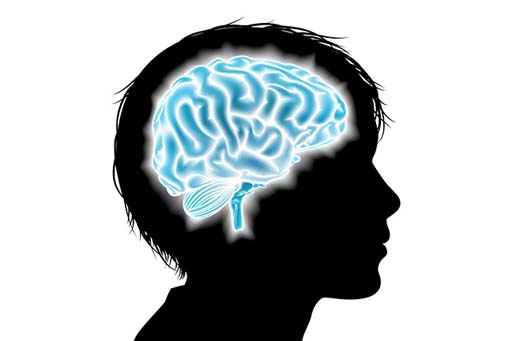
In the face of the barrage of technology-induced stimulation, and new ways of learning and communicating, a common question from parents, educators and scientists is ‘how is this affecting young brains?’
In Week 1, you were introduced to the idea of a ‘digital native’ (Prensky, 2001) and this was linked to the view of neuroscientists that brains can, and do, change constantly with new input throughout our lives, which is a process called neuroplasticity.
A central discovery of neuroscience is that the brain continues to develop its ‘wiring diagram’ well into a person’s twenties at least. The frontal lobes, regions critical to high-level cognitive skills such as judgement, multitasking, executive control and emotional regulation, are the last to develop fully.
It might be useful to revisit those suggestions again and consider whether children’s brains are changing as a result of their engagement with technology, especially video games.
2.1 A young brain and video games
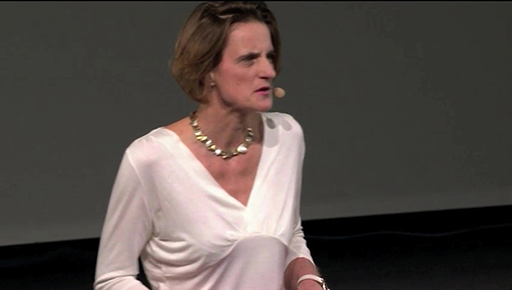
Brain scientist Daphne Bavelier wants to know how fast-paced video games affect the brain. She has some surprising news about how video games, even action-packed shooter games, influence our learning and focus.
As you watch the video, think about the key points that Bavelier raises with regard to the impact of video games on children’s development.
Transcript
The next section summarises other views on this topic.
2.2 The good, the bad and the ugly

Although Daphne Bavelier suggests that video games can be extremely popular and supportive to children and their learning, not everyone takes this view. Since it is still early days in terms of the volume of research, there are as yet no definitive answers.
Consider some of the psychological evidence around the positive and negative aspects of gaming from an article The positive and negative effects of video games focused on younger children (three to six years old), from the Raise Smart Kid website.
Positive aspects may include:
- developing children’s problem-solving and logical thinking
- supporting hand–eye coordination, fine motor and spatial skills
- encouraging quick thinking and decision making
- stimulating memory and concentration and the ability to engage in multitasking.
Negative aspects may include:
- screen time binging is bad for the eyes
- violent video games are likely to increase aggressive thoughts, feelings and behaviours
- frequent and prolonged playing of video games can increase attention problems and distractibility
- immersive video games, especially those with virtual reality and 3D elements can encourage children to confused reality with fantasy.
2.3 Your view on video games
Next, you will think about your own views on video games.
Activity 2
Think about the following questions:
- In your experience is there a link between video game playing and negative behaviours, such as violence, aggression and social isolation?
- Being more of an optimist, what do you feel are the benefits of playing video games?
Make notes about your thoughts.
If you would like to explore more detailed accounts of the academic debate about such a ‘rewiring the brain’ topic, then we would recommend comparing the views of two researchers. Read this article by Professor Susan Greenfield, a professor of psychology and pharmacology at Oxford University: Living online is changing our brains. Compare it to the response from Neil Levy, Head of Neuroethics at The Florey Institute of Neuroscience and Mental Health, University of Melbourne: Your brain on the internet: a response to Susan Greenfield.
3 The strengths of new technology
In the following audio, educational psychologist Paul Howard-Jones offers his views on the impact of gaming on children’s development. He joins Daphne Bavelier in being more of an optimist. In particular, he focuses on how technology can help to shape the neural connections in the brain and strengthen the acquisition of new skills.

Transcript
Do you agree with his views?
3.1 Digital books
Parents and teachers as well as many librarians and book authors often ask whether ebooks are better than paper books or whether reading on screen is worse or better than reading on paper. Comparing the two formats as if one of them could be eliminated is an unhelpful dichotomy. Children need both formats, and both formats are here to stay. A more productive question therefore would be to ask who they work for, how they work, under which conditions and for which purpose of reading.
If you are interested in reading more about the research on children’s digital books, check out this article written by one of the course authors: Reading to your child? Digital books are as important as print books.
3.2 Costs and benefits
This week you focused on how digital technology may be changing the way the digital child thinks and learns. You have looked briefly at some of the influences on that change, such as texting and the way that we engage with information and each other in an online environment.
You considered the impact of a digital culture on children’s brain development and whether the benefits afforded by the digital world outweigh any costs. We hope this has prompted you to consider innovative uses of technology for children and to explore how video games can actually help support and promote learning in interesting ways.
In the final week, you will look to the future for the digital child as a learner and what the learning environment might look like for them.
References
Acknowledgements
This free course was written by Nathalia Gjersoe, Natalia Kucirkova and John Oates. It was first published in October 2016 and updated in January 2020.
Except for third party materials and otherwise stated (see terms and conditions), this content is made available under a Creative Commons Attribution-NonCommercial-ShareAlike 4.0 Licence.
The material acknowledged below is Proprietary and used under licence (not subject to Creative Commons Licence). Grateful acknowledgement is made to the following sources for permission to reproduce material in this free course:
Figures
Figure 1 Source adapted from Wheeler, 2013
Figure 2 © Anatolii Babii/iStockPhoto.com
Figure 3 © Jevtic/iStockPhoto.com
Figure 4 © ManoAfrica/iStockPhoto.com
Figure 6 © PeopleImages/iStockPhoto.com
Figure 7 Images © monkeybusinessimages/iStockPhoto.com, © University of Bristol
Figure 8 © ManoAfrica/iStockPhoto.com
Text
3.2.2 Extract from: Raise Smart Kid (no date) ‘The positive and negative effects of video games online’ [online]. Available at http://www.raisesmartkid.com/3-to-6-years-old/4-articles/34-the-good-and-badeffects-of-video-games
Audio visual
Video
3.1.2 Texting is killing language, 3.2.1 Your brain and video games © TED Conferences LLC TED.com
Audio
3.3 The Educators, Episode 5, 10 September 2014, © BBC
Every effort has been made to contact copyright owners. If any have been inadvertently overlooked, the publishers will be pleased to make the necessary arrangements at the first opportunity.
Don't miss out
If reading this text has inspired you to learn more, you may be interested in joining the millions of people who discover our free learning resources and qualifications by visiting The Open University – www.open.edu/ openlearn/ free-courses.