What do genes do?
Use 'Print preview' to check the number of pages and printer settings.
Print functionality varies between browsers.
Printable page generated Wednesday, 1 April 2026, 4:09 AM
What do genes do?
Introduction
This course explores how information contained in DNA is used, explaining the flow of information from DNA to RNA to protein. Also introduced are the concepts of transcription (as occurs between DNA and RNA) and translation.
This OpenLearn course provides a sample of Level 1 study in Science.
Learning outcomes
After studying this course, you should be able to:
understand how the linear sequence of DNA within a gene is related to the linear sequence of amino acids of a protein
understand how the information in DNA is carried via RNA to make a protein
understand how RNA is synthesised from DNA by the process of transcription
understand where the processes of transcription and translation occur within the cell.
1 Using information stored in DNA
One important property of DNA is that it carries genetic information in the simple coding language of just four bases. These bases, which can be arranged in a huge variety of sequences, represent a vast potential store of information. In this course, we consider how this information is used by the cell. The key structural feature of complementary base pairs, which plays an important role in both stability and replication, is also the basis for how DNA functions as genetic material.
How does the simple coding language of DNA relate to the nature of the gene; that is, how do genes function? Genes, composed of DNA, specify proteins. How genes do this is the topic of this course. The essence is that the structure of DNA can be related directly to the structure of proteins, which come in a huge range of sizes and shapes, and this diversity arises from different combinations of just 20 amino acids. In the text that follows we will examine how the simple coding language of just four letters (bases) in DNA contains information for thousands of different proteins, each with its own unique sequence of amino acids.
The production of proteins is a far more complex process than the more straightforward process of DNA replication, partly because many other molecules are involved. Below we will review the overall process and then go on to examine each step in turn.
2 One gene–one protein
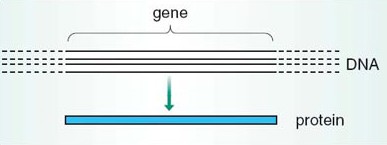
A gene is a short section of a long DNA double helix molecule, which comprises a linear sequence of base pairs.
SAQ 1
What is the basic (primary) structure of a protein?
Answer
A protein is a linear sequence of amino acids.
There is a direct and specific relationship between the linear sequence of base pairs that makes up a gene, and the linear sequence of amino acids in a protein molecule. This relationship, presented in a very simplistic manner in Figure 1, is known as the one gene-one protein hypothesis. Each gene codes for a different protein. Thus the gene for haemoglobin specifies the protein haemoglobin, and the gene for myoglobin specifies the protein myoglobin. How the DNA sequence of a gene gives rise to the protein, i.e. how the protein is synthesized, is the subject of the rest of this course.
Video: Click to view clip on the one gene-one protein hypothesis
3 The flow of information from DNA to RNA to protein
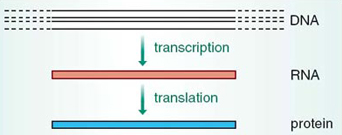
The information flow from DNA to protein is more complex than shown in Figure 1. The genetic information encoded within the DNA of a gene is carried via an intermediary molecule, RNA (ribonucleic acid). Information within a cell can therefore be seen as passing from DNA, via RNA, to a protein. This flow of information can be expressed in another way.
DNA makes RNA makes protein.
This statement implies that there are two separate steps in this information flow: from DNA to RNA and from RNA to protein; these are called, respectively, transcription and translation. Transcription of DNA produces RNA and the subsequent translation of this RNA produces proteins. These steps are summarized in Figure 2 (also click on the link to the video clip below).
Video: Click to view clip from DNA to RNA to protein
4 From DNA to RNA: transcription
In the process of transcription, the information in a gene, i.e. the DNA base sequence, is copied, or transcribed, to form an RNA molecule. RNA is therefore an intermediary in the flow of information from DNA to protein. Before we consider the details of transcription, we will first look at the structure of RNA.
The name ribonucleic acid suggests that RNA is chemically related to DNA. Like DNA, RNA is a chain of nucleotides.
SAQ 2
What are the three component parts of a nucleotide?
Answer
Each nucleotide consists of three parts: phosphate, a sugar and a base.
There are some important differences between DNA and RNA. One way in which RNA and DNA differ is in the sugar component; RNA has ribose (not deoxyribose as in DNA) hence ribonucleic acid. A second difference is in the nucleotide bases.
SAQ 3
What are the four bases in DNA?
Answer
The DNA bases are adenine (A), guanine (G), cytosine (C), and thymine (T).
In contrast, the RNA bases are adenine (A), guanine (G), cytosine (C) and uracil (U). Why one of the four bases in RNA is different from the equivalent base in DNA is not fully understood.
There is a third important structural difference between DNA and RNA. Recall that the basic structure of DNA is a double helix of two spiralled strands, i.e. it is double-stranded. In contrast, RNA is usually a single strand, as shown diagrammatically in Figure 2.
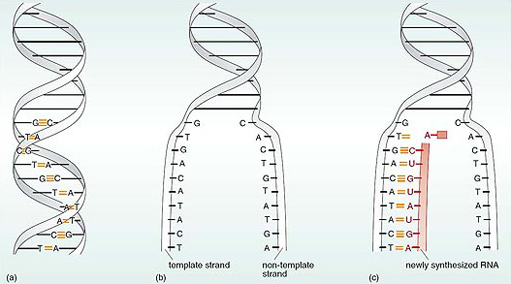
The similarities in structure between DNA and RNA suggest that RNA is synthesized in a manner similar to DNA replication, i.e. using the DNA as a template. This is indeed what happens. The process of transcription is illustrated diagrammatically in Figure 3 (see also the link to the video clip below). As in DNA replication, the starting point is a double helix molecule of DNA (Figure 3a). The length of DNA sequence corresponding to a gene unwinds and the two strands separate (Figure 3b). Here the process of transcription diverges from the familiar one of DNA replication, because synthesis of RNA molecules occurs on only one of the two strands: only one DNA strand is the template for RNA synthesis, and this is termed the template strand. The other DNA strand, which is not used as a template in RNA synthesis, is termed the non-template strand (Figure 3b). The basic mechanism of RNA synthesis is the same as that for DNA, in that pairing of complementary bases is the key to the process. The enzyme that brings about the synthesis of RNA is RNA polymerase, and is a different enzyme from the DNA polymerase that brings about DNA synthesis.
Video: Click to view clip from DNA to RNA: transcription
SAQ 4
Which bases are paired together in DNA?
Answer
C pairs with G, and A pairs with T.
5 Where does transcription occur in the cell?
Up to now we have described the processes of transcription without considering where each occurs within the cell.
SAQ 5
Given that transcription — the production of mRNA — requires a DNA template, where do you think this process occurs in the cell?
Answer
It must occur in the nucleus where the DNA in the cell is located.
However, once mRNA is produced, it leaves the nucleus and protein synthesis – translation – occurs in the cytoplasm. Thus transcription and translation are separated both in space within the cell and in time, in that one occurs after the other, as shown schematically in Figure 11.8. Thus the role of mRNA is to carry a coded message from the nucleus where the information is stored, to the cytoplasm where the coded message is translated into a specific protein; hence it’s name – messenger RNA.
Translation occurs at particular sites within the cytoplasm; it occurs on ribosomes. Ribosomes are large aggregates of proteins and ribosomal RNA (rRNA). Hence three types of RNA are involved in the process of translation but only one of them, mRNA, codes for proteins.
Video: Click to view clip of conclusion to this course
Conclusion
This free course provided an introduction to studying Science. It took you through a series of exercises designed to develop your approach to study and learning at a distance and helped to improve your confidence as an independent learner.
Acknowledgements
The content acknowledged below is Proprietary (see terms and conditions) and is used under licence.
Grateful acknowledgement is made to the following sources for permission to reproduce material in this course:
Course image: brewbooks in Flickr made available under Creative Commons Attribution-ShareAlike 2.0 Licence.
All other materials included in this course are derived from content originated at the Open University.
Don't miss out:
If reading this text has inspired you to learn more, you may be interested in joining the millions of people who discover our free learning resources and qualifications by visiting The Open University - www.open.edu/ openlearn/ free-courses