Artists and authorship: the case of Raphael
Use 'Print preview' to check the number of pages and printer settings.
Print functionality varies between browsers.
Printable page generated Sunday, 7 June 2026, 2:12 PM
Artists and authorship: the case of Raphael
Introduction
The Life and Works of Renoir; In Search of Rex Whistler: His Life and Works; The Life and Works of Rennie Mackintosh; Turner: His Life and Works in 500 Images. These are all titles of books about artists and there are plenty more in the same vein. In fact, there are often multiple variations of the same title: Michelangelo: Life and Work; The Life and Works of Michelangelo; Michelangelo: His Life and Work in 500 Images; Life and Works of Michelangelo Buonarroti, and so forth. Some of these are introductory or popular books, while others are scholarly tomes. A variant form might be Leonardo Da Vinci in His Own Words or Alvar Alto in His Own Words.
If we stop to question what these titles attempt to describe and define, we run up against two highly vexed relationships: first, between the biography of the artist and art-historical writing, and second, between the life of the artist and his or her ‘work’. This free course, Artists and authorship: the case of Raphael, examines both problems, as well as related questions of authorship as a form of explanation in art history, taking Raphael as a case study. The goal will be to initiate debates and discuss issues with regard to approaches that might be characterised as the life-and-works model.
This OpenLearn course is an adapted extract from the Open University postgraduate course, A843 MA Art History Part 1.
Learning outcomes
After studying this course, you should be able to:
understand how both primary and secondary sources need to be read critically to identify and evaluate arguments and approaches
understand and evaluate biography as a form of writing with its own traditions and conventions
demonstrate a critical awareness of differing approaches to art history
comprehend and engage with a range of ideas about selfhood and subjectivity.
1 Methodological transformations: 1970s and 1980s
The 1970s and 1980s were a moment of intense crisis in the discipline of art history, which led to a wide-scale re-conceptualisation of how to practise art history. Understanding this transformation is central to coming to terms with recent art history and we will now turn our attention to it and to the new approaches to the artist that it introduced.
1.1 The new art history
After the Second World War, art history tended to involve a mix of antiquarianism, connoisseurship and liberal humanist values that incorporated some of the idealist notion that art is a reflection of enduring, trans-historical values. At the same time, its commitment to the idea of the individual artist of genius aligned it with the requirements of the art market. The central assumption shared by most practitioners was that art provided its beholders (or consumers) with a unique sensory experience unsullied by social or worldly concerns. One of the better examples of this kind of art history is Anthony Blunt’s book on Poussin (Blunt, 1966). This is a deeply scholarly monograph by the then director of the Courtauld Institute of Art, but it is a world away from current concerns in the discipline.
In 1973 Nicos Hadjinicolaou outlined what he saw as three blockages, or ‘obstacles’ to the production of a serious study of art in Art History and Class Struggle (Hadjinicolaou, 1978). The second obstruction was art history as a history of civilisations, and the third was art history as a history of works of art, but first in his list was art history as a history of artists. Hadjinicolaou’s work was one contribution to a transformation of the discipline in the 1970s and 1980s. During this time there was a growing feeling that art history could no longer be practised in the way that it had been. In the wake of the political upheavals of 1968, which had enormous reverberations in the universities, the sense of gentlemanly taste that underpinned the discipline seemed to many irrelevant if not downright reactionary.
What is sometimes called the ‘new art history’ or the ‘social history of art’ shook up the status quo by asking key questions about the foundations of art history. Drawing on ideas from Marxism, such as the concept of ideology, and subsequently from feminism, structuralism and psychoanalysis, art historians began to challenge the idea of art as an autonomous practice; that is, one separated from wider social forces and interests. New questions seemed to impose themselves:
- What ideological role did art play in sustaining established wealth and power, from the medieval church to the corporate museum?
- How did the institutions of art (the guild, academy, art school, auction house or gallery) shape its production and reception?
- Could art be used to challenge conservative ideologies?
- What role was available for women as makers or beholders of art?
- What place was there for art history as a critical discipline?
- What ideological assumptions were embedded in art history and its forms (the monographic book or exhibition, the catalogue, the survey course)?
1.1.1 Reformulation
The reformulation of the 1970s and 80s took place in all aspects of art history as it bears on the artist’s biography or subjectivity. These new approaches entailed an examination of ideology and subject positions in the making and reception of art that brought about critiques of:
- myths and institutions that sustained the dominant view of art
- the individual as a locus of meaning or intention
- biography as a form or genre
- a coherent subject or body of work (oeuvre)
- genius, gender and related essentialist notions of the self
- rhetorics and practices of biographical explanation – the monographic form of art exhibitions and books.
Rather than a stable and self-contained font of meaning, the artist appeared instead as the carrier or bearer of values, languages and histories produced outside him or herself. As opposed to a unique, expressive subject, the artist was depicted as immersed in historical or socio-sexual forces. Often he or she was thought to be unconscious of these processes, mistaking fragments of ideology or representation for a coherent experience or inner life. The anti-humanist structuralism of the period represented a rich set of themes and questions for research.
This is not to say that everything that was argued or written was productive or ‘correct’. There was a lot of verbiage, fashionable silliness and toeing the line. Other arguments were often marginalised as off-message and some immensely significant thinkers were treated as ‘dead dogs’, only to return later full of vigour. Aesthetics was treated as off-limits, ‘empirical’ testability or ‘experience’ unreasonably dismissed, and art too easily lined up with the ‘dominant ideology’. Sometimes, the ideas were incoherent or their wider implications misunderstood.
1.1.2 From subject to subjectivity
Expanding on these thoughts it can be said that two central problems plagued the new art history as it developed during the 1970s and 1980s:
- Structuralism is notoriously unable to account for change – focusing on synchronic systems (structure), rather than the diachronic dimension (historical development). Change in ‘style’ and even the definition of ‘art’ is central to art history, so the static structuralist approach brings with it considerable problems.
- It introduced an aporia (unsolvable riddle) into conceptualisations of the artist-subject.
It is this second point that we are going to focus on, and it has two dimensions:
- How can subjects act critically or independently?
- How can the ideology of the subject be challenged?
1.2 How can subjects act critically or independently?
Structuralism, and its post-structuralist successor, is a (linguistic) determinist philosophy that allows little scope for human agency or will. This is an old argument that goes back to Christian debates over free will and determination: are humans responsible for their actions, or had God predetermined the course of events? The secularised philosophies of history debate the extent to which people (agents) actually shape the course of events, or are shaped by them. Most notoriously, in the French philosopher Michel Foucault’s account of disciplinary society the subject is constituted by ‘power’. From within this perspective it is not possible to explain how subjects challenge or rework inherited frameworks. There is a performative contradiction in this argument, since Foucault’s ability to analyse this process depended on his being outside the relations that he claimed were all-pervasive, and on the paradox of him being able to evade the conditions of subject formation that he claimed were all-encompassing.
Foucault simply posited resistance as the inevitable (but unexplained) complement to power. For Marxists and feminists committed to the radical transformation of existing social relations – and many of the art historians involved in this debate claimed allegiance to these intellectual perspectives – this is a fundamental problem. In art history, change (of, say, ‘style’) or the reworking of genres, themes and ideologies became difficult to envisage. This is one reason that T. J. Clark’s account of art and ideology seemed so powerful at the time (1973a, 1973b, 1985). While drawing on some aspects of the intellectual configuration we have been considering, Clark’s fundamental debt was to the Hegelian-Marxist tradition, which focused on dialectical contradictions and change (as distinct from more inflexible and dogmatic versions of Marxism, including Althusserianism). This meant that he could argue that works of art do not reflect preformed and stable ideologies; rather they rework inherited values and ways of working. Artworks transform ideology. Clark’s work sometimes runs close to presenting his favoured artist of the moment as transcending the historical forces at work, but he is often able to account for change, novelty and ‘singularity’.
1.3 Foucault, ‘What is an author?’
One key text within the structuralist literature on authorship introduced above is an essay by Michel Foucault (2009 [1969]) in which he poses the question, ‘what is an author?’ (for our purposes the ‘author’ can be understood as the ‘artist’). The article is required reading for many fields in the humanities and is one of the foundational texts of critical theory. In it Foucault challenges at the most fundamental level the idea that the author is the ‘source’ of his works and whose original ideas and intentions are given legible expression in them.
While we won’t have the opportunity to read this here, it is an important essay to consult if these issues interest you. The essay was written in response to a text written in 1967 by Roland Barthes which proclaimed the ‘Death of the author’. Along with ‘What is an author?’, Barthes’s essay has probably been the most influential account of authorship. Barthes insisted the author is a modern phenomenon. He wrote:
The image of literature to be found in ordinary culture is tyrannically centred on the author, his person, his life, his tastes, his passions, while criticism still consists for the most part in saying that Baudelaire’s work is the failure of Baudelaire the man, Van Gogh’s his madness, Tchaikovsky’s his vice. The explanation of a work is always sought in the man or woman who produced it, as if it were always in the end, through the more or less transparent allegory of the fiction, the voice of a single person, the author ‘confiding’ in us.
Barthes insists in a famous passage that the text is not the message of an Author-God, but ‘a multi-dimensional space in which a variety of writings, none of them original, blend and clash. The text is a tissue of quotations drawn from innumerable centres of culture’ (p. 146). These sources, he claims, come together in the mind of the reader and not that of an author beneath or behind the text: ‘the birth of the reader must be at the cost of the death of the Author’ (p. 148). Barthes is contesting the idea that an individual called an author can be the originating locus of a text or artwork. Rather, he suggests writers (or artists) rework existing forms and ideas. They are usually shaped by these pre-existing sources as much, or more, than they transform them.
1.4 Foucault’s author function
In ‘What is an author?’ Foucault uses the term ‘author function’ – a concept that replaces the idea of the author as a person, and instead refers to the ‘discourse’ that surrounds an author or body of work. It starts with the recognition that authorship and the different values and meanings associated with it are cultural products that vary widely from time to time and place to place. Scientific texts, for example, are valued more for their content rather than their ‘authorship’, while in the case of literary texts authorship becomes the most interesting aspect of the work.
According to Foucault, critics invent a variable idea of an author and of authorship that depends entirely upon their own preconceptions.
An important contribution by Foucault is what he calls the ‘discourse’ surrounding an author. Foucault developed the idea of a ‘discursive formation’ as an alternative to conceptions of ‘ideology’, ‘science’ or ‘theory’. According to him, a discourse consists in the whole range of related utterances that shape a particular question or field of enquiry. Discourses produce knowledge and effects of power, and they follow rules. In the case of an artist, the ‘discursive formation’ into which they fit includes not only their own statements, but also the critical writing on their work, popular representations and ‘myths’, institutional conditions of utterances (including legal categories), and general ideas about art and artists, both learned and popular.
So what does Foucault’s account do to the idea of the author as a stable point of origin, a concept fundamental both to the model of the genius artist and to the genre of the art-historical monograph?
Critics are invested in the idea of the author as a unitary font of meaning, a stable entity who precedes and originates the work by depositing any and all significance into it. Yet, Foucault argues, such an idea of the author is a fiction invented by the critic to provide a unifying principle that sets limits on the text’s infinite meanings. The ‘author’ contains the threats posed by the work’s complexities. As Foucault puts it, the author ‘serves to neutralize the contradictions that are found in a series of texts’ (p. 328). However, while Foucault, like Barthes, recognises the author as a fiction, he asks us to consider what that role does, and what it enables. This is a familiar move for him. Foucault regards structures (of power) as generative, rather than repressive. He asks what kind of knowledge they put into place or enable.
1.5 Subjectification: self fashioning
In this section you will consider the painting Hans Holbein’s The Ambassadors (Figure 1) in relation to the theory of ‘self-fashioning’, a concept coined by the American scholar of early modern English literature Stephen Greenblatt.
1.5.1 Greenblatt on Holbein’s Ambassadors
First, we will look at the image that stands at the centre of Greenblatt’s text (Greenblatt, 1980). This extraordinary double portrait in the National Gallery in London has attracted much attention in the fields of art history, philosophy and psychoanalysis, and has been the focus of landmark critical texts about subjectivity.
The portrait, painted in 1533 while Holbein was serving as court painter of King Henry VIII, shows two French ambassadors to England: Jean de Dinteville on the left and Georges de Selve on the right, both in their twenties at the time. They stand above a cosmati marble floor – modelled on the one at Westminster Abbey – in front of a table laden with musical and scientific instruments. The celestial and terrestrial globes, mathematics text, lute, quadrant, and other objects depicted in vividly realistic detail behind them belong to the disciplines known as the quadrivium, the arts of Mathematics, Geometry, Astronomy and Music. The other disciplines taught in universities at the time were part of the trivium, Grammar, Logic and Rhetoric, which, Greenblatt suggests, were represented by the ambassadors themselves. Below, cutting diagonally across the floor, is the famous skull in ‘anamorphic’ perspective (a form of extreme foreshortening that makes the image readable only from a side view). This clever piece of painting only reveals its true identity when the viewer looks at the picture from the right-hand side.
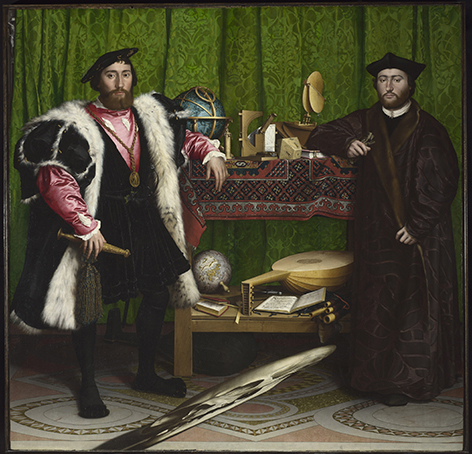
Spend a few minutes exploring the portrait and the skull; follow the link via the Google Art Project if you want to see the painting in ultra high resolution. Keep in mind that skulls were not an unusual feature of Northern European portraits at the time, but were most often placed on the back of the painting. They appeared there as a reminder of death, a memento mori, to counteract the worldliness of the portrait itself and suggest that the achievements celebrated in the portrait proper would ultimately be wiped away.
Now we will turn to Greenblatt’s discussion of this painting. Greenblatt coined the term ‘self-fashioning’, as he writes in the introduction, to suggest ‘quite simply that in sixteenth-century England there were both selves and a sense that they could be fashioned’ (Greenblatt, 1980, p. 1).
Expanding this further, Greenblatt argued for ‘an increased self-consciousness about the fashioning of human identity as a manipulable, artful process’ in this era (p. 2). Greenblatt finds in the Renaissance or ‘early modern’ period (these terms are used interchangeably in Greenblatt’s work) a new interest in the self and in ‘designating the forming of a self’ (p. 2). Long before the 1980s, the Renaissance had been associated with the cult of the individual and a shift of focus from the after-life of Christian belief to self-celebration in a more secular world. The celebration of ‘great men’ in biographies such as Vasari’s.
1.5.2 Ambassadors
Holbein’s Ambassadors appears on the front cover of Greenblatt’s book and Renaissance Self-Fashioning evokes it often as a sort of illustration of Greenblatt’s theory. Greenblatt compares the portrait with Thomas More’s Utopia, describing both as examples of ‘the representational power of art, its central role in man’s apprehension and control of reality’ (p. 21).
In his book, Greenblatt uses Holbein’s painting to describe the complexities of identity and subjectivity in the Renaissance, a new era for ‘the self’. Renaissance Self-Fashioning considers how this modern self is shaped through possibilities of what he elsewhere describes as ‘constraint’ and ‘mobility’. On the one hand, the individual butts up against those limits and structures imposed by society which give shape to the subject, while on the other he or she still possesses the ability to choose and construct an identity in an artful way. Subjectivity emerges out of the opposition between these two forces. With his interest in the social boundaries and ideologies that create the self, Greenblatt reveals his dependence upon Althusser and upon Foucault’s technologies of power.
Greenblatt focuses not only on the ideological construction of the human will. He also underscores the notion that the Renaissance offered new opportunities for the individual, such as the ability to change one’s religious beliefs or one’s social standing. Art (especially, one would imagine, portraiture) gives us insight into the continual back-and-forth between the codes of society and human desire to push against them, self-consciously and sometimes subversively. To access these operations Greenblatt is interested in those aspects of culture that don’t fall neatly into place. Texts and images are marked not by coherence and unity but, as he writes elsewhere, by ‘fields of force, places of dissension and shifting interests, occasions for the jostling of orthodox and subversive impulses’ (Greenblatt, 1982, p. 6).
In searching for particularly significant sites of conflict, Greenblatt maintains a very broad vision of culture, one that brings into its scope art, literature and other elements of what he calls the ‘symbolic economy’. Images, texts and objects circulate within culture just as goods do in a market economy: they are traded, passed from one person to another, and they go up and down in value depending upon how and when they are put to use. Historians of literature must pay close attention to these negotiations wherever they occur; hence Greenblatt’s exploration of a painting to introduce his analysis of Thomas More. Indeed, Greenblatt’s work in the 1980s and 1990s marks a time when the study of images was becoming more common within disciplines outside art history, and when textual–visual relationships were adopted as a concern of cultural studies generally.
2 Raphael, prince of painters
Following the discussion of Renaissance self-fashioning, here we will explore in greater depth the creation of artistic authorship in the early modern era with a case study of the artist Raphael. Traditionally, Michelangelo has been viewed as the paradigmatic genius of his age, and there have been many art-historical studies of his creative personality and its invention by himself and by his contemporaries. Raphael’s persona, however, is often taken for granted, in part because his graceful and well-mannered personality is less appealing to modern sensibilities than the abrasive, fiercely independent Michelangelo. Raphael is an interesting case study because the cult around his persona, first established in the artist’s lifetime, continues to inform his reverent treatment in recent monographs and exhibitions.
2.1 Misconceptions and misreadings
The Art Historian John Shearman spent decades assembling a massive two-volume work, Raphael in Early Modern Sources (1483–1602) (Shearman, 2003). Shearman’s attention to documents and his frustration with overly simplistic readings of them underlines how scholars often fail to look critically at primary sources themselves, resulting in misconceptions or misreadings, which are passed on from generation to generation. However, is it possible to achieve an unbiased understanding of an authentic Raphael? Can the true ‘facts’ of Raphael’s life ever be extracted from the original documents, or purged of our own ‘mistakes’? The analysis of subjects and subjectivity teaches us that the artist’s work cannot exist for us outside the received image of his identity. Instead, by using Foucault’s terms, we might pursue Raphael’s author-function, that is the context surrounding its origin in early modern era, and its transformation through successive generations of critical reception.
Stephen Greenblatt’s new historicism and his writings on self-fashioning have been important for recent methods. Yet, some have been sceptical of Greenblatt’s emphasis on individual personalities who attempt to shape their own destinies, preferring to look instead at social networks, which operate collectively to negotiate identity, and at intersubjectivity. Raphael was not the only person interested in his creative persona. So too were his patrons and literary sponsors: we will see, for example, how his ally Baldassare Castiglione was an important agent in the shaping of Raphael’s identity. We will also see how the artistic persona ‘Raphael’ was formed by its opposition to that of ‘Michelangelo’.
Looking at a Renaissance artist in detail is a particularly useful way of dislodging the sort of reverence for the individual, male genius that has been so dominant in art history. Yet how did Renaissance artists come to epitomise what it means to be an ‘artist’ in the European tradition? Here we will look back to the processes of invention that first created their cult of personality. Using texts and images we will assess how Raphael’s sixteenth-century biographies, portraits and his social behaviour at court shaped his (fictional) identity. A close reading of the sources allows us to consider how Raphael and his circle created ‘Raphael’, testing the boundaries between reality and invention. The point will be to access the creation of a major persona, one that defined a particular paradigm of artistic achievement – closely associated with grace, beauty and harmony – and an artistic ideal of classicism that endured for centuries.
2.2 Vasari and the reception of Raphael
This section will look at how Raphael was constructed as the sixteenth-century epitome of elegance, physical beauty and supreme grace.
Vasari’s biography of Raphael
We will begin to examine the formation of Raphael’s identity and its on-going persistence in the present by reading two more or less heroic accounts of his life: an extract from Giorgio Vasari’s Lives, first published in 1550 and reissued in a revised second edition of 1568, and the entry on Raphael from the The Oxford Companion to Western Art.
Activity 1
To familiarise yourself with Raphael’s career and his reception, first read the entry on Raphael from The Oxford Companion to Western Art (Chapman, n.d.).
Then read the extract from Vasari, Lives.
Now write down a few keywords or phrases that are used to describe Raphael and his work in the Oxford Companion which seem to echo Vasari’s account.
Discussion
The words I noted down were ‘social poise’, ‘sweetness’, ‘grace’, ‘prodigy’, ‘sensitivity’, ‘genius’, ‘harmonious’, ‘ideal of classical beauty’.
With these descriptive words in mind, we can begin to consider how Vasari’s biography canonically tied together Raphael’s work, his personality, and the facts of his life and death.
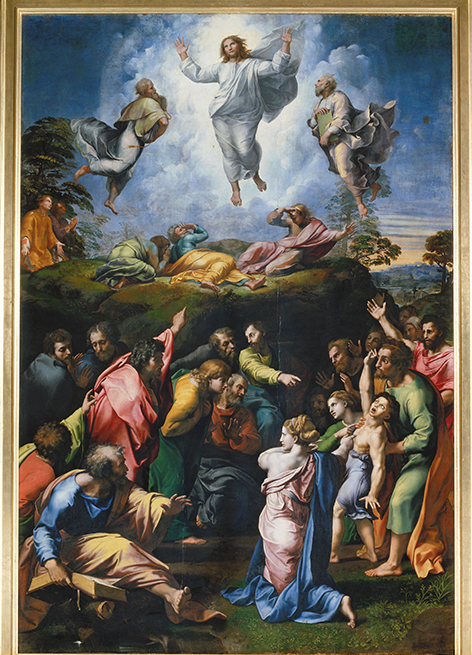
According to Vasari, the face of Christ in the altarpiece of the Transfiguration (Figure 2) was the last work Raphael ever painted. Having put all the ‘force of his art’ into the perfect figure of Christ, Raphael expended his creative powers and was overcome by death. Later on in the Lives Vasari relates that the Transfiguration was placed not for its intended setting in a church but at the head of Raphael’s body lying in state in his own studio. Its display next to Raphael’s corpse seemed to make a not-so-subtle connection between the artist and Christ, in keeping with the idea that Raphael had died after he had come too close to being divine himself. The epitaph written for Raphael’s tomb claimed that Nature had taken Raphael from the earth out of envy, after the artist had shown himself to compete with, or even conquer, Nature itself.
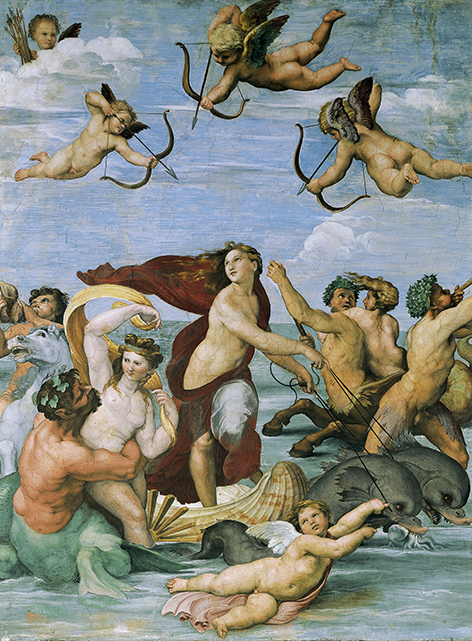
In the surprising passage at the end of the selection from Vasari’s Life, we learn that when Agostino Chigi, a wealthy Sienese banker, commissioned Raphael to work in the Villa Farnesina, the artist arranged for his lover to live there so as to satisfy his sexual passions and find motivation to finish his work. His excessive amorous exertions, Vasari claims, are what brought about the fever that ultimately killed him. This hyper-sexual image of Raphael seems at odds with the gentle and graceful one described earlier in Vasari’s Life, and it may be that the sexually charged subjects of the Farnesina frescoes, exemplified by the nude figure of the sea-nymph Galatea (Figure 3), have somehow infiltrated his account of the artist’s mortal fever. Philip Sohm offers a somewhat different interpretation. As he writes in his study of Caravaggio’s death, ‘a few artists died artistically in ways that bind the mode of dying to the style of painting, where death imitates life … [Some] artists died in the embrace of women or in hot pursuit – Giorgione, Raphael, and Domenico Puligo – and consistently these were artists whose styles were described in terms of feminine attributes: softness, grace, delicacy and tenderness’ (Sohm, 2002, p. 450).
Here it is important to note that the early modern period inherited from antiquity a view of human biology that linked male sexuality with artistic creativity, making men the active agents in procreation and women the passive agents. Women were thought to contribute the inert matter necessary to create a new life, while men’s seed has the power to awaken and animate this matter. Only the male gender, by extension, seemed capable of generating new inventions and creating artistically. Raphael’s hyper-sexualised persona in Vasari’s biography reflects these theories, exaggerating the artist’s sexuality to confirm his unusually potent creative abilities.
2.3 Critiques of Vasari, by Freud, and Kris and Kurz
Vasarian biography is still a powerful model in art history, despite a deep sense of scepticism about the heroic artist that began to find expression in the twentieth century. One blow was delivered by Sigmund Freud’s psychoanalysis of Leonardo, written in 1910. Freud was motivated by distrust of idealised narratives about artists that, in his words, ‘present us with what is in fact a cold, strange, ideal figure, instead of a human being to whom we might feel ourselves distantly related’ (quoted in Soussloff, 1997, p. 125).
Freud based his essay on what Leonardo had written about an early childhood memory of a kite (a type of bird which Freud, following a mistranslation of the original Italian into German, understood to be a vulture). Psychoanalysis led Freud to characterise the artist’s sexual identity as ‘ideal’ or ‘sublimated homosexuality’: Leonardo possessed homosexual inclinations but, according to Freud, had no active sexual life. Leonardo’s well-known love of scientific research had become ‘compulsive and a substitute for sexual activity’ (Freud, 1984, p. 27). Freud’s bold entry into the sexuality of the artist was deeply shocking at a time when the cult of Leonardo as universal genius was flourishing, especially in a newly unified Italy in search of national heroes.
Freud’s method of ‘psychobiography’ – reading into works of art to uncover the secrets of an artist’s unconscious mind – never entered the mainstream of art-historical research. A decade later, however, the fellow-Viennese Julius von Schlosser pioneered a much more influential method of deconstructing the myths of artistic biography in his book Die Kunstliteratur (Art Literature) of 1924 (von Schlosser, 1924). Von Schlosser’s work considered texts about art and artists from a philological perspective, asking how they were governed by literary conventions and rhetoric. Two of his students, Ernst Kris (who had studied with Freud) and Otto Kurz, developed these ideas in their Legend, Myth, and Magic in the Image of the Artist (Kris and Kurz, 1979 [1934]), a study of the patterns and leitmotifs that are repeated over and over again in artists’ biographies.
2.4 Other responses to Renaissance artists
The very powerful legacies of Vasari’s mythicising biographies and the heroicised personalities that Renaissance artists created for themselves have been dealt with in various ways, of which the following is a brief and highly selective review. From this you should get a sense of the varied landscape of scholarship on Raphael, shaped by a long history of reception and recent challenges to it.
2.4.1 Positivism
To a certain extent, a positivistic tradition of scholarship established in the nineteenth century continues today. This method seeks to find as many facts as possible about the life of the artist, in particular by examining archival documents. Examples include:
- J. D. Passavant’s Rafael von Urbino und sein Vater Giovanni Santi of 1839, which first established a canonical model of the scholarly monograph by discussing all of Raphael’s works in chronological order, using an unprecedented amount of archival and documentary material to reconstruct the events of his life and his commissions.
- John Shearman’s Raphael in Early Modern Sources (1483–1602) (2003) aimed to collect all of the surviving written sources related to Raphael. Decades of work went into this effort to end creative transcriptions of primary sources that had been repeated again and again by art historians, which Shearman viewed as an essential part of the creation of idealised, culturally conditioned re-imaginings of Raphael; that is to say, the documents themselves lie tucked away in the archives, unconsulted by art historians, while incorrect transcriptions (and translations of these) that were first published to back up particular interpretations endure in the art-historical literature, where they are used as if they were the ‘sources’ themselves. Shearman hoped to pick out the pieces of broken glass that the errors and biases of past generations of scholarship had left behind, starting anew with documents that had been cleansed of such mistakes. The problem, however, is that no matter how accurately the sources have been transcribed, no point of view on Raphael, and no interpretation of sources about Raphael, can be free from its own interests.
2.4.2 Vasari’s legacy
Further studies of Raphael and other Renaissance artists have challenged Vasari’s legacy on various fronts:
- Bette Talvacchia’s Raphael (2007) is a relatively recent monograph, written as is usual to present the artist’s complete oeuvre, but with an updated methodology that contests the ‘sweet, saccharine or, a more modern variant, boring’ (p. 10) image of the artist handed down by Vasari and others.
- Rudolf and Margot Wittkower’s Born under Saturn: The Character and Conduct of Artists (1963) is a classic text that builds on earlier work by Von Schlosser and Kris and Kurz, but from a less scholarly angle. It is particularly interested in the history of the melancholic artistic persona from Michelangelo to the bohemians.
- Catherine Soussloff’s ‘Lives of poets and painters in the Renaissance’ (1990) continues in the vein of Kris and Kurz by showing how Renaissance biographies of artists are modelled on those of poets; they follow literary conventions rather than offer true accounts of the artist’s style and intentions.
- Patricia Rubin’s Giorgio Vasari: Art and History (1995) was ground-breaking for its analysis of Vasari’s biographies not as a factual narrative but as an artful work of literature. Her chapter on Raphael ‘the new Apelles’ considers in detail how Vasari models Raphael as a courtier-painter who successfully rids his profession of the taint of manual labour.
- Piers Britton’s ‘Raphael and the bad humours of painters in Vasari’s Lives of the Artists’ (2008) underscores the influence of medical theories about human temperaments in Vasari’s Lives. It argues that Vasari’s description of Raphael emphasises the ability to keep his humours in balance, avoiding the problems caused by an excess of blood and bile in other artists (such as the melancholic Michelangelo).
2.4.3 Artist as genius
Some have questioned the notions of the supreme originality and autonomy of Renaissance artists. For example:
- Lisa Pon has considered the paradox in the promotion of individual genius in the sixteenth century when, at the same time, collaboration in the new art of printmaking was necessary for those who wished to publicise their inventions (Pon, 2004).
- Maria Loh’s Titian Remade (2007) considers the ‘minor’ Venetian artists who followed Titian after his death and their denigration in art-historical literature. Using critical theory, she challenges prejudices against imitation, copying or repetition, and argues that Titian’s followers used these techniques as a form of originality.
- Joseph Koerner’s The Moment of Self-Portraiture in German Renaissance Art (1993) is a dense and masterful tome that takes Dürer’s famous Self-portrait in Munich (see Figure 6) as its starting point, asking how Dürer’s portrait initiated a new discourse in Germany about selfhood and artistic sovereignty. Koerner sensitively balances these claims with later ones about the ‘birth of the self’ in the Renaissance, ideas that Dürer’s portrait itself anticipates. Koerner’s training at Berkeley during the formation of new historicism and the impact of Greenblatt’s ideas are evident in his approach.
A host of feminist studies have challenged the notion of the Renaissance as a triumph of the male genius. To cite just one:
- Fredrika Jacobs’s Defining the Renaissance Virtuosa (1997) challenges the idea that Renaissance masters were exclusively male. She asks why the names of female artists (Sofonisba Anguissola or Lavinia Fontana, for example) are overlooked. She traces this in part to the association embedded in Renaissance thought between male sexuality and artistic creativity mentioned earlier.
2.5 Raphael’s death: the primary sources
By now you have learned to question the idea that primary sources about artists, such as biographies, are somehow accurate reports, or offer easy access to artists and their work. While primary sources such as early biographies are generally defined as ‘original’ documents from the time of the artist’s life or shortly thereafter (works of art, or legal documents), and secondary sources as later interpretations or analyses, it is important to recognise that ‘primary’ sources are also interpretive rather than objective, even if the words ‘primary’, ‘source’, or ‘document’ give them an aura of truthfulness. Digging into archival records from the past one finds, just as with artists’ biographies, myth, opinion and self-promoting falsifications. As with secondary sources, understanding the author’s point of view is critical. An important difference between primary and secondary sources, however, is that when dealing with primary sources one needs to understand and analyse the author’s point of view from a historical perspective: the opinions the document expresses in and of themselves speak volumes about the moment in time under investigation.
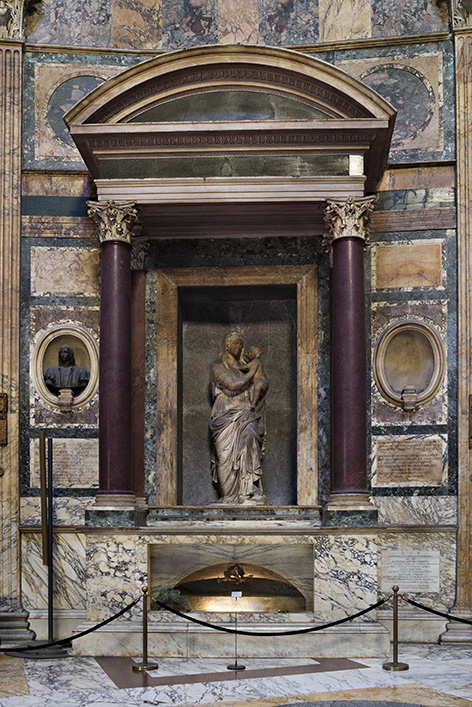
We will now put these ideas into practice by considering Vasari’s biography along with letters composed in the days following Raphael’s death. These describe a profound public reaction to the artist’s passing at such a young age, while in the midst of a major project to carry out a drawing survey and description of the ancient ruins in Rome. When he died Raphael was rich and famous. He lived in a large Roman palace worthy of a gentleman and was even engaged to a cardinal’s niece. He was given the high honour of burial in the Pantheon, an ancient temple built in Rome in the second century CE. Although the Pantheon had been rededicated in the sixth century as the Christian church of Santa Maria Rotonda, burials there were uncommon. Sources inform us that Raphael had set aside a large trust to pay for his tomb (see the ‘Letter from Pandolfo Pico’ in Section 2.6), which was placed at one of the temple tabernacles (Figure 4). A member of his workshop, Lorenzetto, sculpted an over-life-sized marble statue of the Madonna and Child for the altar.
2.6 ‘Raphael’ in death
You will now consider the ways in which fact and fiction blend together in primary sources about Raphael, asking how the artist is made into a mythical, super-human and even divine figure at the moment of his dramatic, premature death.
Activity 2
Thinking again about the extract from Vasari’s Life of Raphael, now read four descriptions of Raphael’s death and consider the common themes found in them.
While reading, ask yourself: how do they create an ideal artist out of Raphael? How is Raphael made Christ-like?
Discussion
The letters are ambassadorial dispatches from Rome, reporting on a piece of news that had gripped the city and would be of great interest to art patrons throughout Italy (Raphael was also engaged in projects outside Rome at the time of his death). The facts of these reports are stretched – either because they are received second-hand, or to add drama to the events.
All stress the artist’s youth at the time of his death, though they differ in their understanding of his age. Marcantonio Michiel gives it as 34, Pandolfo Pico and Girolamo Lippomano 33. Actually the artist died at age 37 but the shift to 33 made Raphael more Christlike, since Christ was also thought to have been 33 years old when he was crucified. Other inconsistencies point to an interest in finding the most meaningful dates for Raphael’s entry and exit into the world. Raphael, Lippomano points out, died on Good Friday, the day Christ died on the cross (‘Letter by Girolamo Lippomano’), while Michiel also relates that Raphael died on his own birthday (‘Diary of Marcantonio Michiel’). The actual date of Raphael’s birthday is not known, but what is clear is the invention of a perfect ‘Raphael’ through the pairing of his birth and his death, giving the artist’s life an aura of ideal harmony that matches the style of his paintings and architectural projects.
Prodigies were not an uncommon feature in Renaissance biographies of ‘great men’, but those described by Pico (‘Letter from Pandolfo Pico’) and Michiel (‘Letter from Marcantonio Michiel’) directly reference Christ. A section of the roof of the papal palace had collapsed shortly before the artist’s death, echoing a passage in the Book of Matthew that describes the earth shaking, rocks splitting and tombs opening up at the moment of Christ’s crucifixion.
Several of the sources mention Raphael’s wealth, which was clearly an important factor in his reputation, and the cost of his palace (which served as studio, showroom and residence) is of particular interest.
It is interesting that Lippomano’s account of Raphael’s death (‘Letter by Girolamo Lippomano’) draws a clear parallel between the artist and his patron Agostino Chigi. Raphael, the best painter of his age, died on Friday and then Chigi, the greatest banker of his age, died on Tuesday, as if God had planned it that way. The coincidence seems all the more providential considering that at the time of his death Raphael was in the process of designing Chigi’s tomb at Santa Maria del Popolo. The equal weight implicitly accorded to their talents in Lippomano’s letter is notable, since it is suggestive of artists’ rapid social and economic self-elevation during the fifteenth and early sixteenth centuries. So too is the mention made of humanists (‘men of letters’ devoted in particular to the study of ancient texts) who grieve Raphael’s death, especially given their interest in Raphael’s survey of ancient Rome. The loss of Raphael’s Rome project adds a transcendental significance to Raphael’s death, as if the loss of the artist re-enacts the loss of all the ancient buildings then lying in ruins in Rome. The ruins, some of the surviving poems imply, would have been brought back to life if Raphael had lived, given his Christ-like ability to ‘resurrect’ Rome.
You might now be asking yourself why these writers elevated Raphael to such heights, and why in particular he would have been compared to Christ. The model of the Christ-like or divine artist was one that had grown in currency since the late fifteenth century, when it took hold as a metaphor for the artist’s powers of creation. It was part of a wider campaign on the part of artists to assert their standing in society, join the ranks of intellectuals and shake off their identity as ‘mere’ craftsmen. It was one way in which Renaissance artists and their social circles, in a process we might refer to as self-fashioning, successfully laid the foundations for their reception by future generations of art historians.
We will now turn from texts to images to consider further the deliberate parallels drawn between Raphael and Christ – in his appearance, his social behaviour, his self-portraits, and in the artistic ideals he has seemed to represent.
2.7 A divine Raphael
The theme of the divine artist is an enduring paradigm that originates in antique notions about the nature of inspiration. In ancient Greece, inspiration was like a gift of prophecy that came to poets, orators and musicians in the form of a possession, a state of madness (furor poeticus) that allowed its ‘chosen’ recipient to see divine truths.
We will now turn to a consideration of how Raphael and his contemporaries made the artist ‘divine’, thereby associating him with God-given inspiration. One way was through his name. At the time of Raphael’s birth the archangel Raphael was the object of intense personal devotion in Italy, in particular because of his reputation as a healer. The angel Raphael had, as the story went, answered the prayers of the boy Tobias to help him restore his blind father’s sight. The artist’s name thus carried universally understood associations with medicine and, appropriately for an artist, the miraculous healing of sight. In his own lifetime and afterwards, Raphael’s last name was given variously as Sanzio, Santi or Santo, with all of the allusions it carries to the Italian ‘santo’ or Latin ‘sanctus’, meaning ‘saint’.
Another way that Raphael associated himself with Christ was through self-portraiture, a topic to which we will now turn.
2.8 Christ’s portrait
In 1590 one of Raphael’s biographers, Giovanpaolo Lomazzo, wrote that ‘his face resembled the one that all the greatest painters use to represent Our Lord’ (Shearman, 2003, vol. 2, p. 1367). What the face of Christ looked like was, in Raphael’s lifetime, a matter of particular interest. In the last decade of the fifteenth century, two books printed in Germany publicised what was claimed to be a recently discovered letter by Publius Lentulus, a purported Governor of Judea during the time of Jesus. The ‘Lentulus letter’ caused a sensation, not least among artists, because it seemed to give a very detailed description of Christ’s appearance. It reads:
His hair is of the colour of the ripe hazel-nut, straight down to the ears, but below the ears wavy and curled, with a bluish and bright reflection, flowing over his shoulders. It is parted in two on the top of the head … His beard is abundant, of the colour of his hair, not long, but divided at the chin. His aspect is simple and mature, his eyes are changeable and bright … He is the most beautiful among the children of men.
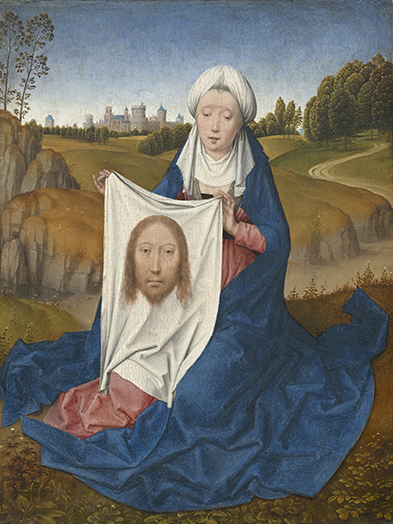
It was this image, the ‘Holy Face’ of Christ, that Raphael would use as a model for his own ‘divine’ face in a Self-portrait with a Friend in the Louvre, a portrait we will explore in Section 2.9. What you should take note of now is interest in the Lentulus letter among fifteenth- and sixteenth-century artists, the physical type described in the letter, as well as the long-standing visual conventions for the depiction of Christ that the Lentulus letter draws upon, in particular that of the ‘Holy Face’: this is the image thought to have been miraculously imprinted on a veil which St Veronica had given to Christ on his way to the crucifixion. Wiping the sweat from his face, it was believed, Christ left his own portrait on Veronica’s veil. This cloth, with the ‘authentic’ portrait of Christ it preserved, was kept by the popes in Rome as one of the holiest relics in Christendom. Not only was this image a relic of Christ’s physical presence on earth; it was also an ‘acheiropoieton’, an image made ‘without human hands’. Veronica and her veil are visualised in Hans Memling’s Saint Veronica (c.1470–75) (Figure 5).
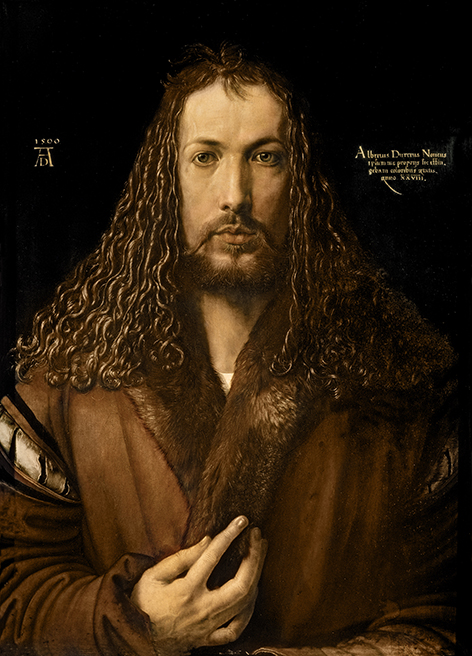
Raphael, and the German master Albrecht Dürer, contemporaries who were both keenly interested in cultivating their identities as ‘divine’ artists, would both show themselves as Christ-like figures in their self-portraits, with features that allude directly to the miraculous Holy Face of Christ. Dürer’s famous self-portrait in Munich (Figure 6) is formatted like an icon, his pose, hairstyle and beard imitating those of Christ. The date and monogram that appear on the left-hand side of the work, ‘1500 AD’, underscore the direct parallel between Christ and the artist, since AD stands here for ‘anno domini’ as well as ‘Albrecht Dürer’. It is no coincidence that a cult of genius that developed around Dürer, like Raphael, focused on the artist’s physical beauty and Christ-like appearance as a sign of his divine favour.
2.9 Raphael’s portrait
Self-portraiture is a fundamental element in the creation and reception of artistic personalities. It is a genre that first came into its own in the early modern era, and it is an essential part of any analysis of issues of subjectivity and self-representation. Self-portraits are different from other genres of image-making: consider, for example, that painters have to look in a mirror to study their own image and transfer it to the canvas or panel. The self-portrait thus somehow always embeds the process of representation itself, as an image that somehow ‘records’ the painter at work. Looking at a self-portrait, we see the artist looking at him or herself in a mirror, while at work.
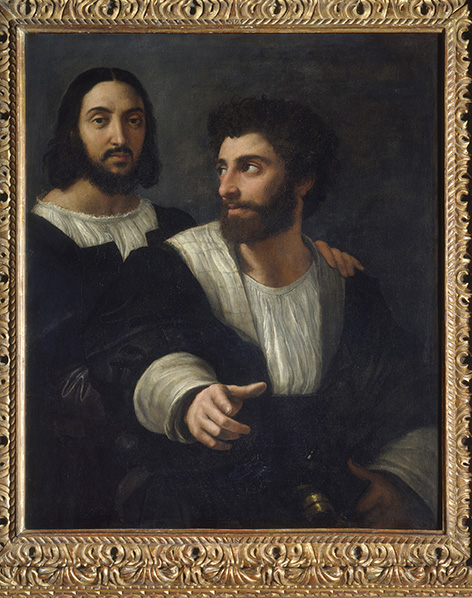
We will now consider an experimental double portrait by Raphael which uses the Holy Face as a model for self-portraiture: a double portrait he painted of himself and a companion, now in the Louvre (Figure 7).
Activity 3
Consider the self-portrait of Raphael (Figure 7). What does it reveal about the artist’s identity? What is the relationship between Raphael and the other sitter, and what does it seem to tell us about Raphael’s persona? Note that the second sitter’s identity is not known, despite much speculation by art historians.
Discussion
In this unusual composition, Raphael paints himself standing on the left, gazing out at the spectator, with his hand resting on the shoulder of his companion. This primary or dominant sitter is positioned underneath and in front of the artist. He looks backwards towards Raphael, pointing out of the canvas with his right hand, as if gesturing towards the viewer, and holding a sword in his left hand. Both men seem close in age and general appearance and their relationship is clearly one of friendship. Yet they are not equals: while Raphael is placed ‘above’ the other figure and seems slightly authoritative in the way he touches his shoulder, the second figure is dressed more expensively and the sword is a clear indication that he is not a fellow artist, but a person of higher rank.
Raphael is shown in a serene and serious pose. His elongated nose, parted, shoulder-length hair and beard, and his nearly front-facing pose all speak to conventions for the representation of Christ (see Figure 5). As the Lentulus letter reminds us, a connection was understood between Christ’s beautiful appearance and his innate goodness, associated in particular with youth, a sense of calm, sobriety and modesty. In the early modern era it was common to equate physical beauty with ‘goodness’, and to understand Christ as a paragon of both. The fifteenth-century Neoplatonic philosopher Marsilio Ficino, for example, wrote about the grace and inherent virtue of those who happen to resemble Christ in their appearance, since this is a sign of their souls’ affinity with the divine.
Unpacking the narrative and temporal moment shown in this portrait reveals further layers of complexity. Raphael looks at ‘us’ while the other sitter points to us and turns to Raphael, as if alerting the artist to the viewer’s arrival on the scene. This pointing hand and extended arm is itself a remarkable sign of the artist’s own ‘dexterity’, in particular his skills at representing the foreshortened human body, considered at the time to be a great artistic challenge.
Raphael’s direct, front-facing gaze reminds us that he is showing himself in the act of painting his own image – by necessity what he sees when looking into a mirror. Yet there is no sign on his face of the mental or physical strain that painting entails. Instead, his face is a vision of serenity, as if Raphael has translated his own mirrored image into the image of Christ when it was transferred – miraculously and without artistic intervention – onto Veronica’s veil.
The artist is poised and the aristocratic gentleman is wearing refined clothes. The sense of idealism is further suggested by the painting’s highly sophisticated compositional scheme: Raphael looks out of this picture, while his companion’s hand and extended arm brings both forward into the world outside. At the same time the companion’s glance brings us back into the picture and returns us to Raphael, as if to create a closed circuit that unites sitters and spectator.
2.10 The intersubjectivity of Raphael and Castiglione
One of Raphael’s most important social contacts at the papal court was Baldassare Castiglione, a nobleman, diplomat and writer, who served as a courtier in Raphael’s home town of Urbino before joining Raphael in Rome. At the end of his life Castiglione penned his best-known literary work, The Book of the Courtier (first published 1528), a tribute to the Urbino court as he had experienced it during his youth. In it Castiglione stages a conversation stretching over several days on the question of what makes an ideal courtier. He describes his memories of Urbino as a ‘painted portrait’, not one by his friend Raphael or by Michelangelo but, he writes, one lacking in beautiful colours and perspective.
2.10.1 Raphael paints Castiglione
In the next two exercises we will consider Raphael’s painted image of Castiglione and Castiglione’s written image of Raphael to see how the two created each other’s identities.
Activity 4
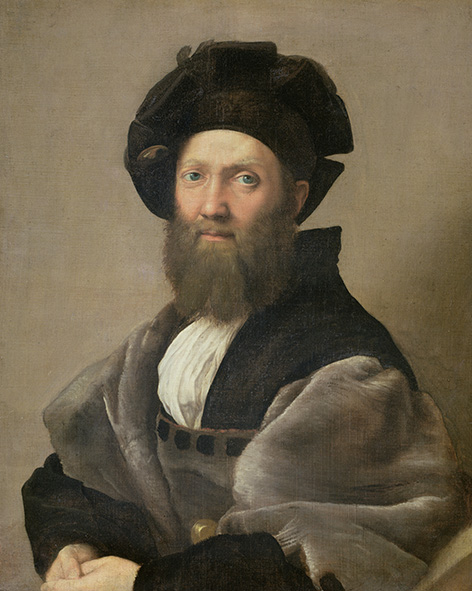
Consider Raphael’s portrait of Baldassare Castiglione in the Louvre (Figure 8), asking what it reveals about the sitter and artist.
- How is the portrait composed?
- How would you describe the relationship between sitter, artist and spectator that it sets up?
Discussion
This portrait is widely celebrated as one of the most innovative and successful in early modern art, not least because of the sense of immediacy and intimacy it conveys. Raphael depicts the sitter in a dignified, monochrome palette. He has worked in relatively loose brushstrokes, allowing the weave of the canvas support to show through.
Castiglione occupies the full surface of the picture, composed geometrically as a triangle locked inside a rectangle. His arresting gaze is the portrait’s most striking feature, as the sitter’s cold blue eyes address the spectator. Implicitly, since this would have hung in Castiglione’s home, this ideal spectator would be a member of his immediate family or an invited friend. Yet the person whom the sitter addresses is also the artist who stood in front of him to paint the portrait, since this image preserves something of the moment of its creation and of the personal relationship between the two men. Raphael and Castiglione regard each other inside this image. The wealthy nobleman dressed in a fashionable fur-trimmed doublet exudes inner calm and aristocratic ease, while the artist is also ‘represented’ in the portrait as a vehicle for the sitter’s impossibly elegant persona. One might even imagine that the surface of the painting is a mirror in which artist and patron reflect one other.
2.10.2 Castiglione ‘paints’ Raphael
If Raphael has left behind the most lasting image of Castiglione, Castiglione was crucial in the formation of Raphael’s legacy, with vast implications for the artist’s posthumous reception.
Now consider two letters, one (probably) written by Raphael and the other (probably) written by Baldassare Castiglione in the voice of Raphael. The first is a transcription of a letter from the painter to his uncle reporting on recent events in Rome. Some doubts about its authenticity remain since the original document is now lost, but most scholars understand it to be genuine. Lodovico Dolce first published the second letter in 1554. This purports to have been written by Raphael and addressed to Castiglione. However, as Shearman first revealed, the second letter is a literary fiction written by Castiglione ‘in the guise’ of Raphael (Shearman, 1994). In it Castiglione pretends to be Raphael, using Raphael as a foil to present his own vision of a perfect artist.
Activity 5
Read the letters by Raphael and by Castiglione in the voice of Raphael and consider the different personas that they channel.
- What sort of artist is Raphael when he writes to his uncle?
- What sort of artist is Raphael when Castiglione invents him in his literary portrait?
Discussion
In the first letter Raphael describes the wealth and prestige he has acquired as head architect of new St Peter’s, the site where the first pope, St Peter, was buried, and the holiest and most important church in Western Catholicism. He has a salaried position, which was rare at the time. The high sums Raphael brags about were, however, about to become extraordinarily controversial, since the vast amount of money used to re-build St Peter’s would become a core point of contention in the Protestant critique of the popes. These circumstances make the artist’s naiveté in touting his own sense of self-importance in this letter particularly striking.
The voice heard in the second letter could hardly be more different from that of the first. Here we find a highly sophisticated and erudite artist who expresses his own concepts of art in philosophical, Platonic terms. It is modelled precisely on the description of the sculptor Phidias in Cicero’s De Oratore: ‘while making the image of Jupiter or Minerva, Phidias did not look at any one model, but there settled in his mind a surpassing ideal of beauty ... so with our minds we conceive the ideal of perfect eloquence, but with our ears we catch only the copy’ (Shearman, 1994, p. 80). Emphasis is placed on the mind of the artist and the ideal images he is able to access, supposedly because of divine favour.
Castiglione’s letter has been highly influential in the reception of Raphael by generations of artists and scholars, since its status as a made-up image of an ideal Raphael was revealed only by Shearman’s article of 1994. Shearman judiciously analysed the letter’s language, content and context to show that it was composed after Raphael’s death, after an aura of divinity had already crystallised around him. A hint of Raphael’s Christ-like identity is seen, for example, in the reference to the ‘great weight’ that the Pope is said to have placed on his shoulders, which echoes the heavy cross carried by Christ up to the site of the crucifixion.
2.11 Identity and style
We are beginning to sense the close relationship between the artist’s work, self-representation and creative persona, as is seen in the deep ambiguity that surrounds descriptions of Raphael’s personality and artistic output.
2.11.1 Raphael and Michelangelo
In the next exercise we look again at some primary and secondary sources about Raphael in order to examine the relation between Raphael’s persona and his style of painting.
Activity 6
- Thinking about the primary texts you read about Raphael’s death, Vasari’s Life of Raphael, and the biography of Raphael from the Oxford Companion, what are some of the connections made between the artist’s persona and his style of painting?
- Although we have not had the opportunity to consider the persona of Raphael’s rival Michelangelo here, if you have any familiarity with this artist you can also think about how Raphael’s artistic persona has been set apart from Michelangelo’s.
Discussion
Raphael is divine and graceful; a work by Raphael is divine and graceful. ‘Raphael’ becomes less a biographical entity than an idea representing grace as the opposite of diligence, the epitome of polish that disguises any trace of the physicality involved in making a work of art. He represents the essence of aristocratic ease and grace. Celio Calcagnini called him the ‘prince of all painters’ (Letter from Celio Calcagnini in Rome to Jacob Ziegler), while Vasari wrote in his biography of Raphael (‘Life of Raphael’) that as an infant he had drunk his own mother’s milk, not that of a nursemaid, thus avoiding ‘absorbing the manners of people of low condition’. This sets him apart from his greatest rival at the papal court, Michelangelo, whom Vasari tells us in his biography of the artist, was nursed by a stone-cutter’s daughter, from whom he drank in not only the art of sculpture but also the social coarseness that was thought to contribute to his difficult personality. Such direct contrasts are found everywhere in the biographies of these two colossal personalities, leaving long-lasting models of working practices and creative identities for generations to come.
Raphael always appeared elegant and Vasari writes that animals were naturally drawn to him, drawing a parallel between the artist and the gentle figure of St Francis or the musician Orpheus. Michelangelo, according to Vasari’s biography of him, cared nothing for his appearance and even slept in his boots. He worked largely alone without a workshop or assistants, disguised his own training and took on no pupils. Raphael’s artistic persona is closely associated with harmony, as is seen not only in the trope of the perfect unity of his workshop but also in the much-praised softness and delicacy of his technique, as well as his care at selecting a harmonious palette of colours.
Raphael’s art can be closely associated with an early modern notion of beauty as ‘a threefold grace which originates in harmonies: the harmony of virtues in souls, the harmony of colours and lines in bodies, and the harmony of tones in music’, which are all different forms of divine grace (Hendrix, 2010, p. 91). As a person of great beauty himself he seemed, much like his artistic creations, the best of humanity, an ideal that brings together, in one person, excellent traits normally found scattered in many different people. Raphael, the artist and the person, is a perfect and well-considered ‘composition’. Michelangelo, on the other hand, was thought to channel a different divinity, one charged with furia (demonic frenzy) and terribilità (terribleness), the uncontrolled forces of divine madness.
Raphael, in his own life and through his reception, has come to be identified as the paragon of the art of painting itself in its universality and its ability to blend, soften and unify. Michelangelo, by contrast, epitomises the art of sculpture in its gravity and the hard, unforgiving surface of marble. These are realities seen in their own work, tropes written into their biographies, and topoi of their art-historical identities.
Having read Foucault, it should be clear to you that these elements of the ‘author function’ of these two artists far exceed the reality of their lives. The invention of the two types in opposition to one another reveals the flaws of the monograph that treats a single life and work, a point that engages the possibility of intersubjectivity. If artistic personas are in and of themselves works of art, in the case of Raphael and Michelangelo they are pendant images that cannot be considered in isolation.
Conclusion
We can begin to sum up some of the artistic and social ideals that Raphael and his work have seemed to represent for generations who have followed him.
As you’ve discovered in this free course, Artists and authorship: the case of Raphael, ‘Raphael’ has been a powerful ideal for artists and critics in the centuries since his death as a seemingly timeless standard of great art, whatever is high, spiritual and lofty, a channel of the divine and perfect or, arguably, an escapist fantasy of the social and intellectual elite. So much about his real life and his biographical one is suited to these roles: his name, his beauty, and his death in the prime of his youth before his body and his art could experience decline. The essence of Raphael’s persona – even soon after his death – was subsumed into a concept of the High Renaissance, a moment which, from the sixteenth century onwards, has been synonymous with perfection itself.
The historical life cycle described by the term ‘Renaissance’ is essentially a history of the classical style. Art first undergoes a formative early period, reaches a pinnacle of ideal purity achieved in high classicism, and then begins to decline as art somehow becomes worse or decadent. As Gombrich’s ‘Norm and form’ described, the styles (Gothic, Renaissance, Mannerist, Baroque, etc.) that have been so predominant in art history all presuppose ‘the classical’ as a normative, enduring and timeless ideal (Gombrich, 1971). Raphael’s Roman works, in his own lifetime and in his reception by academic artists, came to be closely associated with the perfection and enduring values that ‘the classical’ represents. The artist’s death at the apex of his own achievement has thus seemed to articulate a change in the life cycle of art itself, as the end of a high-classical peak.
Critics and tastemakers from Gian Pietro Bellori in the seventeenth century to Johan Joachim Winckelmann in the eighteenth defined Raphael as the greatest master of the classical style. For the artist-followers who modelled themselves on Raphael’s career (such as Parmigianino, Zuccaro, Poussin, Mengs and Ingres), his stature appealed to their sense of social ambition, his artistic style to the classical ideal.
In social and cultural terms, Raphael seems to represent a Golden Age of social and religious harmony, since he worked at a moment in time just before the Protestant revolution. In this it is no coincidence that his style is used as the model for so much devout, sentimental and apolitical Catholic art, past and present.
References
Further reading
Acknowledgements
This free course was written by Kathleen Christian (Section 1.5 and Section 2) and Steve Edwards (Section 1.1–1.4). Edited by Leah R. Clark.
Except for third party materials and otherwise stated in the acknowledgements section, this content is made available under a Creative Commons Attribution-NonCommercial-ShareAlike 4.0 Licence.
The material acknowledged below is Proprietary and used under licence (not subject to Creative Commons Licence). Grateful acknowledgement is made to the following sources for permission to reproduce material in this course:
Course image
© Scala, Florence.
Images
Figure 1: © National Gallery / Scala, Florence.
Figure 2: © Scala, Florence.
Figure 3: ©Villa Farnesina / Bridgeman Images.
Figure 4: © Scala, Florence.
Figure 5: © Courtesy The National Gallery of Art, Washington.
Figure 6: © Alte Pinakothek / Bridgeman Images.
Figure 7: © Scala, Florence.
Figure 8: © Musée du Louvre / Bridgeman Images.
Text
Activity 1: entry on Raphael: Chapman, H. (n.d.) ‘Raphael’, The Oxford Companion to Western Art, Oxford Art Online [Online], Oxford, Oxford University Press.
Activity 2: extracts from Shearman, J. (2003) Raphael in Early Modern Sources (1483–1602), 2 vols, New Haven and London, Yale University Press, vol. 1, pp. 548, 572, 575, 579 (trans. K. Christian).
Activity 5: extract from Shearman, J. (2003) Raphael in Early Modern Sources (1483–1602), 2 vols, New Haven and London, Yale University Press, vol. 1, pp. 180–1 (trans. K. Christian).
Activity 5: extract from Dolce, L. (1554) Lettere di diversi eccellentiss. huomini, raccolte da diversi libri: tra le quali se ne leggono molte, non piu stampate, Venice, Gabriel Giolito de Ferrari, pp. 226–8 (trans. K. Christian).
Every effort has been made to contact copyright owners. If any have been inadvertently overlooked, the publishers will be pleased to make the necessary arrangements at the first opportunity.
Don't miss out
If reading this text has inspired you to learn more, you may be interested in joining the millions of people who discover our free learning resources and qualifications by visiting The Open University – www.open.edu/ openlearn/ free-courses.