Week 4 Nebamun the man and his tomb
Use 'Print preview' to check the number of pages and printer settings.
Print functionality varies between browsers.
Printable page generated Thursday, 4 June 2026, 9:46 AM
Week 4 Nebamun the man and his tomb
Introduction
In this section you will explore who Nebamun was and what we know about him, as well as how we know what we know.
When talking about ancient civilisations – inspired by the hundreds and thousands of books that have appeared on the subject, not to mention films and television programmes that confidently tell stories about Greeks and Romans, Chinese and Vikings, as well as ancient Egyptians – it is instructive to try and tell the story of an individual such as Nebamun.
The paintings from Nebamun's tomb-chapel are internationally renowned (Figure 1). They are among the most remarkable works of art to survive from the ancient world. They make that world seem vivid and immediate to us: the herd of cattle jostling their handlers, bellowing and stirring up the dust, the geese squawking in their boxes, Nebamun's cat flushing out birds among the reeds in the Nile marshes and sending up a cloud of coloured butterflies, his wife in her beautiful dress with immaculate hair and jewellery. We can imagine something of that life because of the apparent spontaneity of the images, very much as we can imagine the life going on in a scene of boating or dancing in nineteenth-century Paris in a painting by Renoir or Degas. But this is the power of pictures. The truth is that we know next to nothing about Nebamun. Or rather, all we know about him is contained in those paintings and their related texts.
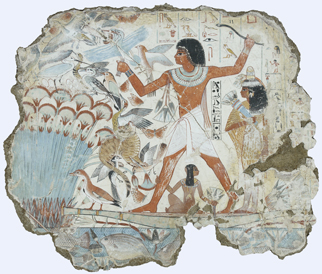
1 Exploring the evidence
One of the principal motors of modernism was the drive to separate image from narrative; indeed abstract art can be seen as the culmination of a tendency to particularise the visual begun by Lessing in 1766. In ancient Egyptian art, the opposite is the case. The linguistic aspect is up there on the wall with the pictures, reinforcing them, interpreting them, even exhorting the spectator to respond.
Key point
The complementary relation of word and image in the ancient Egyptian tomb-chapel is a point worth emphasising. Recent postmodernist theory has frequently used the language of language to talk about images: treating the picture as a 'text' to be read. But for much of the modern period, beginning in the eighteenth century and with redoubled emphasis in the twentieth, the theory of art sought to distinguish pictures from words.
To the modern, non-specialist viewer, however, the picture is the thing: the wonderfully vivid cattle and geese, the dancing girls, the handsome couples. To all but a few highly-trained Egyptologists the hieroglyphs are no more than a general signifier of 'Egyptianness', along with the sideways feet and the wigs. Their specific message is lost on us (Figure 2).
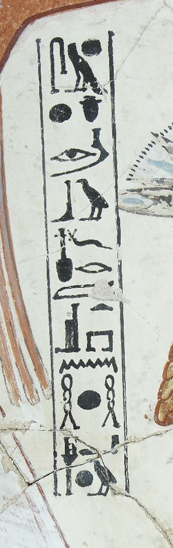
Yet to the literate ancient Egyptian viewer – a very small percentage of the society as a whole – the hieroglyphs would have been at least as important as the pictures, conferring the picture’s particular meaning in its given context. The life stories of tomb-owners were usually given by the narrative texts. In fact the paintings tell us nothing particular about Nebamun, apart from the fact that he aspired to a conventional elite lifestyle. Even when he personally features in the paintings, the images are not likenesses. The agricultural scenes may have been chosen to link with his work, but agricultural scenes also occur in the tombs of people who were not grain-accountants. The only specific thing we know comes from the texts: his name and title.
If the tomb had remained intact, other texts would have told us the names of his parents and perhaps even a version of his life-story in the form of a ‘tomb autobiography’, as if narrated by Nebamun himself from beyond the grave. But as it is, the damaged hieroglyphic captions tell us only that Nebamun was the Scribe and Grain-accountant in the Granary of Divine Offerings in the Temple of Amun at Thebes (Figure 3). This means he was an official in a very important institution. Not a ‘minister’ or ‘secretary of state’, in modern political terms, but something like a middle manager or a civil servant in an important ministry.
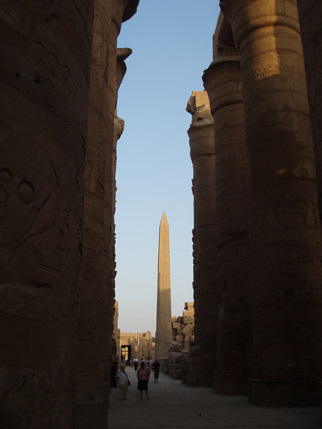
Before and during the Eighteenth Dynasty Amun was the most important of the gods worshipped in the temple complex at Thebes. Some ancient Egyptian names are very common, as in any culture, and many ‘Nebamuns’ have been identified by Egyptologists working on objects from the Theban necropolis (Figure 4), as well as in the necropolis itself. This is unsurprising, since the name translates as ‘My Lord is Amun’.
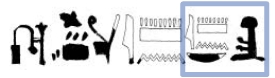
1.1 A man of wealth
Another factor that provides a clue to Nebamun’s status is the importance of grain at this time (Figure 5). Egypt was a barter economy. The idea of money in the form of coinage had not yet been invented. Grain was its nearest equivalent. Workers were paid in grain, which would then be exchanged for equivalent values of staples such as foodstuffs, including bread and beer, clothing and other necessities. So Nebamun’s job situated him at an important junction in Egyptian institutional life, where the fundamental stuff of day-to-day existence touched the world of the gods.
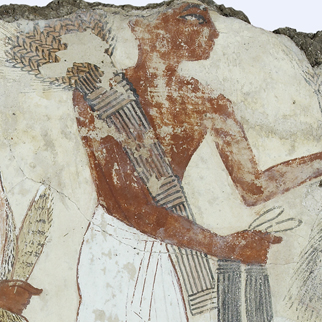
Whatever the circumstances of his early life, which are completely unknown to us, by the time he had achieved the status described in his tomb decorations, Nebamun would have been wealthy – one of the top 5% of Egyptian society. A considerable portion of that wealth was probably invested in planning and making the tomb in the Theban necropolis that would be the gateway for his life in eternity. All that we have is ruins and fragments, but in 1350 BC this would have been a considerable enterprise: carving passageways and two rooms out of the solid rock, decorating them with paintings, texts and sculptures, and building an imposing entrance and courtyard.
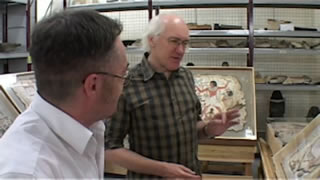
Watch this video in which Richard Parkinson and Paul Wood talk about Nebamun.
Transcript
The tendency of modern popular myth is to summon up images of secrecy and tomb-robbers, searching for caches of gold by candlelight, and making off in the dark. But historically, Egyptian burials were highly public affairs. The tombs would have been planned for years and worked on for many months. After the funeral, the chapels remained open. They were there for family and other visitors to make their devotions during important festivals, and to keep alive the memory of the deceased – not least to ensure his continued prosperity in the afterlife.
It goes without saying that Nebamun could not have imagined the afterlife he actually got: a star attraction in the British Museum, the object of millions of gazes, his image as well as those of his wife, his children and his cat endlessly reproduced in the vast constellation of Egyptiana along with Tutankhamun and the pyramids: notepads, pencil cases, shoulder bags and mugs. Yet of Nebamun the man, beyond his name and the title of his job, we know nothing.
If you wish to get a sense of the fragmented nature of these tomb-chapels click the link below to explore the tomb-chapel of Senneferi at Thebes and view an excavation conducted by Nigel Strudwick.
2 Belief in an afterlife
Why, it might be asked, did the ancient Egyptians in general, and Nebamun in particular, go to such extraordinary lengths to construct and decorate their own private tombs?
One of the most persistent modern myths about ancient Egypt is that it was a culture obsessed with death. In fact Egyptian art is full of the details of life as it was lived by human beings on Earth many thousands of years ago, and the artefacts that have come down to us indicate a keen appreciation of the good things in life, at least for the elite. At the same time, however, it would be futile to claim that ancient Egyptians were not concerned with ensuring their rebirth into the much-desired afterlife.
Key point
The important point is two-fold:
- that the modern distinction between sacred and secular scarcely applies, the whole of life was imbued with a spiritual dimension involving gods who were ever-present
- that an Egyptian conception of the afterlife was closely modelled on the fears and hopes, needs and desires experienced in life on Earth (Figure 6).
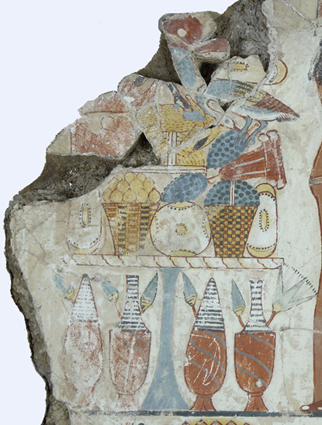
We have to be careful not to impose a Christian conception of life on Earth and life after death (not to mention a modern secular concept of life on Earth and nothing after death) upon Egyptian representations of their beliefs about humans, gods and what happens to the human body (as well as to the more intangible aspects of life) after the individual has died.
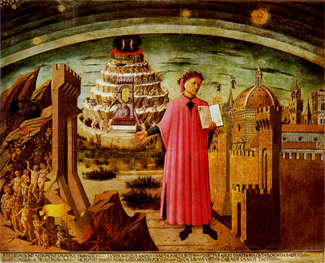
One thing in particular is of note. In a Christian conception the body tends to carry negative connotations and to be associated with sin, whereas notions of a reward for a good life in heaven tend to be couched in rather more ethereal terms. A case in point would be the contrast between Dante's Inferno (Figure 7), where most of the torments are resolutely and literally corporeal, and his Paradiso, where the experience of ascending into heaven is described in predominantly abstract terms of light and colour. The ancient Egyptians, however, (and once again one has to make the qualification that here we are speaking about the well-to-do) seem to have combined an abstract ‘spiritualised’ element with an altogether more worldly aspect.
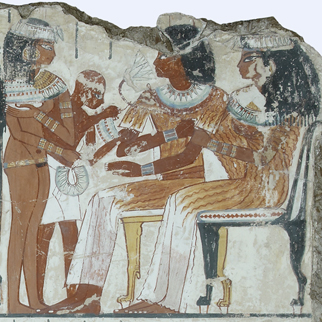
At one level, the ancient Egyptians held ideas of posthumously joining the cosmic cycle and becoming one of the ‘imperishable stars’, while at another, they regarded their afterlife as being, at least in part, an idealised continuation of life on Earth: food, drink, sexual love, luxurious surroundings, even down to the matter of having adequate supplies of servants to do all the work (Figure 8).
3 Daily life
The life-world of most of the population of ancient Egypt would have differed quite considerably from the image conjured up by museum exhibits of the glittering wealth of royal and elite burials, and indeed from the image promoted by Hollywood films. This is the case at both ends of the social spectrum. Gold tiaras were doubtless always at a premium, but Egyptian workers were not slaves either, lashed up and down the slopes of a pyramid by cruel overseers.
Because so much that has survived from ancient Egypt has been from elite burials, our picture of Egyptian life has been inflected in a particular direction. The truth is that until recently comparatively little was known about how ordinary people lived their lives. A better picture is beginning to emerge, both with the development of improved archaeological techniques but even more so with a disposition to ask the right kinds of question.
Watch this video in which Richard Parkinson and Paul Wood talk about daily life in ancient Egypt.
Transcript
3.1 A hierarchical society
Egyptian society, like its most famous monuments (and like virtually all pre-modern societies after the paleolithic) was pyramidal. While there was some scope for social mobility, there was not much. And unlike contemporary globalised capitalism, driven by a relentless dynamic of transformation and innovation, Egypt was driven by an overwhelming imperative to keep things stable, to preserve order, and prevent a descent into chaos. In fact the very notion of an ‘Egyptian’ identity seems to have involved a reflection of the environment they inhabited: being defined against the threat of surrounding chaos, both natural in the form of the desert, and social, in the form of hostile neighbours.
At the head of human society was the king, the ‘Pharaoh’. The king occupied a unique position in that, although human, he was also divine. He was the single point of contact between the world of humankind and the world of the gods. To the virtue of the king alone fell the task of preserving what was termed ‘maat’, meaning balance, order and harmony in human affairs.
Watch this video in which Richard Parkinson and Paul Wood talk about the hierarchy of ancient Egyptian society.
Transcript
The king was assisted by an administrative elite, including such all-powerful figures as a vizier and a treasurer who oversaw the running of the main offices of the state: justice, religion, the economy, the army. These were duplicated at regional levels. Egypt was divided into 42 nomes (provinces), each of which had its own administration with figures responsible for the various walks of life in their own areas. Within these geographical areas a similar sort of hierarchy held sway: in the top levels, literate administrative figures such as Nebamun, keeping the day-to-day organisation going. Below that was a layer of tradesmen and skilled craftsmen, including those who would work on the decoration of a private tomb-chapel. Below that again there was the majority of the population: the mass of workers, including those who worked on the land, either with crops or animals, as well as fishermen, and many servants.
3.2 Death rituals
A poor person in ancient Egypt would have been buried, with at most a modest ceremony involving immediate family and friends, in a relatively shallow grave in the sandy soil. A member of the elite, however, such as Nebamun the Grain-accountant in the Temple of Amun would have undergone the most extraordinarily elaborate and long drawn out rituals all aimed at securing a happy and serene afterlife in eternity.
The focus of these rituals, needless to say, was the process of mummification. The complex, multidimensional Egyptian conception of individual identity – made up, in addition to one’s body, of ‘ka’ and ‘ba’ (akin to, though not the same as, our notions of ‘immortal soul’ and ‘individual personality’) but also the name and the shadow – required a well-preserved body for the other aspects to attach themselves to in the afterlife to produce the ‘akh’, the state of transfigured being in a condition of permanent beatitude.
So after death, the body and internal organs (though puzzlingly to us, not the brain, whose function was not appreciated) were all preserved through an elaborate embalming process taking several weeks. The mummy was then placed in a coffin, itself covered with many images and texts aimed at helping the person on their journey through the underworld towards rebirth and eternal life in the realm of Osiris where, in effect, time stopped. Ceremonies and spells known to us as the Book of the Dead accompanied this process, although their other name, the Spells of Going Forth by Day, better captures the sense of rebirth involved. In the generation after Nebamun, illustrations from these spells were often painted on the tomb-chapel walls as well (Figure 9).
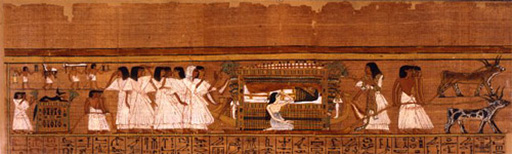
It was this complex thing, part physical object, part sacred text, and accompanied by an equally complex complement of grave goods ranging from food to furniture, that was eventually placed in the tomb. Below the decorated tomb-chapel that had been painstakingly prepared during the owner's lifetime, the tomb-owner would live on in his ‘house of eternity’.
4 Tomb-chapels
In this section you will look at the purpose, layout and decoration of Eighteenth Dynasty tomb-chapels.
Museums all over the world are full of objects from ancient Egypt (Figures 10–12). Some of the large sculptures are from public sites such as temple facades where they would have been seen by many people taking part in the festivals that marked the Egyptian calendar. But most of the smaller sculptures, the wall paintings and even the other kinds of objects from daily life such as jewellery, furniture, utensils and tools – not to mention, of course, coffins and mummies – have been taken from tombs: the burial sites of an elite wealthy enough to command the resources to construct memorials to themselves.
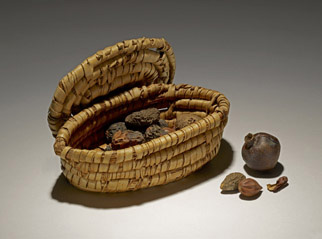
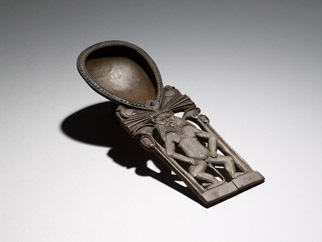
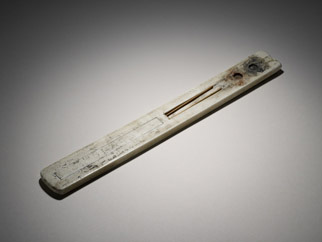
The fact that so much of this material comes from tombs means it has a peculiar status. Those objects that have come from the burial chamber itself, such as goods to accompany the deceased on his journey through the underworld, were not meant to be seen again by human eyes. The most well-known of these caches came, of course, from the tomb of Tutankhamun.
A good part of the allure of ancient Egypt comes from this resurrected gold: jewels, funerary masks, coffins and so forth. Because of the power of this legend of the Egyptian tomb, exemplified above all by Tutankhamun, there can be misunderstanding about Egyptian art. No less a figure than Gombrich, in his canonical Story of Art, writes, directly underneath an illustration of one of the paintings from Nebamun's tomb, that this was ‘an art which was meant to be seen by no-one but the dead man’s soul’. But the tombs themselves, concealed underground and never meant to be opened again, were only part of an enterprise that included a much more public dimension: than that of the tomb-chapel. Decorations such as those from the tomb-chapel of Nebamun were very much meant to be seen. They were in fact a focal point for gatherings of relatives and friends, a hinge almost, between life in this world and eternal life, carrying great responsibility for the success of the transition.
4.1 The west bank of the Nile
The area of the desert escarpment on the west bank of the Nile adjacent to Thebes is extraordinarily striking (Figure 13). Seen from the relatively lush green area by the river, the bare mountains glow pink in the morning sun and later in the day achieve a powerful visual effect as the sun sinks behind them. The area had been sacred since the Old Kingdom, not only because of these effects of the light on the rock but possibly also because of the curious natural formation of the peak that dominates the area, which resembles a natural pyramid (Figure 14).
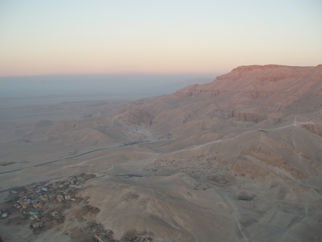
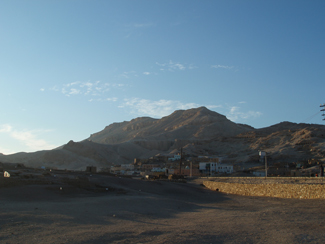
By the Middle Kingdom the West Bank site had become a major cemetery, and a festival route led to it from the temple of Karnak on the east bank of the Nile. In the New Kingdom there evolved an extensive necropolis, the best-known part of which is known to us as the Valley of the Kings, behind which rises the Theban peak. The Valley of the Kings contained royal tombs, of which 63 have now been discovered. Other non-royal burial sites developed nearby in the area around the valley below the royal memorial temples.
There were several festivals during the year, the two most important being the New Year festival and the summertime Festival of the Valley. During this latter festival, the sacred bark of Amun was brought out of its temple at Karnak on the east bank of the Nile, over to the west bank, and carried in a procession. The god was taken to the sanctuary of the goddess Hathor in the royal funerary temples in the ‘Valley’ of Deir el-Bahri (Figure 15).
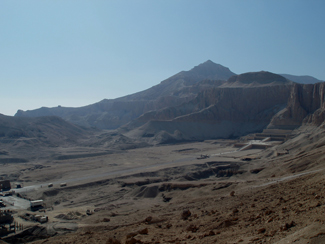
In the description of Melinda Hartwig, there ‘Amun joined with the goddess to renew the fertility of the land. The bark spent the night floating on a lake of gold surrounded by four basins filled with milk, around which were placed burning torches. In the morning the torches were extinguished in the milk, signifying the return of the dead to Hathor, and the barks of Amun set out again, this time to return to their home at Karnak’.
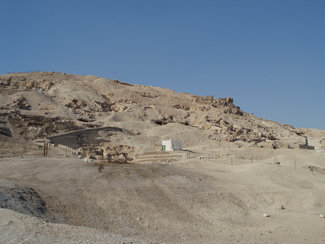
The festival went on for two days during which time the private tomb-chapels became focal points for social gatherings. The chapels were lit up and feasts were held inside in the presence of the painted banquets depicted on the walls. The deceased’s name was recited and prayers were said according to the instructions of the hieroglyphs that were part of the painted decoration. Many hundreds of these private tombs have now been discovered in this west bank necropolis. One of these contained the now lost tomb-chapel of Nebamun. The exact location is no longer known, but evidence suggests that it was in the area of Dra Abu el-Naga (Figure 16), in the northern half of the necropolis, to the north of the Valley.
5 Tomb layout
Typically one of these tombs would consist of three parts. First, as one approached, one would walk through a whole village of tombs before arriving at an entrance area cut into the hillside. This consisted of a high wall surrounding a doorway, with a sheltered courtyard in front of it. Tombs were ideally built on an east–west axis, the directions of the rising and setting sun respectively. The east represented the land of the living, the west the land of the dead. The entrance into the courtyard would be from the east (Figure 17). The door into the tomb-chapel itself would be wooden, with a decorated stone surround and above it was often a niche for a statue, facing the east. Usually a frieze of so-called funerary cones, set in the wall with the round end visible, ran around the top of the wall just below the cornice. The importance of these is that they were stamped with the name and titles of the tomb-owner and family members.

Inside the door was a passage, rectangular in section, and either more or less steep depending on the terrain, but basically leading either into the hill or below the ground (Figure 18). This passage led to what was usually the first of two rooms. This first room was normally transverse to the entrance passageway and was decorated with paintings on all its walls. The ceiling was painted too, often in a pattern imitating decorative textiles. Beyond this room would be another passageway leading from the middle of the opposite wall into the second room. This led away longitudinally, giving an overall T-shape to the tomb-chapel. This design is the commonest, though there are variations – sometimes a single room, and sometimes even a larger room with columns holding up the roof. But the T-shape is the norm (Figure 19). At the far end of the second room, that is to say at the westernmost end of the chapel, there would be a niche containing a statue of the tomb-owner and his wife.
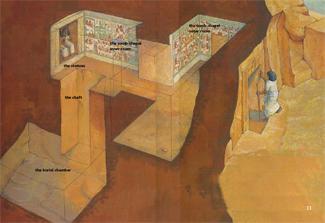
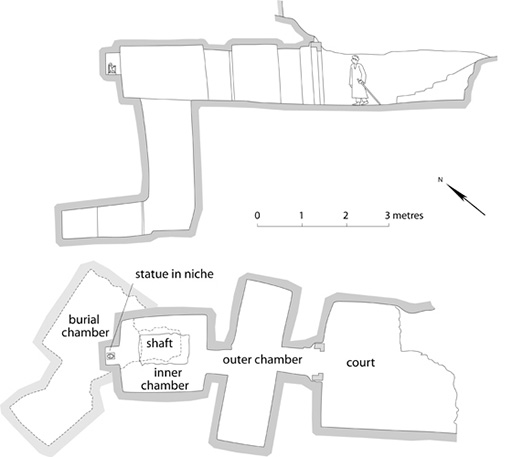
Somewhere below the floor of one of the rooms of the chapel, or even the courtyard, there would be a vertical shaft leading down to the actual burial chamber. This contained the coffin and the burial goods, but most often remained undecorated. The chamber was sealed with either a wooden door or stones, and the passage was backfilled after the burial to prevent access. Because the tombs were an important family site, however, they could be re-opened for the addition of further burials in subsequent years.
The tomb-complex, then, was on three levels: the upper level, the courtyard, with its entrance leading from the outside world into the interior. The next level slightly below ground containing the two decorated rooms of the chapel, and the third level, deeper underground containing the coffin and mummy itself. It is important to grasp that this layout is not merely physical, not merely contingent. The layout of the tomb-chapel, and the tomb overall, in effect figures the journey of the deceased towards the afterlife. Each level had a different spiritual focus: the first, the courtyard, on life and the worship of the sun god; the second, the tomb-chapel, on the deceased tomb-owner his status and achievements; the third, the burial chamber itself, on Osiris and the underworld.
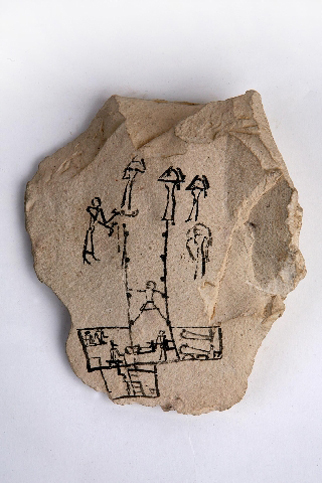
In one remarkable drawing, depicting a tomb during a funeral, the layout of such a tomb is preserved on an ostracon (Figure 20). The depicted scene shows, at the top, a priest and a group of weeping women. In the centre a figure is descending the shaft. At the bottom can be seen another figure with the coffin, as well as (to the left) a jackal-headed priest and (to the right) a chamber already containing two coffins.
6 Tomb decoration
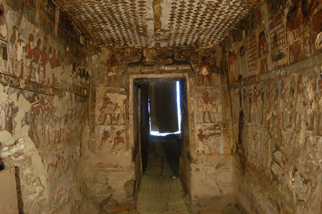
The tomb-chapel was filled, practically from floor to ceiling, with painted decorations and accompanying hieroglyphic inscriptions (Figure 21). On the basis of a study of decorated Eighteenth Dynasty Theban tomb-chapels undertaken in the 1980s, Lise Manniche drew up a summary of the paintings they would typically contain:
- representation of the reigning king
- scenes relating to the office of the tomb-owner
- the tomb-owner making offerings
- the tomb-owner fishing and fowling
- hunting in the desert
- agricultural scenes
- wine making
- offering bringers
- banquets
- the funeral procession
- the deceased's voyage to Abydos
- rituals before the mummy, including the ceremony of Opening of the Mouth.
Watch this video in which Richard Parkinson and Paul Wood talk about interpreting Nebamun paintings.
Transcript
One of the effects of this information is to underline just how much is missing from Nebamun's tomb-chapel. The surviving fragments are, of course, parts of paintings; but more than that, many of the paintings have simply not survived at all. Neither has the sculpture of Nebamun and his wife, which would have been placed in a niche at the far western end of the rooms (Figure 22), nor the stela which would have contained a biographical text.
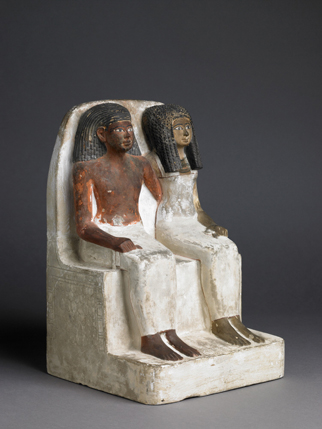
Even if not all of these were present in any one tomb, it is easy to see how little of the decoration of Nebamun’s tomb has survived. What has seems mostly to be from the outer room, which normally contained the scenes concerning the life of the deceased person. Very little has come down to us from the inner passageway and room containing the scenes of the funeral and entry into the afterlife; and it is likely these would have been there. Manniche writes that ‘there is scarcely a single tomb of those with completely preserved decoration that omits it’.
6.1 Tomb graffiti
The decorated tomb-chapel, therefore, was a liminal space, a crucial threshold between the world of the living and the world of the dead. Its public rooms formed the chapel in which family members and other visitors could continue to perform ceremonies and remembrances for the deceased, to assist him on his journey towards eternity.
That there was an important aesthetic dimension to this role is clear from surviving ancient evidence of viewers’ responses, which have been preserved in the form of graffiti. The beauty and accomplishment of the decorations played a significant role in eliciting the desired responses.
You can read four of these now. They are Eighteenth Dynasty graffiti on the walls of a tomb-chapel that was already 400 years old at the time of the inscription (Figure 23). It belonged to a relative of the Vizier Intefiqer.
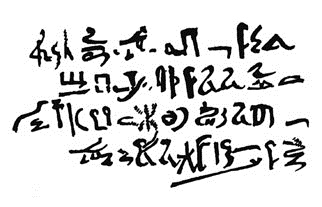
The scribe Im[....son of ...] came to see this tomb [of Sobekneferu] With
friend Hotep...
The scribe Bak
To see tomb the time of Sobekneferu. He found it like heaven in its interior.[…with the sun shining in it; And he said 'May heaven rain fresh myrrh And sprinkle incense Upon this temple of that Khufu, true of voice'.]
The scribe Djehuti, true of voice, came To see this tomb of the time of Kheperkare – may he live for all Time.
The scribe Amenemhat, Son of the Elder of the Portal Djehutimes, Who was born of Intef, came To see [this] tomb [of the Lord Vizier] Intefiqer. It was pleasant to his heart…[…a monument(?)] which exists, Excellent for all time. His name shall exist [for eternity…] […with] offerings in it, Saying: 'An offering which the king gives to Osiris [Foremost of the Westerners] [and Amen-Ra], and the gods who are lords of the necropolis: Invocation offerings of bread and beer, Flesh and fowl, Alabaster and linen, Incense and unguent, All the goodly pure things, Which heaven gives, and earth creates, And the inundation brings, as his offering To the spirit of Intefiqer, true of voice!'
7 Symbolism
Just as the paintings in the tomb were not simple depictions of flowers, food, animals, recreation and work activities, but also carriers of a supererogatory symbolic range of meaning concerning progress into the afterlife, so too the tomb itself was not merely a physical space into which the mummies were placed. Like a Christian church in the shape of a cross, it too had a symbolic dimension. The organisation of the space, no less than its painted decoration, represented the transition from life to death, or more accurately, from life into the afterlife.
Watch this video in which Richard Parkinson and Paul Wood talk about the purpose of tomb-chapels.
Transcript
Melinda Hartwig, who has made a recent detailed study of Eighteenth Dynasty tomb-chapels, makes clear their great importance in ensuring the transition of the ‘justified’ individual into the afterlife. Their functioning had two distinct aspects, albeit connected: on the one hand to project the deceased through to the afterlife, on the other to commemorate his existence to those still living – the more to ensure that they keep up the various forms of commemoration that alone can ensure successful entry into the afterlife. ‘Remembrance was vital for the time after death, because the dead who were venerated and commemorated were retained in the community of ordered being. Those who were not commemorated were cast off into the land of non-being and relegated to an existence as ghosts.’
In short, the whole success of his ‘afterlife project’, so to speak, for any one individual depended on the efficacy of his tomb-chapel: both the beauty of the paintings and the power of their accompanying texts to generate the necessary admiration, prayers and recitations of his name, and the stranger, magical sense in which the images could assume the reality of the things they depicted in order to assure the spirit’s survival in the underworld. There was a tradition of visiting old tombs to admire their paintings, so that the quality and beauty of the paintings – that is, their purely aesthetic aspect – was integral to their memorial aspect.
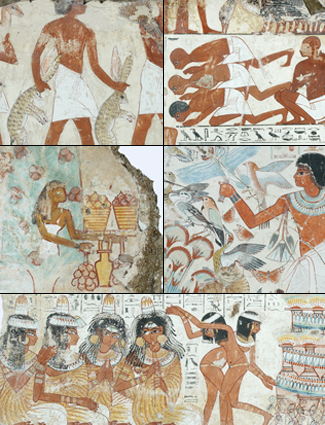
The tomb-chapel is in effect an absolutely critical life-support system (or more aptly, afterlife-support system) for the akh, the transfigured being, on its journey to eternal life (Figure 24). There could hardly be a more compelling reason for getting the decoration right.
Summary
This week you learnt that we know very little about Nebamun himself, although the fragments of the wall paintings from his tomb are well known. He must, however, have been wealthy to have undertaken such a project as a tomb-chapel. You then explored the purpose and nature of tomb-chapels in general, before considering how the Egyptian conception of the afterlife was closely modelled on the desires and experiences of life.
You can now go to Week 5.
References
Acknowledgements
Except for third party materials and otherwise stated (see terms and conditions), this content is made available under a Creative Commons Attribution-NonCommercial-ShareAlike 4.0 Licence.
The material acknowledged below is Proprietary and used under licence (not subject to Creative Commons Licence). Grateful acknowledgement is made to the following sources for permission to reproduce material in this course:
In line with the British Museum’s wishes and aims to encourage the dissemination and use of information about their collections, The Open University is delighted to confirm that all content credited to © The Trustees of the British Museum is also made available under a Creative Commons Attribution-NonCommercial-ShareAlike 4.0 International (CC BY-NC-SA 4.0).
Figures
Figure 1 Nebamun hunting in the marshes (EA 37977) © Trustees of the British Museum
Figure 2 Hieroglyphs from the scene of hunting in the marshes, ‘Taking enjoyment, seeing good things in the place of eternity’ (EA 37977) © Trustees of the British Museum
Figure 3 The Temple of Amun Photograph courtesy of R. B. Parkinson
Figure 4 Hieroglyphs of Nebamun’s title and name, ‘Scribe and Grain-accountant of Amun, Nebamun’ © Trustees of the British Museum, Drawing by R. B. Parkinson
Figure 5 Offering bringers with sheaves of grain (EA 37980) © Trustees of the British Museum
Figure 6 A table piled with food at banquet (EA 37986) © Trustees of the British Museum
Figure 7 Domenico di Michelino, Dante and his Poem, 1465, fresco, Santa Maria del Fiore, Florence
Figure 8 Continuation of an idealised life (EA 37986) © Trustees of the British Museum
Figure 9 The funeral procession and burial of the scribe Ani from his Book of the Dead (EA 10470.5 © Trustees of the British Museum
Figure 10 Oval fruit-basket of woven palm fibre with lid; contains figs and dates (EA 5396) © Trustees of the British Museum
Figure 11 Wooden cosmetic-spoon (EA 5954) © Trustees of the British Museum
Figure 12 Ivory scribal palette bearing rough Hieratic jottings in black ink (EA 5524) © Trustees of the British Museum
Figure 13 The west bank escarpment looking towards the Valley of the Queens courtesy of R B Parkinson
Figure 14 A view of the Theban peak Courtesy of R. B. Parkinson
Figure 15 A view of Deir el-Bahri Courtesy of R. B. Parkinson
Figure 16 Part of Dra Abu el-Naga Courtesy of R. B. Parkinson
Figure 17 A reconstruction drawing of the outer parts of a Theban tomb-chapel, showing the courtyard and facade decorated with funerary cones Drawing by Claire Thorne after Kampp, Die Thebanische Nekropole (Mainz 1996), Fig. 67. © Trustees of the British Museum
Figure 18 Impression of tomb-chapel layout A reconstruction by R. B. Parkinson. From Meredith Hooper, The Tomb of Nebamun: Explore an Ancient Egyptian Tomb (London 2008), 10-11
Figure 19 Plan and elevation of the Eighteenth Dynasty tomb-chapel of Nakht Drawing by Claire Thorne after Norman Davies, The Tomb of Nakht at Thebes (New York 1917), 36. © Trustees of the British Museum
Figure 20 Ostracon depicting a tomb (5886) Courtesy of The Manchester Museum, The University of Manchester
Figure 21 Long hall of Theban Tomb-chapel 147 Courtesy of Boyo Ockinga, Macquarie University, Australia
Figure 22 Statue of a couple from a Theban tomb-chapel (EA 2301) © Trustees of the British Museum
Figure 23 One of the graffiti From R. B. Parkinson, Voices From Ancient Egypt (London 1991), p. 148.
Figure 24 The eternal life of a tomb-chapel (EA37977, EA 37978, EA 37980, EA 37983, EA 37986) © Trustees of the British Museum.
Every effort has been made to contact copyright owners. If any have been inadvertently overlooked, the publishers will be pleased to make the necessary arrangements at the first opportunity.
Don't miss out:
1. Join over 200,000 students, currently studying with The Open University - http://www.open.ac.uk/ choose/ ou/ open-content
2. Enjoyed this? Find out more about this topic or browse all our free course materials on OpenLearn - http://www.open.edu/ openlearn/
3. Outside the UK? We have students in over a hundred countries studying online qualifications - http://www.openuniversity.edu/ - including an MBA at our triple accredited Business School.