What is rewilding and why is it important?
1 Rewilding and ‘big picture’ thinking
1.4 An introduction to natural processes
Rewilding involves a focus on the return of natural processes into an ecosystem with the aim of making them more self-managing.
But what are the natural processes are we referring to? They are the virtually infinite interactions between and amongst the elements, habitats, and species.
They can vary in scale, from the global carbon cycle to an ant eating a leaf, and timeframe, from photosynthesis happening overnight, to tectonic plates shifting over the course of millennia.
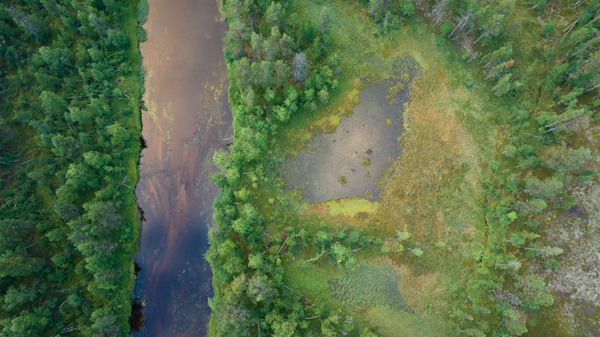
Oxbow lake in side channel of Torne river, Sweden. Credit: Arthur de Bruin.
Some natural processes are driven by the elements, habitats or vegetation, such as weather conditions, geological processes and water-related dynamics. Cold temperatures cause water to freeze, which can split rocks and trigger seeds to germinate. Rushing rivers erode their banks, creating canyons and, later, nutrient-rich sediment deposits, while falling leaves in autumn deliver nutrients back to the soils.
Other natural processes are driven by wildlife itself, such as grazing, seasonal migrations, weather responses, and predator reactions. Dead plankton and other marine life play a crucial role in regulating the climate by storing carbon as it falls to the ocean floor. Salmon carry important nutrients from the sea up into our river systems and soils. The carcasses of animals provide food for others and enrich the earth. Collectively, the eating, breeding, dunging, swimming, flying and trampling of thousands of different species drive the creation of an extraordinary range of different natural processes, habitat types, growth stages, and habitat niches.
Because natural processes are interactions between plants, animals, fungi, bacteria and the environment they are hard to categorise.
Click on each icon below to view four examples.
These interactions continue in an endless web of connections, each part connected to the other in multiple ways. This means that when some interactions and connections are lost, it has impacts throughout the entire system.
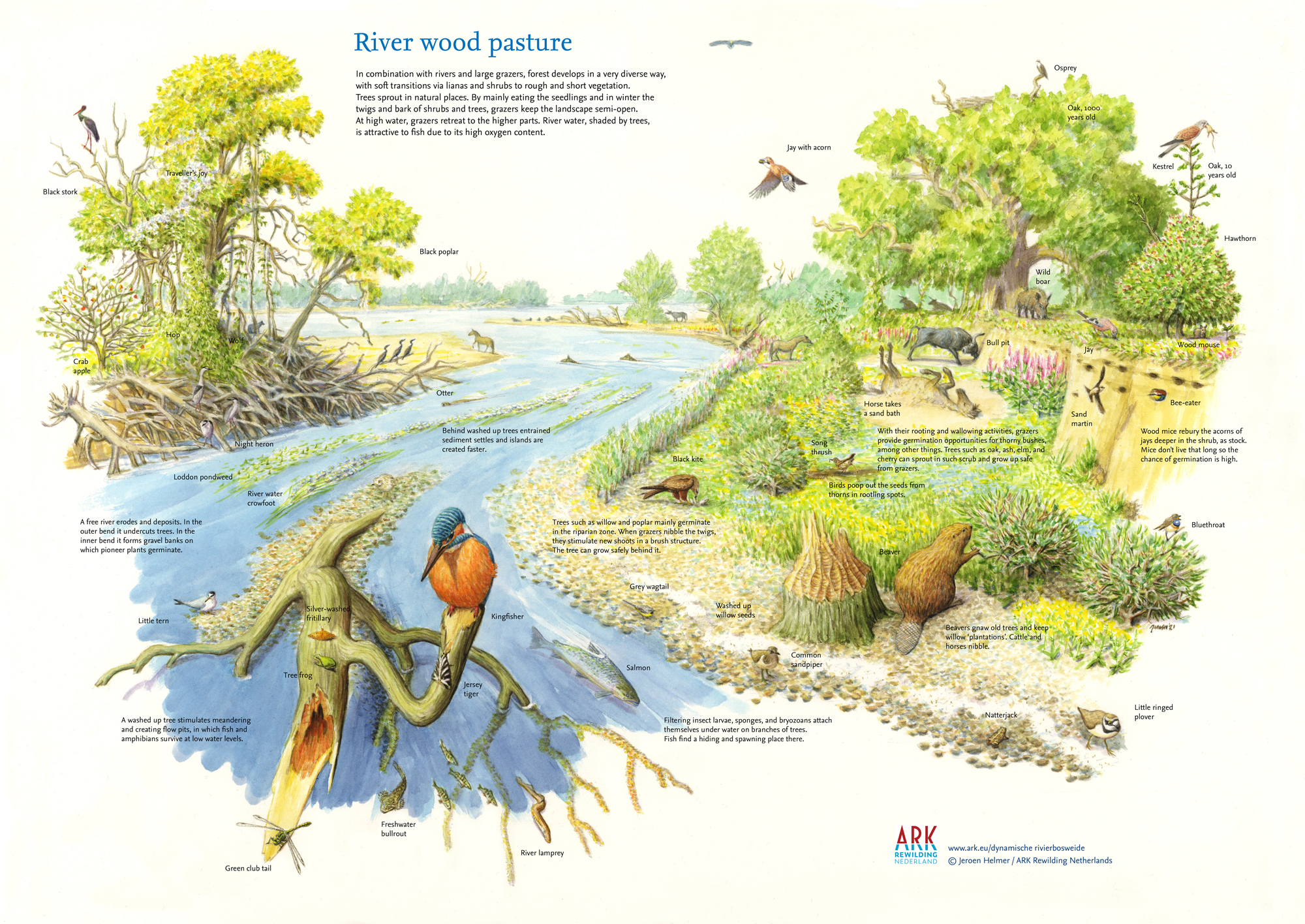
River wood pasture ecosystem. Credit: Jeroen Helmer / ARK Rewilding Netherlands.
Click here for an enlarged version of the above image.
Rewilding aims to restore natural processes by reducing human management and allowing nature to lead its own recovery. This can take many forms, such as removing a dam that allows water to flow more naturally; reducing hunting pressure to allow predator populations to increase and predation and scavenging to resume; or leaving dead wood to decompose in the forest, providing habitat for invertebrates and locking up carbon in the resulting soils.
By allowing natural processes to reshape and enhance ecosystems, rewilding can revitalise land and sea, helping to alleviate some of society’s most pressing challenges and creating spaces where nature and people can thrive in harmony.
Rewilding principle

From the free movement of rivers to natural grazing, habitat succession and predation, rewilding lets restored natural processes shape our landscapes and seascapes in a dynamic way. There is no human-defined optimal point or end state. It goes where nature takes it. By helping nature’s inherent healing powers to gain strength, in the future we will see people intervene with nature less.
In Module 2, we will discuss natural processes in the context of rewilding in more detail, with a particular focus on nature comeback and coexistence.