What is rewilding and why is it important?
2 Historical context
2.2 How can we counteract shifting baseline syndrome?
Education can help to counteract shifting baseline syndrome. Since you are taking this course, you may already know about the biodiversity decline and habitat degradation that has been negatively impacting the natural world for many decades.
Europeans used to share their landscape with woolly mammoths, giant deer, cave lions, and woolly rhinoceros, all of which became extinct between 15,000 and 4,000 years ago.
Time travelling back into the European past further reveals that even more species are now missing from the contemporary landscape in Europe, such as hippopotamus, straight-tusked elephants and interglacial rhinoceros, all of which became extinct around 35,000 years ago (Svenning et al., 2024).

Megafauna diversity and functional declines in Europe from the Last Interglacial (LIG) to the present. Davoli et al. (2023).
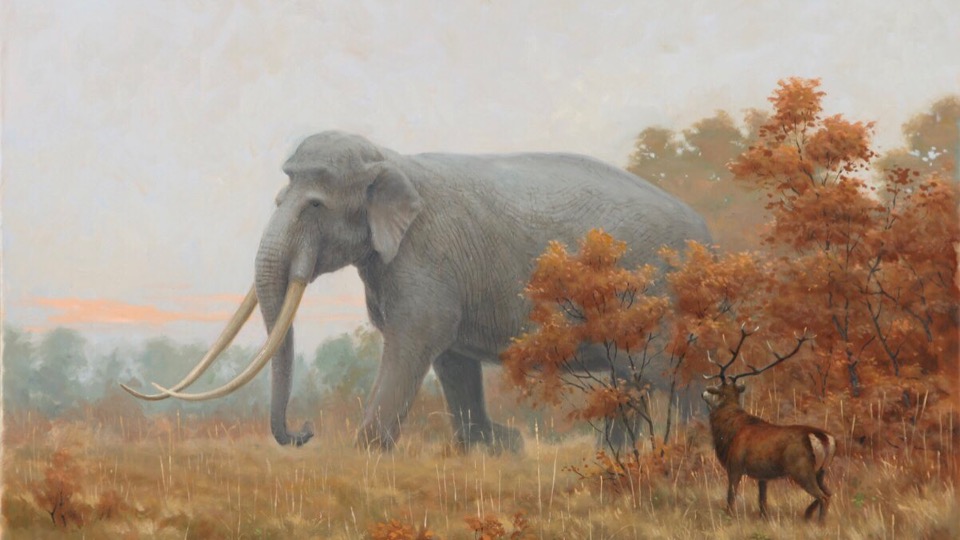
A straight-tusked elephant (Palaeoloxodon antiquus), by Julian Fiers. The species inhabited Europe, having become extinct during the latter half of the Last Glacial Period, with the youngest remains found in the Iberian Peninsula, dating to around 44,000 years ago.
This state of co-existence, with Europeans living alongside such very large animals (megafauna), is so far from our current reality that it is hard to even imagine.
Also, it used to be common to see more interactions between different habitat types. For example, rivers would spill over into their floodplains in spring, depositing sediments and seeds from upstream. This natural interaction between water, soils and vegetation is now rare in Europe: it is more common to see flood defences and embankments along the rivers, with agricultural land or buildings on the floodplains.
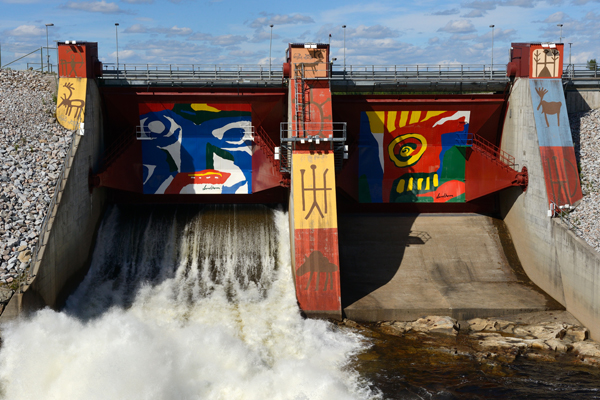
Stora Sjöfallet water power station, Greater Laponia rewilding area, Nordic Taiga, Norrbotten, Sweden; Credit: Staffan Widstrand / Rewilding Europe.
If we take a time period thousands of years ago as a baseline, any assessment of the status of contemporary European nature will find it severely degraded, with many important species missing, and an environment that has been transformed from mostly natural to one that has been substantially urbanised and industrialised. Losing interactions between different elements of the ecosystem means we lose the vital ecological roles they play.