What is rewilding and why is it important?
2 Historical context
2.3 Focus on functionality
Click on each list item below to learn more about the key difference between conservation and rewilding:
Humans have impacted their natural environment throughout history – in more recent times, this impact has intensified. Many species have been driven to extinction since the last ice age. The aurochs (the ancestor of domestic cattle), for example, was hunted to extinction in Europe in the seventeenth century. European bison had been driven to the edge of extinction by the twentieth century, while wolves became extinct in Britain in the 1700s.
A wide range of other European animal and plant species have become locally extinct or less common over the last few thousand years, from brown bears and Eurasian lynx to Dalmatian pelicans and Atlantic sturgeon.
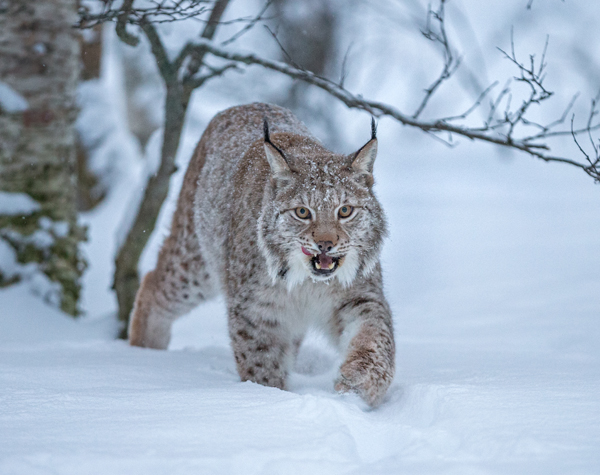
A Eurasian lynx in Nordic Taiga. Credit: Daniel Allen / Rewilding Europe.
Instead of trying to restore nature to a historic baseline, rewilding looks to the future, with the aim of restoring natural processes and ecological functioning. This can often be achieved by focusing on proxy species. The beneficial natural grazing impact of the aurochs, for example, can be restored by reintroducing and enhancing populations of other wild herbivores that are in existence today.
Remembering the past can help us to understand how much contemporary European nature has been depleted. It can challenge shifting baseline syndrome, help us to ‘think big’, and inspire us in terms of moving towards a natural world that is healthier, more abundant, and more ecologically functional.
|
‘A landscape without animals is like a stage without actors’ – Frans Schepers |
|