Terrestrial rewilding
1 European forests in context
1.1 Types of European forest
Historically, Europe was once covered by vast expanses of forest. These ancient woodlands were home to a diverse array of flora and fauna, including large mammals such as European bison, wolves and bears. As human populations grew and civilisation advanced these forests were gradually cleared for agriculture, settlements and industrial use. By the Middle Ages, huge swathes of primary forest had been converted to farmland or used for timber and fuel.
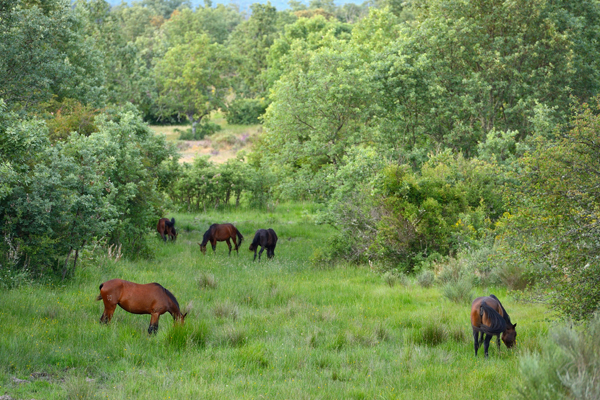
Wild horses living wild in the Campanaruis de Azába Reserve, Salamanca, León, Spain. Credit: Staffan Widstrand / Rewilding Europe.
Today, the forests that remain in Europe are largely secondary or managed forests. Secondary forests are those that have regrown after being cleared or those that have been significantly altered by human activity. Managed forests on the other hand, are actively maintained and harvested for resources such as timber, pulp and non-timber forest products.
These forests are often planted with specific tree species and managed to optimise economic return which means they typically have less biodiversity than natural forests and have a lower capacity to absorb and store atmospheric carbon.
Learned land abandonment, particularly in remote areas, has also resulted in an increase of wooded areas and new opportunities for rewilding.