Terrestrial rewilding
8 Coexistence
8.4 Case study: What does working with others and knowledge exchange look like in practice?
Bear-smart communities
Today, the Rewilding Apennines team and local partners are working hard to protect and enhance the endangered population of Marsican brown bears living in the Central Apennine mountains in Italy. The team are developing a network of large-scale wildlife corridors, enabling bears – and a wide range of other wildlife species – to move safely between protected areas.
In and around these wildlife corridors – which are focused on the Abruzzo, Lazio and Molise National Park, Sirente-Velino Regional Nature Park, and Gran Sasso and Laga Mountains National Park – the team are establishing a network of ‘Bear-Smart Communities’.
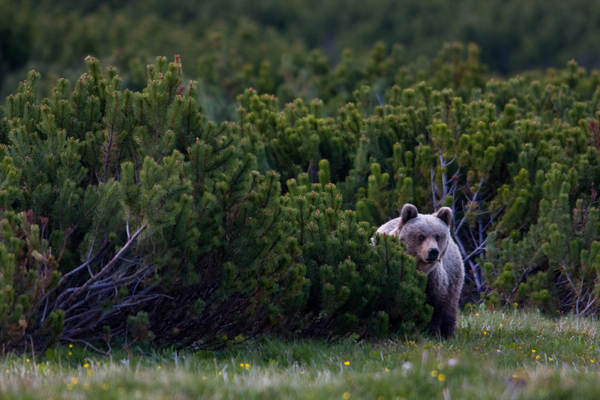
Wild European brown bear, solitary female peering from behind dwarf pines in mountain meadow. Western Tatras, Slovakia.
The Bear-Smart Community model, originally developed in British Columbia (Get Bear Smart, n.d.), employs various measures to help residents and businesses coexist with bears.
Click on each of the icons below to learn more about what these measures include:
Decisions on which measures to employ are made in consultation with community stakeholders and incorporated into coexistence plans overseen by community members. Benefit-sharing mechanisms may also be included.
In Pettorano sul Gizio, the first Bear-Smart Community in the Central Apennines, the team worked with a local NGO, authorities, and protected area managers. They used geo-spatial analysis to identify interaction areas and improve surrounding forests for bears. They also analysed local attitudes towards bears to prepare educational materials and guide community meetings.

The village of Pettorano sul Gizio, the first Bear Smart Community in the Central Apennines, Italy. Credit: Nelleke de Weerd / Rewilding Europe.
First information panel placed in light of LIFE Bear-Smart Corridors for the bear-smart community Genzana. Credit: Nelleke de Weerd / Rewilding Europe.
Following this period of assessment and dialogue, it was decided that the following coexistence measures would be employed:
- Modifying pools and tanks where bears could drown.
- Enhancing habitat – for example, by clearing scrub away from fruit trees in former orchards, in order to provide food for bears and divert them away from orchards under cultivation.
- Distributing damage prevention equipment, such as solar-powered electric fences, to enable people to protect beehives and other property.
- Replacing old rubbish bins with bear-proof bins to stop bears being attracted to waste.
- Developing rapid intervention teams, which local people could call if a bear was present in their area.
The Rewilding Apennines team also work with local businesses to explore new opportunities for nature-based tourism and help producers using bear-smart approaches benefit from a unified marketing strategy.
All these measures are brought together under the umbrella of a Bear-Smart Community that is chaired by the local mayor. A ‘bear conservation fund’ has also been set up to help finance expenses related to coexistence measures.
The impact of a Bear-Smart Community
After two years of work, in Pettorano sul Gizio and 15 other small towns across the Central Apennines, the Bear-Smart Community approach has:
- Enhanced 500 hectares of habitat, with greater availability of food for bears, in the corridors between the protected areas.
- Reduced by 30% bear damage to farm property and assets. For beehives, the reduction in damage was over 90%.
- Secured 21 pools to prevent bears from drowning.
- Enhanced public knowledge of monitoring, management, and human–bear coexistence.
- Developed at least one bear-related tourist package in each community.
Benefits to the economy
Working with local people to enable peaceful coexistence with bears has benefitted the local economy. People coming to see, monitor, or learn about the bears has meant extra business for hotels and hostels, restaurants, transport providers, and tour guides.
The Marsican brown bear has become a flagship species for the region and a valuable nature-based tourism asset. This is reflected in many different ways, from branded local products and statues to public bear-watching viewpoints and the names of local pubs.

Bear advocate Matteo Simonicca from Lecce nei Marsi in his ‘Bear Pub’. Central Apennines, Abruzzo, Italy. Credit Bruno D’Amicis / Rewilding Europe.
A replicable model
This model can be applied to more than one species. Although we began by focusing on bears, the same approach could be used for multiple species at once. Wildlife-smart communities have huge potential across Europe and need to be part of our rewilding plans. As European wildlife populations recover, encouraging and empowering people to live alongside them can generate wide-ranging benefits for communities and businesses, as well as generate additional support for further nature recovery.
‘I like to think of it as a positive feedback loop,’ says Rewilding Apennines team leader Mario Cipollone. ‘As more people here get behind rewilding, the more quickly nature can recover, which enhances the benefits it can provide to local communities. People in our communities then become even more supportive of rewilding and passionate about and proud of the nature around them. Pettorano sul Gizio is a prime example of how this cyclical process can work.’
‘We are now hosting many rewilding events,’ says Milena Ciccolella, owner of Il Torchio restaurant in Pettorano sul Gizio. ‘These have been a real lifesaver in economic terms, and have stimulated us creatively, as we now offer vegetarian dishes on our daily menu. We are also planning to offer cooking courses to ‘rewilding guests’.’
If you would like to dive deeper into this topic, here are some further resources you might be interested in:
- More detailed overview.
- Information on bear-smart produce.
- Useful video for context (first four minutes).
The work in Italy was funded by the EU LIFE Programme.