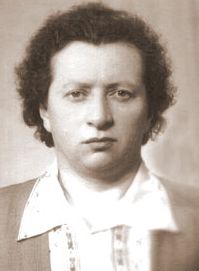
Figure 1: Kateryna Yushchenko
Source: Samoylen (1960)
Downloadable teaching resource
Overview
Kateryna Yushchenko (Катерина Ющенко) was a Ukrainian computer scientist recognised for developing the Address programming language, one of the world's first high-level programming languages.
Background
Born in Chyhyryn, Ukraine in 1919 to a family of scholars, Yushchenko enrolled in the Faculty of Physics and Mathematics at Kyiv State University in 1937, after graduating high school (Національної академії наук України, no date). Whilst in her first year there, her father was arrested for Ukrainian nationalism, followed by her mother after she tried to prove his innocence.
This resulted in Yushchenko being labelled as a “daughter of enemies of the people” and her expulsion from the University. Rejected from other universities upon discovery of her parent’s fate, and in need of a scholarship with housing, she travelled to Uzbekistan and began study at Uzbekistan State University in Samarkand. This university underwent reorganisation in 1941, during which she transferred and ultimately graduated from the Central Asian University in Tashkent, Uzbekistan (Staves, 2022; Videla, 2018).
After graduating she relocated to Angren-Stalin to work in a Coal Plant as part of the war effort, followed by a call to help teach mathematics and physics back in Tashkent. Eventually Yushchenko and her family were able to return to Ukraine, where she discovered a branch of the Institute of Mathematics of the Academy of Sciences of Ukraine had opened in Lviv, and she was immediately offered a job in the department of probability theory upon review of her University transcripts (International Charity Foundation for History and Development of Computer Science and Technique, no date).
Contributions
Kateryna Yushhenko was one of the top specialists for programming in her time. In 1950 she was the first woman to be awarded a Doctor of Physical and Mathematical Sciences in programming in the Union of Soviet Socialist Republics (USSR), and was heavily involved in the development of “addressable programming” resulting in the creation of Addressable Language in 1955, an indispensable advancement for programming theory and technology that was adopted and implemented in many fields adjacent to programming.
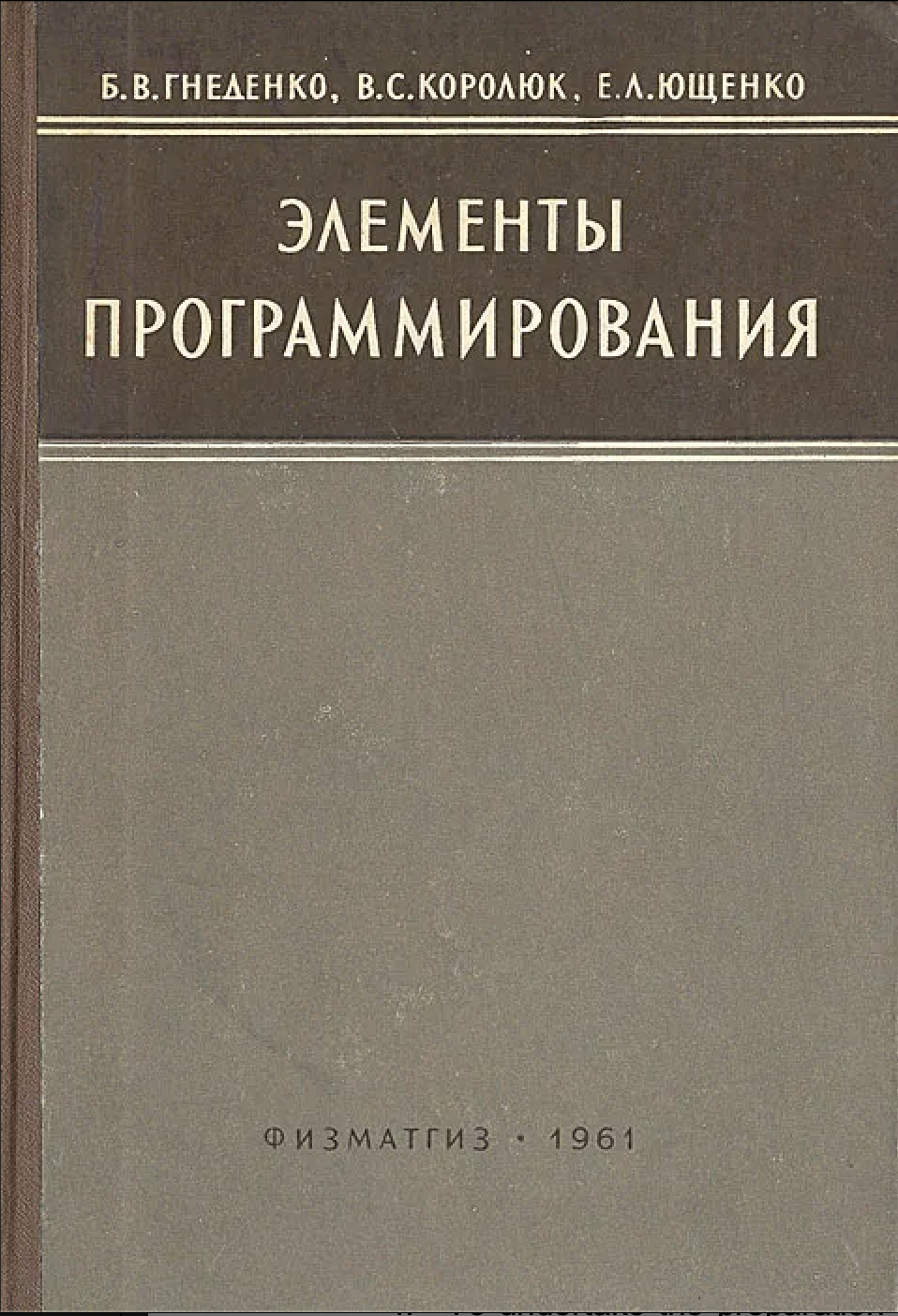
Figure 2: Элементы программирования
(Ozon, 2025)
Along with two fellow authors, Yushchenko helped write the first Soviet programming textbook, “The Elements of Programming” first released in 1961.
She founded the Kyiv School of Theoretical Programming, won multiple state awards as a result of her research, and went on to support over 45 PhD students (History of Computing in Ukraine, no date).
Feature: Address Programming Language
The Ukrainian Academy of Sciences had access to a MESM (Ru: Малая Электронно-Счетная Машина) or Small Electronic Calculating Machine, which contained many vacuum tubes causing instability of work, as well as having a limited internal memory and slow running speeds. There was a strong need for an effective high-level language to interact with the machine.
The Address programming language was Yushchenko’s solution to this problem. Unlike earlier languages where programming involved direct reference to the exact memory cell holding the data, Address could indirectly address memory, referring to a cell that held the location of the data - allowing programmers to edit the value stored without re-writing the program. This flexibility and abstraction opened the ability to write more general-purpose algorithms rather than typical hard-coded sequences and was the precursor to the later concept of pointers (Shvets, no date).
The Address language grew very popular throughout Soviet computing and in 1975 was even utilised in the computers associated with the Apollo-Soyuz space mission (Gutnyk and Ruhalenko, 2023).
A volunteer from the National Museum of Computing, Jerry McCarthy, has produced the following talk where he discusses and emulates the mechanisms of Address Programming Language as described in the original Soviet programming book written in part by Kateryna Yushchenko in 1961.
Watch
This video discusses the impact Kateryna Yushchenko's work had on Ukraine and technology.
Video 1: Women Code Too | Beyond East and West (Hromadske International, 2020)
Transcript
MESM stands for Small Electronic Calculating Machine. It's our first machine. The first computer in continental Europe was created in Kyiv in the 1950s. It was developed by professor Serhiy Lebedev. Lebedev's computer could only work thanks to a special programming language. Its development was carried out by Ukranian scientist Kateryna Yushchenko.
Oksana Bilodid (engineer, daughter of Katerina Yushchenko) - The first machines had this language as their base. The machines that were created in Kyiv, but not only in Kyiv. She actually founded a programming school, a school of theoretical programming in Kyiv. She read lectures to programmers and taught quite a few people.
But most of Yushchenko's work was done with another academician Viktor Hlushkov, the inventor of the first personal computer. Hlushkov founded the Institute of Cybernetics in Kyiv, and worked on the development of artificial intelligence and military systems.
Vira Hlushkova (scientist, daughter of Viktor Hlushkov) - The sixties, seventies, eighties... Since then, nothing new has been invented in IT.
The scientists were one step ahead of the Americans in their inventions and developments. But the Soviet Union was in no hurry with the practical realisation of their developments.
Vira Hlushkova - The Soviet Union was very inflexible, and that was very bad. That's why my father created his own electronic factory at the institute, in order to carry out experiments.
Oksana Bilodid - They never reached the international level. Because the country was closed and all developments were kept secret. That's what I think.
Despite everything, Yushchenko continued her work and helped female scientist to realise their potential in the profession.
Oksana Bilodid - It was mostly women working in my mother's department. She gave many of them a start in life. Many of them went to become Doctors of Science.
Since then, the number of women engaging in technical sciences is constantly rising in Ukraine. IT is one of the sunrise industries for Ukraine. A local representative office of the global organisation Women Who Code was opened in Kyiv in 2017
Hanna Lazarieva (tester, director of Women Who Code) - The organisation's mission is to inspire women to become successful in the field of IT, gain knowledge, develop the skills necessary in professional activities.
Female scientists share their experiences on global platforms. But now experts from all over the world are working on new developments.
References and further reading
Gutnyk, M. and Ruhalenko, S. (2023) ‘History of theoretical programming in Ukraine (contribution of Kateryna Yushchenko)’, IEEE. Available at: https://ieeexplore.ieee.org/document/10380381 (Accessed: 2 August 2025)
History of Computing in Ukraine (no date) Kateryna L. Yushchenko. Available at: https://uacomputing.com/persons/yushenko/ (Accessed: 5 August 2025)
Hromadske International (2020) Women Code Too | Beyond East and West. Available at: https://youtu.be/5Uo2X3e0e5U (Accessed: 2 August 2025)
International Charity Foundation for History and Development of Computer Science and Technique (no date) Дочка "ворога народу". Available at: https://web.archive.org/web/20120113112357/http://www.icfcst.kiev.ua/museum/Ushchenko-memoirs_u.html (Accessed: 2 August 2025)
McCarthy, J. (2023) Soviet Computing - Kateryna Yushchenko and the 'Address Programming Language' | Virtual Talk. Available at: https://youtu.be/ztcS5hwx9-Q?si=QzGvv5D0ezQWLuiU (Accessed: 5 August 2025)
Національної академії наук України (no date) Ющенко Катерина Логвинівна. Available at: https://www.nas.gov.ua/employee/yushhenko-katerina-logvinivna (Accessed: 2 August 2025)
Ozon (2025) Элементы программирования | Гнеденко Борис Владимирович, Ющенко Екатерина Логвиновна. Available at: https://www.ozon.ru/product/elementy-programmirovaniya-gnedenko-boris-vladimirovich-yushchenko-ekaterina-logvinovna-21727984/features/ (Accessed: 14 September 2025)
Samoylen (1960) File: Kateryna Lohvynivna Yushchenko.jpg. Available at: https://en.wikipedia.org/wiki/File:Kateryna_Lohvynivna_Yushchenko.jpg (Accessed: 2 August 2025)

Shvets, M. (no date) Kateryna Yushchenko: The Programmer Who Changed the World. Available at: https://stemisfem.org/en/ushchenko (Accessed: 5 August 2025)
Staves, E. (2022) Kateryna Yushchenko. Available at: https://www.computingatschool.org.uk/forum-news-blogs/2022/march/kateryna-yushchenko/ (Accessed: 5 August 2025)
Videla, A. (2018) Kateryna L. Yushchenko — Inventor of Pointers. Available at: https://medium.com/a-computer-of-ones-own/kateryna-l-yushchenko-inventor-of-pointers-6f2796fa1798 (Accessed: 14 September 2025)