Astronomy for Mental Health and Well-being
6. Module 5: Monitoring and Evaluation
Learning Outcome
By the end of this module you will be able to monitor, evaluate, and report on your activities in ways that protect participants, improve quality, and demonstrate impact.
Why Monitoring and Evaluation Matters
When your session ends, your work is not over. Monitoring and Evaluation (M&E) carry the learning forward. They help you:
-
Protect participants by identifying risks, unmet needs, and unintended consequences
-
Improve practice by clarifying what worked, what did not, and why
-
Demonstrate impact to funders, partners, and communities, building trust and support
-
Contribute to wider knowledge so others can learn from your work
Think of monitoring as tracking the journey in real time (what happened, when, and how), and evaluation as reflecting afterwards on the destination (what changed, for whom, and why). Both are needed to close the loop.
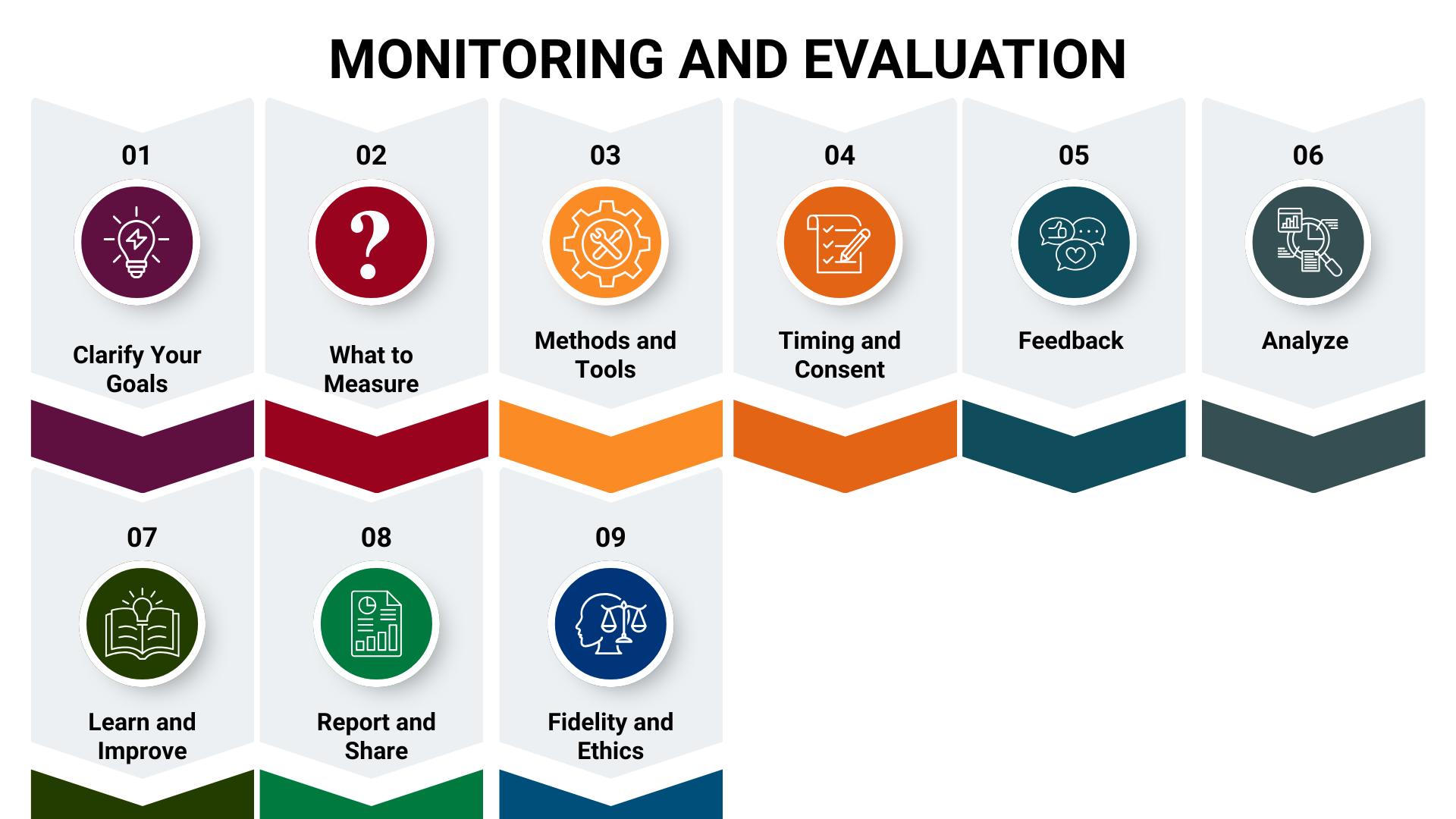
Image caption: Monitoring and Evaluation Steps.
Step 1: Clarify Your Goals
Before you measure, be clear on what you want to learn. Ask yourself:
-
What do I want to understand from this activity?
-
How will I know if participants experienced benefits?
-
How can this help me improve next time?
Keep goals simple: protect participants, improve quality, communicate value.
Step 2: Decide What to Measure
You cannot measure everything. Focus on what matters most in astronomy and well-being.
-
Well-being: mood, stress, connectedness
-
Learning: recall of one astronomy anchor or concept
-
Skills: noticing, clarifying values, choosing a next step
-
Inclusion and safety: access needs met, opt-outs respected, no unmanaged incidents
-
Fidelity: awe, perspective, or ACT-inspired reflection delivered as intended
-
Equity: who attended, who benefited, and who may have been left out
Translate outcomes into clear indicators such as:
-
Sliders (0–10) for mood, stress, connectedness
-
% recalling the astronomy anchor
-
Number of incidents and how they were resolved
-
Attendance by age or language
Step 3: Choose Methods and Tools
Keep data collection light but consistent.
Essentials:
-
One paper or phone form with 3 sliders and 2 open questions
-
A tick-box for values-based next step
-
A short fidelity checklist for facilitators
-
An incident note template
-
An attendance record
Optional add-ons (if ethics and capacity allow): a short validated scale or a 2–4 week follow-up message.
Accessibility matters: offer options (paper and phone), use plain language, large font, and audio if possible.
Step 4: Plan Timing and Consent
-
Collect baseline data at arrival
-
Gather post-session data before closing
-
Optionally follow up after 2–4 weeks
Consent should be short and clear.
Example:
“We will collect three sliders and two questions. You may skip any item or withdraw at any time. Your responses are anonymous, stored securely, and used only in group summaries.”
Step 5: Gather Feedback from Multiple Sources
Triangulate perspectives to build a fuller picture:
-
Participants: quick sliders, what helped most, what to change
-
Facilitators: 24-hour debrief on what worked, what did not, what to try next
-
Partners: short email or call to confirm safety and relevance for their group
Step 6: Analyze and Make Sense of Results
Analysis does not need to be complicated. Focus on clarity.
-
Numbers: average change on sliders, % recall, incidents, fidelity achieved
-
Themes: top three points from open responses (what helped, what to change, barriers)
-
Quotes: one or two that capture the experience
-
Equity: ask whether some groups benefited less and why
Step 7: Learn and Improve
Turn results into action.
-
Use an After Action Review: What was expected? What happened? What went well? What will we change?
-
Apply a Plan–Do–Study–Act cycle: plan one change, test it, study results, act to adapt or adopt.
This creates a rhythm of continuous improvement.
Step 8: Report and Share
Reporting is about closing the loop, not ticking boxes. Share results with those who participated, supported, and delivered the activity.
A strong one-page summary includes:
-
Who took part and the context
-
What was done and how many joined
-
3–5 headline results
-
One participant quote
-
Planned improvements for next time
-
Contact or support information
Keep tone plain, transparent, and respectful. Never share personal details without explicit consent.
Step 9: Fidelity and Ethics
Check whether the core ingredients were delivered:
-
Content notice and opt-out provided
-
Awe or perspective moment included
-
Reflection or values-based action offered
-
Grounding or present-moment cue provided
Ethics are non-negotiable: collect only what you need, store data securely, report in aggregate, and delete raw data on schedule.
Types of Evaluation
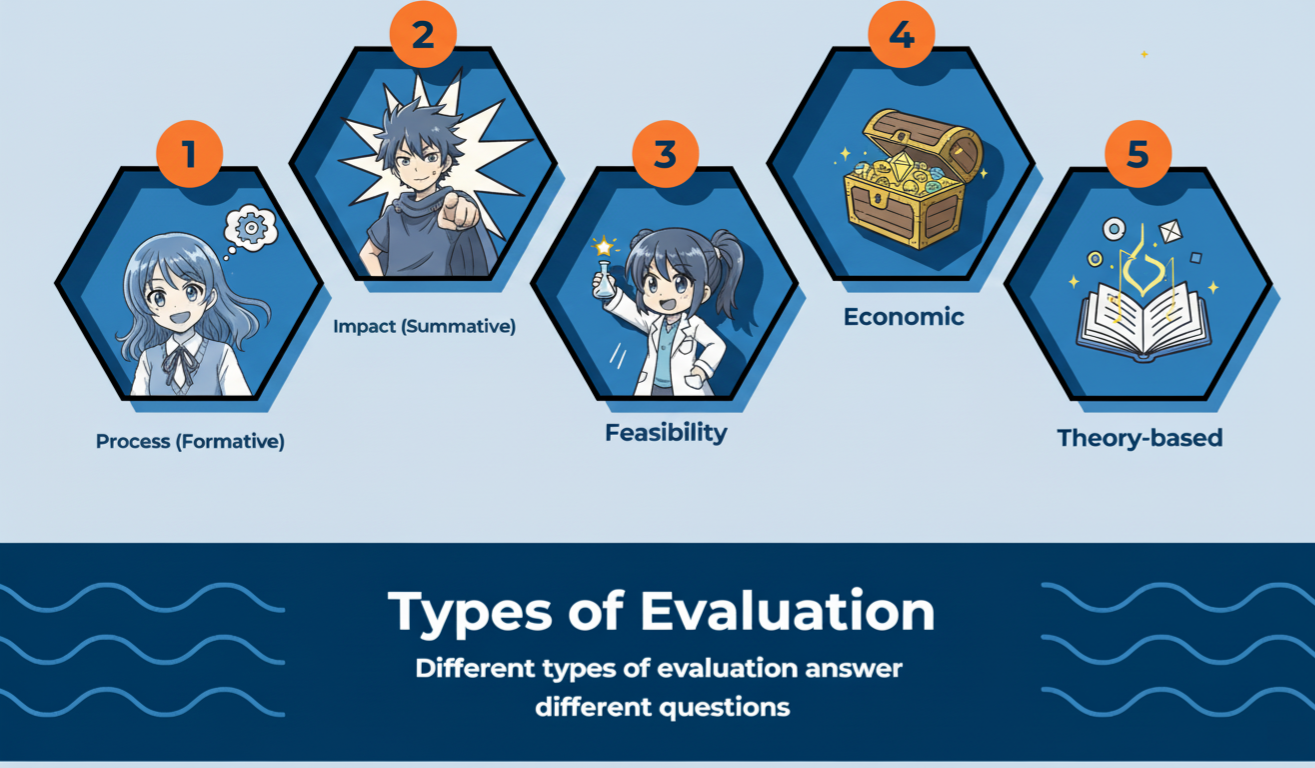
Image caption: Types of Evaluation.
Different types of evaluation answer different questions:
-
Process (Formative): How was the activity implemented? What worked, what did not, and for whom?
-
Impact (Summative): Did outcomes change? To what extent were changes due to the activity?
-
Feasibility: Could this be scaled up or repeated sustainably?
-
Economic: Was it cost-effective compared to alternatives?
-
Theory-based: Did the project follow its intended theory of change, and were mechanisms confirmed in practice?
When Not to Evaluate
Evaluation is powerful but not always appropriate. Avoid heavy evaluation when:
-
The project is very small and measurement would outweigh its value
-
The activity has no observable outcomes (e.g. simply aiming to inspire wonder)
-
The design is too complex to evaluate meaningfully
-
There is no clear hypothesis or goal
-
Outcomes are obvious without formal measurement
In these cases, focus on basic monitoring: attendance, safety, simple reflections, and team debrief.
Recognizing Constraints
Good M&E is proportionate. Keep in mind:
-
Cost: larger projects may devote 10–20% of budget; small projects should keep it light
-
Burden: avoid overwhelming facilitators or participants
-
Scope: measure what matters, not just what is easy to count
Final Reflection
Monitoring and Evaluation is about more than data. It is about creating a culture of learning, trust, and safety. Done well, it strengthens your practice, protects participants, and builds evidence for the unique role of astronomy in mental health and well-being.
Keep it proportionate, ethical, and practical. Focus on what matters most, share results openly, and use every cycle to get better.