Week 1 Readings
2. The 6-minute method
Use this every time you meet an object (in a museum, a photo, a video, or your own work).
Minute 1: Shape & function
-
What is it? (bowl, jar, vase, plate, flask…)
-
What might it be used for? (serve, store, display, ritual…)
Minute 2: Structure
-
Rim, neck, shoulder, belly, foot/base: what do you notice?
-
Is it thin or thick? Symmetrical or hand-built? Stable or risky?
Minute 3: Surface & colour
-
Glaze or unglazed? Matte or glossy?
-
Colours: underglaze blue? iron red? celadon green? white body?
Minute 4: Decoration & layout
-
What motifs? (dragons, flowers, waves, geometric borders)
-
How is the decoration organised? (bands, panels, central medallion)
Minute 5: Making clues
-
Signs of wheel-throwing? joins? trimming? brushwork?
-
Any firing marks? (foot ring, kiln grit, uneven glaze)
Minute 6: Evidence-based interpretation
Write two sentences:
-
“I observe…” (only what you can see)
-
“This suggests…” (your best interpretation + why)
Figure 1: Porcelain painted with cobalt blue under transparent glaze
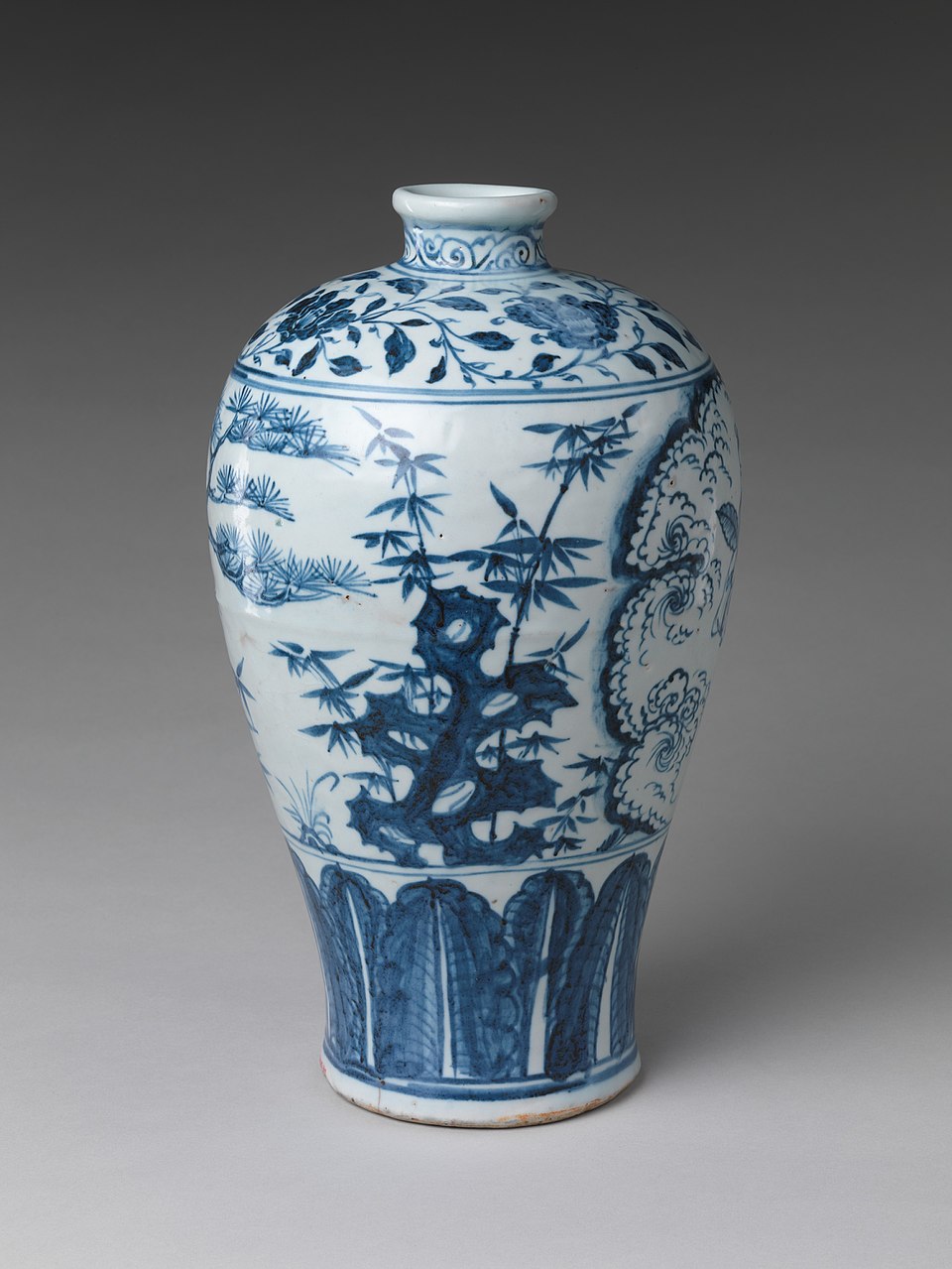
A ceramic vessel can be read through shape, surface, and traces of making.
Minute 1: Shape & function
-
What is it? A vase (tall body, narrow mouth).
-
What might it be used for? Most likely display (flowers/branches) rather than pouring; the mouth is relatively small and controlled.
Minute 2: Structure
-
Rim/neck: A short, slightly flared rim and a short neck with a narrow decorative band.
-
Shoulder/belly: A broad shoulder that transitions into a tall belly; the form narrows toward the base.
-
Foot/base: A stable foot ring with a flaring lower section; visually weighted to support the tall body.
-
Overall build: Looks symmetrical and carefully proportioned—consistent with wheel-throwing and later joining/finishing.
Minute 3: Surface & colour
-
Surface: Appears glazed and glossy (light reflections on the white ground).
-
Colours: Underglaze cobalt blue on a white porcelain body; darker areas show heavier pigment/brush loading.
Minute 4: Decoration & layout
-
Motifs (visible):
-
Bamboo stalks and leaves (center-left)
-
A porous scholar’s rock (center)
-
Cloud scrolls (right side)
-
Floral scrolls around the shoulder (top band)
-
A bold lappet/petal-style band around the lower body (deep blue)
-
-
Organisation: Mainly bands + a main scene: narrow bands at neck/shoulder and a larger central field with bamboo/rock/clouds; heavy decorative band at the base anchors the composition.
Minute 5: Making clues
-
Brushwork: Varied line thickness and darker pooling suggest freehand brush painting with changes in pressure and pigment load.
-
Glaze boundary clues: The base shows a clear stopping area near the foot (common in glazed wares to prevent sticking in firing).
-
Form clues: The clean symmetry suggests wheel work; the crisp bands suggest planned layout and controlled decoration.
Minute 6: Evidence-based interpretation (2 sentences)
-
I observe… a tall, symmetrical blue-and-white vase with bamboo and a scholar’s rock in the main field, framed by multiple decorative bands and a strong dark-blue lower border.
-
This suggests… the maker designed it primarily for visual display, using a structured banded layout and symbolic plant/landscape motifs to create a balanced, “scholar’s studio” style composition that reads clearly from a distance.