Lesson 2.3: Media Narratives Across Europe
4. Culture-war dynamics and media representation
 In Western Europe, ‘anti-gender’ discourses frequently take on the form of a culture war over language, identity, and free speech. The UK, for example, has a highly commercialised media landscape where gender debates are framed as questions of fairness, safeguarding, or freedom of expression.
IN FRANCE |
Discussions of gender and sexuality are filtered through republican secularism and laïcité (state secularism). Gender studies and intersectional feminism are sometimes portrayed by officials as divisive imports threatening civic unity. |
|
The dynamics of culture war occurs both intra- and cross-nationally. ‘Anti-gender’ media discourses use both national(istic) tropes and references to foreign cultural contexts, often depicted as sites of moral decay that threaten ‘Christian values’, ‘tradition’, ‘the natural order’ and ‘common sense’. Meanwhile, ‘pro-gender’ actors and media narratives tend to reference the ‘West’ as an idealised arena of progress, showing the complexities and ambiguities of Polish geospatial cultural imaginary. |
IN POLAND |

Reflect
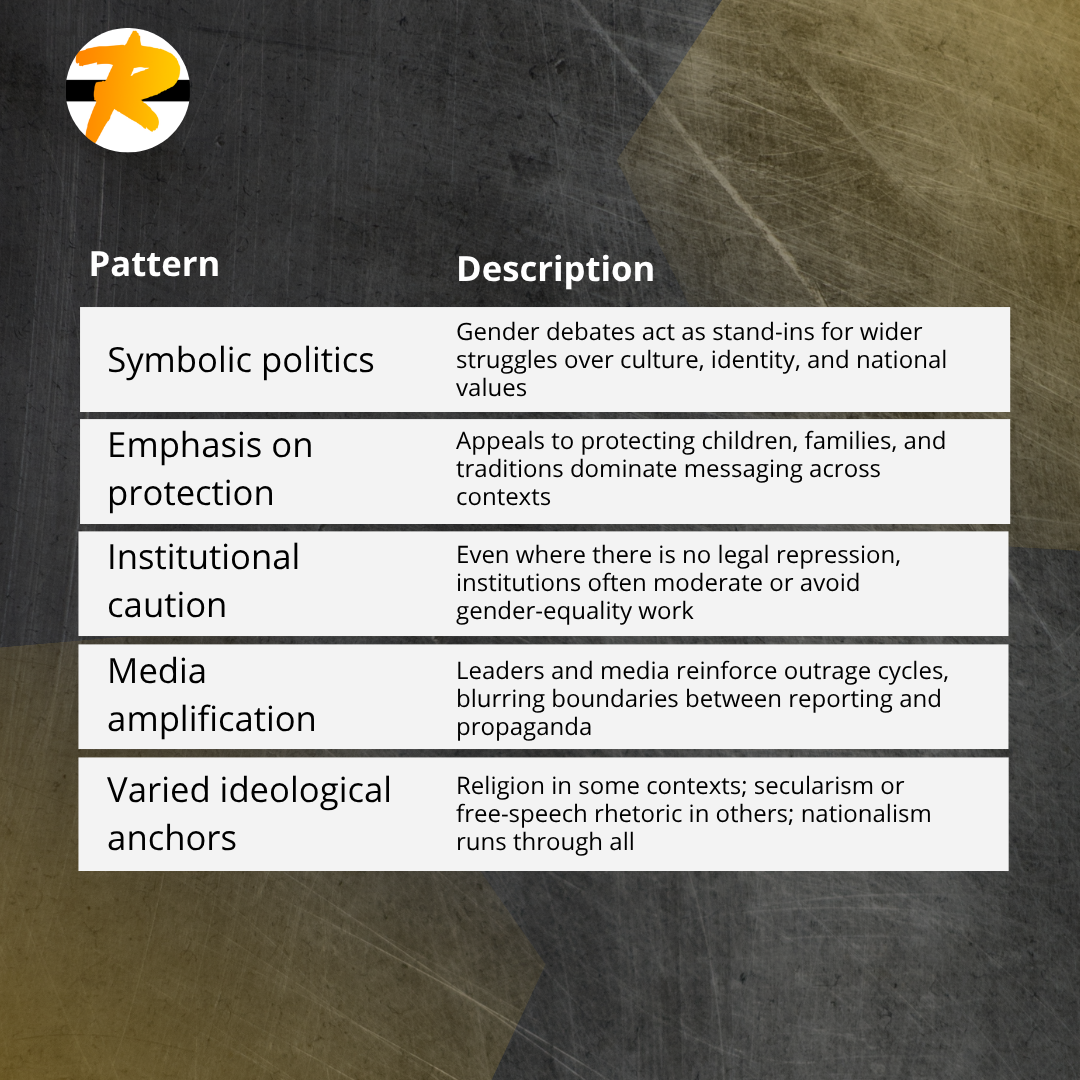
These examples reveal how ‘anti-gender’ narratives attach themselves to culturally specific notions of morality and public order. Whether invoking religion, secularism, or free speech, they all mobilise emotion and identity to delineate who belongs and who endangers society.
- Which narratives in your context draw most heavily on religion?
- Which rely on secularism, science, or free speech instead?