Module 5
1. Competency frameworks
Purpose
Introduce competency frameworks and show how they give CPD direction and a common language.
Learning objectives
By the end of this module you will be able to:
- Explain what a competency is
- Describe how professional frameworks such as APM and BCS/SFIA are structured
- Use maturity levels to rate your own competency
- Map CPD activities to competencies
- Use competencies in career planning
5.1 What are competencies?
A competency is a combination of knowledge, skills and behaviours that enables someone to perform a task or role effectively. Competencies describe what good looks like in practice, not just what someone has studied.
For example, "stakeholder engagement" is not just knowing a stakeholder-mapping technique. It includes identifying the right people, communicating appropriately, managing conflicting interests and building trust.
5.2 How professional frameworks are structured
Frameworks differ, but most share a common shape: competency areas or categories, individual competencies within them, and levels describing increasing capability.
- APM: the APM Competence Framework organises project, programme and portfolio competences into groups and describes what is expected at different levels of practice.
- BCS / SFIA: BCS uses SFIA (Skills Framework for the Information Age), which describes skills by category and defines seven levels of responsibility.
- Employer frameworks: many organisations adapt these into their own role profiles or career frameworks.
Use the framework your professional body or employer actually uses. If you have none, a role profile or a job advert for a target role is a workable starting point.
5.3 Competency maturity levels
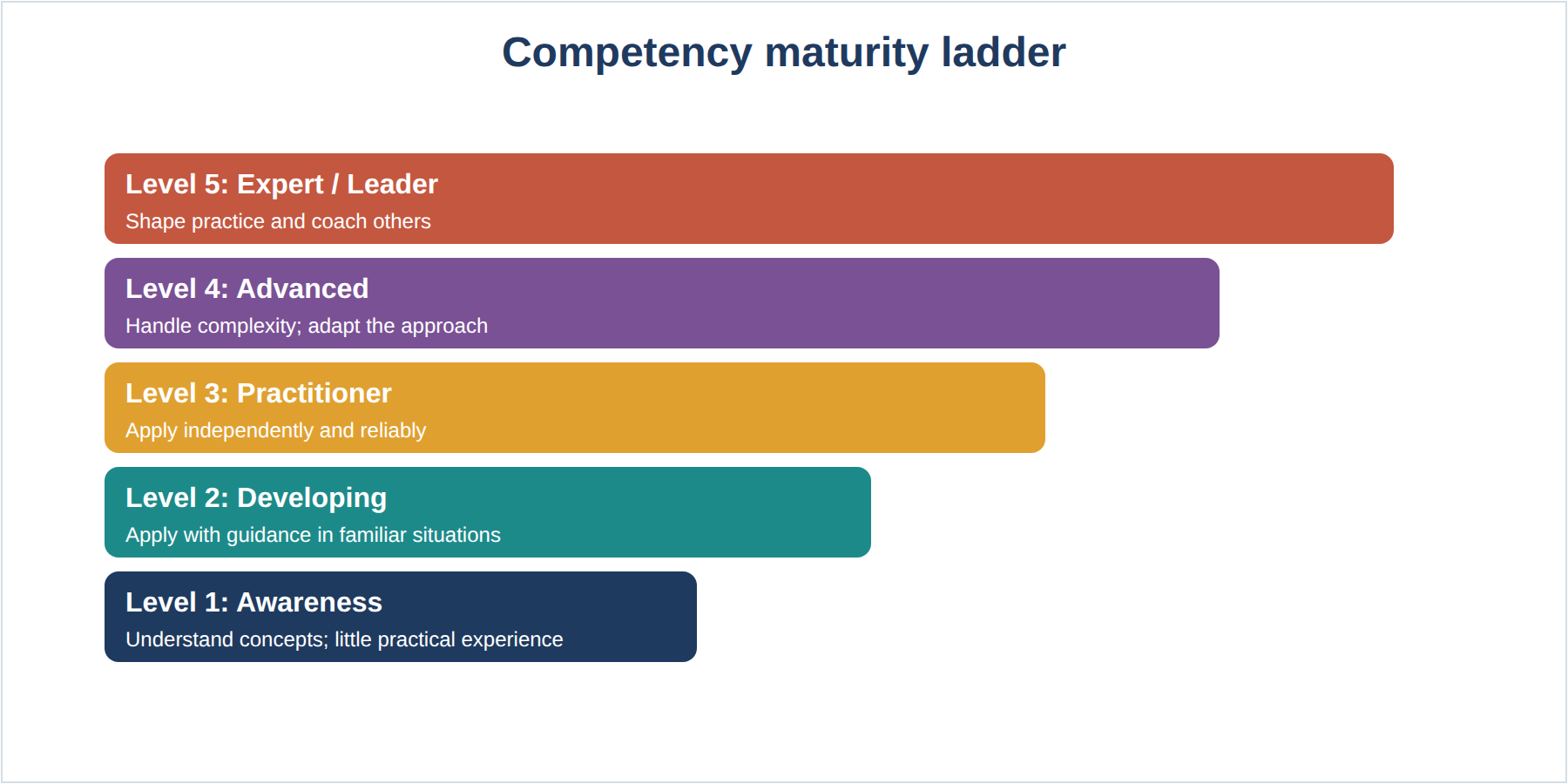
| Level | Label | What it looks like |
|---|---|---|
| 1 | Awareness | I understand the concept and vocabulary but have little or no practical experience |
| 2 | Developing | I can apply it with guidance in familiar, straightforward situations |
| 3 | Practitioner | I apply it independently and reliably in my normal work |
| 4 | Advanced | I handle complex or unfamiliar situations and adapt the approach |
| 5 | Expert / Leader | I shape how others do it, coach people and contribute to the profession |
Rate yourself honestly. Base your rating on what you have actually done and can evidence, not on theory. Ask: "What is my best recent example of doing this at this level?" If you cannot think of one, rate one level lower or note it as a development area.
5.4 Mapping CPD to competencies
- Pick a CPD log entry.
- Ask what competency (or competencies) it exercised.
- Note whether it introduced the competency, practised it or demonstrated it at a higher level.
- Record the mapping in your log.
Over time a pattern emerges: some competencies are well supported by CPD, others have none. That pattern drives your gap analysis in Module 7.
5.5 Using competencies for career planning
Compare the competencies and levels expected in a target role with your current ratings to see what stands between you and your next step. Share this with your manager or mentor to get realistic, specific guidance.
Key takeaways
- Competencies describe observable capability, not just knowledge
- Frameworks give you a shared language and a way to judge progress
- Maturity levels turn "skilled / unskilled" into a scale you can move along
- Mapping reveals both strengths and neglected areas