Module 6
1. Evidence collection & management
Purpose
Show you how to gather, organise and use evidence so that your competency claims are credible.
Learning objectives
By the end of this module you will be able to:
- Decide what counts as good evidence
- Explain how evidence supports a competency claim
- Build and organise an evidence vault
- Use evidence in appraisals
- Link evidence to CPD entries and development plans
6.1 What counts as evidence?
Evidence is anything that shows you did something and what resulted from it. Good evidence is:
- Relevant: clearly linked to the competency being claimed
- Authentic: genuinely your own work or contribution
- Current: recent enough to reflect your present ability
- Specific: showing what you did, not just that you were present
- Sufficient: more than one example for important claims
Examples:
| Category | Examples |
|---|---|
| Documents you produced | plans, reports, presentations, process maps, designs |
| Feedback | emails, testimonials, 360 feedback, appraisal comments |
| Outcomes | metrics, delivery results, cost or time savings, quality improvements |
| Learning records | certificates, transcripts, course notes, badges |
| Reflections | written reflections on what you learned and changed |
| Observations | mentor or manager observation notes |
Important: before storing any work document as evidence, check that it is not confidential or commercially sensitive. Remove or anonymise client names, personal data and anything your employer would not want shared. Follow your organisation's policies.
6.2 How evidence supports competency claims
A claim without evidence is an opinion. A strong competency claim has three parts:
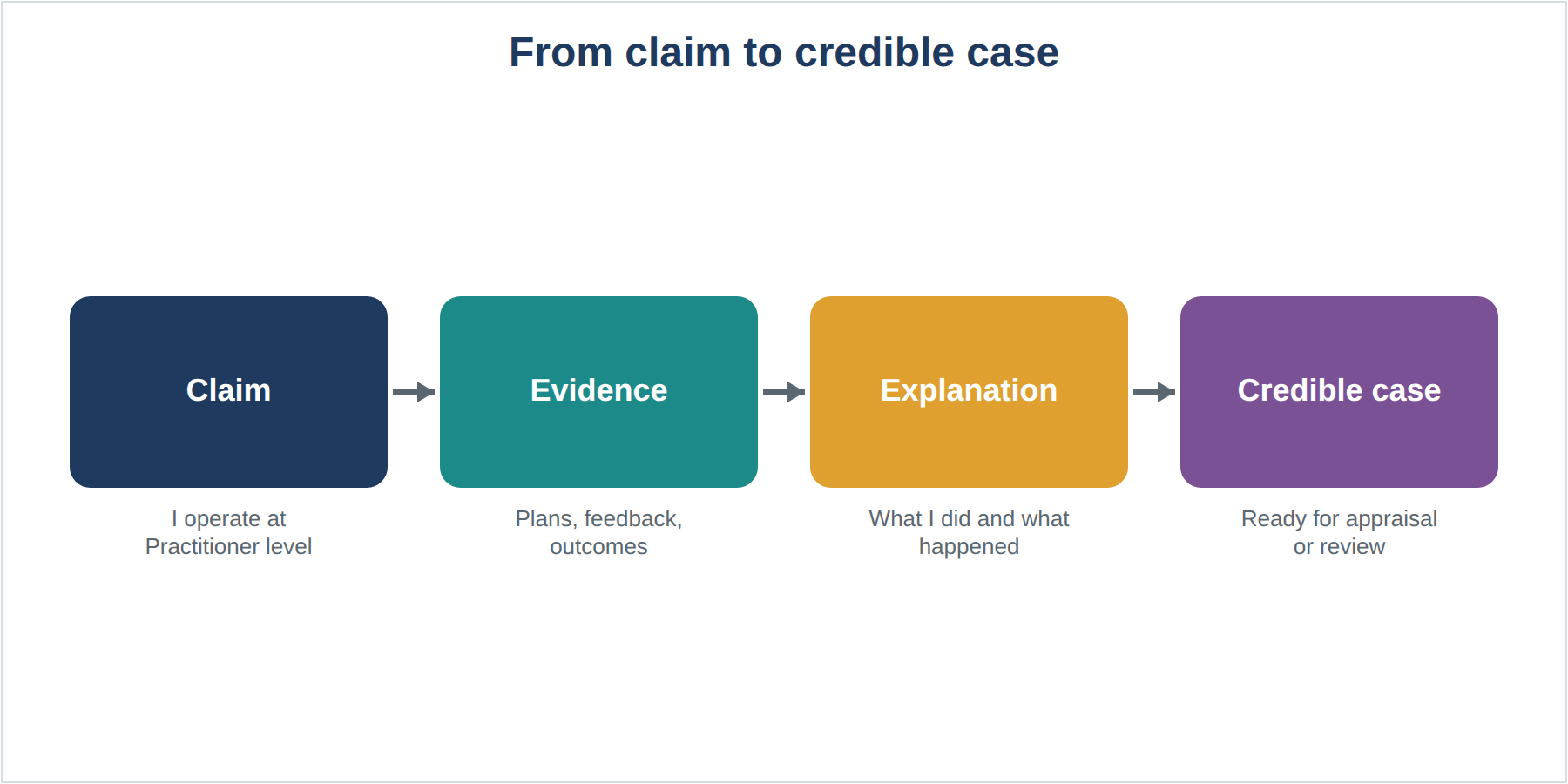
- Claim: "I operate at Practitioner level in stakeholder engagement."
- Evidence: "Stakeholder map and engagement plan for the billing migration; feedback email from the programme sponsor."
- Explanation: "I identified 14 stakeholders, tailored communications to each and resolved a conflict between finance and operations, which kept the go-live date."
6.3 Building an evidence vault
An evidence vault is an organised, backed-up place where you keep your proof.
Set-up steps:
- Choose a location you will keep long term and can access if you change employer (a personal cloud folder works well).
- Create folders by competency or by year. Pick whichever you will actually maintain.
- Use a consistent file-naming convention, such as YYYY-MM_topic_type.
- Keep a short index listing each item, date, competency and CPD log reference.
- Back it up and review it quarterly.
Evidence index template
| ID | Date | Item | Type | Competency | CPD log ref | Notes |
|---|---|---|---|---|---|---|
| E001 |
6.4 Using evidence in appraisals
Good evidence lets you move from "I think I did well" to "here is what I did and what happened." Before an appraisal, select your three to five strongest pieces, matched to the objectives or competencies being discussed. Quality beats quantity.
6.5 Linking evidence to CPD and development plans
- Backward to the CPD log: each entry points to its proof
- Sideways to competencies: each piece supports a rating
- Forward to your development plan: gaps in evidence often reveal where to develop next
Key takeaways
- Good evidence is relevant, authentic, current, specific and sufficient
- A competency claim needs evidence and a short explanation
- A simple, consistent vault with an index saves hours later
- Always protect confidential information