Module 9
1. Using CPD for appraisals and PDPs
Purpose
Show how your CPD record, evidence and competency ratings support employer processes such as annual appraisals and personal development plan (PDP) reviews.
Learning objectives
By the end of this module you will be able to:
- Prepare effectively for an appraisal
- Use your CPD log as evidence of development
- Use competency maturity in PDP discussions
- Demonstrate commitment to your own growth
- Showcase achievements with evidence and impact
9.1 Preparing for appraisals
Start four to six weeks ahead.
- Re-read your objectives and last year's PDP.
- Review your CPD log and highlight the entries that matter most.
- Select 3-5 strong pieces of evidence matched to your objectives.
- Update your competency ratings and note what has changed.
- Draft your key achievements using the structure in 9.5.
- Decide what support you want: time, budget, projects, mentoring.
- Prepare two or three questions for your manager.
9.2 Using CPD logs as evidence
Your log shows consistency and intent. You can say, "Over the year I completed 14 activities across formal, informal and experiential learning, concentrated on risk and leadership," and then give a specific example. Summarise the log by theme rather than handing over every entry, and keep the full record available if asked.
9.3 Using competency maturity in PDP discussions
Maturity levels give you and your manager a shared, specific vocabulary. Instead of "I want to develop my leadership," you can say:
"I rated myself 2 in leadership at the start of the year and now 3, supported by leading the migration workstream. To reach 4, I need experience leading a multi-team delivery. Could we explore that as a stretch assignment?"
This shows self-awareness, provides evidence and makes a clear request your manager can act on.
9.4 Demonstrating commitment to development
Commitment is shown by behaviour over time:
- A regularly updated log and plan
- Development done in your own time as well as work time (where you choose to)
- Applying learning to work and sharing it with colleagues
- Acting on feedback
- Taking initiative, such as proposing a development activity rather than waiting to be offered one
9.5 Showcasing achievements
Use Situation, Action, Result, Learning (SARL).
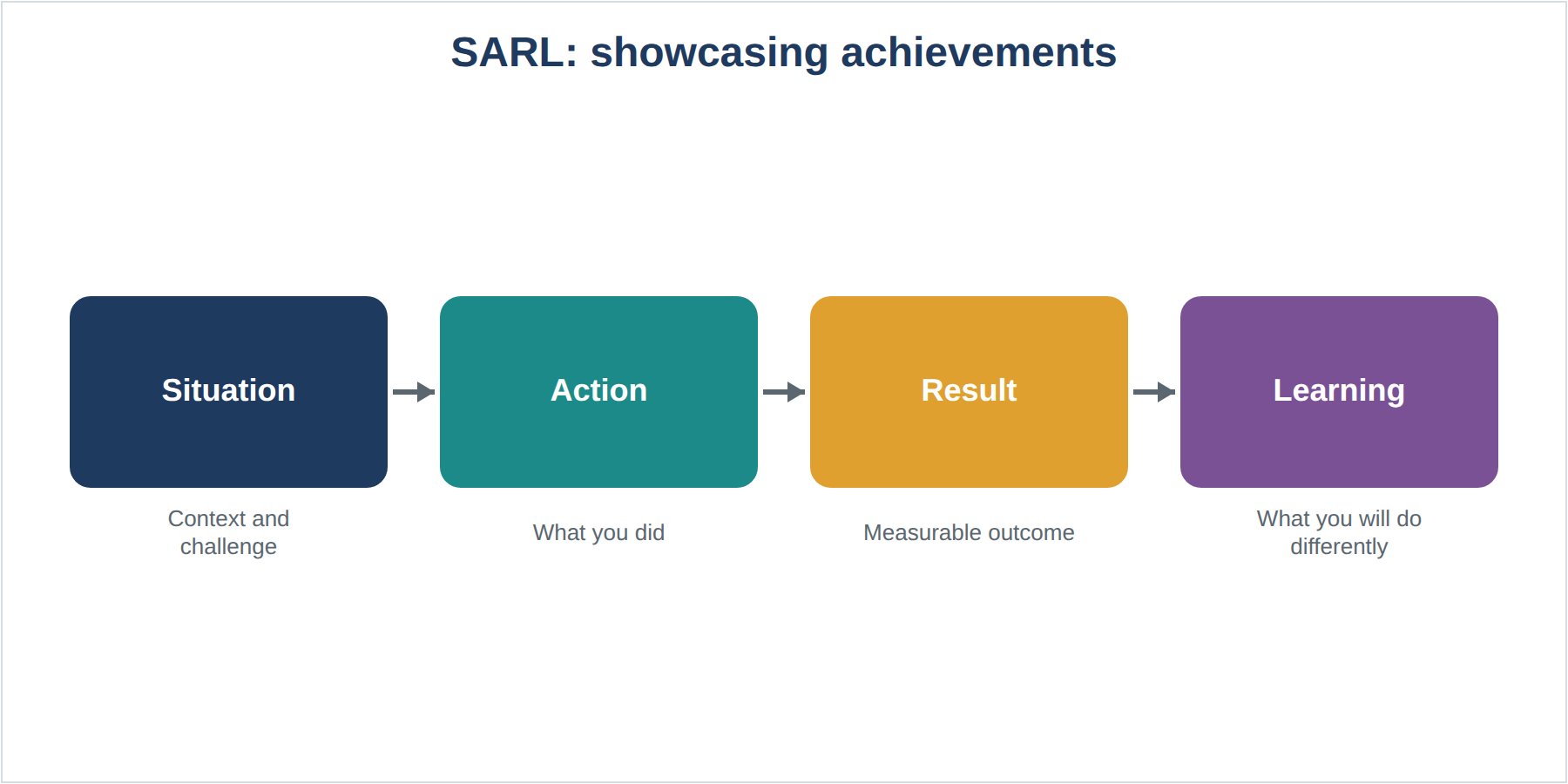
- Situation: the context and challenge
- Action: what you specifically did
- Result: the measurable or observable outcome
- Learning: what you learned or will do differently
Example: "Our project had no consistent way to track risk (S). I introduced a monthly risk workshop and quantified the top ten risks (A). The sponsor reallocated contingency early and we delivered within budget (R). I learned that visible numbers change decisions faster than narrative (L)."
Be honest about team contributions and avoid exaggeration; evidence will back you up or expose you.
9.6 Writing a PDP reflection
- What happened: a brief description
- What I learned: knowledge, skill or insight gained
- What I would do differently: honest self-assessment
- What next: specific follow-up actions
Aim for 250-400 words in the first person, with at least one concrete example.
Key takeaways
- Prepare for appraisals weeks ahead using your log and evidence
- Summarise and theme your CPD rather than listing everything
- Maturity levels turn vague wishes into specific, actionable requests
- Use SARL to present achievements clearly and credibly