You can do this: How to build confidence with numbers
| Site: | OpenLearn Create |
| Course: | Building number confidence: Graphical data |
| Book: | You can do this: How to build confidence with numbers |
| Printed by: | Guest user |
| Date: | Sunday, 25 October 2026, 11:23 PM |
1. Introduction
Many people feel anxious or uncomfortable when it comes to numbers. This could be due to negative school experiences, neurodiversity, or a belief that they’re just "not a maths person." These feelings and experiences can make it harder to engage with numeracy later in life.
Maths anxiety is real and can cause stress, avoidance, and even physical symptoms. But it’s important to know that everyone can improve their numeracy skills with time, practice and the right support.
This guide provides practical tips and strategies for helping yourself and others to build confidence with numeracy. Using a strengths-based approach, we start by recognising what you already know and can do, even if you don’t think of it as maths. We’ll also explore ways to tackle maths anxiety, share tips for supporting people with neurodivergent conditions like ADHD or dyscalculia, and suggest ways to make numeracy feel more accessible, relevant, and fun.
2. Understanding maths anxiety
What is maths anxiety?
What is maths anxiety? | Multiply Highland, 1:41
Maths anxiety is a feeling of tension, worry, or fear that interferes with your ability to work with numbers. It can affect anyone, regardless of age, background, or ability.
People with maths anxiety often avoid situations involving numbers, even when they have the relevant skills.
This anxiety can stem from past experiences such as feeling embarrassed in school, being told they were 'bad at maths', or being rushed or pressured to get the right answer. Over time, these experiences can lead to a lasting fear of failure and avoidance of numeracy altogether.
Math's anxiety can show up in different ways. For example, feeling panicked when faced with numbers and worrying about getting things wrong, avoiding tasks that involve maths, like splitting a bill, feeling ashamed or inadequate, or even physical symptoms like a racing heart or feeling sick.
It's important to recognize these feelings are real and manageable. You're not alone. And maths anxiety doesn't mean you can't improve. You can do this!
Maths anxiety can interfere with our working memory. Working memory is the part of your brain that helps you hold and use information for a short time, like remembering a number while doing a sum. When we have learnt to become nervous about numbers, it can sometimes affect our ability to take in and recall information.
What can help?
Studies have shown that using interventions designed to reduce maths anxiety can help us feel calmer. These strategies can help us prepare for everyday numeracy challenges and improve how we respond to numbers.
Here are some simple, practical things you can try (click headings to expand):
Acknowledging intrusive thoughts and expressing them externally can prevent them from interfering with other mental processes, including working memory. Writing about anxiety can also help us to understand and find ways to overcome it.
Engaging with numbers as much as possible outside of formal learning can help us to see them as a normal and positive part of daily life. For example, playing number-rich board games, or chatting about sports using scores and statistics.
Give yourself permission to go slowly and check your thinking. Writing things down can help reduce the amount we need to remember at one time and help free up our working memory.
Mistakes are part of learning and help build understanding. By looking back at what might not have worked you are learning how to improve. Turn negatives into positives!
Feeling nervous or anxious can produce physical symptoms. Breathing exercises or a short walk or even meditation can help reduce stress and anxiety.
Tackle one small step at a time instead of a whole problem.
Instead of "I’m rubbish at maths," try "I’m learning to feel more confident with numbers". When faced with challenges, recognise your ability to succeed, even if it could take some time. This is a form of self-efficacy and is a psychological technique suggested by Albert Bandura.
Short, regular sessions are more helpful than long ones that leave you feeling drained.
3. Supporting others with maths anxiety
Why your support matters
Many people feel unsure about numbers, and having someone supportive in their corner can make a big difference. Whether you’re helping a child with homework, working alongside a colleague, or encouraging a friend or family member, your attitude and approach matter as much as your skills.
If someone you know is struggling:
- be patient and encouraging
- avoid making jokes about maths being hard or scary
- praise effort, not just correctness
- help them find a calm environment to practise
- share your own strategies or positive experiences.

People feel safer and more open to learning when they don’t fear judgement. You don’t need to have all the answers, you just need to show support.
Reflection
Think about a time when you or someone you know has experienced symptoms of maths anxiety.
Consider the strategies suggested above. Do you think that any of these might have helped and why?
How might you approach a similar situation in future?

Scenario
You’re helping your friend Ceitidh, who’s applying for a new job.
She needs to complete an online numeracy assessment as part of the application, but she looks worried and says, "I’ve always been terrible at maths. I’ll probably fail."
How do you respond?
- “Don’t worry about it—just guess your way through and hope for the best.”
- “You’ve got this! Let’s look at a few examples together and take it one step at a time.”
- “Well, if you’re not good at maths, maybe it’s not the right job for you.”
The best option is B
“You’ve got this! Let’s look at a few examples together and take it one step at a time.”
This option is encouraging and practical. It shows empathy, avoids judgement, and offers to support Ceitidh in a manageable way. Breaking tasks down into smaller steps can reduce anxiety and help build confidence.
Why not A or C?
A might seem reassuring, but it avoids the issue and could increase stress if Ceitidh feels unprepared.
C reinforces negative beliefs and could make Ceitidh feel worse about herself.
4. Providing guidance and encouragement
Let's explore now how we can support others with numeracy. Click the headings below to expand.
- Be positive: Avoid saying things like "I was never good at maths either." Instead, model a growth mindset.
- Focus on understanding: Ask children to explain their thinking rather than rushing to the answer.
- Use real-life examples: Relating maths to their interests (e.g. football scores, baking, pocket money) can make it more meaningful.
- Stay calm: If you’re unsure, say, "Let’s figure it out together." Showing how to work through uncertainty is a valuable skill.
- Create safe spaces: Whether at work or socially, normalise asking for help and talking about difficulties with numbers.
- Share strategies: What works for you might work for others e.g., apps, visual aids, note-taking, or breaking problems into parts.
- Avoid unhelpful jokes: Comments like "I can’t even count to ten" may seem harmless, but they reinforce negative attitudes and fears.
- Celebrate small wins: Acknowledge progress, however small, and help others notice their own growth.
- Talk about numbers casually: Compare prices, estimate arrival times, or count change together.
- Use games and challenges: Card games, logic puzzles, or number-based mobile apps can build skills without putting us under pressure. Equally as important is not to force participation. Negative outcomes can reinforce a negative outlook on participation in numeracy-based games.
- Involve others in planning: Invite children or friends to help with meal planning, budgeting or travel logistics such as bus and train timetables, how much time is required to travel, where do you need to change and how long do you need to wait. Home improvements – how much lino might be needed for a new floor? This all counts as numeracy and increases number confidence.
Being a role model
Remember that not everyone may be confident at maths. Your attitude can influence how others see maths. If you speak confidently, take your time, and stay curious, others are more likely to do the same. Being honest about your own learning journey can make numeracy feel more human and achievable.
Reflection
Think about past situations where someone (yourself or someone else) has needed help with numeracy.
What type of support was offered (if any) and did it help?
What could have been done differently to increase number confidence?

Scenario
You’re in a team meeting to plan a community event. The group needs to work out quantities and costs for food and materials.
One team member, Seumas, stays quiet while others make quick decisions involving numbers. Later, in a smaller group, Seumas quietly says to you, “I never say much when it comes to the maths stuff. I always end up feeling a bit out of my depth.”
How do you respond?
- “Same here. I jot down some calculations, but mostly just nod and hope no one asks me to check the figures.”
- “It’s just basic maths, really. You’d pick it up if you joined in more.”
- “I’ve noticed you’re great with the logistics side though. Maybe next time we can look at the numbers together before the meeting?”
The best option is C
“I’ve noticed you’re great with the logistics side though. Maybe next time we can look at the numbers together before the meeting?”
This response affirms Seumas’s strengths and gently opens the door to build confidence with numbers in a low-pressure setting. It suggests collaboration and trust while acknowledging the difficulty without judgement.
Why not A or B?
A might feel supportive on the surface, but it reinforces avoidance and shared insecurity instead of offering a positive step forward.
B dismisses Seumas’s feelings and implies the issue is effort, not confidence, which could discourage them even further.
5. Neurodivergence and numeracy
What is neurodivergence?
Neurodivergence refers to natural differences in how people think, learn, and process information. It includes conditions such as ADHD, dyscalculia, autism, dyslexia, and others. These differences can affect how someone experiences numeracy, and how they are supported.
Recognising and respecting neurodivergence is key to helping people feel confident and included in numeracy learning. Click the headings below to expand.
ADHD (Attention Deficit Hyperactivity Disorder) is a condition that affects how people focus, stay organised, and manage impulses, often making it harder to concentrate or complete tasks.
People with ADHD may experience:
- difficulty focusing or maintaining attention on long or repetitive tasks;
- trouble with working memory (holding information in mind while solving a problem);
- impulsivity (rushing through calculations or skipping steps);
- struggles with time management or sequencing steps in multi-step problems.
Numeracy strategies for people with ADHD
- Break tasks into small, manageable steps.
- Use visual aids, colour coding, or checklists.
- Provide regular breaks and movement-friendly learning environments.
- Encourage hands-on, practical approaches to learning.
Dyscalculia is a specific learning difference that affects a person’s ability to understand and work with numbers. It’s sometimes called "maths dyslexia."
People with dyscalculia may:
- struggle to recognise quantities or patterns;
- find it hard to remember number facts or sequences (like times tables);
- confuse symbols and signs (like + and x);
- experience anxiety around even simple calculations.
Numeracy strategies for people with dyscalculia
- Use concrete materials (e.g. counters, number lines, visual models)
- Repeat key concepts in varied ways
- Offer alternative tools (e.g. calculators, apps, visual schedules)
- Focus on understanding, not speed or rote memorisation.
- Remember that once learnt, it quite often does not stay learnt! Constant reinforcement or practice can help. Often a simple example and answer breakdown may help prompt memory recall and help with confidence.
- Autistic spectrum disorder (ASD): A lifelong neurodevelopmental condition affecting communication, interaction with others, and processing of information. Individuals may benefit from clear structure, routines, and reduced sensory distractions. Individual interests might be a powerful way to connect with numeracy (e.g. trains, stats, or coding).
- Dyslexia: A life-long, neurodevelopmental condition characterised by difficulty with reading, which may affect a person’s ability to process maths problems or remember instructions. Try using audio support, visual aids, and step-by-step guides.
- Mental health conditions: Neurodivergence and mental health conditions often co-occur and overlap. Reducing stress and creating calm, reassuring spaces is always ideal, but may be vital for anyone who is experiencing mental health issues.
Person-centred support
These tips may be helpful but remember that people with the same conditions can still have very different needs.
Most older children and adults will have already developed some learning preferences and can tell you what works best for them.

Photo by jose aljovin on Unsplash / Licence
So, just ask: How do you like to learn? What tends to work best for you?
There’s no one-size-fits-all approach. The most effective support comes from listening, being flexible, and adapting to the individual’s needs.
Encourage people to use tools and techniques that work for them, even if they seem unconventional. What matters is confidence, understanding, and empowerment.
Reflection
Some people may be living with undiagnosed conditions, such as ADHD or dyscalculia, and it will be up to them to decide if they want to seek formal diagnosis or specialised support.
However, it is not necessary to have a diagnosed condition to make use of the numeracy strategies outlined in this chapter. If they could help, give them a go!

Think about some situations when you or someone else has experienced one or more of the following challenges when approaching a numeracy task:
- Difficulty concentrating
- Being distracted by other things/people
- Feeling impatient/bored and wanting to skip/rush ahead
- Difficulty getting organised
- Feeling stressed/anxious
Can you identify some strategies suggested in this chapter that might have helped?
How might you make use of some of the strategies in future?
Scenario
You’re volunteering at a community workshop that includes a budgeting activity with several steps.
One participant, Ravi, quietly says, “I have ADHD, and I find it hard to focus when there’s too much going on. I want to do it, but I keep losing track.”
How do you respond?
- “That makes sense. ADHD means you probably can’t manage this kind of task. I’ll just take over and explain the final answers later.”
- “Lots of people get distracted, you might just be overthinking it. Try to stay positive and push through.”
- “Thanks for letting me know. Would it help to break the task into smaller steps or work through it in a quieter spot together?”
The best option is C
“Thanks for letting me know. Would it help to break the task into smaller steps or work through it in a quieter spot together?”
This response shows respectful listening and avoids making assumptions. It offers flexibility and choices based on Ravi’s preferences, not stereotypes. Importantly, it supports inclusion while maintaining dignity and agency.
Why not A or B?
A assumes Ravi can’t participate fully, which may feel dismissive and reinforces exclusion based on a label rather than listening to what he actually needs.
B downplays the impact of ADHD by treating it as just a mindset problem, which can increase frustration and self-doubt.
6. Changing your mindset
The power of mindset
The way we think about our abilities, especially in maths, can have a big impact on how we learn. Many adults have internalised the idea that they're "just not a numbers person." But research shows that everyone can improve with the right support, practice, and mindset.
A growth mindset means believing that skills can be developed over time. It focuses on effort, persistence, and learning from mistakes, rather than expecting instant success.
Shifting your thinking
Try replacing unhelpful thoughts with more encouraging ones:
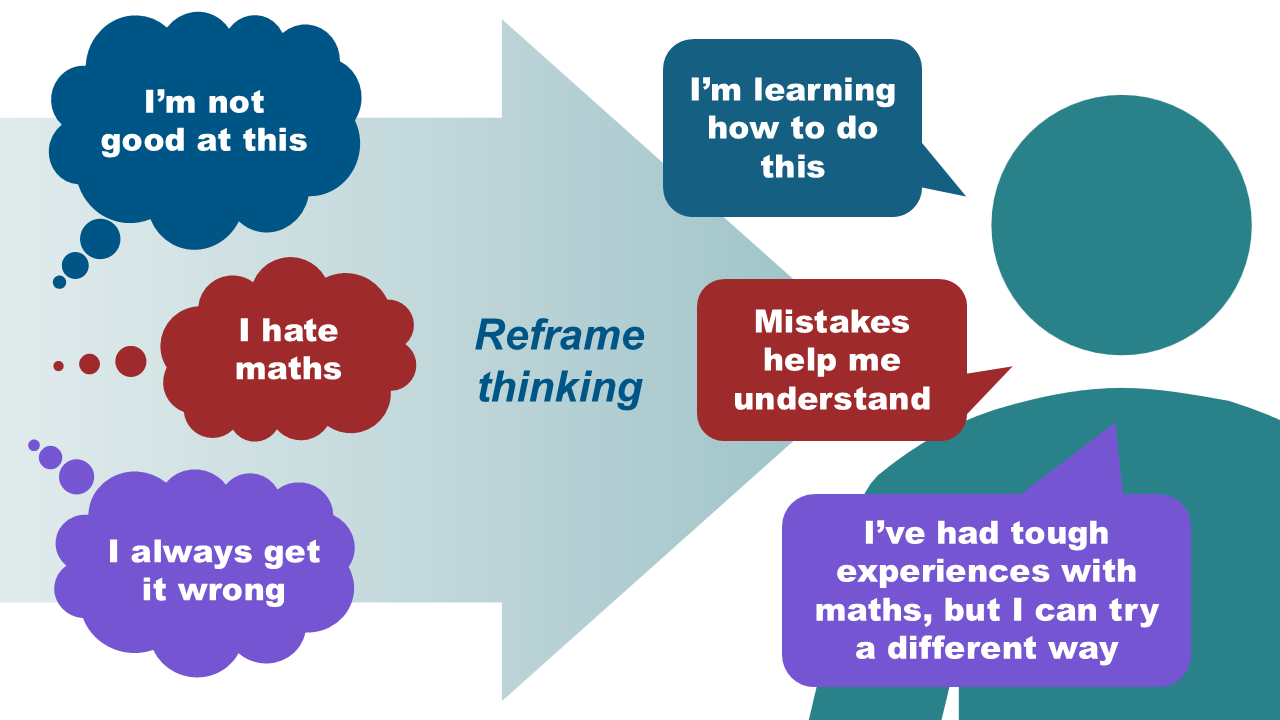
- "I’m not good at this" becomes "I’m learning how to do this."
- "I always get it wrong" becomes "Mistakes help me understand more."
- "I hate maths" becomes "I’ve had tough experiences with maths, but I can try a different way."
These small shifts can reduce anxiety and help you stay motivated.
Celebrate progress
Confidence builds with practice and success, even small breakthroughs. Notice your progress and give yourself credit for:
- attempting something new;
- sticking with a tricky problem;
- learning from a mistake;
- helping someone else understand something.
Reflecting on these moments helps you see yourself as capable and growing.
Explore different ways of learning
Everyone learns differently. You might prefer:
- visual tools like diagrams, number lines, or videos;
- hands-on learning like measuring objects or using building blocks as counters;
- talking it through with others or explaining your thinking aloud;
- tech-based approaches using apps or digital tools.
Experiment to find what works best for you. Remember, there’s no right or wrong way to learn.
Normalise numeracy
You use numeracy skills more often than you might think. From checking your change, to estimating journey times or cooking dinner, numbers are everywhere. Recognising where and how you use these skills can help you feel more confident.
Here are some tips to keep practising through your normal day-to-day activities:
- Start where you are: Build on what you already do (e.g. tracking spending or reading recipes).
- Make it relevant: Choose activities that matter to you (e.g. planning a holiday, managing a budget).
- Use technology: Try apps, calculators, or spreadsheets to support learning.
- Play games: Logic puzzles, board games, and brain training apps can be fun and educational.

Photo by Maria Lin Kim on Unsplash / Licence
Improving numeracy is like building a muscle; regular, small amounts of practice are more effective than occasional, prolonged sessions. Try 10–15 minutes a day using real-life situations.
Examples
- Use a recipe to cook something new, budgeting for ingredients needed, and calculating cooking times.
- Work out how long it will take to get somewhere, and when you’ll need to leave to arrive by a certain time.
- Look for graphs and visual data in the news and interpret the information to support an opinion or decision.
Reflection
Think about your strengths and weaknesses in relation to numeracy.
If someone were to ask you about your weaknesses, how would you normally respond? What language would you use?
Write down your typical responses. Does your language reflect a growth mindset? If not, have a go at positively reframing each one and practise saying them aloud.

Check your understanding
Psychologist Carol Dweck coined the term growth mindset to describe a way of thinking that helps people learn and improve over time.
Which one of the following options best describes a growth mindset?
- Believing that skills and understanding can improve with effort, practice, and the right support.
- Believing that some people are naturally good at things like maths, and others just aren’t.
- Believing that people only succeed when they never make mistakes.
The correct answer is A
Believing that skills and understanding can improve with effort, practice, and the right support.
Carol Dweck’s research shows that people with a growth mindset are more likely to persevere through challenges because they believe they can learn and grow, even if something feels hard at first.
Why not B or C?
B reflects a fixed mindset - the belief that ability is something you either have or don’t.
C misunderstands learning. Making mistakes is a natural and helpful part of the learning process.
7. Resources and further support
Free and accessible learning tools
There are plenty of websites, apps and courses that can help you build your numeracy skills at your own pace. The following sites may be useful for helping you manage anxiety and build confidence while developing your skills:
- The Maths Anxiety Trust: Organisation aiming to eliminate anxiety about maths.
- Every mind matters: NHS-supported platform with free resources to help you take care of your mental wellbeing.
- Tackling Maths Anxiety: Collection of free resources developed by the Exeter Science Centre in partnership with the University of Exeter.
- Dyscalculia Network: Organisation raising awareness, educating, supporting and empowering people with dyscalculia; with useful webpage on Maths Anxiety.
Where to get extra support
If you or someone you know needs more structured or personalised help:
- Local adult learning centres often offer free or low-cost maths classes.
- Community organisations and charities may run confidence-building numeracy workshops.
- Speak to your workplace or union about learning support programmes.
- Seek advice from your GP or mental health professional if you feel anxiety or neurodivergence is affecting your ability to learn.
- If you are experiencing maths anxiety, look for local mental health services and support groups who may be able to help.
Keep going
Numeracy is not just about numbers, it’s about confidence, curiosity and making sense of the world. Every step you take builds your skills and strengthens your belief in what you can do.
Remember that one way to solve a problem may not be the only way. Sometimes a different person explaining a new way or different way to solve the problem may just click with you so don't be scared to try again.
You’ve already made a great start by using this handbook. Keep going. You can do this!