Astronomy for Mental Health and Well-being
| Site: | OpenLearn Create |
| Course: | IAU Office of Astronomy for Development Astronomy for Mental Health |
| Book: | Astronomy for Mental Health and Well-being |
| Printed by: | Guest user |
| Date: | Tuesday, 6 October 2026, 1:17 PM |
1. Introduction
Welcome to the Astronomy for Mental Health Facilitator Course
This course introduces astronomy not only as a science but as a resource for personal exploration, reflection, and growth. It is designed for facilitators of wellness programs, mental health practitioners, astronomy outreach professionals, science communicators, and educators, with plans to later expand to the general public through a preparatory module.
The course provides tools to integrate astronomy-based practices into non-clinical settings that support well-being. It focuses on education and mental health promotion rather than psychotherapy, with clear boundaries that avoid diagnosis, treatment, or therapy-style disclosure. Reflections are optional and present-focused, and participants are not asked to share personal histories. Only trained and licensed mental health professionals may adapt elements for therapeutic use within their scope of practice and local regulations.
Across five modules you will:
-
Explore how astronomy fosters awe, perspective, mindfulness, and connectedness.
-
Learn key concepts of mental health and the need for accessible approaches.
-
Understand risks and safeguarding with simple frameworks to keep activities safe and inclusive.
-
Gain step-by-step guidance to design, deliver, and adapt astronomy-based well-being activities.
-
Explore light-touch monitoring and evaluation methods to improve practice and demonstrate impact.
-
Connect with resources, networks, and further training opportunities.
What to expect:
-
Readings.
-
Templates and facilitator guides.
-
Practical examples and case studies.
-
Reflection prompts and optional peer discussion.
-
Invitation to join the OAD discord.
By the end of the course, you will be equipped with the knowledge, confidence, and practical tools to safely and effectively use astronomy as a pathway to support well-being in your community.
2. Module 1: Astronomy for Mental Health and well-being
Welcome to the Sky
Astronomy is not only a science. It is also a deeply human experience. For thousands of years people everywhere have looked up at the night sky, tracing patterns, telling stories, and finding meaning in the stars. Ancient monuments such as Chichén Itzá in Mexico were aligned with celestial events, showing how the sky guided farming, timekeeping, and rituals. The Moon’s cycle shaped calendars and cultural traditions across the world.
Today we explore the cosmos through telescopes, satellites, and data. Yet the sense of wonder remains the same. You do not need to be a scientist to feel awe at Saturn’s rings or a meteor streaking across the sky. The sky belongs to all of us. It is a shared canvas that connects us to one another and to our past.
Reflection Prompt
Think about a time when you looked up at the sky and felt a sense of wonder or calm. What made that moment memorable?
Astronomy and Astrology: Understanding the Difference
Because both speak about constellations, astronomy and astrology are often confused. Their purposes are very different.
Astronomy is a science. Constellations act as markers that help scientists identify where objects are in the sky. For example, a supernova may be described as appearing in the constellation of Ophiuchus.
Astrology is a belief system. Constellations are used symbolically and connected with zodiac signs that are believed to influence personality or life events.
The zodiac illustrates this difference. Astronomy recognises 13 constellations along the Sun’s path, including Ophiuchus. Astrology recognises only 12 signs. This means that the zodiac signs and dates no longer match the actual positions of the stars today.
In short, astronomy relies on evidence and observation while astrology interprets the sky symbolically.
Why Astronomy Supports Well-being
Astronomy offers more than scientific knowledge. It can also support personal and social well-being. Looking up at the sky can:
-
Evoke awe, which research shows can reduce stress, improve well-being, and encourage kindness.
-
Offer perspective by reminding us of our place in the universe and showing the small yet meaningful role of human life.
-
Create a sense of connectedness, both to nature and to one another.
-
Encourage mindfulness by helping us slow down and be present in the moment.
-
Support meaning making by linking personal experiences to the larger story of the cosmos.
Pause and Consider
Which of these benefits feels most relevant to your own life right now?
Evidence and Examples
Iconic Images
The Earthrise photograph, taken by Apollo 8 astronauts in 1968, showed Earth rising above the Moon. It highlighted our planet as fragile and borderless, sparking reflection on unity and responsibility.

Image caption: Apollo 8 image of "Earthrise".
The Pale Blue Dot image, captured by Voyager 1 in 1990, inspired Carl Sagan’s reflection on the fragility of our world. He described Earth as a tiny speck in a vast cosmic arena, reminding us of our shared struggles and our duty of care.

Image caption: Photograph of Earth taken on Feb. 14, 1990, by NASA’s Voyager 1 spacecraft.
Both images show that astronomy does more than explain the universe. It also inspires emotional reflection, humility, and compassion.
Astronomy in Practice
-
Stargazing can support trauma recovery. Trauma often disconnects thoughts, feelings, and bodily awareness. Guided stargazing provides grounding through visual and sensory experience. It creates a safe space where people reconnect with themselves and the present moment.
-
Planetarium mindfulness sessions are another example. Participants are guided in breathing and sensory awareness beneath a dome of simulated stars. This calm environment can reduce anxiety and encourage relaxation.
-
Researchers recently developed the Night Sky Connectedness Index (NSCI). Results show that feeling connected to the night sky is linked with better mental health and happiness. People in light polluted areas often feel less connected and less motivated to protect the night sky.
-
Community initiatives also bring people together. The nonprofit Reach for the Stars in Arizona organises monthly stargazing events that focus on mental health and community connection.
The Role of the OAD
The International Astronomical Union’s Office of Astronomy for Development (OAD) is exploring these ideas globally. The OAD works with partners to create projects where astronomy supports education, social development, and mental health. For example, initiatives such as Astronomy for Mental Health focus on using stargazing, storytelling, and guided reflection as tools to improve well-being. These projects highlight how astronomy can be accessible, inclusive, and relevant to everyday life.
By supporting local organisations and communities, the OAD ensures that astronomy is not only a science of discovery but also a resource for connection, resilience, and care.
3. Module 2: Mental Health
Learning outcome
By the end of this module you will understand what mental health is, how it is shaped, and how different dimensions of mental health interact. You will also learn how mental health moves along a continuum and why small changes can create positive ripple effects.
Definition
Mental health is a fundamental human right and an essential part of overall health. As the World Health Organization states, there is no health without mental health. Good mental health enables people to realise their potential, to study or work effectively, to build relationships, to contribute to their communities, and to make everyday decisions.
Mental health is holistic and dynamic. It is shaped by biology, life experiences, culture, and the social and physical environments around us. At the same time, our mental state influences how we perceive and respond to those environments, making them feel either more supportive or more stressful. Importantly, mental health can be strengthened, supported, and improved.
Dimensions of mental health
Mental health is not a single thing. It is a set of interconnected dimensions that rise and fall together. Seeing these dimensions clearly helps us notice strengths, spot early warning signs, and choose practical next steps.
Emotional
This dimension relates to how we experience and regulate feelings such as calm, worry, or frustration. Skills like naming emotions, soothing the body, and using grounding techniques provide support here.
Cognitive (Thinking)
This dimension involves attention, memory, problem-solving, and the stories we tell ourselves. Unhelpful habits such as all-or-nothing thinking can narrow choices, while flexible thinking opens them up.
Behavioral (Actions)
This dimension refers to daily habits and coping strategies. Sleep, movement, nutrition, and helpful routines build resilience. Avoidance and short-term fixes, however, can keep us stuck.
Social (Connection)
This dimension reflects the quality of relationships and sense of belonging. Supportive ties can buffer stress, while isolation and conflict increase risk.
Physical and Biological
This dimension captures brain–body links including sleep, hormones, medical conditions, and substance use. Body states strongly shape mood and attention.
Meaning and Values
This dimension is about sense of purpose and alignment between actions and what matters. In Acceptance and Commitment Therapy terms, it involves clarifying values and taking committed action, even in the presence of difficult thoughts and feelings.
Environment and Culture (Context)
This dimension covers safety, income, workload, stigma, discrimination, and access to nature and services. Context can either help or hinder every other dimension.
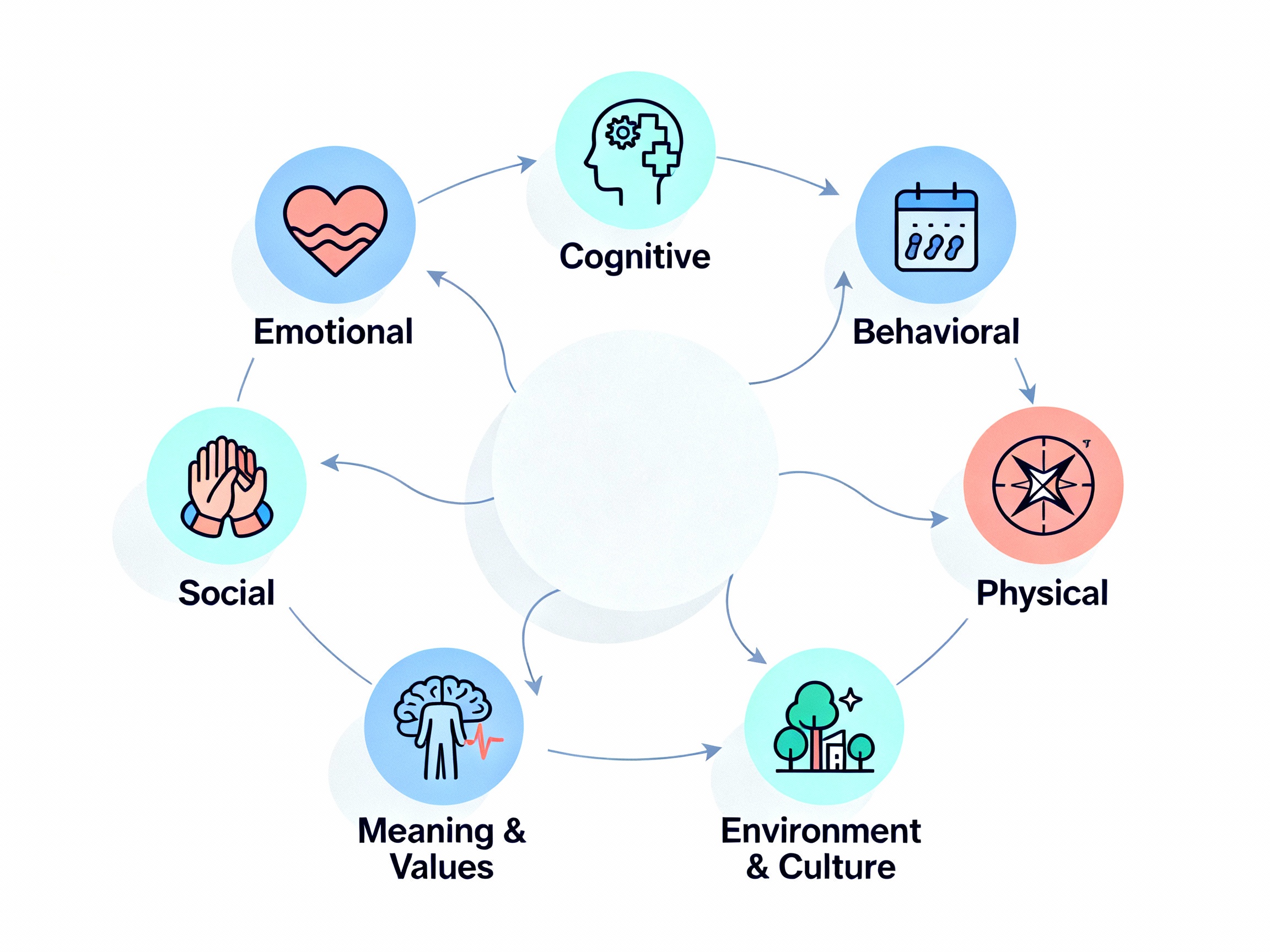
Image caption: Dimensions of Mental Health.
Key idea
Small, doable changes in any one dimension often ripple across the others. For example, better sleep, a values-guided action, or a supportive conversation can have wider benefits.
Mental health as a continuum and fluid system
Mental health is not an “on or off” state. It sits on a continuum that shifts over hours, days, and life stages. You may feel steady in some dimensions such as relationships while feeling strained in others such as sleep or workload, and that is normal.
A simple way to picture this is a slider that moves between Thriving, Coping, Struggling, and Crisis. People move in both directions over time.
Mental health also behaves like a fluid system. The dimensions interact in loops. Better sleep can lift mood and attention. Social connection can reduce stress. An unfair workload or stigma can push the whole system toward struggle. Small, values-guided actions can create positive ripple effects across the system.
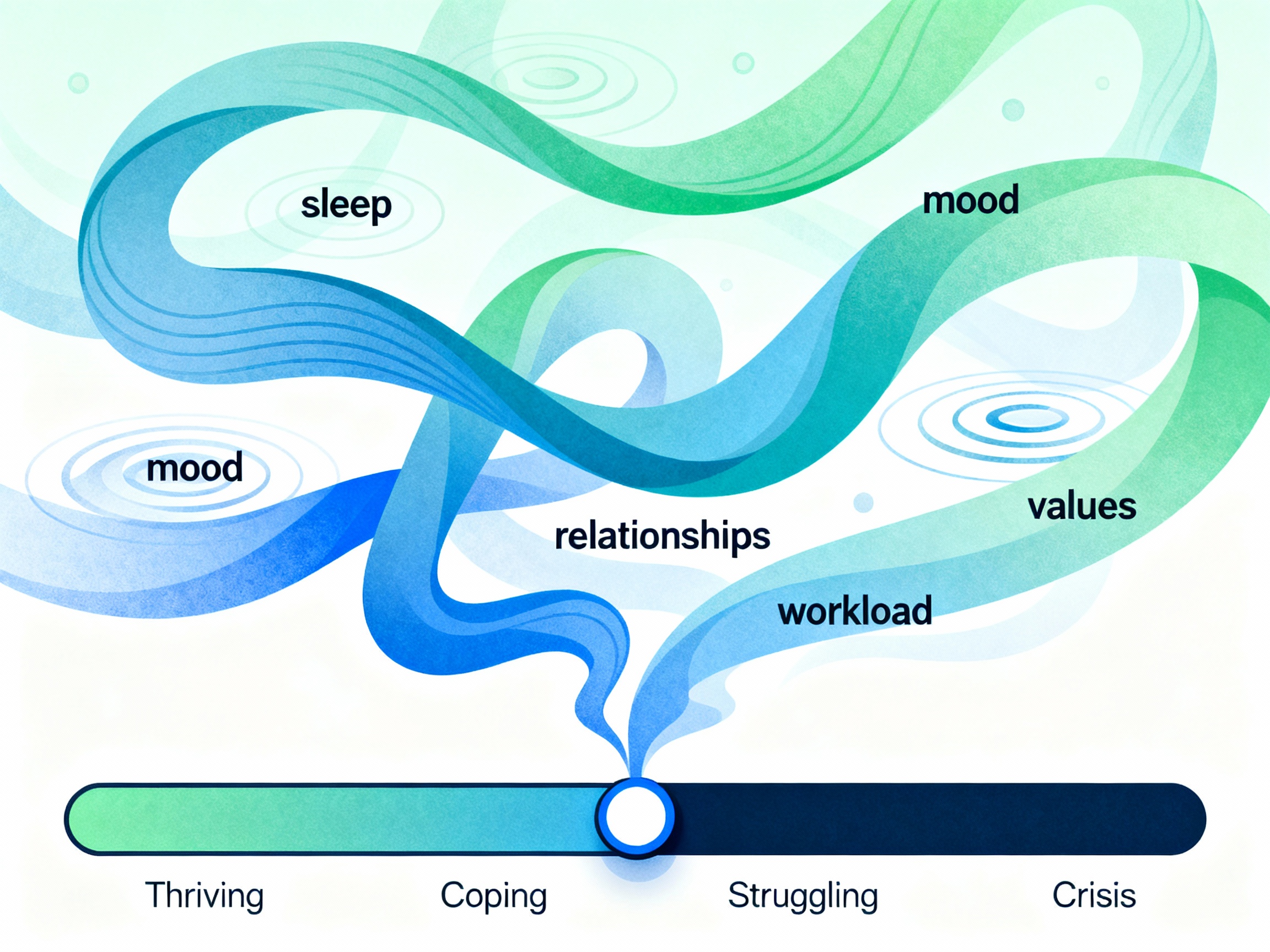
Image caption: Mental Health Continuum.
Final reflection
Understanding mental health as dynamic, interconnected, and fluid allows us to see both risks and opportunities. No single dimension tells the full story, and no state is fixed. By noticing shifts and making small changes, we can strengthen resilience and support ourselves and others in meaningful ways.
4. Module 3: Risks and Considerations
Learning Outcomes
By the end of this module you will be able to:
-
Run a short five minute risk scan before any activity
-
Put simple safeguards in place using predict, prevent, and prepare
-
Recognize red flags and know when to refer participants for professional support
1. Why Safeguarding Matters
Astronomy activities can inspire awe and joy, but they may also surface strong emotions or practical risks. One person may feel calm under the night sky, while another may feel overwhelmed. Outdoor sessions deepen connection with nature, yet they bring challenges such as uneven ground, cold weather, or sudden changes in conditions.
Safeguarding is not about restricting activities. It is about creating conditions where participants feel safe enough to explore awe, perspective, and connection.
Reflection Prompt: Recall a time you joined a group activity outdoors. What small things made you feel safe and comfortable?
2. The 3P Model
A simple model helps you anticipate and manage risks.
-
Predict: Ask what could go wrong for this group, in this place, with this plan.
-
Prevent: Adjust content, roles, and logistics to reduce risks before they occur.
-
Prepare: Have scripts, supplies, and referral contacts ready in case something does happen.
Once you have a plan, the next step is to scan the session environment quickly and systematically.
3. The Five Minute Risk Scan
Before each session, pause and scan across five areas. This should take no more than five minutes.
-
Psychological
Could the content bring up strong emotions such as thoughts of mortality or trauma reminders
Provide a content notice, allow opt outs, and include grounding breaks -
Group dynamics
Might some feel anxious about speaking or could others dominate
Set a group agreement, use small groups or pairs, and invite quieter voices -
Physical and outdoor
Are there hazards such as uneven terrain, poor lighting, or wildlife
Walk the site, check the weather, bring torches, and carry a first aid kit -
Cultural and context
Could your framing cause misunderstanding or resistance
Involve local partners, use familiar stories, and respect privacy -
Accessibility and legal
Is the activity safe for minors and people with different abilities
Provide accessible seating, follow safeguarding rules, and minimise data collection
Practice Task: Choose one upcoming activity and run through these five areas. Which colour rating would you give each: red for urgent, amber for moderate, green for low
4. Safeguards in Practice
Before the session
-
Ask about access needs and mobility
-
Share a short content notice
-
Assign clear roles such as facilitator, safety lead, well-being contact
-
Check logistics and backup plans
-
Prepare essentials such as blankets, water, torches, first aid kit, and incident forms
During the session
-
Begin with a group agreement
-
Watch for signs of distress such as confusion, withdrawal, or agitation
-
Offer grounding exercises if needed
-
Balance voices and remind participants that passing is always an option
After the session
-
Debrief on what worked and what was difficult
-
Share local support contacts
-
Record incidents factually and store them securely
Practical safeguards create stability in the session. Clear scripts can make responding in the moment easier.
5. Quick Scripts
Content notice
“Some people feel awe or big questions when looking at the night sky. You are free to participate, adjust, or step aside at any time. If anything feels off, please speak to me or another facilitator.”
Pause, Protect, Refer
-
Pause: Lower your voice and breathe together
-
Protect: Move to a quieter spot, offer water, guide a short grounding exercise
-
Refer: Suggest connecting with a local support service if needed
Managing group tension
“Let us pause. Our agreement was one voice at a time. We will return to short turns so everyone has space.”
Scripts help in sensitive moments. Outdoor activities also require specific care.
6. Outdoor Safety
-
Walk the site to identify hazards and exit routes
-
Check weather and advise on clothing
-
Use red lights rather than bright white torches
-
Brief participants on equipment and supervise its use
-
Use a buddy system and headcounts
-
Coordinate with site staff or rangers where possible
With safety addressed, it is also important to be clear on ethical limits.
7. Ethical Boundaries
-
Clarify that the activity is not therapy
-
Maintain confidentiality, but break it if safety is at risk
-
Gain informed consent for participation, with separate consent for photos or data
-
Collect only minimal data and store it securely
Clear boundaries make it easier to know when professional help is required.
8. Knowing When to Refer
Seek professional help immediately if you observe:
-
Talk of suicide or self harm
-
Threats of harm to others
-
Acute psychosis
-
Uncontrolled panic
-
Collapse or injury
Critical reminder: Never leave a person in crisis alone.
Referral is only part of adapting. Activities also need to fit the needs of specific groups.
9. Tailoring for Audiences
Children and teens
Shorter sessions, movement breaks, simple grounding, guardian consent
Adults
Normalize stress, offer one small values based next step
Older adults
Provide seating, warmth, toilets, and slower pacing
Displaced or refugee groups
Co-facilitate with community leaders, create quiet spaces, be trauma-aware
Specific conditions
Provide structure for anxiety, small wins for depression, avoid abstract cosmic themes for psychosis or dissociation, consult a clinician if needed
Tailoring for the group is important, and so is tailoring for the culture and context.
10. Cultural and Contextual Sensitivity
-
Work with local educators or elders
-
Use plain and respectful language
-
Check for sensitive themes, dates, or symbols to avoid
-
Default to no photos unless explicit consent is given
Cultural sensitivity builds trust. Templates can then help standardize practice and reduce mistakes.
11. Templates and Tools
Screening questions
-
Do you have any access needs such as mobility or lighting sensitivity
-
Are there any topics you would prefer we avoid
-
Who can we contact in case of an emergency
Group agreement
-
Participate at your own pace
-
One voice at a time
-
Passing is always okay
-
Keep others’ stories private
-
Ask for help when needed
Incident note
-
What happened, when, and where
-
Actions taken
-
Who was informed
-
Next steps
-
Store securely
Templates reduce mental load and allow facilitators to focus on people rather than paperwork.
Final Reflection
Safeguarding is about creating conditions where people can explore awe and perspective without fear. By predicting, preventing, and preparing, you give participants the freedom to connect with the night sky and with each other, knowing they are supported.
Reflection Prompt: Think about your own practice. Which one safeguard will you commit to using in your very next session?
5. Module 4: Design Your Activity
Learning outcome
By the end of this module, participants will be able to design, deliver, and adapt astronomy-based mental health activities that are safe, inclusive, and effective.
The Five Phases
-
Assess
-
Define
-
Design
-
Implement
-
Review
Phase 1. Assess
Purpose
Understand your audience, context, and needs.
Outputs
- Context brief
- Stakeholder map
- Target group profile
- Resource and risk register with ratings
- Referral map
- Ethics and consent notes
Steps
-
Context and community: Identify participant demographics, astronomy conditions, and local services.
-
Stakeholders and partners: Map partners who unlock access, trust, or safety.
-
Target group profile: Name stressors, strengths, and access needs. Identify advisors.
-
Resources, risks, referrals: Assign roles, scan risks across five domains, create referral map.
-
Ethics and consent: Decide on minimal data, secure storage, and clear consent wording.
Gate check
- Target group and delivery mode are clear
- One referral pathway confirmed
- Top risks have mitigations
- Consent and data plan drafted
Phase 2. Define
Purpose
Set aims, outcomes, and measures.
Outputs
- One astronomy outcome
- One well-being outcome
- Success indicators
- Mini evaluation plan
Steps
-
Objectives: Choose one astronomy outcome and one well-being outcome.
-
Success indicators: Use before and after sliders, percentage choosing an action, recall of a sky anchor, incident count.
-
Mini evaluation plan: Keep to one page with indicators, methods, timing, and responsibility.
Gate check
- Outcomes are simple and observable
- Evaluation fits on one page
- Data burden is minimal
Phase 3. Design
Purpose
Choose content, techniques, and safeguards.
Outputs
- Activity blueprint
- Safeguarding plan
- Pilot plan
- Materials list
Steps
-
Content and mode: Select one or two sky anchors and decide how to deliver them.
-
Inclusion and access: Provide seating, clear paths, plain language, journaling or listen-only options.
-
Safeguards: Prepare content notice, opt-downs, quiet space, and referral contacts.
-
Materials: Gather equipment such as lights, seating, sky maps, and first aid.
-
Pilot: Test with your real audience, observe clarity and tone, refine as needed.
Gate check
- Partner review complete
- Safeguards and referral map ready
- Pilot confirms mechanism works
Phase 4. Implement
Purpose
Deliver the activity safely and consistently while collecting useful data.
Roles
- Facilitator: guides pace, language, and engagement
- Safety Lead: checks site, lighting, and first aid
- Well-being Focal: supports participants, records incidents, manages referrals
Session flow
- Welcome with group agreement and content notice
- Do a short grounding exercise
- Deliver awe or perspective through sky, image, story, or app
- Invite reflection in pairs or journaling
- Prompt values step and ask each person to choose one action
- Close with support contacts and feedback
Adaptation
- Switch delivery methods if needed
- Provide accessibility supports
- Use grounding if emotions run high
- Manage group tension with structured turns
Safeguarding in action
- Pause: invite calm and one breath
- Protect: move to quiet space, offer water, guide grounding
- Refer: connect to support, log incident
Documentation
- Attendance details
- Feedback with sliders and open questions
- Incident facts and actions taken
- Adaptations made
Gate check
- No unmanaged incidents
- Feedback captured
- At least one improvement identified
Phase 5. Review
Purpose
Reflect, learn, and plan improvements.
Steps
-
Debrief with team: what was expected, what happened, what worked, what to change
-
Analyse data: sliders, values actions, incidents, quotes, themes, equity patterns
-
Plan one change using Plan–Do–Study–Act cycle
-
Share insights: short summary for partners and participants
-
Check fidelity: confirm awe, values, grounding, and consent elements were delivered
-
Ensure ethics: store data securely, delete raw data when no longer needed
Ready-to-use microcopy
Content notice
Sky watching can bring up big feelings or questions. Join at your pace. You can pause or step aside at any time.
Group agreement
Participate at your pace. One voice at a time. Passing is okay. Keep others’ stories private.
Values prompt
Choose one small action for tomorrow that reflects what matters to you.
Grounding
Notice three sounds. Feel two sensations in your body. Take one slow breath.
Consent
We will collect only what we need. Age band, language, and simple feedback. No photos unless you say yes. You can opt out at any time.
6. Module 5: Monitoring and Evaluation
Learning Outcome
By the end of this module you will be able to monitor, evaluate, and report on your activities in ways that protect participants, improve quality, and demonstrate impact.
Why Monitoring and Evaluation Matters
When your session ends, your work is not over. Monitoring and Evaluation (M&E) carry the learning forward. They help you:
-
Protect participants by identifying risks, unmet needs, and unintended consequences
-
Improve practice by clarifying what worked, what did not, and why
-
Demonstrate impact to funders, partners, and communities, building trust and support
-
Contribute to wider knowledge so others can learn from your work
Think of monitoring as tracking the journey in real time (what happened, when, and how), and evaluation as reflecting afterwards on the destination (what changed, for whom, and why). Both are needed to close the loop.
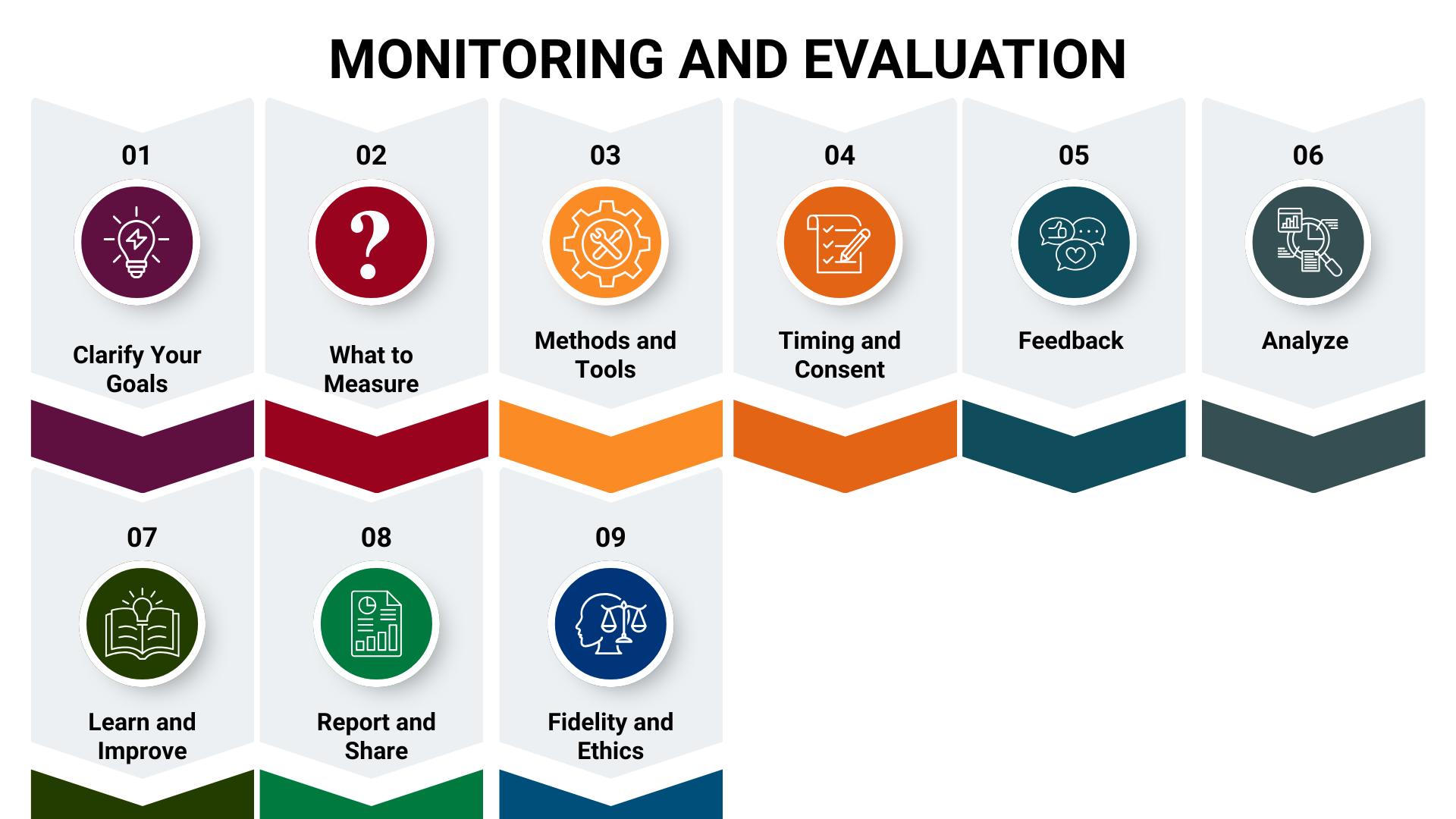
Image caption: Monitoring and Evaluation Steps.
Step 1: Clarify Your Goals
Before you measure, be clear on what you want to learn. Ask yourself:
-
What do I want to understand from this activity?
-
How will I know if participants experienced benefits?
-
How can this help me improve next time?
Keep goals simple: protect participants, improve quality, communicate value.
Step 2: Decide What to Measure
You cannot measure everything. Focus on what matters most in astronomy and well-being.
-
Well-being: mood, stress, connectedness
-
Learning: recall of one astronomy anchor or concept
-
Skills: noticing, clarifying values, choosing a next step
-
Inclusion and safety: access needs met, opt-outs respected, no unmanaged incidents
-
Fidelity: awe, perspective, or ACT-inspired reflection delivered as intended
-
Equity: who attended, who benefited, and who may have been left out
Translate outcomes into clear indicators such as:
-
Sliders (0–10) for mood, stress, connectedness
-
% recalling the astronomy anchor
-
Number of incidents and how they were resolved
-
Attendance by age or language
Step 3: Choose Methods and Tools
Keep data collection light but consistent.
Essentials:
-
One paper or phone form with 3 sliders and 2 open questions
-
A tick-box for values-based next step
-
A short fidelity checklist for facilitators
-
An incident note template
-
An attendance record
Optional add-ons (if ethics and capacity allow): a short validated scale or a 2–4 week follow-up message.
Accessibility matters: offer options (paper and phone), use plain language, large font, and audio if possible.
Step 4: Plan Timing and Consent
-
Collect baseline data at arrival
-
Gather post-session data before closing
-
Optionally follow up after 2–4 weeks
Consent should be short and clear.
Example:
“We will collect three sliders and two questions. You may skip any item or withdraw at any time. Your responses are anonymous, stored securely, and used only in group summaries.”
Step 5: Gather Feedback from Multiple Sources
Triangulate perspectives to build a fuller picture:
-
Participants: quick sliders, what helped most, what to change
-
Facilitators: 24-hour debrief on what worked, what did not, what to try next
-
Partners: short email or call to confirm safety and relevance for their group
Step 6: Analyze and Make Sense of Results
Analysis does not need to be complicated. Focus on clarity.
-
Numbers: average change on sliders, % recall, incidents, fidelity achieved
-
Themes: top three points from open responses (what helped, what to change, barriers)
-
Quotes: one or two that capture the experience
-
Equity: ask whether some groups benefited less and why
Step 7: Learn and Improve
Turn results into action.
-
Use an After Action Review: What was expected? What happened? What went well? What will we change?
-
Apply a Plan–Do–Study–Act cycle: plan one change, test it, study results, act to adapt or adopt.
This creates a rhythm of continuous improvement.
Step 8: Report and Share
Reporting is about closing the loop, not ticking boxes. Share results with those who participated, supported, and delivered the activity.
A strong one-page summary includes:
-
Who took part and the context
-
What was done and how many joined
-
3–5 headline results
-
One participant quote
-
Planned improvements for next time
-
Contact or support information
Keep tone plain, transparent, and respectful. Never share personal details without explicit consent.
Step 9: Fidelity and Ethics
Check whether the core ingredients were delivered:
-
Content notice and opt-out provided
-
Awe or perspective moment included
-
Reflection or values-based action offered
-
Grounding or present-moment cue provided
Ethics are non-negotiable: collect only what you need, store data securely, report in aggregate, and delete raw data on schedule.
Types of Evaluation
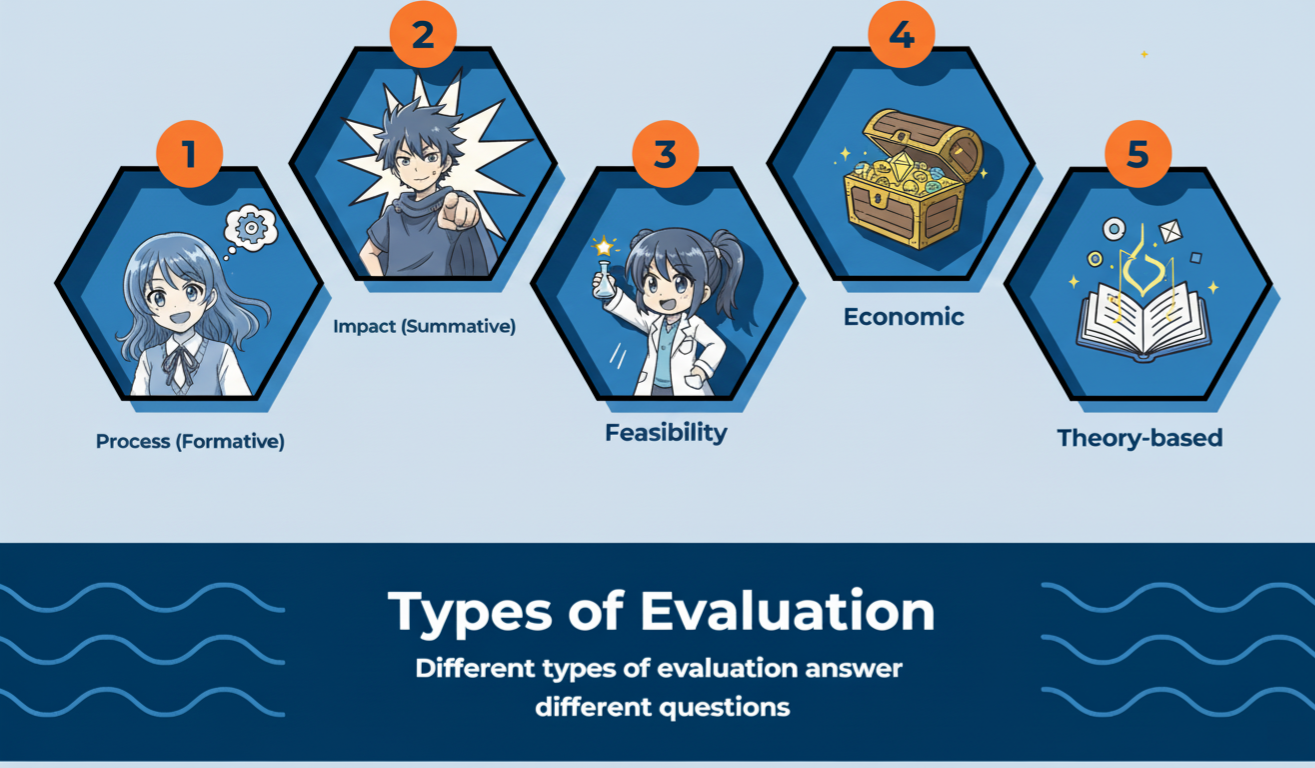
Image caption: Types of Evaluation.
Different types of evaluation answer different questions:
-
Process (Formative): How was the activity implemented? What worked, what did not, and for whom?
-
Impact (Summative): Did outcomes change? To what extent were changes due to the activity?
-
Feasibility: Could this be scaled up or repeated sustainably?
-
Economic: Was it cost-effective compared to alternatives?
-
Theory-based: Did the project follow its intended theory of change, and were mechanisms confirmed in practice?
When Not to Evaluate
Evaluation is powerful but not always appropriate. Avoid heavy evaluation when:
-
The project is very small and measurement would outweigh its value
-
The activity has no observable outcomes (e.g. simply aiming to inspire wonder)
-
The design is too complex to evaluate meaningfully
-
There is no clear hypothesis or goal
-
Outcomes are obvious without formal measurement
In these cases, focus on basic monitoring: attendance, safety, simple reflections, and team debrief.
Recognizing Constraints
Good M&E is proportionate. Keep in mind:
-
Cost: larger projects may devote 10–20% of budget; small projects should keep it light
-
Burden: avoid overwhelming facilitators or participants
-
Scope: measure what matters, not just what is easy to count
Final Reflection
Monitoring and Evaluation is about more than data. It is about creating a culture of learning, trust, and safety. Done well, it strengthens your practice, protects participants, and builds evidence for the unique role of astronomy in mental health and well-being.
Keep it proportionate, ethical, and practical. Focus on what matters most, share results openly, and use every cycle to get better.