Conducting a Risk Assessment
| Site: | OpenLearn Create |
| Course: | Clearing the Air: A PHI’s Guide to Ice Arena Air Quality Inspections |
| Book: | Conducting a Risk Assessment |
| Printed by: | Guest user |
| Date: | Tuesday, 6 October 2026, 12:25 PM |
Table of contents
- 1. COMPONENTS OF A RISK ASSESSMENT
- 2. ICE RESURFACER & EDGER MAINTENANCE
- 3. TEACHABLE MOMENTS: Ice Resurfacer Maintenance
- 4. THE EVOLUTION OF ICE RESURFACERS
- 5. ELECTRIC-POWERED ICE RESURFACERS
- 6. VENTILATION SYSTEMS
- 7. TEACHABLE MOMENTS: Ventilation
- 8. HISTORY OF VENILATION SYSTEMS
- 9. AIR QUALITY MONITORING
- 10. TEACHABLE MOMENTS: Air Quality Monitoring
- 11. EVALUATING STAFF KNOWLEDGE AND TRAINING
- 12. QUIZ
1. COMPONENTS OF A RISK ASSESSMENT
A public health inspection of an ice arena should include an assessment of how well the facility has adopted best practices to improve indoor air quality into standard operating procedures.
The four main components that should be included in a risk assessment tool are:
-
Ice resurfacer and edger maintenance
-
Ventilation systems
-
Air quality monitoring
-
Evaluating the facility staff's indoor air quality training and knowledge
The following sections will review each component in more detail.
2. ICE RESURFACER & EDGER MAINTENANCE
Ice pads are cleaned and smoothed by ice resurfacing and edging equipment. Ice resurfacers maintain the entire ice surface, while ice edgers shave near the boards where the ice resurfacer cannot reach.
Ice resurfacing is typically conducted frequently, as often as every hour, while edgers are used less frequently but can still significantly contribute to emissions. Increasing ventilation during and after edger use, as well as on ice maintenance days, is recommended.
Ice arena operators must follow regular maintenance schedules as per the manufacturer's instructions for ice resurfacers and edgers.
Service of ice surfacers should include exhaust gas analysis and engine adjustments to reduce air pollutant emissions. The richness of the fuel or air-fuel ratio can be adjusted to decrease pollutant emissions. Routine maintenance of ice resurfacers includes tune-ups and replacement parts when needed (i.e. spark plugs, plug wires, timing belts, and fuel system components).
The goal is to maintain carbon monoxide and hydrocarbon levels at the lowest possible levels. Ice arena operators should produce a record of the last ice resurfacer emissions test at the time of inspection.
Where emissions are elevated or a problem is identified, the PHI should direct the operator to have the equipment assessed and repaired by a qualified technician and to obtain a new emissions test following the repairs.
In addition to routine maintenance, ice resurfacers should be warmed up outdoors or in a room equipped with a carbon monoxide alarm and sufficient ventilation for at least five minutes prior to use, allowing the catalytic converter to reach the appropriate operating temperature.
SAMPLE EMISSIONS TEST
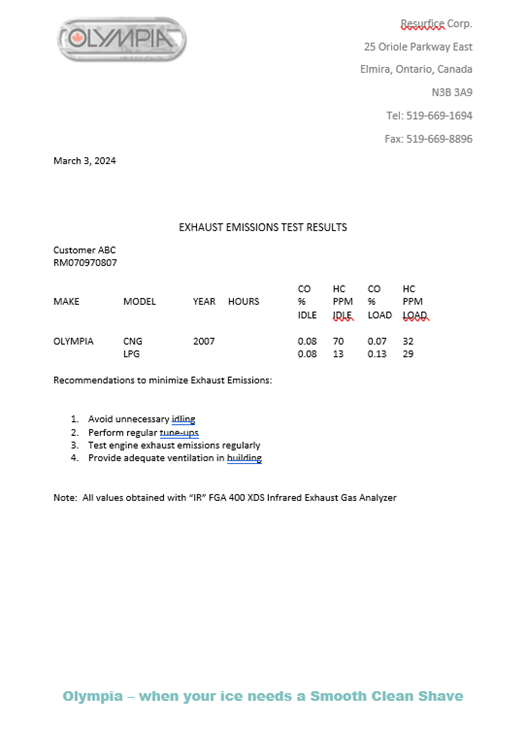
Definitions:
LPG = Liquified Petroleum Gas (propane)
CNG = Compressed Natural Gas
IDLE = Lower Engine RPM, Idling Speed
LOAD = Higher Engine RPM, Operating Speed
Pass/Fail
It is not a simple pass or fail threshold; the goal is to achieve the lowest exhaust emissions possible.
The following factors must also be considered:
· volume of space in the building,
· extent of the air make-up system in the building,
· typical daily usage of the ice resurfacer, and building standards for air quality.
However, technicians try to achieve less than 0.10 – 0.20% CO and less than 100 HC (under LOAD).
Note: To convert CO% to PPM, multiple by 10,000, (i.e., 0.10% = 1,000 PPM).
Troubleshooting High CO or HC:
· High CO – Rich fuel mixture, defective oxygen sensor, defective fuel control valve, defective computer, defective catalytic converter.
· High HC – Ignition problems, fuel mixture, mechanical problems like oil consumption or camshaft, vacuum leaks.
3. TEACHABLE MOMENTS: Ice Resurfacer Maintenance
4. THE EVOLUTION OF ICE RESURFACERS
Before continuing, please watch the following video featuring Terry Piche, a representative from the Ontario Recreation Facilities Association. In this video, he discusses the evolution of ice resurfacing equipment from diesel and gas to propane and now electric. These changes are essential for recognizing their impact on indoor air quality in ice arenas.
5. ELECTRIC-POWERED ICE RESURFACERS
Arenas can transition to electric-powered resurfacers and edgers to eliminate tailpipe emissions and reduce the risks of poor indoor air quality. Although switching to electric equipment requires a budgetary investment, electric edgers provide a cost-effective alternative with significant reductions in emissions. However, ventilation remains crucial, as emissions from concessions and propane or natural gas-powered heaters in spectator areas still require sufficient air exchange.
6. VENTILATION SYSTEMS
The cold ice surfaces, boards, and plexiglass trap pollutants at the ice surface. To effectively ventilate the ice pad, arenas should implement the following strategies:
-
Ensure the exhaust fans and makeup louvres operate during resurfacing activities and continue running for at least 15 minutes afterward.
-
Ensure ventilation systems are automatically activated when the ice resurfacer enters the ice pad, rather than relying on a manual switch, to avoid the need for human intervention.
-
Open all gates around the ice surface during resurfacing to enhance air circulation, provided operational policies permit this practice.
-
Ensure the ventilation system is programmed to turn on when the gas sensor or continuous air monitoring system detects elevated levels of air pollutants.
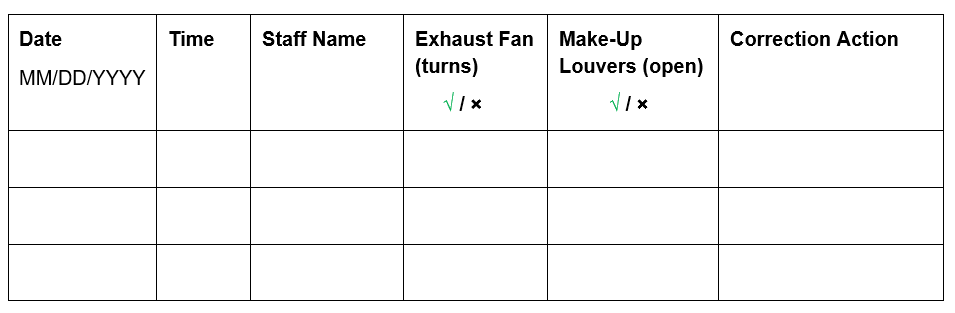
Ice arena operators should maintain ventilation maintenance records and make them available on-site.
SAMPLE VENTILATION MAINTENANCE RECORD
Arenas may have a combination of heating, ventilation, air conditioning, and dehumidification equipment for air management. However, there is no accreditation or obligation for the operation and maintenance of this equipment. The required ventilation rate should maintain carbon monoxide and nitrogen dioxide levels within recommended standards.
It is essential to note that outdoor air pollutants can also enter arenas and impact indoor air quality, particularly from vehicles idling near the facility’s entrances.
7. TEACHABLE MOMENTS: Ventilation
8. HISTORY OF VENILATION SYSTEMS
Before moving forward, please watch this video featuring Terry Piche, as he provides a brief history of ventilation systems in ice arenas. He discusses how ventilation technology has evolved over the years and its impact on indoor air quality. The information will help you better understand the role of ventilation in maintaining safe environments in indoor ice arenas.
9. AIR QUALITY MONITORING
Air quality monitoring helps to ensure that the steps taken to maintain air pollutant concentrations as low as possible are effective. Actively monitoring air quality provides the operator with an opportunity to identify trends in real-time, allowing action to be taken to lower air pollutant levels.
Note: There is no legal requirement for ice arenas to install carbon monoxide and or nitrogen dioxide sensors. However, facilities should implement real-time air quality sensors and alarms to promptly detect elevated pollutant levels.
Continuous air monitoring systems with digital readouts and readings recorded in a logbook are the best option.
SAMPLE AIR QUALITY MONITORING LOG SHEET
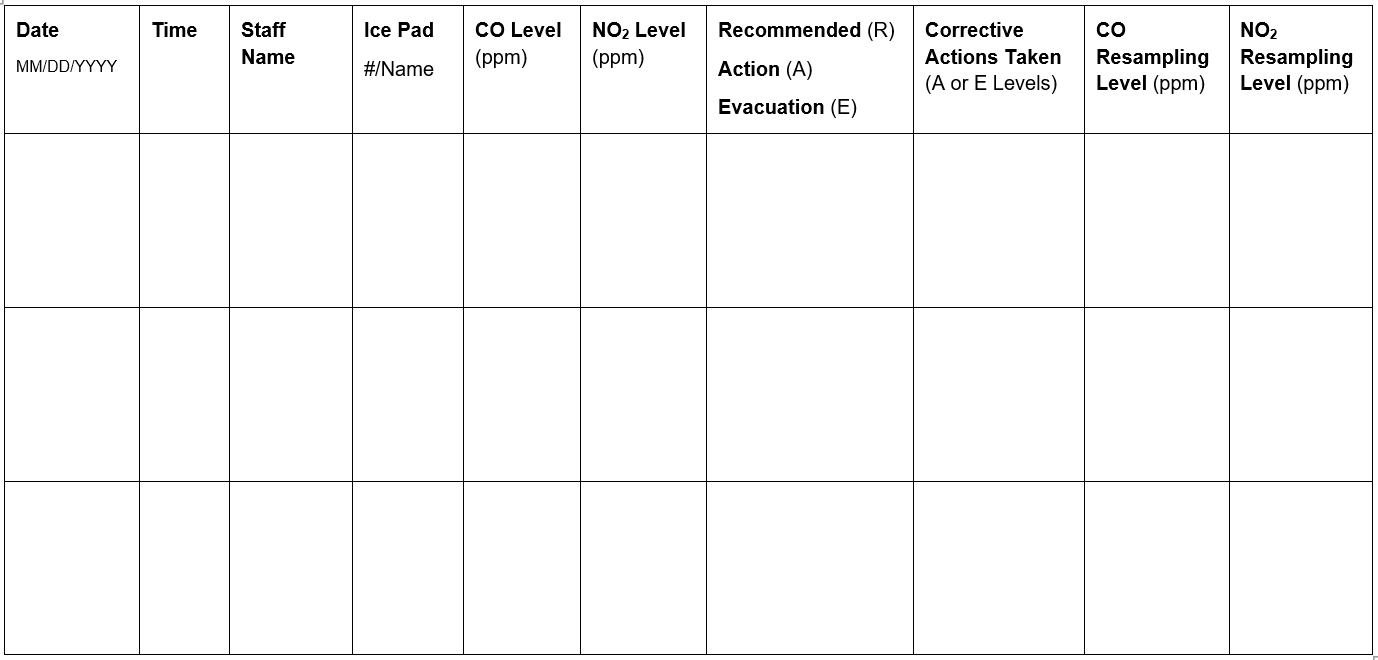
If continuous air monitoring systems are unavailable, portable air monitoring equipment should be used to measure weekly one-hour averages, and the readings should be documented in a logbook. A one-hour average refers to monitoring 30 minutes at the player's bench and 30 minutes at the spectators' area.
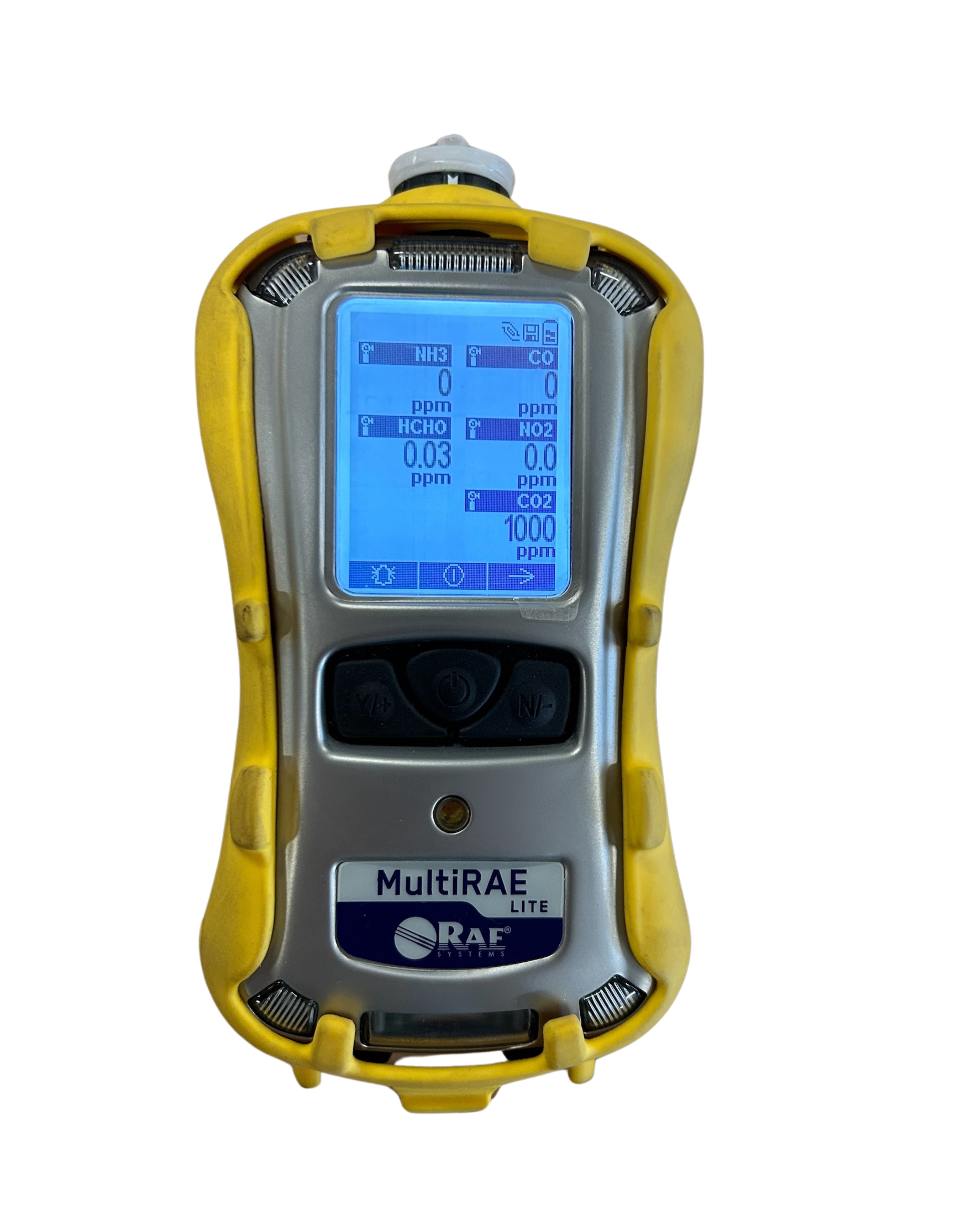
HANDHELD AIR MONITORING DEVICES
The images below show examples of handheld air quality monitoring devices commonly used in ice arenas. These devices are portable, easy to operate, and allow operators or inspectors to measure contaminants such as carbon monoxide and nitrogen dioxide in real time.
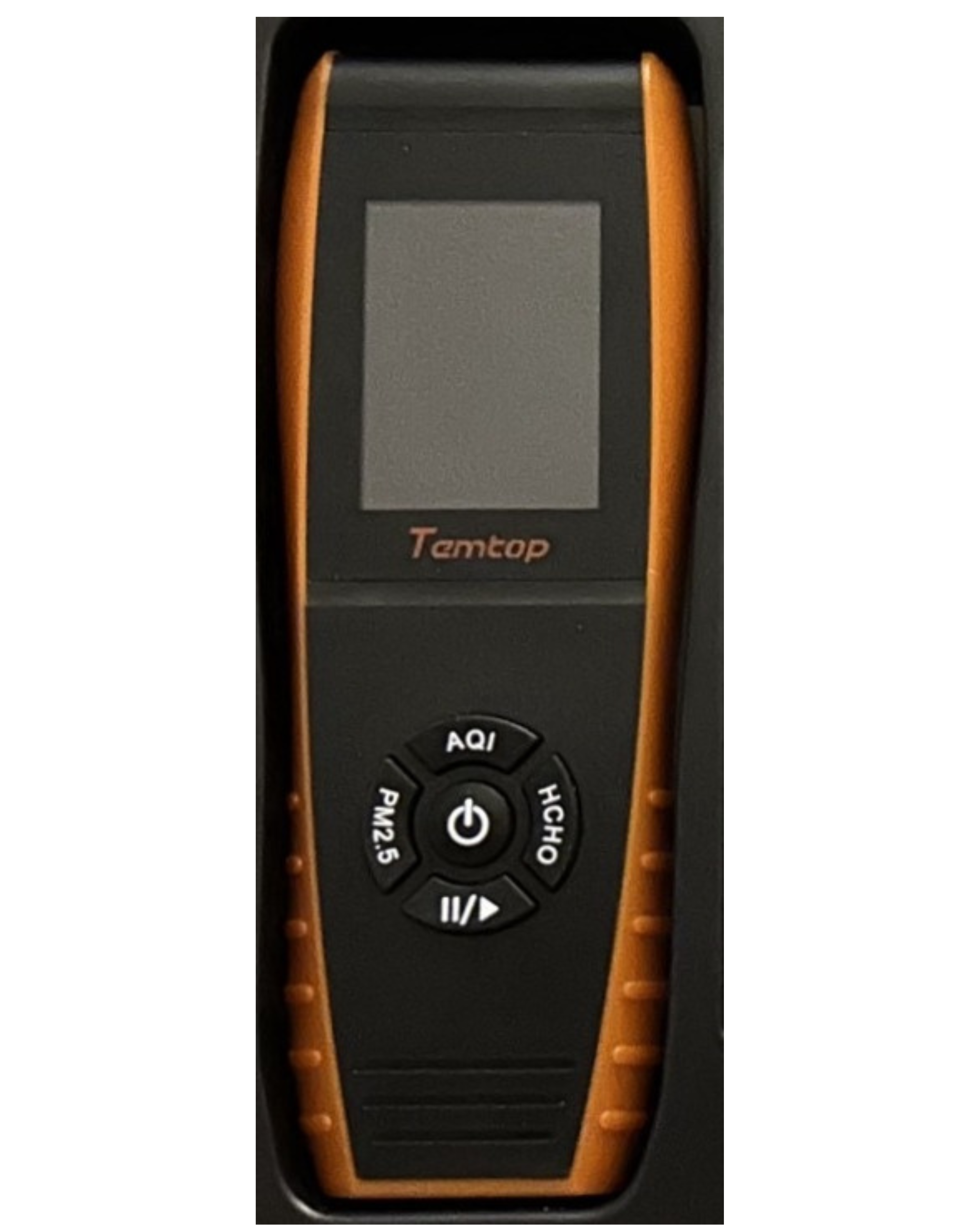
It is recommended that continuous air monitoring systems be equipped with an audible alarm and set to sound at a level below occupational levels or to the threshold set by the public health unit to reduce the air pollutant levels.
Setting the air monitoring system to alarm at these levels is more protective of the health of susceptible populations and will avoid emergency situations.
Operators should ensure gas sensors meet the required resolution range and precision required, and are calibrated and replaced according to manufacturers' instructions. They should also consult with the indoor air quality equipment company to determine the number and location of adequate gas sensors.
10. TEACHABLE MOMENTS: Air Quality Monitoring
11. EVALUATING STAFF KNOWLEDGE AND TRAINING
There is currently no formal certification or accreditation requirement for staff working in Ontario ice arenas regarding indoor air quality. While it would benefit all arena staff to understand indoor air quality hazards, each facility determines whether this is a priority and how much they invest in training.
Consequently, public health inspectors should expect varying levels of knowledge and commitment to indoor air quality management across different arenas.
Public health inspectors should assess staff knowledge and commitment by reviewing evidence of training, such as:
-
Internal municipal training programs (e.g., WHMIS, orientation/onboarding programs)
-
Written policies or training manuals
-
ORFA's ice maintenance and equipment operations (OLSS) course
A survey of Ontario ice arena operators revealed that staff training primarily focuses on three key areas:
-
Proper use and maintenance of ice resurfacing equipment and edgers (89%)
-
Proper use of ventilation systems (78%)
-
Facility emergency response procedures for air quality incidents (67%)