Practical Inspection Procedures
| Site: | OpenLearn Create |
| Course: | Clearing the Air: A PHI’s Guide to Ice Arena Air Quality Inspections |
| Book: | Practical Inspection Procedures |
| Printed by: | Guest user |
| Date: | Tuesday, 6 October 2026, 12:23 PM |
1. TOOLS & METHODOLOGY
Before starting an ice arena inspection, the public health inspector should ensure the following items are available:
-
Calibrated air quality equipment to test carbon monoxide and nitrogen dioxide levels.
-
Standardized checklist and inspection report to document risk assessment and inspection findings.
-
Reference materials such as:
- A review of historical inspections to determine trends in compliance rates.
- PPE such as CSA-approved shoes and a CSA-approved helmet.
- Established inspection policy and procedure outlining the actions to be taken if elevated levels of air pollutants are observed at the time of inspection.
2. INSPECTION WALK-THROUGH
Before continuing, please watch this video featuring public health inspector Vittoria Vecchiarelli as she walks through how she conducts an indoor air quality inspection in an ice arena. This step-by-step overview will help you understand the key areas of focus during an inspection and the role of public health in ensuring safe air quality.
Inspection checklist:
The following checklist provides examples of items that may be considered during an inspection of an ice arena. The items are presented in no particular order and are not intended to represent a complete or exhaustive list of inspection considerations. Inspectors should use their professional judgment to determine which items are applicable based on the facility, equipment, and circumstances.
- Determine fuel source for all ice resurfacers, edgers and radiant heaters in the spectator area (if available)
- Observe a recent ice resurfacer service record
- Observe a recent ice resurfacer emissions test, and note the emission levels
- Observe a recent edger maintenance record (i.e., filters changed)
- Observe a recent record of a ventilation system service check (exhaust fan/make-up louvers)
- Observe how the ventilation system is activated (exhaust fans and make-up louvers)
- Sensor triggers the ventilation system when the ice resurfacer enters the ice pad
- CO sensor triggers the ventilation system when CO levels reach a pre-determined level
- Manual switch only
- Ventilation continuously active during operational hours
- A combination of the above
- Observe if the exhaust fan and make-up louvers are turned on when operator floods the ice (exhaust fan blades spin and make-up louvers open)
- Observe any CO and/or NO2 sensors installed around the ice pad area
- Determine if sensor(s) is equipped with a digital display
- Determine what level(s) the alarm will activate
- Determine the last and next calibration date (found on a sticker affixed to the sensor)
- Observe daily logs of CO and NO2 air quality readings
- Air Quality Testing
- Take a baseline CO and NO2 air quality measurement anywhere around the ice pad
- Request the operator to turn on any fuel-powered radiant heaters in the spectator area and flood the ice
- Take a CO and NO2 air quality reading after the ice is flooded at the player’s bench
- Take a CO and NO2 air quality reading in the spectator area if fuel-powered radiant heaters are available
- Repeat the above air quality testing procedure for each ice pad
3. IAQ TESTING PROCEDURE
Step-by-step guide to IAQ testing:
1. Take an air sample of carbon monoxide and nitrogen dioxide in the ice pad area before any ice resurfacing activities to determine baseline levels and record findings. Good locations for baseline readings include the outside edge of the ice pad, the players’ bench, or outside a gate providing access to the ice pad.
2. Ask the operator to turn on fuel-powered radiant heaters and flood the ice pad. Wait 5 minutes after resurfacing before proceeding.
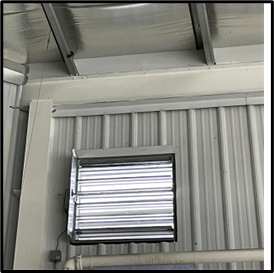
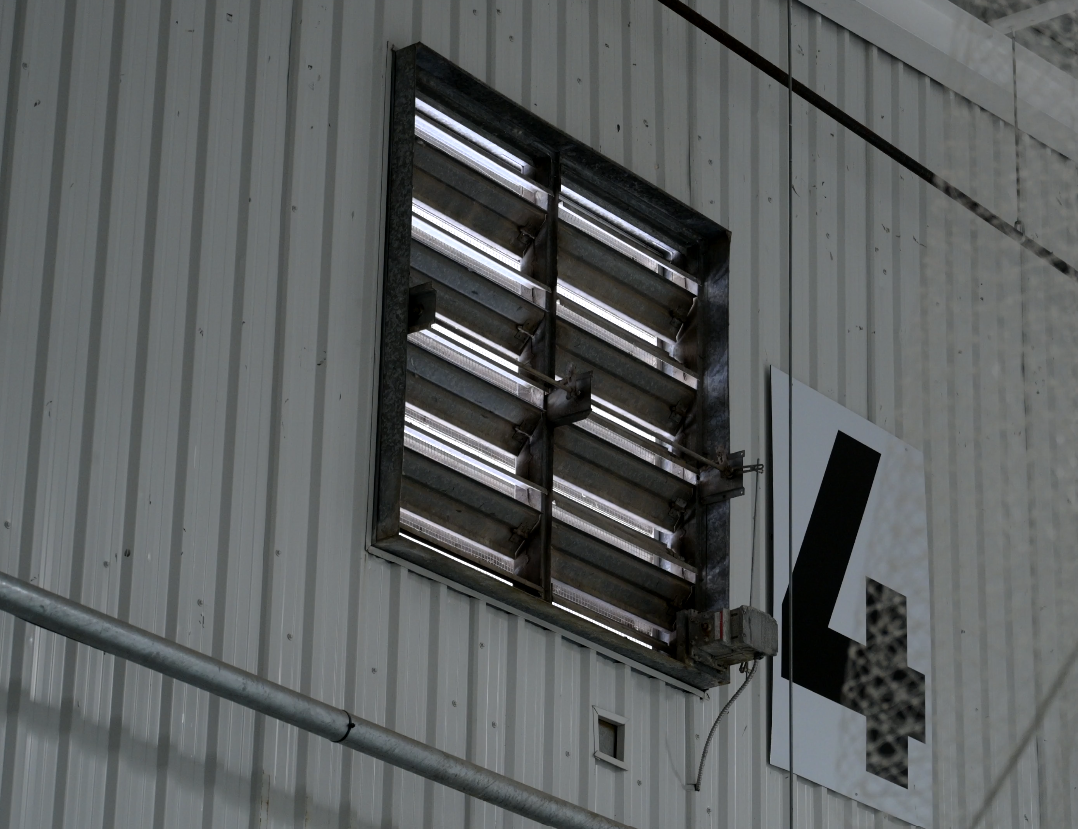
3. Observe whether the ventilation system is turned on and functioning properly. The exhaust fan should be moving, and the make-up louvres should be open.
EXHAUST FANS
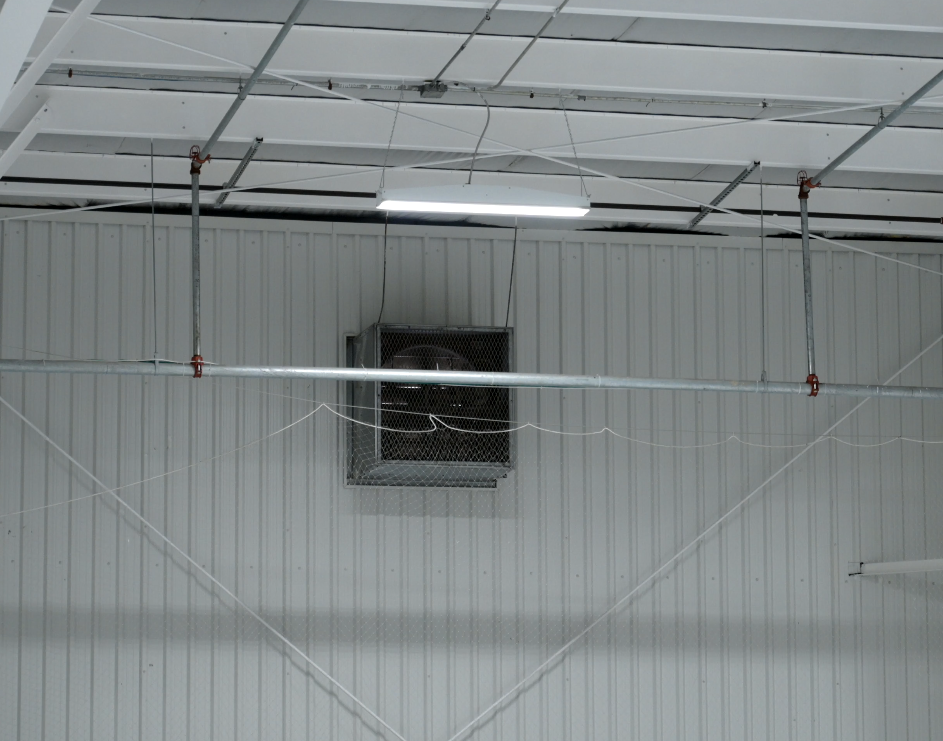
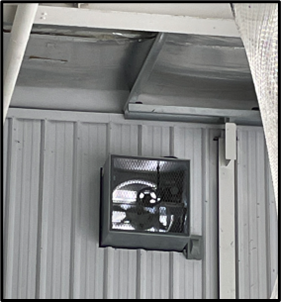
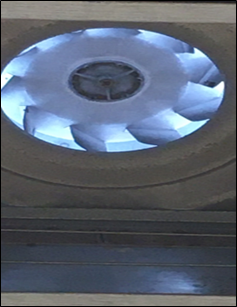
MAKE-UP LOUVRES
4. If ventilation systems are not operational, educate the operator on the importance of proper ventilation, document your findings, and recommend repairs.
5. Take an air sample at the player's bench, 1 metre above the ice surface (breathing height), for 15 minutes. Ensure the location is not enclosed by plexiglass.
6. Take an air sample in the spectator seating area at breathing height, preferably under a radiant heater, and record values.
7. Repeat the steps for each ice pad.
4. INCREASED POLLUTANT LEVELS
5. BENEFITS OF ROUTINE INSPECTIONS
Before continuing, please watch this video featuring public health inspector Vittoria Vecchiarelli as she discusses the benefits of incorporating routine indoor air quality inspections into public health practice. Currently, indoor air quality inspections are conducted only on a complaint basis, but Vittoria highlights why proactive inspections could significantly improve health and safety in ice arenas.
6. RESPONDING TO ELEVATED AIR POLLUTANT LEVELS
Public health units should stay up-to-date on the latest safe exposure levels for carbon monoxide and nitrogen dioxide. Below are examples of recommended action and evacuation levels that may prompt a public health response, operator education, control measures, re-inspections, or evacuation orders. Public health units must ensure their indoor air quality equipment can accurately measure these levels, considering detection limits, resolution, and range.
DEFINITIONS
Recommended Level - Air pollutants at concentration levels that protect the health of the most vulnerable populations.
Action Level - Air pollutants at concentrations below evacuation levels but above recommended levels. Air pollutant concentrations have reached a level that is no longer protective to health, and increased ventilation is necessary to introduce fresh air into the facility. Direct the operator to implement corrective actions (see below). Consider conducting a re-inspection.
-
Advise operator to increase ventilation rates (e.g., open exterior doors and increase mechanical exhaust).
-
Consider reducing/suspending ice arena resurfacing activities or stopping all public activity on the ice surface.
-
Implement corrective actions to ensure acceptable indoor air quality can be maintained while the potential cause of poor indoor air quality is investigated. Document corrective actions.
-
Re-inspect the facility to ensure corrective actions were successful in maintaining acceptable indoor air quality. If the re-inspection reveals continued non-compliance, consider enforcement after consultation with management.
Evacuation Level - Air pollutants at concentrations elevated enough to meet the definition of a health hazard and warrant an evacuation of patrons and the issuance of a closure order under section 13 of the HPPA.
-
Issue a section 13 closure order to the facility operator to close the affected area(s) as determined by the inspection.
-
Direct the operator to evacuate all patrons from the area immediately and contact emergency services. The public health inspector must ensure the arena is evacuated and contact their supervisor/management.
-
Advise operators to suspend ice resurfacing activities and increase ventilation rates immediately (e.g., open exterior doors, increase mechanical exhaust).
Air Pollutant Action Levels as Recommended by Health Canada
|
|
Recommended Level |
Action Level |
Evacuation Level |
|
Carbon monoxide |
Below 10ppm |
Above 25 ppm |
Above 75ppm * |
|
Nitrogen dioxide |
Below 0.09ppm |
Above 0.25ppm |
Above 2ppm |
*this is an occupational level
Before continuing, please watch this video featuring public health inspector Vittoria Vecchiarelli as she discusses how to respond to a health hazard in an ice arena. Vittoria outlines the steps involved in identifying, assessing, and addressing potential health risks to ensure the safety of all individuals in the facility.
7. SHEDULING A ROUTINE INSPECTION
There are various factors to consider when scheduling an inspection during peak operating hours vs. off-peak operating periods.
Peak operating periods are often on weeknights, weekends or during tournaments. The ice resurfacing equipment will be in frequent use, and pollutant levels may be higher. Ice arena staff may not be available to answer questions for the risk assessment and provide necessary documentation.
Off-peak operating hours are typically during the weekdays (and regular working hours for public health inspectors). The ice arena staff may be more available to answer questions for the risk assessment, provide documentation, and discuss recommendations. However, pollutant levels may be at their lowest, and the ice resurfacer is used less frequently during off-peak hours.
Each option has pros and cons and must be considered and determined by the public health unit management based on available resources.
8. INDOOR AIR QUALITY TESTING EQUIPMENT
Ensure that air quality monitors meet the resolution, range, and precision required for the desired measurement ranges of both carbon monoxide and nitrogen dioxide.
PURCHASING IAQ TESTING EQUIPMENT
Health Canada recommends using an air quality monitor that is designated as a Federal Reference Method (FRM) or a Federal Equivalent Method (FEM). However, air quality monitors designated as FRM or FEM are significantly more expensive compared to electrochemical gas sensors on the market.
The cost of an FRM or FEM designated sensor may not fit the budget of many public health units or ice arenas. In addition, most electrochemical sensors do not meet the resolution requirement of 0.02 ppm, which impacts recommendations and action levels set by the public health unit.
EQUIPMENT LOAN PROGRAM
Due to budgetary constraints, it may be more sensible for your health unit to borrow indoor air quality testing equipment. For short-term access to monitoring equipment, consider utilizing the Public Health Ontario Equipment Loan Program.
Ensure all public health inspectors are trained on the correct operation, storage, calibration, and maintenance of indoor air quality testing equipment.
CLICK HERE TO CONTINUE