Week 1 Readings
| Site: | OpenLearn Create |
| Course: | Chinese Ceramics: Kilns to Smart Materials |
| Book: | Week 1 Readings |
| Printed by: | Guest user |
| Date: | Monday, 21 September 2026, 2:50 PM |
Table of contents
- 1. Welcome: A practical way to “read” Chinese ceramics
- 2. The 6-minute method
- 3. Chinese ceramics in one story
- 4. Guided looking: watch, pause, and note like a curator
- 5. Your first “mini catalogue entry”
- 6. Video Appreciation 1: Touch the Green Porcelain of the Yue Kilns
- 7. Video Appreciation 2: Read the Changsha Tongguan Kiln
- 8. Acknowledgements
1. Welcome: A practical way to “read” Chinese ceramics
What you will do in Week 1
By the end of this week, you will be able to:
- describe a ceramic object clearly using evidence (not guesses)
- separate what you can see from what you think it means
- create your first “mini catalogue entry” (useful for portfolios and study notes)
Why this matters (real-world lens)
OpenLearn learners are global and often study for skills and real-life problems, not only academic interest. This unit gives you a simple toolkit you can apply immediately in a museum, a studio, or online research: look → describe → interpret → evidence.
2. The 6-minute method
Use this every time you meet an object (in a museum, a photo, a video, or your own work).
Minute 1: Shape & function
-
What is it? (bowl, jar, vase, plate, flask…)
-
What might it be used for? (serve, store, display, ritual…)
Minute 2: Structure
-
Rim, neck, shoulder, belly, foot/base: what do you notice?
-
Is it thin or thick? Symmetrical or hand-built? Stable or risky?
Minute 3: Surface & colour
-
Glaze or unglazed? Matte or glossy?
-
Colours: underglaze blue? iron red? celadon green? white body?
Minute 4: Decoration & layout
-
What motifs? (dragons, flowers, waves, geometric borders)
-
How is the decoration organised? (bands, panels, central medallion)
Minute 5: Making clues
-
Signs of wheel-throwing? joins? trimming? brushwork?
-
Any firing marks? (foot ring, kiln grit, uneven glaze)
Minute 6: Evidence-based interpretation
Write two sentences:
-
“I observe…” (only what you can see)
-
“This suggests…” (your best interpretation + why)
Figure 1: Porcelain painted with cobalt blue under transparent glaze
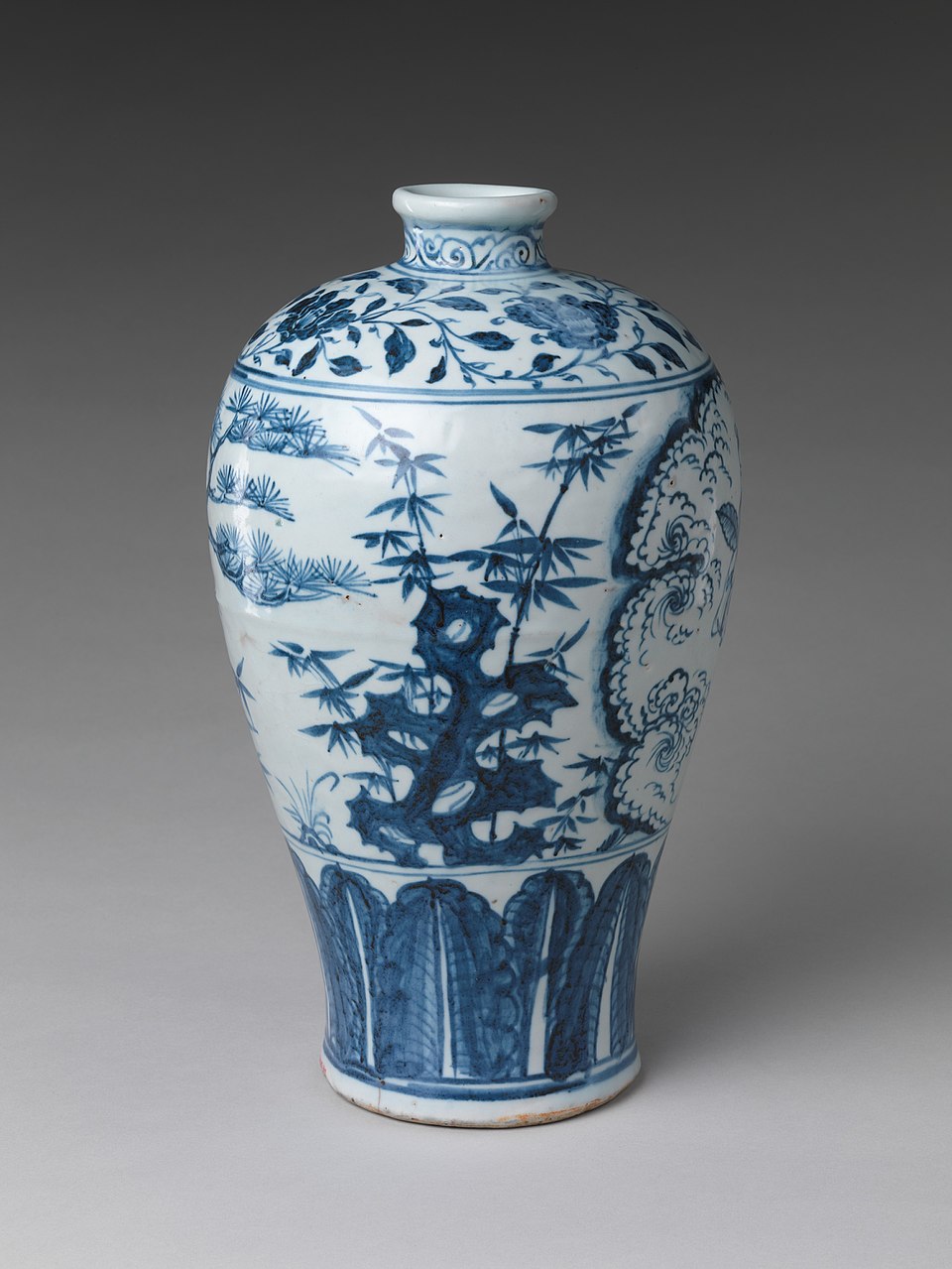
A ceramic vessel can be read through shape, surface, and traces of making.
Minute 1: Shape & function
-
What is it? A vase (tall body, narrow mouth).
-
What might it be used for? Most likely display (flowers/branches) rather than pouring; the mouth is relatively small and controlled.
Minute 2: Structure
-
Rim/neck: A short, slightly flared rim and a short neck with a narrow decorative band.
-
Shoulder/belly: A broad shoulder that transitions into a tall belly; the form narrows toward the base.
-
Foot/base: A stable foot ring with a flaring lower section; visually weighted to support the tall body.
-
Overall build: Looks symmetrical and carefully proportioned—consistent with wheel-throwing and later joining/finishing.
Minute 3: Surface & colour
-
Surface: Appears glazed and glossy (light reflections on the white ground).
-
Colours: Underglaze cobalt blue on a white porcelain body; darker areas show heavier pigment/brush loading.
Minute 4: Decoration & layout
-
Motifs (visible):
-
Bamboo stalks and leaves (center-left)
-
A porous scholar’s rock (center)
-
Cloud scrolls (right side)
-
Floral scrolls around the shoulder (top band)
-
A bold lappet/petal-style band around the lower body (deep blue)
-
-
Organisation: Mainly bands + a main scene: narrow bands at neck/shoulder and a larger central field with bamboo/rock/clouds; heavy decorative band at the base anchors the composition.
Minute 5: Making clues
-
Brushwork: Varied line thickness and darker pooling suggest freehand brush painting with changes in pressure and pigment load.
-
Glaze boundary clues: The base shows a clear stopping area near the foot (common in glazed wares to prevent sticking in firing).
-
Form clues: The clean symmetry suggests wheel work; the crisp bands suggest planned layout and controlled decoration.
Minute 6: Evidence-based interpretation (2 sentences)
-
I observe… a tall, symmetrical blue-and-white vase with bamboo and a scholar’s rock in the main field, framed by multiple decorative bands and a strong dark-blue lower border.
-
This suggests… the maker designed it primarily for visual display, using a structured banded layout and symbolic plant/landscape motifs to create a balanced, “scholar’s studio” style composition that reads clearly from a distance.
2.1. 2-minute Practice: Observe vs Interpret
Instructions:
Choose any ceramic object you can see right now (a mug, bowl, plate, vase, or an online image). Set a timer for 2 minutes.
Write two sentences:
-
I observe… (only what you can see)
-
This suggests… (one careful interpretation + why)
Then add one caution line:
3) I might be wrong because…
REVEAL (Example answer)
1. I observe a glossy white surface with blue painted lines, and a raised foot ring.
2. This suggests the decoration was applied before glazing or under the glaze, and the foot ring indicates it was lifted from the kiln surface during firing.
3. I might be wrong because the photo angle hides the base and I cannot confirm how the decoration was applied.
3. Chinese ceramics in one story
The big picture: Why Chinese ceramics became world-changing
Three reasons Chinese ceramics matter globally
-
Materials and technology
Clay bodies, glazing, and kilns improved over centuries, enabling strong, beautiful, and consistent wares. -
Daily life and culture
Ceramics were not only “art objects” but practical tools in homes, trade, ritual, and gift exchange. -
Trade and exchange
Chinese ceramics travelled widely and influenced local tastes and ceramic industries around the world.
Don’t memorise dynasties yet
This course starts with skills. Dates and dynasties come later—after you can already look closely and describe confidently.
4. Guided looking: watch, pause, and note like a curator
Video-based learning (how to watch like a professional)
When you watch ceramics videos, do not watch them like entertainment. Watch like a maker and a curator:
-
pause and capture the moment where a decision is made (shape, join, brushwork)
-
write one “observe → suggests → apply” note per video
Watch the video to see the process of making a piece of porcelain.
5. Your first “mini catalogue entry”
The skill: a mini catalogue entry (150–220 words)
A catalogue entry is a professional format used in museums, collections, exhibitions, and portfolios.
This week you will produce a beginner version:
Template
-
Object type (what it is):
-
Materials/technique (what it seems to be):
-
Description (shape, surface, decoration):
-
Making clues (evidence):
-
Interpretation (careful, not absolute):
-
One question you want to research next:
Example (short)
Object type: lidded jar
Materials/technique: glazed ceramic with painted decoration
Description: A rounded body with a fitted lid; glossy surface; blue motifs arranged in bands.
Making clues: A defined foot ring suggests it was supported during firing; brushwork indicates hand-painted decoration.
Interpretation: The layout suggests a planned decorative system rather than random painting.
Research question: What motifs or borders are typical for similar jars in museum collections?
6. Video Appreciation 1: Touch the Green Porcelain of the Yue Kilns
This series focuses on introducing the evolution of China's porcelain ware tradition and its cultural and historical milieu. Filmed in three ancient capitals of Chinese porcelain—Dehua in Fujian Province, Jingdezhen in Jiangxi Province and Liling in Hunan Province—it elaborates on the preeminent position of porcelain and its manufacturing technology in the civilized history of China and the world, and shows the audience the five famous kilns of the Song Dynasty in the heyday of ancient Chinese porcelain, including Ru, Guan, Ge, Ding and Jun. The film crew headed south to Hunan, Jiangxi, Fujian and Zhejiang to capture the most traditional Chinese porcelain-making techniques, to delve into the stories behind the porcelain and to demonstrate the evolution of China's porcelain over a thousand years.
7. Video Appreciation 2: Read the Changsha Tongguan Kiln
Changsha Tongguan Kiln is one of the most charming porcelain Kilns in the Tang Dynasty, which incorporated Chinese calligraphy, painting, sculpture, poetry and proverbs into ceramic decorative art, enriched the decorative art of porcelain, is the creation of Chinese porcelain decorative art. Changsha Tongguan Kiln is located in the site of Changsha Tongguan Kiln in Hunan, China. There are three Kiln areas of size, namely Tongguan Town Kiln Area, Gucheng Kiln Area and Shizhu Kiln Area. And the process of discovering it is full of serendipity, it was not until the 1950s that it began to appear clearly before the world. Changsha Tongguan Kiln newly started in the Middle Tang Dynasty, late Tang Dynasty technology reached its peak, with its unique glaze color technology, so it has dominated the world. Changsha Tongguan Kiln has gained unprecedented development by virtue of its historical advantages. However, in the end, it could not escape the fate of decline, which became a regret in the history of Chinese ceramics Changsha Tongguan Kiln not only decorated porcelain, but also improved the cultural taste of porcelain, representing the highest level of Chinese ceramic art.
8. Acknowledgements
This course includes third-party materials (images and videos). Every effort has been made to ensure that these materials are used with appropriate permission and that they are acknowledged correctly. If you believe any content has been used without appropriate permission, please contact the course team so we can review and, if needed, remove or replace it.
A. Images used in Week 1
Figure 1: Porcelain painted with cobalt blue under transparent glaze © Wikimedia
B. Videos used in Week 1
- Creator/uploader: VideoChinaTV
- Source: YouTube
- Licence/Permission: Embedded/linked from the original hosting platform (YouTube).
Title: the process of making a piece of porcelain
- Creator/uploader: Morrow Land
- Source: YouTube
- Licence/Permission: Embedded/linked from the original hosting platform (YouTube).