Week 3 Readings
| Site: | OpenLearn Create |
| Course: | Chinese Ceramics: Kilns to Smart Materials |
| Book: | Week 3 Readings |
| Printed by: | Guest user |
| Date: | Monday, 21 September 2026, 2:51 PM |
Table of contents
- 1. A toolkit: Motif → Layout → Meaning
- 2. The Motif-to-Meaning Toolkit (use in 3 steps)
- 3. A beginner’s motif vocabulary
- 4. Writing like a museum label (the “90-word rule”)
- 5. A bias-check for interpretation
- 6. Video Appreciation 1: Chanting of Famous Kilns and Imperial Porcelains of Song Dynasty (II)
- 7. Video Appreciation 2: Ode to the Cizhou Kiln
- 8. References
- 9. Acknowledgements
1. A toolkit: Motif → Layout → Meaning
What you will learn this week
By the end of Week 3, you will be able to:
-
describe decorative motifs and layout clearly (what you can see)
-
distinguish symbol, pattern, and story scene
-
write a short interpretation that stays cautious and respectful
Real-world lens (why this matters)
Museum labels, auction catalogues, and exhibition texts often rely on short, dense descriptions. If you can read decoration clearly, you can:
-
communicate professionally about ceramics
-
compare objects without needing advanced dates
-
avoid common mistakes like “mystical guessing” or cultural stereotypes
2. The Motif-to-Meaning Toolkit (use in 3 steps)
Step 1: Name what you see (motif vocabulary)
-
animals (dragon, phoenix, fish, crane)
-
plants (lotus, peony, plum, bamboo)
-
landscapes (mountains, waves, clouds)
-
geometric borders (key-fret/meander, diapers, ruyi heads)
Step 2: Describe the layout (how it’s organised)
-
bands (horizontal rings)
-
panels/cartouches (framed scenes)
-
central medallion (one focal motif)
-
all-over pattern (repeating texture)
Step 3: Interpret carefully (meaning = hypothesis)
Use cautious language:
-
“may suggest…”, “often associated with…”, “could imply…”
Avoid absolutes: -
not “this definitely means…”, not “this proves…”
2.1. 2-minute Practice: Motif spotting
Figure 1: Ming dynasty blue and white dragon vase.
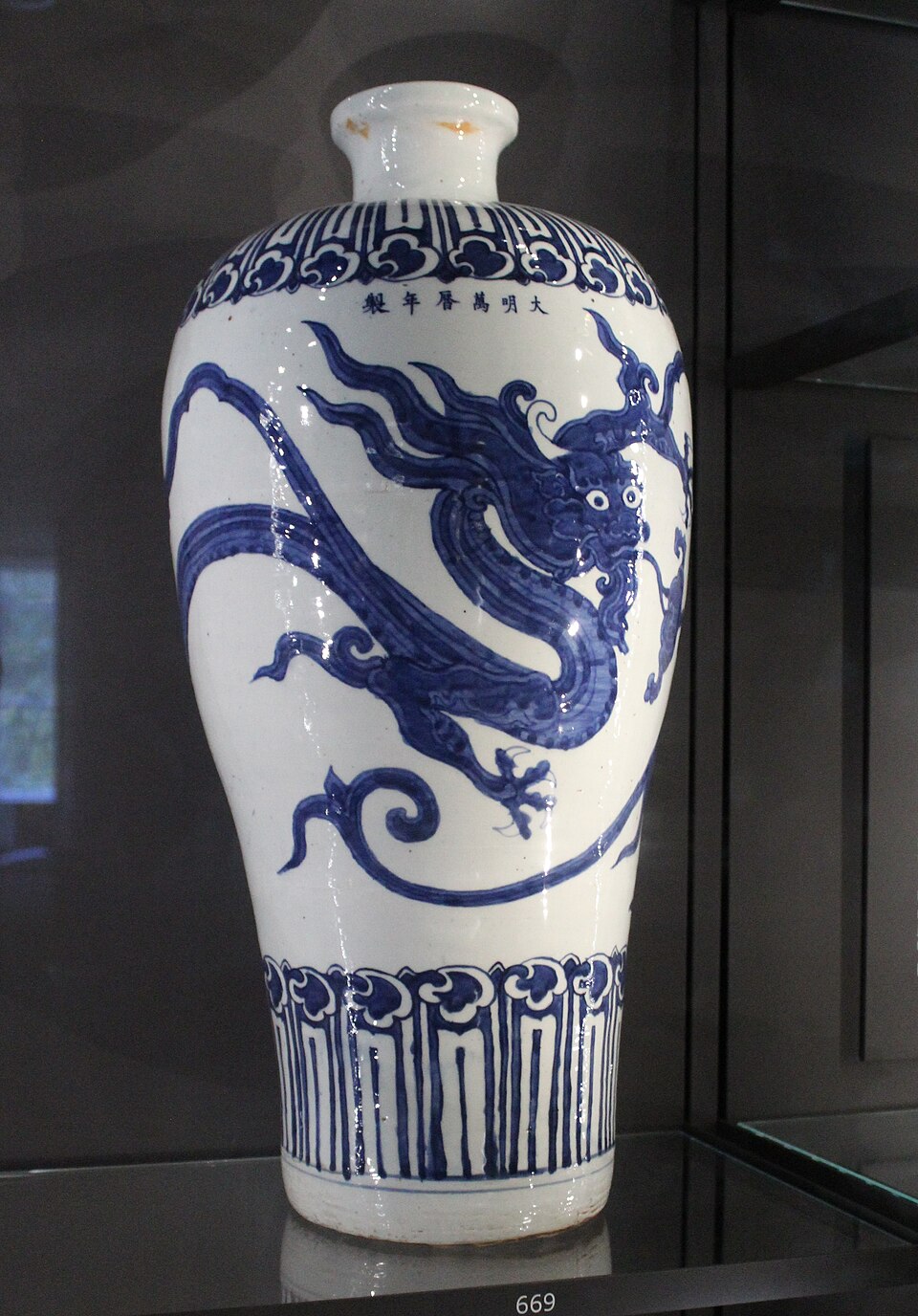
In 2 minutes, write:
-
3 motifs you can name (even if simple)
-
1 layout type (bands/panels / central/all-over)
-
1 sentence beginning “I observe…”
Reveal (Example):
3 motifs: dragon; cloud scrolls; wave/sea pattern (water band).
1 layout type: bands (decorative bands wrap around the vessel).
I observe… a blue-and-white vase with a large dragon as the main motif, surrounded by swirling cloud forms, with patterned border bands and a wave band placed around different sections of the body.
Quick check: Are your motifs visible, not assumed?
3. A beginner’s motif vocabulary
A practical way to learn motifs
You don’t need a giant dictionary. Start with function words:
-
main motif (the star)
-
support motifs (background fillers: clouds, waves, scrolls)
-
borders (frame and rhythm)
Common motif groups (starter set)
Animals
-
Dragon: often linked to power/authority (context matters)
-
Phoenix: often linked to virtue/auspiciousness (context matters)
-
Fish: often linked to abundance (context matters)
-
Crane: often linked to longevity (context matters)
Plants
-
Lotus: purity/renewal associations in many contexts
-
Peony: wealth/status associations in some contexts
-
Plum/blossom: resilience/seasonal symbolism in some contexts
Borders and fillers
-
Key-fret/meander: geometric continuity
-
Ruyi heads: cloud-like framing shapes
-
Waves/clouds: movement, space, atmosphere
Important: meanings vary across time, region, and use. Your job is to describe clearly first, then interpret carefully.
3.1. 2-minute Practice: Border vs main motif
Figure 2: Ming Dynasty porcelain bowl
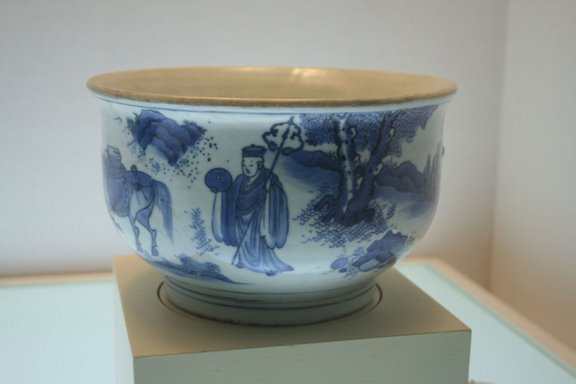
Set a timer for 2 minutes. Look at the bowl image and write 4 bullets:
-
Main motif:
-
Support motifs/fillers: (2 items)
-
Border(s): (describe where they are and what they look like)
-
Layout focus: where does your eye go first, and why?
REVEAL (Model answer)
Main motif: a human figure (scholar/attendant) within a landscape scene.
Support motifs/fillers: deer; trees/foliage; rocks/mountains (any two are fine).
Border(s): thin linear band(s) close to the rim; additional banding around the lower body/above the foot ring (simple lines that frame the scene).
Layout focus: the eye goes first to the figure (central visual anchor), then moves to the deer/trees and finally to the rim/foot borders that “contain” the scene.
4. Writing like a museum label (the “90-word rule”)
A museum label is short, clear, and respectful.
The 90-word label template
Sentence 1 (object ID): what it is + key material/technique (simple)
Sentence 2 (what you see): decoration layout + motifs
Sentence 3 (meaning hypothesis): cautious interpretation (may suggest…)
Sentence 4 (context question): one research question for next steps
Example label (approx. 90 words)
“This vessel is a glazed ceramic jar with blue painted decoration. I observe a banded layout with a main dragon motif and cloud fillers, framed by geometric borders. The repeated dragon imagery may suggest themes of authority or protection, though meanings depend on period and context. The stable foot ring and controlled band spacing suggest planned production and careful finishing. Research question: in museum collections, how do similar dragon-and-cloud jars differ in border style and foot treatment?”
Now read an article about labelling a metal or ceramic object.
5. A bias-check for interpretation
Common interpretation traps (and better alternatives)
Trap 1: Over-certainty
-
Instead of “This definitely means…”
-
Try “This is often associated with…, but context could vary.”
Trap 2: One-symbol-fits-all
-
Instead of “Dragon = always imperial”
-
Try “Dragon imagery appears in many contexts; we should check form, quality, and setting.”
Trap 3: Exoticising language
Avoid phrases like “mysterious,” “magical,” “ancient secrets.”
Use neutral academic language: “symbolic,” “ritual,” “auspicious,” “decorative program.”
6. Video Appreciation 1: Chanting of Famous Kilns and Imperial Porcelains of Song Dynasty (II)
The Chinese ceramic archaeology community believes that the northern Song Official Kiln is the Ru Kiln, so people have been exploring the Ru Kiln. After the tireless efforts of archaeologists, the imperial Ru Kiln center burning area has finally returned to the day. According to the analysis of the Kiln site, the porcelain was mainly fired during the reign of Emperor Huizong. But because of the demise of the Northern Song, those craftsmen moved to the South with the Ru porcelain burning process, in turn, it led to the opening of the Southern Song official Kiln. However, due to the strict restriction of raw materials and conditions, the Ru porcelain burning process slowly lost. With the discovery of Hangzhou official Kiln, people found the southern Song official Kiln located in Hangzhou, it absorbs the characteristics of the northern and southern folk Kiln, so made it became the peak of Chinese celadon fashion.After the collapse of the Southern Song Dynasty, the Southern Song official Kiln disappeared into the history of the Long River, leaving only porcelain tablets to the descendants, but because of its own special status, it has become a treasure of value. Song Dynasty is the most brilliant period in the history of Chinese ceramics, so the value of even the city of porcelain is not only official Kiln family, which also includes Ge Kiln. This kind of porcelain is not only extremely rare, but has not even recorded by historical materials, so the porcelain is called the most mysterious color porcelain in the history of Chinese ceramics.
7. Video Appreciation 2: Ode to the Cizhou Kiln
The Song Dynasty was a period of artistic prosperity, and this rich artistic atmosphere had a direct influence on the decoration of ceramics. Porcelain was not only a living article, but also a tool for people to express their feelings. The Cizhou kiln products rich and colorful beauty, but the best display of Cizhou kiln art is porcelain pillow. The use of porcelain pillows became a trend at the time, in the vast countryside almost everyone has one. Due to the low level of culture of the kiln factory master, so often on porcelain appeared some typos, it is also a strange phenomenon in the history of ceramics. The influence of the Cizhou kiln on the country and abroad was so extensive that now almost all the major museums at home and abroad have Cizhou porcelain. The eternal social effects of Cizhou kiln ceramics in history have made great contributions to world civilization and have become a valuable asset shared by mankind.
8. References
- National Museums Scotland (No date) Labelling a metal or ceramic object. Available at https://www.nms.ac.uk/our-impact/national-work/training-and-guidance-for-museums/collections-care/object-labelling/labelling-a-metal-or-ceramic-object
9. Acknowledgements
This course includes third-party materials (images and videos). Every effort has been made to ensure that these materials are used with appropriate permission and that they are acknowledged correctly. If you believe any content has been used without appropriate permission, please contact the course team so we can review and, if needed, remove or replace it.
Images used in Week 3
Figure 1: Ming dynasty blue and white dragon vase © Wikimedia Commons
Figure 2: Ming Dynasty porcelain bowl © Wikimedia Commons
Videos used in Week 3
- Title: Chanting of Famous Kilns and Imperial Porcelains of Song Dynasty (II)
- Title: Ode to the Cizhou Kiln
- Creator/uploader: VideoChinaTV
- Source: YouTube
- Licence/Permission: Embedded/linked from the original hosting platform (YouTube).