Week 2 Readings
| Site: | OpenLearn Create |
| Course: | Chinese Ceramics: Kilns to Smart Materials |
| Book: | Week 2 Readings |
| Printed by: | Guest user |
| Date: | Monday, 21 September 2026, 2:51 PM |
Table of contents
- 1. The “Form-to-Function Map”
- 2. The Form-to-Function Map (use this every time)
- 3. Bowls, Cups, Plates: everyday forms
- 4. Jars and vases: reading necks, shoulders and balance
- 5. Output: Build a Form Profile
- 6. Video Appreciation 1: The Yaozhou Kiln—An Endless Story
- 7. Video Appreciation 2: Chanting of Famous Kilns and Imperial Porcelains of Song Dynasty (I)
- 8. Acknowledgements
1. The “Form-to-Function Map”
What you will learn this week
By the end of Week 2, you will be able to:
-
identify common ceramic form families (bowl, cup, jar, vase, plate, flask)
-
explain how rim, belly, neck and foot signal function and stability
-
write a clear form description that avoids guessing
Real-world lens (why this matters)
Whether you are viewing a museum object, reading a catalogue entry, or planning your own piece, “form literacy” helps you:
-
understand why a vessel is shaped the way it is
-
avoid common misunderstandings (“It’s decorative only!” vs “It was made to pour/store/serve”)
-
design more stable vases and more usable tableware
2. The Form-to-Function Map (use this every time)
For any vessel, answer these 4 questions:
-
Opening (rim/mouth): wide or narrow? thick or thin?
→ suggests serving vs storage, pouring control, cleaning ease -
Body (belly/shoulder): round, angular, tall, squat?
→ suggests capacity, visual emphasis, stability risk -
Neck (if present): long/short? narrow/wide?
→ suggests pouring control, display emphasis, splash control -
Foot/base: flat, ring foot, recessed? wide or small?
→ suggests kiln support, stability, lifting/handling
2.1. 2-minute Practice: “What form family is it?”
Look at any ceramic object (real or image). In 2 minutes, write:
-
Form family (choose one): bowl / cup / plate / jar / vase / flask
-
2 clues from shape
-
1 likely function
-
1 alternative function
REVEAL (Example)
Form family: jar
Clues: round belly + relatively narrow mouth; stable foot ring
Likely function: storage
Alternative function: display container (if decorated and kept visible)
Quick check: Did you use shape clues, not dynasty guessing?
3. Bowls, Cups, Plates: everyday forms
Bowl logic (why bowls dominate many dining cultures)
Bowls are stable, easy to stack, and suitable for liquids and mixed foods. When reading a bowl, look at:
-
rim curve (comfortable drinking? easy to serve?)
-
wall thickness (heat handling + durability)
-
foot ring (stability + firing support)
Cup logic
Cups often reveal design trade-offs:
-
thin walls feel elegant but crack more easily
-
a small foot ring can be stable but can chip
-
proportions influence how heat feels in the hand
Plate logic
Plates are harder than they look:
-
wide flat surfaces warp easily in drying/firing
-
plate feet and slight curves often reduce warping and improve handling
Skill card (portable skill):
Write a “function sentence” without guessing date:
“This wide opening suggests serving or displaying food, while the stable base suggests it was meant to sit on a flat surface.”
Watch a video about Foot Trimming Tool - Top Pottery Tools.
Transcript: Bowls, Cups, Plates: everyday forms
This tool is probably one of my most asked-about tools, along with the dent puller, and that is my foot trimming tool. The idea behind this is that it has two shaped ends that are different-sized semi-circles. You push it into the base after you’ve thrown, and it adds a rounded foot in a couple of seconds, rather than having to trim one on later.
I came up with the idea—there are variations on it, but I never found anything quite like this. The thing was, I’d been throwing these small trinket bowls quite flat, so they didn’t have much height to them. When I was trimming them, it was a real chore to get the trimming tool around the foot to trim it properly. I always felt it was worth adding a foot because it made dipping the glaze so much easier. Then again, if you’re using them for things and loading them in the dishwasher, you can pick them up when they’re upside down much more easily if they have a foot, rather than just ending flat.
So, I wanted to add a foot, but trimming them on was probably taking longer for each thing than throwing them did. I was sure there was going to be a better way of doing it. Anyway, long story short, I made myself a tool out of mild steel that did it. People kept asking me where they could buy one, and the answer was obviously that you couldn’t, because I’d made it. I put up build instructions on my blog if you want to make your own, and those instructions are still there.
After a little while—being asked by people who wanted one—I looked into making them out of stainless steel, because mild steel goes rusty, so it’s not ideal. When demand proved to be more than the five that I initially bought material for, I got them laser cut by a laser cutting company. The profile is laser cut, so it’s super precise. Then I do the finishing myself.
Basically, they work like this: you go from having a straight foot to a rounded foot just by pushing that in. I know a lot of you will have found my channel through John the Potter, who has one of these and uses it on a lot of his pots. Yeah—thanks, John. I’m glad he’s still using it after I sent that probably a year ago, and he’s used it on a lot of pieces by now.
I’ve been using mine for years. It’s 2 mm thick stainless steel, laser-cut shape. It’s got an 8 mm round end on one end—which is the one I just used for that smaller piece—and a 12 mm end, which is what I use on my fruit bowls. They’re available from my website, and nowhere else stocks them. Maybe that’s something I’ll look into one day, but I don’t know. I’d much rather be a potter than a tool maker.
This is one of those things where I’m happy to make them and sell them to other people who want them, but I don’t really want that to become the main focus of what I do. But they are available through my shop, and that’s it really. They are what they are. [Music]
I’ll just record one more clip demonstrating how they cut the foot. They are very useful, particularly for smaller bowls where the time to trim a foot afterwards would be kind of a hundred times more than the time to add it like this. Plus, obviously, they give you a very consistent profile to the foot, because it’s 2 mm thick stainless steel and it’s not going to change shape. It’s going to take you years of constant use to even think about wearing it out.
You want to leave yourself roughly the height of clay at the bottom that you want to trim off, and then you just push the foot trimming tool in and you’ve got a foot. Simple as that.
3.1. 2-minute Practice: Foot-ring detective
Figure 1: Small covered wine pot or teapot
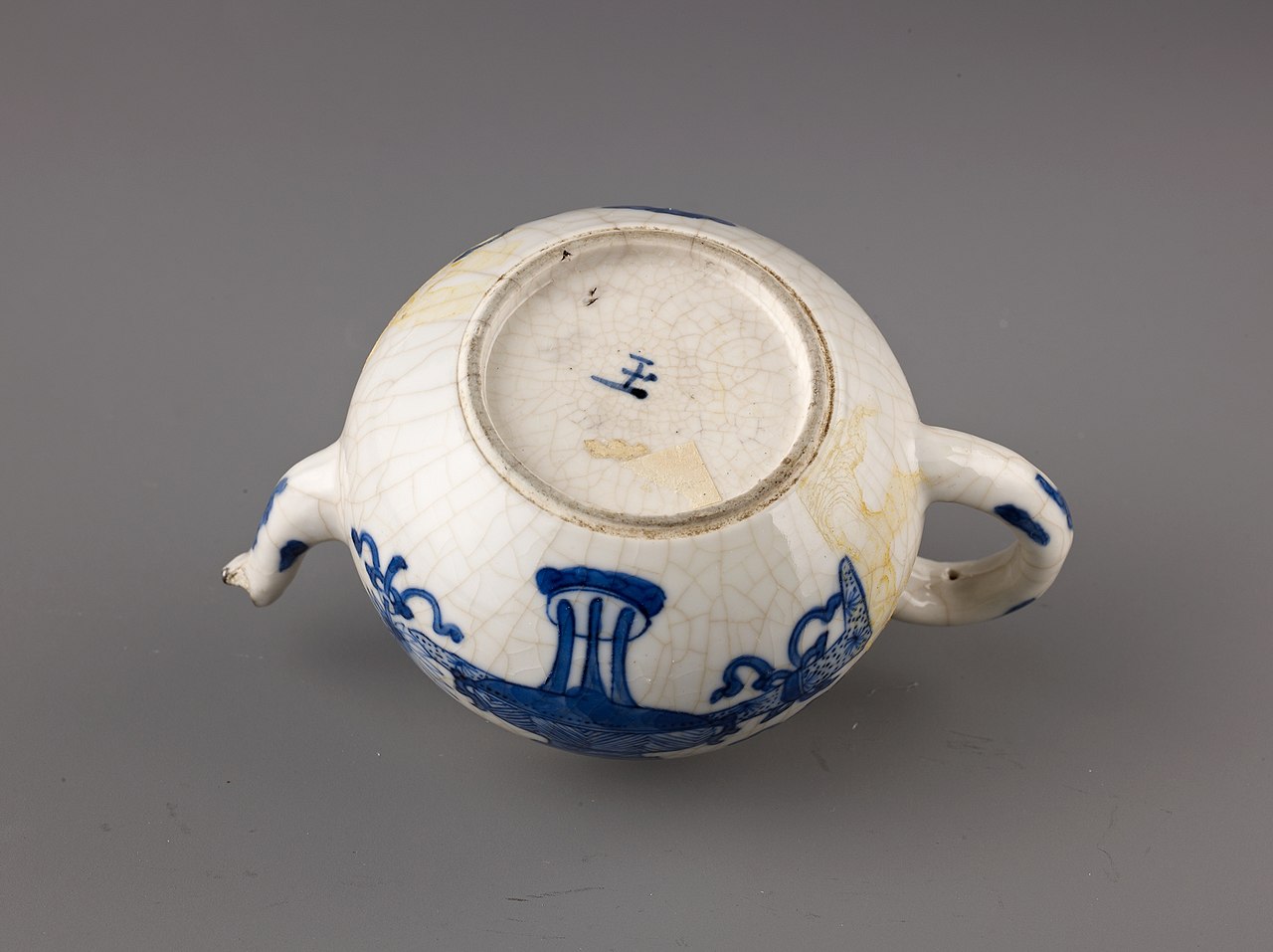
Answer quickly in bullet points:
-
Does it have a foot ring? (yes/no)
-
What does the foot/base suggest about stability?
-
What might it suggest about making/firing?
-
One risk if you tried to make this form at home
REVEAL (Example):
Foot ring: yes
Stability: stable placement; lifted edge reduces wobble
Making/firing: foot ring can help separate glazed body from kiln shelf
Home-making risk: uneven thickness at base may crack
4. Jars and vases: reading necks, shoulders and balance
Jar vs vase (a useful beginner distinction)
-
Jars often prioritise storage: a controlled opening, volume, stable body
-
Vases often prioritise display: silhouette, neck length, viewing angles, balance
Three stability rules for beginners (especially useful for home-making)
-
A wider base is safer than a narrow base
-
Tall forms need controlled drying and stage building
-
Smooth joins and even thickness reduce cracking
Function changes meaning
The same decoration can signal different things depending on use:
-
a ritual vessel, a storage jar, and a display vase can share motifs, but their intended environments differ.
4.1. 2-minute Practice: Compare two objects (shape → use → evidence)
Pick two objects (two photos, two video frames, or one object + one photo). In 2 minutes write:
-
Object A: likely function + 2 evidence clues
-
Object B: likely function + 2 evidence clues
-
One sentence comparing them: “A suggests…, while B suggests…”
REVEAL (Example):
A function: storage; clues: narrow mouth + large belly
B function: display; clues: taller neck + emphasized silhouette
Compare: “A suggests controlled access and capacity, while B suggests visual display and height.”
5. Output: Build a Form Profile
Your output this week: a Form Profile (180–260 words)
Choose ONE form you want to understand or make in the future (tableware OR vase). Write:
-
Form family + dimensions (approx.)
-
Function hypothesis (and alternative)
-
3 key design features (rim/body/neck/foot)
-
2 making risks (crack/warp/weak join/collapse)
-
1 question for next week (motif? glaze? kiln?)
Why this helps later
This Form Profile will become:
-
a foundation for Week 7 home-making (tableware/vase planning)
-
a building block for Week 8 capstone plan and documentation
Accessibility reminder: If you include any image, add a short text description.
6. Video Appreciation 1: The Yaozhou Kiln—An Endless Story
Yaozhou Kiln is a treasure in the traditional Chinese porcelain making process, has more than 1,300 years of history, it is famous for its variety of glazed color and styling in the world. Although the Tang Dynasty was not the heyday of the development of Yaozhou Kiln, the Yaozhou Kiln craftsmen who strive to be the best of their families still created many beautiful styles of porcelain. But the war in late Tang Dynasty has a great impact on the ceramics industry, many porcelain Kilns successively decline, but Shaanxi's Yaozhou Kiln has not gone into decline. On the contrary, this kind of daily porcelain is more and more loved by people. In the Song Dynasty, Yaozhou Kiln continuously innovated and eventually burned unique Yaozhou cyan porcelain. While considering artistry, those craftsmen also paid more attention to practicality. Yaozhou cyan porcelain, both artistic and practical, is well loved by royalty. Yaozhou Kiln porcelain also through the ancient silk road to the world. Yaozhou Kiln combined with its own strengths to continuously develop innovative ceramic firing technology behavior and pushed the development of China's ceramics industry to the top. Creating a period of prosperity before and after the history of China's ceramics.
7. Video Appreciation 2: Chanting of Famous Kilns and Imperial Porcelains of Song Dynasty (I)
The development and progress of unified ceramics in the Northern Song Dynasty provided the conditions for its unprecedented artistic achievements, which were closely related to th Emperors at the time. At that time Jun porcelain and Ding porcelain had the same status, Jun porcelain is famous in the world for its unique glaze and burning method of Kiln transformation, Ding porcelain is loved for its colorful pattern decoration. But just as the development of porcelain in the Ding Kiln is going on, a war to change the history of Chinese ceramics has broken out, that is the famous Song Jin War in the history of Chinese feudalism. The protracted war not only caused great disaster to the people of the Central Plains, but also destroyed the otherwise thriving Song Dynasty ceramics industry, which resulted in the loss of Ding porcelain for more than 800 years. So far the production technology of fixed Kiln porcelain still plays a huge role in the development of China's ceramics business.
8. Acknowledgements
This course includes third-party materials (images and videos). Every effort has been made to ensure that these materials are used with appropriate permission and that they are acknowledged correctly. If you believe any content has been used without appropriate permission, please contact the course team so we can review and, if needed, remove or replace it.
Images used in Week 2
Figure 1: Small covered wine pot or teapot © Wikimedia Commons
Videos used in Week 2
- Title: The Yaozhou Kiln—An Endless Story
- Title: Chanting of Famous Kilns and Imperial Porcelains of Song Dynasty (I)
- Creator/uploader: VideoChinaTV
- Source: YouTube
- Licence/Permission: Embedded/linked from the original hosting platform (YouTube).
Title: Foot Trimming Tool - Top Pottery Tools
- Creator/uploader: Old Forge Creations
- Source: YouTube
- Licence/Permission: Creative Commons Attribution license