Week 4 Readings
| Site: | OpenLearn Create |
| Course: | Chinese Ceramics: Kilns to Smart Materials |
| Book: | Week 4 Readings |
| Printed by: | Guest user |
| Date: | Monday, 21 September 2026, 2:52 PM |
Table of contents
- 1. A toolkit: Read glaze and surface like a ceramic professional
- 2. Kilns and firing: what changes colour and surface results
- 3. Common glaze “problems” as learning signals
- 4. Materials science connection: from glaze logic to smart ceramics
- 5. Video Appreciation 1: The Thousand Years Old Kiln Fire in Jingdezhen 1
- 6. Video Appreciation 2: Thousand Years Old Kiln Fire in Jingdezhen 2
- 7. Acknowledgements
1. A toolkit: Read glaze and surface like a ceramic professional
What you will learn this week
By the end of Week 4, you will be able to:
-
describe glaze surfaces using accurate vocabulary (gloss, matte, texture, defects)
-
explain how firing and atmosphere can change colour and surface results
-
connect “surface choices” to performance thinking (durability, safety, function)
Real-world lens (why this matters)
Glaze and firing decisions affect:
-
how an object looks (colour depth, translucency, texture)
-
how it performs (durability, staining, water resistance)
-
what risks appear (crazing, pinholes, crawling, running)
The 90-second Surface Reading Checklist
Use this when you see any ceramic object (photo or real):
-
Gloss level: glossy / satin / matte
-
Colour response: uniform or varied? pooled in recesses? thinner on edges?
-
Texture: smooth / orange peel / crystalline / crackle
-
Defects: pinholes, crawling, blistering, running, crazing (tiny crack lines)
-
Clues at edges/foot: glaze stops? bare foot ring? kiln marks?
Tip: Start with describing. Interpretation comes second.
1.1. 2-minute Practice: Surface vocabulary
Choose any glazed object photo (or your own mug). In 2 minutes, write 5 bullets, each starting “I observe…”, using at least 3 words from this list:
glossy / matte / pooled / thin edge / crackle / pinholes / crawling / even coating / bare foot / drip
REVEAL (Example):
I observe a glossy surface that reflects light clearly.
I observe colour pooling in recessed areas and appearing darker there.
I observe a thin edge where the colour looks lighter near the rim.
I observe a bare foot ring where glaze stops at the base.
I observe tiny surface marks that could be pinholes (small dots) rather than painted texture.
Quick check: did you describe what you see, not “it must be…”.
2. Kilns and firing: what changes colour and surface results
Three beginner ideas
-
Heatwork matters
Ceramics change with temperature + time. Even “similar” glazes can look different if fired differently. -
Atmosphere matters
-
Oxidation: more oxygen available
-
Reduction: less oxygen available (fuel-burning environments can create this)
These conditions can shift colours and surface effects.
-
Placement matters
Where an object sits in a kiln can change outcomes:
-
hotter/cooler zones
-
flame path / airflow
-
glaze thickness and pooling
A useful speaking rule
Instead of claiming certainty, use:
“This surface effect could be influenced by glaze thickness and firing conditions.”
Now watch a video about
Transcript: Kilns and firing: what changes colour and surface results
These cups have way too much glaze on them. I’ve never done this before on purpose, so I’m going to load the glaze onto both of these so it will drip off. We’ve got some serious drippage right there.
What’s up, guys? We have a new addition to the studio, which is super exciting. Today we’re talking about kilns. This video is sponsored by Advancer kiln shelves, and I’ll talk more about them later.
Thank you for joining me in the studio today. I want to do a video all about kilns, because kilns are what bring life to clay. Without kilns, we wouldn’t be able to do the things that we do or get the results we get. There are lots of different kinds of kilns, so this will be a brief overview.
Since we just got a new Skutt 818 kiln, I thought it would be a good time to talk about the different sizes of electric kilns and the different types of fuel used for kilns. I get this question a lot: no, you cannot use your kitchen oven to fire ceramics. It does not get hot enough. There are some materials you can heat slightly in an oven, but they are not suitable for functional ceramics and they really limit your possibilities.
So let’s talk about kilns. A kiln is an insulated vessel that gets extremely hot. There are three basic types of fuel used to reach firing temperatures: electric, gas, and wood.
Electric kilns are the most common and the most affordable way to get started. We have three electric kilns in our studio. Gas kilns, usually fueled by propane, are commonly used for high-fire work, especially cone 10 firings. They allow for reduction atmospheres, which I’ll explain shortly. The third type is wood kilns. These are the least common, usually custom-built rather than purchased, and they require a lot of effort and a team of people to fire.
There are also two main firing atmospheres: oxidation and reduction. Oxidation firings occur when oxygen is present throughout the firing, which is typical for electric kilns. Reduction firings occur when oxygen is limited, and these are usually done in gas or wood kilns. Other kiln types, such as soda kilns and raku kilns, introduce additional atmospheric effects or involve shorter, lower-temperature firings.
This video is meant to be introductory. If you’re thinking about buying your first kiln, I want you to finish with a general idea of what might work for you.
Another key difference between electric, gas, and wood kilns is temperature. Electric kilns usually top out around cone 8. Firing higher than that is very hard on the kiln elements. Gas and wood kilns commonly fire to cone 10 and can reach high temperatures more efficiently. This is one advantage of gas and wood firing.
Electric kilns are most commonly found in schools and production studios because they’re relatively affordable, easy to use, and don’t require special buildings or fuel systems. That’s why I want to focus mainly on electric kilns.
Let’s take a look at the kilns in my studio. We have three kilns here: a Skutt 1027, a Skutt 818, and a Skutt 1218. The numbers refer to the shape and height. For example, the 1027 is a ten-sided kiln that is 27 inches tall, while the 818 is eight-sided and 18 inches tall.
There are many good kiln brands available. I’ve always used Skutt, and I’ve had good experiences with their customer service and maintenance. I especially like their touchscreen controller because it offers a lot of firing options.
I use the larger kilns mainly for bisque and glaze firings. The 1218 can hold around 100 small pieces for a bisque firing. The 1027 is typically used for glaze firings and can hold around 50 to 60 mugs. However, firing large kilns requires a lot of work to fill them efficiently.
That’s why I wanted a smaller test kiln. It allows me to fire more often with fewer pieces, which is useful for testing glazes and firing schedules. Smaller kilns give you more flexibility, especially when you’re learning or experimenting.
If you’re just starting out, a large kiln like a 1027 or 1218 may feel overwhelming. It can take a long time to produce enough work to fill it. Smaller kilns allow more frequent firings and quicker feedback.
I want to briefly thank Advancer kiln shelves. They’re lightweight, durable, and easier to clean. When glaze drips onto these shelves, pots are much easier to remove, which can save a lot of work and prevent damage.
For this firing, I loaded two cups with intentionally heavy glaze so it would drip off. One was fired on a standard kiln shelf, and the other on an Advancer shelf. We used a slow-cool firing schedule to cone 7.
After firing, you can clearly see the difference. The cup on the regular shelf stuck badly and damaged the base. The cup on the Advancer shelf popped right off, leaving the clay intact and much easier to clean.
That’s one of the reasons I like these shelves so much. They allow for more experimentation with less risk.
To wrap up, kilns come in many shapes, sizes, and firing styles. Electric kilns are the most common and accessible. In the future, I’d love to explore gas, wood, and reduction firings to expand the possibilities in my studio.
Thanks so much for watching, and thanks to everyone who supports the channel. If you enjoyed this, feel free to like, subscribe, and share. I’ll see you in the next video.
2.1. 2-minute Practice: Cause-and-effect
Complete these two lines with your best hypothesis:
-
If glaze is thicker in recesses, I might observe…
-
If firing is uneven, I might observe…
REVEAL (Example):
1. If glaze is thicker in recesses, I might observe darker colour pooling, stronger gloss, or more running in those areas.
2. If firing is uneven, I might observe patchy colour, uneven gloss, or differences between one side and another.
Bias-check line (optional): “I would need more context (kiln type, glaze recipe, firing schedule) to confirm.”
3. Common glaze “problems” as learning signals
Why “defects” are useful for learning
Many surface issues are not just “mistakes”: they are clues about decisions and conditions.
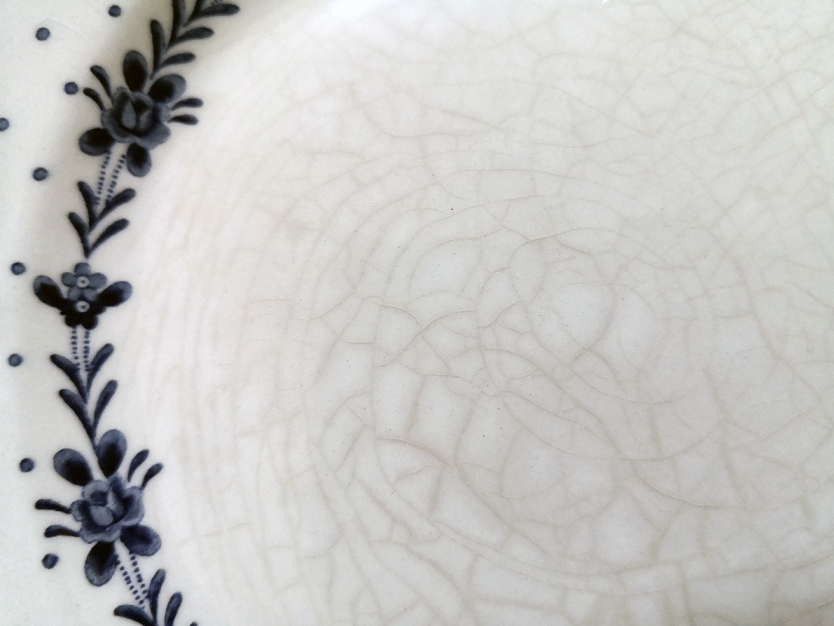
Crazing (fine crack lines):
-
often related to glaze/body fit (thermal expansion mismatch)
-
can affect water resistance and staining
Pinholes (tiny holes):
-
can result from gases escaping or firing/glaze issues
-
can affect surface smoothness and cleanability
Crawling (bare patches):
-
glaze pulls away; could relate to surface contamination or glaze properties
Running/drips:
-
glaze too fluid or too thick; can stick to kiln shelves
Figure 1 Crazing at ceramic flatware
3.1. 2-minute Practice: Defect → risk → mitigation (quick thinking)
Figure 2 Glaz Crawling Defect
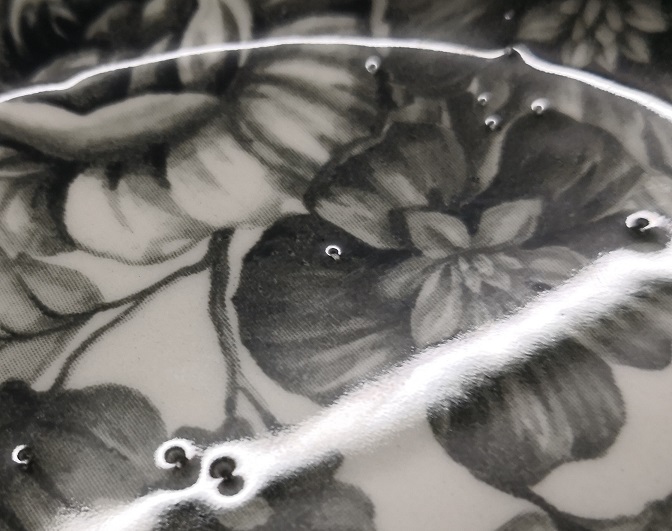
Look at the image and write 3 bullets:
-
What I observe (visible clue):
-
Why it matters (risk):
-
One mitigation idea (simple):
Optional fourth bullet: One question you would ask (about process/material).
REVEAL (Example)
1. Observe: I observe irregular bare patches where the glaze has pulled away, leaving exposed clay body (a crawling pattern).
2. Risk: The surface can be rough and harder to clean, may trap dirt, and can be unsuitable for functional tableware depending on the intended use and finish requirements.
3. Mitigation: Improve glaze adhesion by ensuring the bisque surface is clean and dust-free, adjusting application thickness, and testing a small tile before glazing a full piece (plus record results).
4. Question: Was there dust/grease on the bisque, or was the glaze applied too thick / with high surface tension?
4. Materials science connection: from glaze logic to smart ceramics
Why connect art ceramics to advanced ceramics?
Traditional ceramic practice teaches a powerful design logic:
-
choose materials → control processing → achieve properties → deliver function
That same logic appears in modern ceramic industries.
Two advanced ceramics examples (conceptual, beginner-friendly)
A) Silicon carbide (SiC) ceramics
Why it matters: often valued for high-temperature stability, wear resistance, and strength.
Design translation: “surface durability + thermal performance” becomes the goal, not decoration.
B) Piezoelectric ceramics
Why it matters: can convert mechanical stress into electrical signals (useful in sensors and actuators).
Design translation: “structure + processing” affects performance and reliability.
Skill card: Property → Design → Application (fill-in)
-
Property I want: __________
-
Design decision: __________
-
Possible application: __________
Example:
Property: electrical insulation
Design decision: choose a ceramic body with stable insulating behaviour
Application: insulators or protective components
Output this week
You will create:
-
a Surface Reading Note (5 observations + 1 cautious hypothesis)
-
a Kiln/Firing explanation in 3 sentences (no formulas)
-
a Property → Design → Application mini map
5. Video Appreciation 1: The Thousand Years Old Kiln Fire in Jingdezhen 1
Jingdezhen has a long history, and porcelain is the whole life of Jingdezhen's history. The Song Dynasty was a period of great development of Chinese porcelain. At that time, the bluish-white porcelain of Jingdezhen kicked off the glorious history of Jingdezhen. This is because the water of Jingdezhen and the mountains are rich in high-quality porcelain stone and porcelain clay. However, the war in the Song and Yuan Dynasties made Jingdezhen rise and become the world's porcelain capital. Due to the disappearance of many competitors in the war, many artists moved to Jingdezhen, coupled with the frequent trade between China and the West, the porcelain industry has achieved unprecedented development. At the same time, the people of Jingdezhen successfully burned blue and white porcelain. Later, when Jing dezhen was in a raw material crisis, the craftsmen excavated a high-quality porcelain raw material: kaolin. Many stories of emperors and porcelain have also been recorded in history. Different emperors are in the reign, and the porcelain fired in Jingdezhen is different, and the porcelain also reflects the character of the emperor. Finally, porcelain was successfully fired in the West in the 18th century, and the porcelain industry in Jingdezhen declined.
6. Video Appreciation 2: Thousand Years Old Kiln Fire in Jingdezhen 2
The Hutian ancient kiln is the oldest and largest of the ancient porcelain kiln ruins in Jingdezhen. The archaeological team's archaeological work on the Hutian kiln has never stopped. First, it was found that the formulas mastered by the porcelain workers of the Hutian kiln, and then because of the discovery of the bluish white porcelain, it was determined that the most important kiln site for firing bluish white porcelain in Jingdezhen was the Hutian kiln. In 1997, Experts believe that the Hutian kiln was a special kiln factory in the Song Dynasty. The archaeological team also found many exclusive pattern porcelains of the royal family, which established the exclusive kiln factory of the Fuliang Porcelain Bureau in the Yuan Dynasty. In 2002, a tribute porcelain specially burned for the court was found. In the subsequent excavation, the only kiln in China that fired Blue and White Porcelain of Yuan Dynasty was found. In recent years, Jingdezhen has strengthened the protection of Hutian kiln sites.
7. Acknowledgements
This course includes third-party materials (images and videos). Every effort has been made to ensure that these materials are used with appropriate permission and that they are acknowledged correctly. If you believe any content has been used without appropriate permission, please contact the course team so we can review and, if needed, remove or replace it.
Images used in Week 4
Figure 1: Crazing at ceramic flatware © Wikimedia Commons
Figure 2: Glaz Crawling Defect © Wikimedia Commons
Videos used in Week 4
- Title: Thousand Years Old Kiln Fire in Jingdezhen 1
- Title: Thousand Years Old Kiln Fire in Jingdezhen 2
- Creator/uploader: VideoChinaTV
- Source: YouTube
- Licence/Permission: Embedded/linked from the original hosting platform (YouTube).
Title: Let's talk about KILNS
Licence/Permission: Creative Commons Attribution license