Week 6 Readings
| Site: | OpenLearn Create |
| Course: | Chinese Ceramics: Kilns to Smart Materials |
| Book: | Week 6 Readings |
| Printed by: | Guest user |
| Date: | Monday, 21 September 2026, 2:52 PM |
Table of contents
1. The “Portfolio Pack”
What you will learn this week
By the end of Week 6, you will be able to:
-
plan and produce portfolio-ready documentation (six views + captions)
-
write a clear object label and a short maker statement
-
describe process choices and limitations ethically (materials, use, safety notes)
-
create accessibility-friendly text (alt text + clear captions)
Real-world lens (why this matters)
In ceramics, opportunities often depend on how clearly you can communicate your work:
-
applications (study, residencies, exhibitions)
-
collaboration (studio teams, industry partners)
-
education and outreach
-
professional online presence
Your Week 6 output (a “Portfolio Pack”)
You will produce:
-
6-view documentation plan (or photos if you have them)
-
Captions (one line each)
-
90-word object label (from Unit 3 method)
-
Maker statement (120–160 words)
-
Process note + limitations (60–90 words)
-
Accessibility text (alt text for 2 images)
1.1. 2-minute Practice: Write one perfect caption
Choose any ceramic image (yours or a public object). In 2 minutes, write one caption (max 20 words) that includes:
-
what it is
-
material/technique (simple)
-
one visible feature (shape/surface)
REVEAL (Model answer):
“Handbuilt stoneware vase with a narrow neck and matte glaze, showing carved linear texture around the shoulder.”
Quick check: Does your caption avoid guessing dynasty or value?
2. The 6-view standard: photograph like a catalogue
Why six views?
Six consistent views help others understand form, scale, surface, and making quality—even online.
Required views
-
Front/full view
-
Side view
-
Back/second angle
-
Top view (rim/mouth)
-
Base/foot view
-
Detail close-up (texture, motif, glaze edge)
Shot list tips (beginner-friendly)
-
Use plain background; avoid busy patterns
-
Use soft light (window light is fine)
-
Keep camera level; don’t distort the form
-
Include scale cue if possible (hand, ruler, or known object)
-
Take at least 2 photos per view; choose the clearest
Accessibility reminder
If you upload images, add short, helpful alt text describing what is visible.
2.1. 2-minute Practice: Alt text that actually helps
Figure 1 Glazing detail
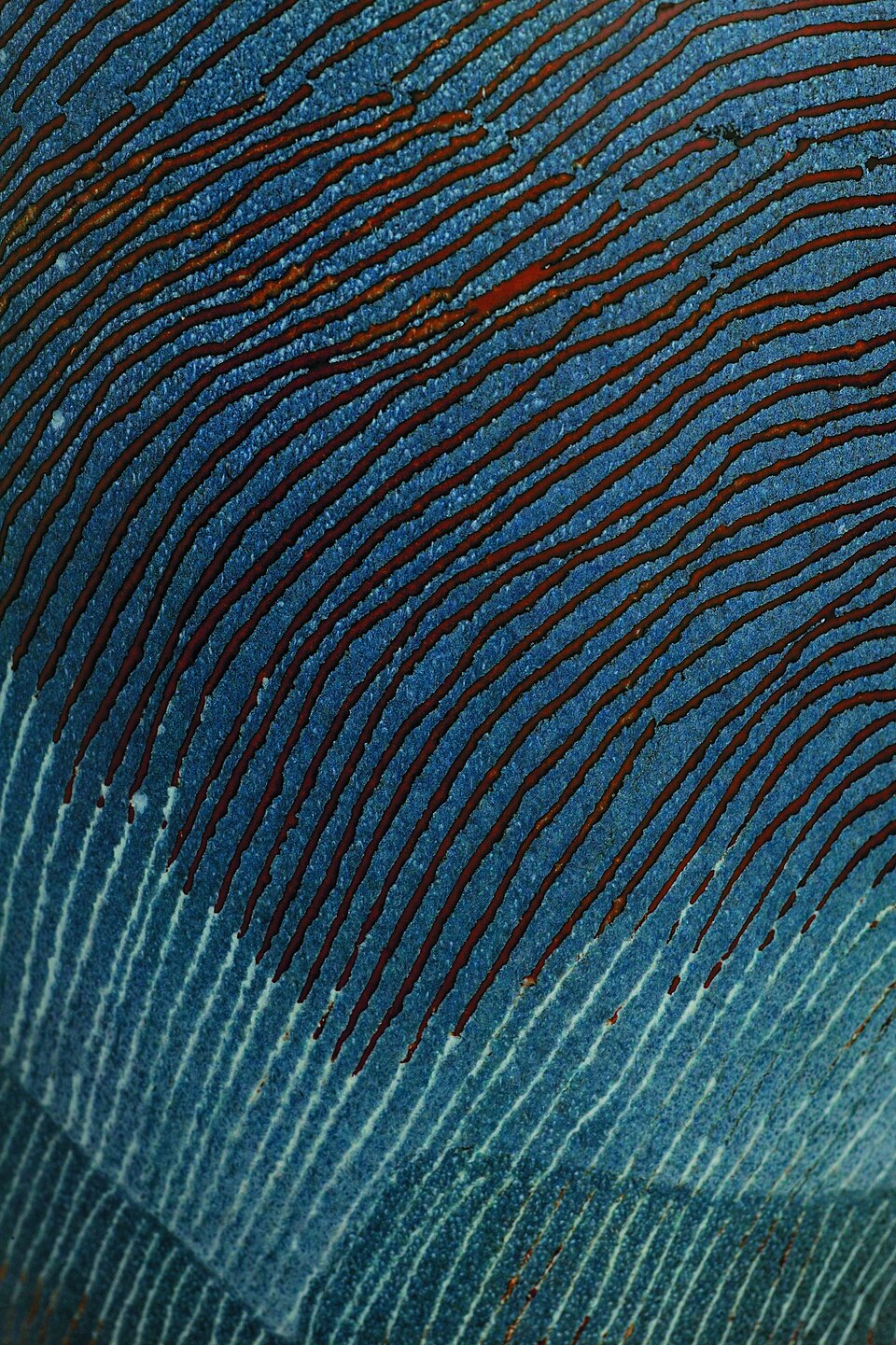
Look at the image for 30 seconds. Then write 1–2 sentences of alt text that includes:
-
where on the object (e.g., “detail view of the surface/edge”)
-
what you can see (colour, gloss/matte, texture)
-
one specific feature (e.g., crackle lines, pooling, speckling, brush mark, glaze edge)
REVEAL (Model answer):
Close-up of a ceramic surface showing layered blue glaze with vertical streaks and dark reddish-brown lines where glaze has flowed downward, creating visible running and pooling effects.
3. Writing your work: label, maker statement and limitations
A) The 90-word object label (evidence-based)
Use the Week 3 label template:
-
what it is
-
what you see
-
cautious meaning
-
one question
B) Maker statement (120–160 words)
A maker statement explains intent and choices in a personal but professional tone.
Maker statement template
-
What question/theme you explore
-
Why ceramics is the right medium
-
One key form decision and one surface decision (evidence-based)
-
What you want the viewer/user to notice
-
One reflection on learning or process
C) Process note + limitations (60–90 words)
This is where you communicate responsibly.
Include:
-
forming method (coil/slab/wheel/cast)
-
firing status (unfired/bisque/glazed/fired) if relevant
-
limitations (e.g., “prototype”, “home-made without kiln”)
-
functional safety note if needed (e.g., “not food safe unless properly fired and glazed”)
3.1. 2-minute Practice: One sentence of ethical limitation
Write one sentence that responsibly states a limitation (choose one):
-
home process limitation
-
firing limitation
-
food-safety limitation
-
prototype limitation
REVEAL (Model answer):
“This piece is a home-made prototype and has not been high-fired; it is for display rather than functional food use.”
“Glaze testing is ongoing; surface results may vary in future firings.”
“This is a study piece made to explore form and texture, not a final production standard.”
4. Using your Portfolio Pack for real opportunities
Where your Portfolio Pack can be used
-
class or studio critique
-
residency / workshop applications
-
exhibition proposals
-
professional collaboration requests
-
learning logs and reflective practice
What makes a portfolio entry strong
-
clear photos (6 views)
-
short, readable writing
-
evidence-based description
-
one strong idea (not 10 ideas at once)
-
honest limitations (trust-building)
Output checklist
Before moving to Week 7, check you have:
-
6-view plan or photos
-
6 captions
-
90-word label
-
maker statement (120–160 words)
-
process + limitations note (60–90 words)
-
alt text for 2 images
5. Video Appreciation 1: Porcelain Dehua
During the Song and Yuan Dynasties, the demand for Dehua porcelain was very large and continuously exported. In Europe and the United States, Dehua porcelain enjoys the honor of Chinese white and is the pearl of oriental art. From the royal aristocracy to the common people, it is keen to collect, and it has also had a great impact on the development of porcelain technology in Europe and the United States. In the Sui and Tang Dynasties, Buddhist culture enriched the performance content of ceramics and promoted the development of ceramic culture. After the 16th century, it gradually depressed due to the Qing Dynasty's policy of seclusion.
6. Video Appreciation 2: Ever Lasting Kiln Fire
Despite the difficult road, many ceramic practitioners are still ahead. With their unique understanding of the art of porcelain carving, Ke Hongrong and Chen Guiyu created exquisite porcelain carving works. Dehua's porcelains are constantly rich in varieties and improved, which has not only won praise but also spread the reputation of the hometown of Chinese porcelains. porcelain artists also pay more attention to learning and communication and constantly try new techniques. Tangshan Bone China, which appears in many major events in Chinese history, is one of their achievements. Through wider contact with the world, Chinese porcelains have gradually embarked on a booming track. We believe that the future of Chinese porcelains will be more colorful!
7. Acknowledgements
This course includes third-party materials (images and videos). Every effort has been made to ensure that these materials are used with appropriate permission and that they are acknowledged correctly. If you believe any content has been used without appropriate permission, please contact the course team so we can review and, if needed, remove or replace it.
Figure 1 Glazing detail © Wikimedia Commons
Videos used in Week 6
- Title: Porcelain Dehua
- Title: Ever Lasting Kiln Fire
- Creator/uploader: VideoChinaTV
- Source: YouTube
- Licence/Permission: Embedded/linked from the original hosting platform (YouTube).