Week 7 Readings
| Site: | OpenLearn Create |
| Course: | Chinese Ceramics: Kilns to Smart Materials |
| Book: | Week 7 Readings |
| Printed by: | Guest user |
| Date: | Monday, 21 September 2026, 2:52 PM |
Table of contents
- 1. Textbook Recommendations
- 2. Home ceramics: what you can do safely and successfully
- 3. Tools and setup (low-tech and practical)
- 4. Three home-friendly forming methods (tableware + vases)
- 5. Joining, drying, and preventing failures (cracks/warping)
- 6. If you don’t have a kiln: realistic pathways
- 7. Tutorial Videos
- 7.1. How much I spent building a pottery studio
- 7.2. Make Pottery At Home Without a Kiln (Or Anything Else)
- 7.3. How To Make Clay At Home (It's Just Dirt)
- 7.4. Pit Fire Pottery In Your Backyard | NO Kiln!
- 7.5. Almost Anywhere Kiln: Simple, Cheap, Effective.
- 7.6. How I make ceramics at my home studio (hand-built ceramics) | The entire pottery process
- 7.7. Unveiling how ceramic mugs are made – they come in so many beautiful colors! Let's visit our factory!
- 7.8. Handmade ceramic bowls step by step | no wheel pottery
- 7.9. How long does it take to make a mug?
- 7.10. How to prevent 8 common cracks
- 7.11. Explore Jingdezhen in 8 minutes: How did a "remote" city that focuses solely on porcelain making become so popular?
- 7.12. Nine Steps in the Jingdezhen Ceramic Production Process
- 7.13. Cultural China Tour: Jingdezhen Taoyangli – A Glimpse into a Thousand Years, A New Charm of the Porcelain Capital
- 8. Selling your handmade ceramics online (starter guide)
- 9. Acknowledgements
- 10. References
1. Textbook Recommendations
- Go beyond the basics and learn how to throw or handbuild a bottomless cylinder. Then explore seams and alterations for projects like an oval serving tray, altered cylinder vase, and dessert boat.
- Learn about small changes that make a big impact, making an asymmetrical slab plate, throwing plates, and creating a cake stand.
- Master bisque molds and use them to open a new world of possibilities. Make spoons, a goblet, a butter dish, and more.
- Add complexity for stunning forms, including a pitcher, juicer, teapot, and oil pourer.
2. Home ceramics: what you can do safely and successfully
What you will learn this week
By the end of Week 7, you will be able to:
-
plan and complete a realistic home-making workflow for ceramic tableware or a vase, including drying control and risk reduction
-
apply the “watch like a maker” method to learn from short videos (timestamp decision notes + one action to try)
-
document your prototype using the six-view standard (Week 6), with captions, alt text and an ethical limitations statement
-
create a simple online-ready presentation pack for your work: a short product-style description, clear photos, and practical information (care, size, limitations)
-
choose an appropriate online platform pathway (marketplace → own site → local markets) based on your goals, time, and level of control
Real-world lens (why this matters)
Many learners want to create ceramics without access to a full studio. This unit teaches:
-
realistic “home studio” decisions
-
how to build skills step-by-step
-
how to document results honestly for learning and portfolios
Home safety note (important)
Home making can be done responsibly, but always:
-
keep work areas clean (reduce dust)
-
avoid eating/drinking near clay work
-
follow product safety guidance if using any materials
-
remember: functional food-safe ware usually requires proper firing and glaze testing. If you cannot test, treat pieces as display prototypes.
2.1. 2-minute Practice: Choose your home project
In 2 minutes, choose ONE:
A) cup/bowl/plate (tableware)
B) small vase
Write:
-
Project choice (one sentence)
-
Two risks (from: cracking/warping/weak joins/collapse)
-
One mitigation idea for each risk
REVEAL (Example)
Project: “I will make a small coil-built vase for display.”
Risks: cracking at joins; collapse while too wet.
Mitigation: score + compress joins carefully; build in stages and let the clay firm up between stages.
3. Tools and setup (low-tech and practical)
You do not need expensive equipment to learn core making skills.
Basic tools (low-cost)
- plastic or wooden rib (or an old gift card) for smoothing/compression
- needle tool (or toothpick) for scoring and lines
- small sponge, bowl of water
- rolling pin (for slabs)
- wire cutter (optional; dental floss can work for cutting soft clay)
- ruler/tape for measuring height and diameter
Basic setup
- protect a work surface (canvas cloth, board, or plastic)
- work in a place where clay dust can be cleaned safely
- keep clay covered when not in use to control drying
Safety note
-
Avoid creating clay dust; clean with a damp wipe rather than sweeping.
4. Three home-friendly forming methods (tableware + vases)
This course focuses on methods suitable for beginners and small spaces.
Method A: Pinch (best for bowls and small cups)
- Make a ball of clay
- Press thumb into center; pinch walls evenly
- Rotate as you pinch; check thickness
- Compress rim gently to reduce cracking
Best for: small bowls, tea cups, practice forms
Common risk: uneven thickness → cracking
Method B: Coil (best for vases)
- Make coils of consistent thickness
- Build walls in stages; join coils with score + slip
- Compress and smooth from inside and outside
- Let the form stiffen between stages to prevent collapse
Best for: vases, jars, taller forms
Common risk: weak joins → cracks along coil seams
Method C: Slab (best for plates, cups, and angular vases)
- Roll slab evenly (use guides if possible)
- Cut shapes; allow slabs to firm up to “leather-hard”
- Score + slip joins; compress seams
- Support shapes while drying to reduce warping
Best for: small plates, slab cups, geometric vases
Common risk: warping if slab dries unevenly
5. Joining, drying, and preventing failures (cracks/warping)
Most beginner problems come from two things: uneven thickness and uneven drying.
Joining basics (strong seams)
- Score both surfaces
- Add slip (liquid clay)
- Press together firmly
- Compress the seam (inside and outside)
Drying control (the most important home skill)
- Dry slowly and evenly
- Cover loosely with plastic to slow the process
- Turn pieces occasionally so the base doesn’t stay wetter than the rim
- Avoid placing pieces near heat sources or strong sunlight
Common failures and what they suggest
- Crack at base: base too thick or dried slower than walls
- Crack at join: join not scored/compressed enough
- Warped plate: slab dried unevenly or wasn’t supported
- Collapsed vase: walls too wet; built too fast without stiffening
Mini-checklist
- Keep wall thickness consistent
- Compress rims and joins
- Dry slowly
- Support wide forms during drying
5.1. 2-minute Practice: Join strength test (mental checklist)
Write 3 bullets:
-
Where is the most likely join failure point in your form?
-
What visible sign would warn you early?
-
What action will you take to strengthen it?
REVEAL (Example)
Failure point: coil joins around the shoulder/neck transition.
Early warning: hairline cracks forming as it dries.
Action: score + slip + compress both sides; keep thickness even; slow drying with light covering.
6. If you don’t have a kiln: realistic pathways
To make functional ceramic tableware, you need proper firing. If you don’t have a kiln at home, here are education-friendly, realistic options:
-
Local studio “firing services” (where available)
You can build at home, then take greenware/bisque to a studio for firing (rules vary). -
Community studio membership
Many cities have shared kilns and classes. -
Remote alternative for this course
Even without firing, you can complete the unit by submitting: - form sketches + a home-making plan
- risk management notes
- documentation photos of prototypes or modeling trials
Food safety (conceptual reminder)
Food safety depends on:
- clay body and firing maturity
- glaze chemistry and correct firing
- surface integrity (no cracks/crazing that traps residues)
This course does not certify food safety; it teaches safe planning and documentation.
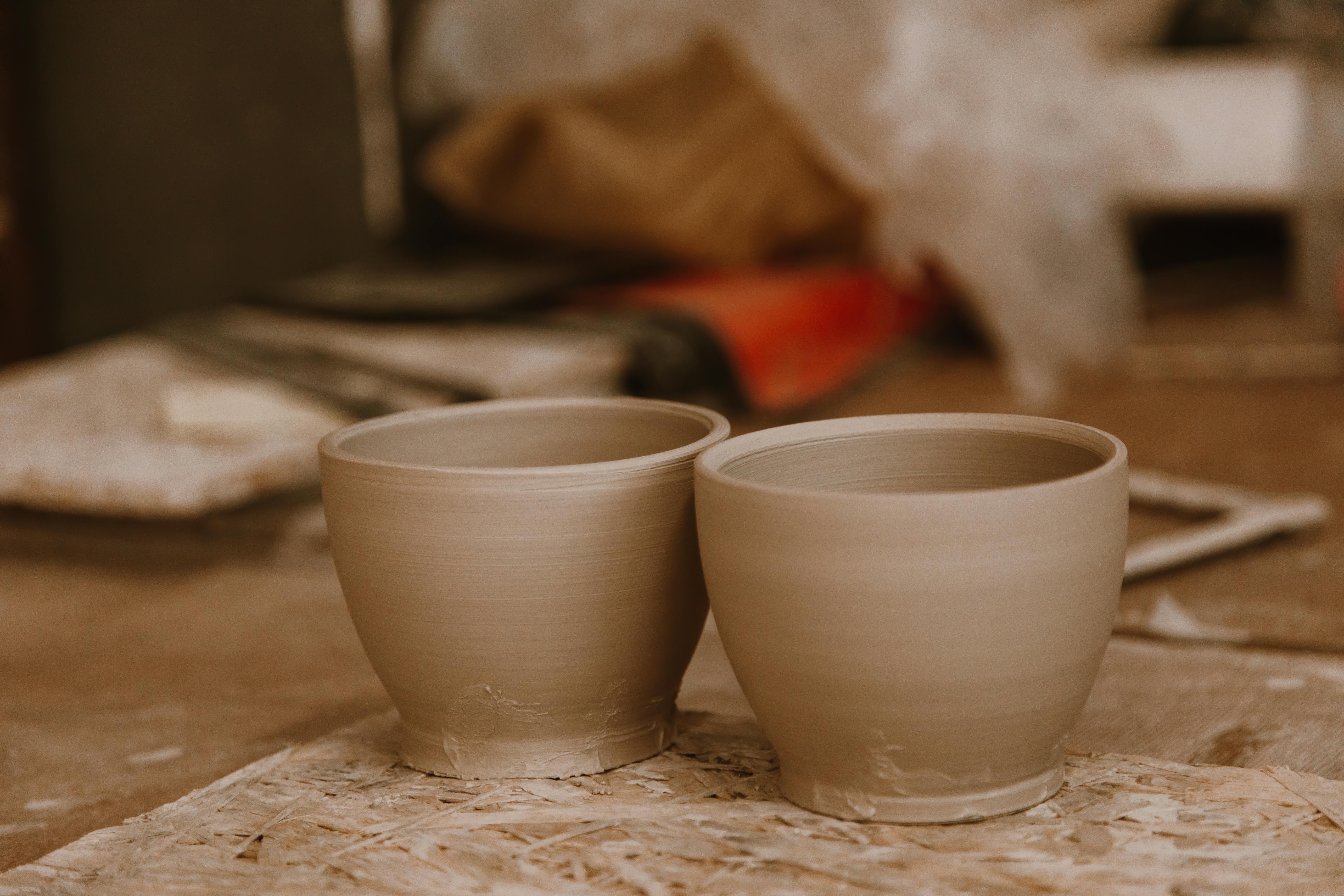
The picture shows the Pots Made of Clay.
7. Tutorial Videos
This week focuses on how individuals can make ceramic tableware (cups, bowls, plates) and ceramic vases at home using accessible, low-tech methods. The video series below gives you step-by-step demonstrations of key home-making skills such as forming, joining, smoothing/compression, drying control, and basic finishing.
Now watch a vdieo about a beginner's guide to starting pottery.
Transcript: Tutorial Videos
Hi, welcome to my first ceramics video tutorial.
When I first started doing ceramics, I was really confused about where to begin with tools, clay, kilns, firing, and everything else. I remember believing at the beginning that it would be an expensive endeavour to get into. I want to tell you that this is not necessarily true. There is an accessible way to start making and firing ceramic pieces, and I would like to guide you through that today.
Tools
There is a common misconception that you need everything to begin: a kiln, a wheel, a full studio setup. However, I started with just four basic tools. To demonstrate, I will make a small mug and show how each tool is used.
First, I wedge the clay, which is similar to kneading bread. Then I use the pinch-pot method to form the bowl of the mug. I use an X-Acto knife to trim any uneven rim and a sponge to smooth it.
Next, I roll a coil of clay for the handle. I trim and shape it with the knife. To attach the handle, I score both the mug and the ends of the handle using a wire tool, add a small amount of water, and press them together. I often add a small extra roll of clay where the handle joins the mug for added strength. Then I smooth the transition using a wooden tool.
Before setting the mug aside, I clean up my workspace. I place the mug on a wooden shelf to dry. If it seems too dry, I sometimes flip it over to prevent cracks forming in the base.
Types of Clay
Beginners are often confused about the difference between polymer clay and kiln-fired clay such as stoneware.
Polymer clay is plastic-based and usually sold in small packaged blocks in craft stores. It is generally not food safe and is better suited to decorative or small craft objects.
Stoneware and other kiln-fired clays are typically sold in larger bags, often 25-pound bags, at pottery supply stores. When fired properly and glazed correctly, these clays can be food safe and waterproof.
In this tutorial, I am focusing on kiln-fired ceramics.
Underglazes and Glazes
Underglazes are used when you want detailed designs or colours that stay separate and do not blend together.
Glazes melt during firing and become glass-like. If glazes touch during firing, they may mix together. It is important to keep the base of your piece free from glaze so it does not stick to the kiln shelf.
Firing Your Work
One of the most common questions is: how do I fire my pieces?
There are several options. I now own a kiln, but before that, I used kiln firing services. Many pottery studios or ceramic supply stores offer firing services. You can check their website or ask in person.
These services are typically priced by piece, by size, or by the space your work takes up in the kiln. In my experience, small pieces may cost around $2 to $4 for a six-inch piece, with larger pieces costing more.
Cost Options
There are three main ways to begin your pottery journey.
1. Home setup (lowest cost)
You can work from home with basic tools and clay. Starter tool kits are often available for around $13–$15. Clay may cost between $18 and $25 per bag. With firing services, you could start pottery as a hobby for approximately $50–$60 over several months.
2. Studio membership (mid-range cost)
Joining a pottery studio provides access to wheels, kilns, tools, and a community environment. In my area (Seattle), memberships range from about $195 to $330 per month.
3. Building your own studio (highest cost)
This option includes purchasing a kiln (around $2,000–$3,000), a pottery wheel (around $1,000), and potentially installing a 240-volt electrical outlet. Rent and electricity costs may also apply. While this is the most expensive option, it offers independence and flexibility.
Pottery can be a rewarding long-term hobby or practice. Many people find it deeply enjoyable and meaningful.
Thank you for watching this tutorial. I hope it was helpful. If you have any questions or topics you would like me to cover in future videos, please leave a comment. Have a great day.
7.1. How much I spent building a pottery studio
Transcript: How much I spent building a pottery studio
Here is how much I spent building a pottery studio in my house.
This is my pottery wheel. It cost approximately $300,000—just kidding. This wheel is a Shimpo Aspire Whisper, and it cost about $1,600 including tax.
The table behind it was thrifted for about $10. The mirror behind it was $40 from IKEA, and the IKEA chairs were $10 each from Facebook Marketplace.
My main work table is also from IKEA. It used to be my dining table in my previous apartment. When we moved into a new house and replaced the dining table, I repurposed it as a work surface. I added a sheet of HardieBacker board on top, which cost about $20. The table itself originally cost around $100.
My shelving unit is also from IKEA. It is modular and expandable. I started with one section and added more as I needed additional storage. Altogether, the shelving has cost approximately $350.
All of my ware boards cost about $50 in total. Most of my tools together are worth around $450, although you definitely do not need that many tools to get started.
The slip buckets cost around $30, and the plastic mat cost about $30.
I do not own my own kiln. Instead, I pay $0.02 per cubic inch to fire my work through a kiln firing service.
That brings the grand total to the amount shown.
7.2. Make Pottery At Home Without a Kiln (Or Anything Else)
Transcript: Make Pottery At Home Without a Kiln (Or Anything Else)
Today I want to talk about making pottery at home without any specialised equipment. It is actually quite easy to do.
Tools
You might think you need a wheel or specialised tools to make pottery. You do not. The most important pottery tools you have are your hands. You can make pottery using only your hands, although simple tools can be helpful.
Tools you likely already have at home:
- A paring knife for trimming rims
- A butter knife for scraping and smoothing
- A spoon for burnishing and smoothing
- A credit card for scraping clay thinner or smoother
These tools work well when clay is damp or leather hard.
Tools you can make yourself:
I use a gourd scraper that I shaped with a rasp. Similar tools can be made from coconuts or plastic containers. Any rounded, slightly flexible material can work as a rib.
Basic tools you can buy:
Inexpensive hand-building tool kits often include:
- A metal rib
- A wooden shaping tool
- A wire cutter
- A sponge
These are generally affordable and widely available.
Working Base
You need a base to support your work while shaping it.
If making a flat-bottomed pot, such as a mug or vase, use a small board. A simple square of plywood works well.
If making a round-bottomed pot, you need a “pookie,” which is a bowl-shaped mould. You can:
- Make your own
- Use a plastic or glass bowl lined with cloth
- Use a wooden bowl
Work Area
You can work at a kitchen table if you are careful. Use:
- A work board (plywood)
- An old towel underneath to protect the table
The towel prevents scratching and helps contain mess. After working, you can take the board outside and rinse it clean.
Firing Without a Kiln
A common question is: Can I fire pottery in my oven?
No. Household ovens do not reach high enough temperatures to turn clay into ceramic.
However, pottery can be fired outdoors using:
- Bricks
- Charcoal briquettes
- A small contained fire setup
This method produces minimal smoke and can reach sufficient temperatures for basic firing.
Making the Bowl
I start with locally sourced clay. You can also use commercial clay.
- Flatten a piece of clay into a pancake shape.
- Press it into the pookie to form the base.
- Roll a coil about the thickness of your thumb.
- Attach the coil using a bonding pinch.
- Smooth the seam carefully to prevent cracking.
- Continue pinching until the walls are evenly thin.
- Use a rib to smooth the inside.
- Trim the rim evenly with a knife.
- Smooth the rim with wet fingers.
Stone Smoothing
After partial drying:
- Use a wet smooth stone (or spoon) to smooth the surface.
- Later, use a dry stone to polish slightly damp clay.
- This compresses the surface and refines texture.
Outdoor Firing Process
Once fully dry, the pot must be preheated to remove moisture. Moisture left inside clay can cause it to crack or explode during firing.
For firing outdoors:
- Lay down sand to protect pavement.
- Stack loose bricks to create a firing space.
- Add charcoal fuel.
- Place the pot upside down on bricks.
- Use a metal container to prevent fuel from touching the pot directly.
Keeping fuel from direct contact reduces black carbon staining and produces warmer red-orange tones.
Temper and Thermal Shock
If using wild clay, add 20–30% temper (sand or non-plastic material). This helps protect against thermal shock during rapid temperature changes.
Commercial clay may require added sand if firing outdoors.
Result
After firing, the bowl turns a natural red colour from the clay body. This demonstrates that pottery can be made and fired at home without specialised equipment.
Thank you for watching.
7.3. How To Make Clay At Home (It's Just Dirt)
Transcript: How To Make Clay At Home (It's Just Dirt)
Most people buy their clay at the store, but it is essentially dirt. In fact, many of us probably walk past usable clay on our way to buy clay.
In this video, I discuss three ways to make your own clay at home using dirt. I also explain when each method is best used.
What is clay?
If you look up a technical definition of clay, it is a sediment with particles smaller than silt. That definition helps us understand that not all dirt will work the same way for making clay. Some dirt contains a lot of clay, while other dirt contains almost no clay. This is why some “make clay from dirt” videos show people struggling to get usable clay.
For example, in some popular videos, someone may start with a bucket of dirt and end up with only a handful of clay. That usually means the dirt they collected did not contain much clay.
How to recognise clay-rich dirt
Dirt that contains a lot of clay often has recognisable properties.
When wet, clay-rich dirt may feel sticky or plastic, meaning it holds together and can be shaped. When dry, you may see clues such as:
-
Tire tracks that stay visible for a long time, because clay helps hold the shape.
-
A crackled surface texture, showing that the clay expands when wet and contracts when dry.
A crackled texture often suggests a higher percentage of clay.
Today I will collect dirt from three different locations around town. Then I will take the samples back to my studio and test them to see how much clay they contain. This will help us decide which processing method each sample needs.
Testing three dirt samples
I have three samples of dirt from different places around town. Now I need to determine how much clay and how many impurities each sample contains.
First, I grind each sample into a loose powder using my hands. Then I add water.
Once the dirt is wet, I can feel how clay-like it is: how well it sticks to itself, how plastic it feels, and how gritty it is. This helps me decide how much processing is required.
Sample 1
Sample 1 is high in clay. It sticks to itself well and feels plastic. Because I collected it from an area with traffic, it contains some plant bits and gravel. I will screen it to remove larger debris, but I do not think it needs heavy purification.
Sample 2
Sample 2 feels like a fairly pure clay. It has a good texture and does not contain noticeable plant material or rocks. This sample does not need much purification, so I will dry-process it.
Sample 3
Sample 3 is gritty and contains gravel and sand, and likely silt as well. It does not hold together well. This sample needs significant purification, so I will use levigation to separate the clay from the sand and silt.
Method 1: Screening (Sample 1)
For sample 1, I begin by screening.
I put the dirt into a bucket, add water, and mix it until it is thin and smooth with no lumps. Then I pour the mixture through a screen.
You can use a purpose-made strainer screen, but you do not need special equipment. A piece of window screen or a section of screen mesh from a hardware store can work.
After screening, I now have liquid clay. Next, I need to remove excess water.
I let it sit for about an hour so the clay settles to the bottom. Then I pour off the clear water from the top.
The clay is still too wet to use, so I pour it into an old pillowcase. I set the pillowcase outside so the water can drain and evaporate until the clay reaches a workable consistency.
Method 2: Dry processing (Sample 2)
For sample 2, I use dry processing. This is the fastest method when your dirt is already close to pure clay.
I crush the dry clay into powder using a rock on a hard surface. Clay usually breaks down easily and does not need to become perfectly fine like flour.
If your clay is too wet to grind, you can leave it in a covered area for a couple of weeks so it dries out.
Method 3: Levigation (Sample 3)
For sample 3, I use levigation. Levigation uses gravity to separate particles by size.
I add water, mix the dirt thoroughly, and break up any lumps. Then I let it sit briefly—about one or two minutes.
The larger particles, such as sand and silt, settle quickly to the bottom. The clay stays suspended longer. I pour off the clay-rich liquid into a second bucket.
I repeat this process several times: add water, mix, let settle briefly, and pour off the liquid clay. I continue until the first bucket contains mostly grit.
Now the second bucket contains mostly liquid clay. I let it sit longer so the clay settles to the bottom. This may take an hour, or you can leave it overnight. Then I pour off the clear water at the top.
The remaining clay is still too wet to use. To dry it, I pour it into a cotton cloth trough supported by bricks. Moisture drains through the cloth and evaporates from the top. By the end of the day, it should become workable.
Adding temper (important final step)
Even after making clay, there is another important step before using it for pottery.
All clay shrinks as it dries. If it dries unevenly, it can crack. To help reduce cracking and improve thermal shock resistance, temper is added.
Temper is any non-plastic material mixed into clay. The clay itself is plastic and mouldable. Temper provides structure and reduces shrinkage stress.
In commercial clay, temper is often grog, which is fired clay that has been crushed into a granular material. In wild clay, temper can be grog, sand, volcanic ash, or diatomaceous earth.
A useful general guideline is to add about 20% non-plastic material.
I collected sand and will add about 20% to these clay bodies.
I have not mixed the dry-processed clay yet because it is easier to add temper while the clay is dry. When clay is wet, measuring and mixing temper evenly is more difficult and requires extended kneading.
Now that you know how to make clay from dirt, you may want to learn how to find clay in nature near your home. I have another video on that topic.
Thanks for watching. I will see you next time.
7.4. Pit Fire Pottery In Your Backyard | NO Kiln!
Transcript: Pit Fire Pottery In Your Backyard | NO Kiln!
Here is how you turn this into this.
But if you rush the process, everything can crack or explode. I learned that the hard way.
In this tutorial, I will share primitive firing techniques that I have developed through trial, error, and research. These methods will help you fire pottery successfully in your backyard without excessive breakage.
Understanding Clay and Heat
It helps to understand what happens to clay when you heat it.
Clay is plastic and pliable when wet. After firing, it becomes hard and durable.
Chemically, clay contains alumina, silica, and chemically bound water. However, natural or commercial clay is not pure. It is a clay body that includes sand, organic material, and other impurities.
During firing:
-
Organic material burns away.
-
Water is driven off.
-
The clay shrinks.
At higher temperatures, alumina and silica begin to fuse together. This process is called sintering. At sintering temperatures—commonly achieved in pit firing—the clay becomes durable and will no longer dissolve in water, though it remains porous.
At even higher temperatures (around 1300°C or above), the clay becomes vitrified, meaning it melts into a glass-like structure. Pit firing does not typically reach vitrification temperatures.
Rapid shrinkage from fast heating causes cracking or explosions. Slow, controlled heating is essential.
Step 1: Making the Pots
Hand-building is the oldest method and requires only clay and a basic surface.
A scrap of canvas works well as a work surface. A rotating cake stand can help, but a board or countertop is sufficient.
Important considerations:
-
Do not over-invest emotionally in your first pots. Breakage is common while learning firing techniques.
-
Maintain even wall thickness. Thin and thick areas shrink at different rates and may crack.
-
Use coarse clay (grog clay).
Grog is pre-fired clay that has been crushed and added back into clay. It reduces shrinkage and cracking. Clay marketed for raku or atmospheric firing typically contains grog.
If using smooth clay, you can crush previously fired pottery and wedge it into your clay as grog.
Step 2: Drying and Oven Preheating
Let pots air-dry for several days until bone dry.
Then preheat them in a household oven:
-
Start at 200°C.
-
Gradually increase to 500°C over 1–2 hours.
-
Hold at 500°C for at least one hour.
This step removes remaining moisture. Even bone-dry pieces can still lose 5–10% weight in the oven.
The oven will not sinter the clay, but it prepares it for pit firing.
Step 3: Preparing the Pit
Dig a pit deep enough to hold the pots below ground level. The shape does not matter.
Start a small fire in the pit to dry out the earth. Moisture is the main cause of explosions during pit firing.
Use dry fuel. Wet or green wood pops and can break pottery.
Allow the pit to heat and dry for some time before adding pots.
Step 4: Gradual Heating
Place oven-dried pots near the fire to warm gradually.
Think of it like sitting by a fire: you get warmer slowly before getting very hot. Do the same with your pots.
-
Keep a small fire.
-
Rotate the pots for even heating.
-
Avoid direct flame at first.
-
Be patient.
This gradual heating may take about an hour.
You may cover the pots with scrap metal to create a small heat chamber.
Step 5: Coal Stage
Let the fire burn down to hot coals.
Rake out a clear space in the centre. Place pots in this space so they are surrounded by heat but not directly buried in coals.
Continue heating gradually for 30–40 minutes. Add small pieces of wood as needed.
Leather welding gloves can help you reposition pots safely.
Step 6: The Main Fire
Build a larger fire over the pots.
Add wood gently to avoid knocking or cracking them.
You may maintain the fire for about an hour.
If visible, glowing red pottery indicates approximately 900°C, which is typical for low firing.
Understanding Colour in Pit Firing
Clay colour changes due to smoke and vapours entering the porous surface while hot.
When clay cools, the pores close and trap those colours.
Black (Carbon Trapping)
To achieve jet black:
-
Smother hot pots in sawdust, dry grass, or pine needles.
-
Completely cover them.
Carbon becomes trapped in the clay body.
Other Colours
Minerals in the fire release vapours that create colours. For example:
-
Copper can produce green tones.
Be cautious: some materials (such as salt) can release toxic fumes.
Step 7: Reduction Atmosphere (Optional)
Covering the fire while still hot reduces oxygen. This creates heavy smoke and encourages colour development.
You can experiment:
-
Let pots cool naturally.
-
Remove a hot pot and smother it for black effects.
-
Combine techniques.
Avoid rapid cooling, especially with smooth clay bodies, as thermal shock can cause cracking.
Final Results
Pit-fired pots will:
-
Be sintered (if hot enough).
-
Resist dissolving in water.
-
Remain porous.
They are not vitrified and are not suitable for food or liquids. However, they are suitable for decorative use or holding dry materials.
Some pieces may break. Others may survive beautifully.
7.5. Almost Anywhere Kiln: Simple, Cheap, Effective.
Transcript: Almost Anywhere Kiln: Simple, Cheap, Effective.
Hi, Wes here. Thanks for joining me.
For many people interested in primitive pottery, getting pots fired is one of the biggest obstacles. Today I am going to fire this small mug in a way that is simple, accessible, inexpensive, and uses very little space. I will show you how to set it up safely and how the firing works.
Why this method?
Building a large wood fire in your yard takes space and is not always practical. This method uses a compact charcoal setup instead.
Equipment
The main piece of equipment is a large metal kettle like this. Mine is an enamel-steel canning kettle with many holes drilled into it.
We will fill it with charcoal as the fuel. Wood is not ideal for this setup, because charcoal burns more evenly and predictably in a small container.
Airflow is important, which is why the kettle needs holes for ventilation.
Important note: Do not use aluminium. Aluminium has a low melting point and could warp or fail. Stainless steel can also work if you can drill holes in it.
This setup works best for small pieces such as mugs, small bowls, and small pots.
Setup
Outside, I place the kettle on bricks. The bricks serve two purposes:
-
They raise the kettle and protect the surface underneath.
-
They allow air to circulate under the kettle, which helps the charcoal burn properly.
You can set this up on cement or dirt. Asphalt may be possible, but it can soften or be damaged by heat, so use caution.
I placed a piece of plywood underneath as a test to see how hot it gets. That was a mistake, and I do not recommend putting this setup on wood.
Do not place this setup on a wooden deck.
Inside the kettle
Inside the kettle, I place a few bricks. The mug sits on those bricks.
It is important to raise your pottery off the bottom of the kettle, because airflow underneath improves firing and reduces uneven heating.
Fuel and protecting the surface
I use charcoal briquettes and lump charcoal. Either can work, and you can also use a mix.
One option is simply to fill the kettle with charcoal. In this case, I also have a painted piece and I want to protect the surface. To do that, I use a perforated tin can as a protective chamber. The holes allow ventilation while reducing direct charcoal contact.
I also place a pottery sherd above the piece. This helps keep charcoal from touching the mug directly.
Starting the fire
I start the charcoal and let it act as a preheater and primary fire.
I already dried the mug in the oven, so I know it is very dry. Charcoal also tends to start gradually, which helps reduce thermal shock.
Once the charcoal is burning well, I add more fuel. You want at least 2–3 inches of charcoal space around the pot to provide even heat.
As the charcoal heats up, the initial smoke reduces.
Firing temperature and timing
At peak firing, the temperature reached around 868°C, and briefly over 900°C. I could see the pot inside glowing red.
After about 40 minutes, the pot was fully fired. At that point, it was mainly a matter of waiting for it to cool safely.
Safety lesson: heat underneath
The area beneath the kettle got much hotter than I expected. The plywood underneath actually caught fire.
This shows how much heat can build underneath the setup. Do not place it on wood or on any surface that could burn.
If you are using asphalt, consider adding extra layers of bricks or a larger heat barrier. Use your best judgement and prioritise safety.
Cooling and removal
After about two hours, the pot was still hot. After about four hours, it had cooled to around 100°C.
At that point, I removed the pottery sherd and lifted out the mug.
The protective “make-do” chamber inside (the tin can and temporary shielding) worked, although it became brittle and was essentially a one-time use solution.
Result
The mug came out close to how I wanted it. It also rings, which suggests a successful firing. Since temperatures reached well over 800°C and briefly over 900°C, I am pleased with the outcome.
Closing
Thanks so much for joining me today. I really appreciate it.
Until next time, I wish you health, happiness, peace, and love. Take care.
7.6. How I make ceramics at my home studio (hand-built ceramics) | The entire pottery process
7.7. Unveiling how ceramic mugs are made – they come in so many beautiful colors! Let's visit our factory!
7.8. Handmade ceramic bowls step by step | no wheel pottery
7.9. How long does it take to make a mug?
Transcript: How long does it take to make a mug?
This video includes sponsored content from Barkley.
How long does it take to make a mug?
“How long does it take to make a mug?” is a question potters get asked all the time. My short answer is: a long time. The reason is that most potters work in batches, which is the most efficient way to make a set of similar mugs.
A full batch typically takes multiple weeks if you include drying and firing time. However, what many people really want to know is the number of active working minutes or hours it takes to make one mug. I want to know that too, so today I am going to test it.
I will make a batch of ten mugs (for easy maths) and time each step.
Throwing the mugs
The first step is preparing the clay, then throwing the mugs on the wheel.
After preparing the clay, I begin throwing. I complete ten mugs, although I mess one up and have to wedge and throw one again. That extra work also counts toward the total time.
After throwing, the batch takes about an hour of active work. At this point, I cannot do the next steps immediately because the mugs need to dry.
I leave them to dry overnight, flip them, and let the bottoms dry. Then I return the next day.
Trimming
The next day, the mugs are ready to trim. They are still slightly wet, but workable.
After trimming, they look good overall. One or two have slightly thin bottoms. It is sometimes difficult to judge thickness when the clay is still quite wet, so I will only know for sure after firing.
Handles
Next, I make and attach handles. This is the part I like least because it is slow and repetitive.
I am using reclaimed clay for the handles. Reclaimed clay can create a nice effect, but it may not match the mug bodies perfectly if it comes from a different batch. I hope the colour difference is minimal, and that the glaze will reduce how noticeable it is.
Because I am using reclaimed clay, some mugs show slight marbling where the clay was not fully wedged. That can also look interesting.
After attaching all handles, the timer shows a little over two hours of active work for the making stage so far.
I tidy them slightly, then wrap the mugs in plastic overnight. This helps equalise moisture between the handles and the mug bodies. The handles are still wetter than the mugs, and I want them to reach a similar leather-hard stage before final smoothing.
Smoothing and signing
The next day, I smooth fingerprints, tidy the surfaces, and sign the mugs. At this point, the timer shows approximately 2 hours and 24 minutes of active making time for the batch.
I then let the mugs dry completely for about a week before firing.
Loading the kiln for bisque firing
About a week later, the mugs are dry and ready to load into the kiln for a bisque firing.
Loading the kiln takes only a few minutes. The bisque firing itself takes about 24 hours, but that time is not active working time.
After the bisque firing, I unload the kiln. Unloading takes very little time, so I estimate about one minute.
Checking the bisque
After unloading, I inspect each bisque-fired mug. I check for small defects such as dried slip stuck to the surface or rough areas around the signature. This inspection and minor cleanup takes a few minutes.
Glazing and reloading
Next, I glaze the mugs. In this batch, I choose to glaze them all in the same colour (a sky blue). Glazing one consistent colour is faster than testing multiple glaze combinations.
After glazing, I wipe the bottoms clean to remove glaze. I do not wax the bottoms because I still need to wipe them, and I prefer to save time.
Glazing and reloading the kiln takes about 15 minutes.
The glaze firing takes about 24 hours (again, not active working time). I also load other pieces into the kiln where possible, because firing fuller loads is more energy efficient.
Final results and usable count
After firing and cooling, I open the kiln and check the final results.
Most pieces survive. However, one mug has a bottom that is too thin, so I do not feel comfortable selling it for functional use. Another mug has kiln wash or a rough white deposit stuck to its base. Because the rough area could trap residue and be difficult to clean thoroughly, I would not consider that mug food safe. It may still be useful for non-food purposes (for example, holding pencils), but I remove it from the count of functional mugs.
That leaves eight mugs suitable for sale as functional ware.
Total active time and time per mug
Here is the total active time I recorded:
-
Making (throwing, trimming, handles, smoothing, signing): about 2 hours and 24 minutes
-
Bisque unload: about 1 minute
-
Bisque inspection/cleanup: about 3 minutes
-
Glazing and reloading: 15 minutes
Total active time is about 2 hours and 44 minutes.
Because only eight mugs are usable as functional ware, I divide the total time by eight. That works out to about 20.5 minutes of active work per mug.
Important context
This number can be misleading without context.
It does not include the many hours it takes to learn the skills needed for throwing, trimming, handle making, and glazing. It also does not include the design development time spent testing shapes and glaze combinations.
For professional potters, additional time is also required for photography, listing, administration, packing, shipping, bookkeeping, and customer communication.
Finally, this time estimate reflects one potter’s workflow and one simple mug design. Different potters and different designs will require different amounts of time.
Thanks for watching.
7.10. How to prevent 8 common cracks
Transcript: How to prevent 8 common cracks
This video includes sponsored content from Squarespace.
Introduction
Do you struggle with cracks in your pottery? Few things are more frustrating than opening a kiln to discover that a large portion of your work has cracked.
In this lesson, we will look at eight of the most common types of cracks in pottery and how to prevent them.
The root cause of all cracks is stress. Stress may come from how the clay is handled, how it dries, how it is fired, or from incompatibility between clay and glaze. When the stress exceeds the strength of the pot, cracks occur.
Part 1: General Causes of Cracking
Before discussing specific crack types, it is important to understand the general causes of stress in ceramics.
1. Over-firing
Firing clay too high or for too long can weaken the structure. Always follow appropriate firing schedules for your clay body.
2. Repeated firings
Multiple firings increase vitrification and can make clay bodies more brittle over time. Most functional ware requires only two firings (bisque and glaze), unless adding specialty surfaces such as lustres.
3. Drying too fast or unevenly
Drying is one of the most common causes of cracking.
-
Drying too fast (e.g., strong sun, excessive heat)
-
Uneven drying (thick bases and thin walls drying at different rates)
Important preventative step:
Flip pots over as soon as they are firm enough to support themselves. This allows air to reach the base and helps prevent S-cracks.
If a pot remains upright too long, the base may dry more slowly than the walls, creating stress.
4. Opening the kiln too early
Cooling too quickly causes thermal shock. It is generally recommended not to open a kiln until it has cooled to around 100°C.
5. Uneven wall thickness
Large differences between base thickness and wall thickness create internal stress during drying and cooling.
6. Poor glaze fit
Clay and glaze shrink at different rates. A good glaze fit means both materials shrink at compatible rates. Poor fit causes tension, leading to cracks such as crazing or shivering.
Part 2: Specific Types of Cracks
Now we will look at eight common crack types and their causes.
1. Vertical Cracks
Most common in handbuilt work.
Cause:
-
Weak points created during forming
-
Uneven slab thickness
-
Overworking or bending clay excessively
Prevention:
-
Use thickness guides
-
Avoid over-manipulating clay
-
Maintain structural integrity during forming
Cracks may appear late in the process but originate from early handling.
2. Shattered Bottom
A crack across or through the base.
Causes:
-
Base too thick or too thin
-
Excess water trapped in the bottom (e.g., leftover throwing slip)
-
Uneven drying
-
Excess glaze pooling on the interior base
Prevention:
-
Remove excess slip after throwing
-
Maintain even thickness
-
Avoid heavy glaze pooling inside the base
3. S-Cracks
Common in wheel-thrown work.
Usually caused by uneven drying at the base.
Prevention checklist:
-
Remove excess slip from the base immediately after throwing
-
Flip pots over once firm enough
-
Allow even airflow during drying
There is debate about compressing the base. Some potters advocate compression; others find flipping sufficient. Results may vary by clay body and technique.
4. Edge Cracks
Cracks near the bottom edge.
Cause:
-
Thermal shock during cooling
-
Thick bases retaining heat longer than thin rims
As the rim cools and shrinks faster than the base, stress forms at the lower wall.
Prevention:
-
Maintain even thickness
-
Allow proper kiln cooling
5. Glaze-Induced Shatter Cracks
Often seen when only the interior is glazed.
Cause:
-
Poor glaze fit
-
Tension between glaze and clay
-
Thin walls under stress from glaze contraction
Prevention:
-
Test glaze fit
-
Adjust glaze or clay body if necessary
6. Shivering
Glaze flakes or pops off the surface.
Cause:
-
Poor glaze adhesion
-
Dust, oil, or contamination on bisque
-
Handling bisque with oily or sweaty hands
-
Dust settling before glazing
Prevention:
-
Keep bisque clean
-
Avoid touching surfaces excessively
-
Clean before glazing
7. Crazing (or Crackle)
Fine cracks in the glaze surface.
If intentional, it is called crackle.
If unwanted, it is called crazing.
Cause:
-
Poor glaze fit
-
Glaze shrinking more than clay
Crazing may appear weeks after firing as internal tension releases.
Prevention:
-
Adjust glaze chemistry
-
Choose compatible clay-glaze combinations
8. Springing (Handle Separation)
Handle cracks or detaches from the mug body.
Cause:
-
Attaching to clay that is too dry
-
Inadequate scoring and slipping
-
Uneven drying between handle and body
Prevention:
-
Attach handles at similar moisture levels
-
Score and slip thoroughly
-
Cover with plastic for 24 hours after attachment to allow moisture equalization
Allowing attachments to homogenize under plastic significantly reduces failure.
Conclusion
Cracks are part of ceramics practice. Every potter experiences them.
Understanding the sources of stress—during forming, drying, firing, and glazing—allows you to diagnose problems and improve success rates.
By controlling drying speed, maintaining even thickness, ensuring good glaze fit, and allowing proper cooling, most cracking issues can be prevented.
7.11. Explore Jingdezhen in 8 minutes: How did a "remote" city that focuses solely on porcelain making become so popular?
This video takes us on a tour of Jingdezhen, a city in Jiangxi Province, China, known as the "Porcelain Capital"!
Included attractions:
1. **[Ancient City Charm]**: Changjiang River, Gaoling Village, Yaoli Ancient Town, Taoyangli Imperial Kiln Scenic Area, Imperial Kiln Factory, Imperial Kiln Museum, Longzhu Pavilion!
2. **[Contemporary Splendor]**: Taoxichuan Ceramic Cultural and Creative Street, Sanbao International Porcelain Valley, Ancient Kiln Folk Customs Expo Area, China Ceramic Museum, Jingdezhen Ceramic University!
7.12. Nine Steps in the Jingdezhen Ceramic Production Process
7.13. Cultural China Tour: Jingdezhen Taoyangli – A Glimpse into a Thousand Years, A New Charm of the Porcelain Capital
Jingdezhen is China's "Millennium Porcelain Capital," and it can be said that "one Jingdezhen is half the history of ceramics." Taoyangli Historical and Cultural District preserves the richest historical and cultural information of Jingdezhen, serving as a witness to Jingdezhen's ceramic culture and earning the reputation of being a "living fossil." Follow the reporter into Taoyangli to explore the "secret" behind the ever-burning kilns of Jingdezhen through the changes of this old street in the porcelain capital.
8. Selling your handmade ceramics online (starter guide)
Why this is included
Many makers want to share their work with a wider audience. This page focuses on practical, transferable skills: presenting your work clearly, choosing a platform, and building an ethical, sustainable workflow. You do not need to “sell” anything during this course.
Step 1: Choose a platform pathway (simple overview)
Different platforms suit different stages:
Marketplace (beginner-friendly): good if you want built-in discovery and a simple setup process.
Own site (more control): good once you have repeat buyers or consistent output.
Local markets (fast feedback): useful for testing designs and learning what people actually pick up and hold.
Step 2: “Etsy first” (beginner pathway)
Etsy is often recommended for beginners because it has a built-in audience for handmade items. It can help you test which forms (mugs, bowls, vases) and which surfaces people respond to—without building a website first.
Why makers often start with Etsy
-
Built-in shoppers: people actively search for handmade ceramics.
-
Low setup barrier: you can publish listings quickly if you already have good photos and clear descriptions.
-
Learn fast: reviews and buyer questions show what information is missing (size, weight, food safety, care).
Typical fees (always verify on the platform):
-
A small listing fee per item
-
A transaction fee on sales
(Fees change, so check the official platform pages before setting prices.)
Resource (video):
Transcript: Selling your handmade ceramics online (starter guide)
Welcome to part two of this series on where to sell your handmade ceramics. In last week's video, we walked through all the offline selling options available to ceramic artists like markets, confinement, studio sales, and custom orders. If you haven't watched that one yet, I recommend checking it out for a complete picture.
Today, we are shifting gears and diving into the online world. We'll explore the different platforms and online selling channels you can use to share your work, from personal websites to online marketplaces to social media. As always, I'll break down the pros and cons of each of these options, share some insider tips, and help you think through what might work best for you and your creative business.
We'll also talk about how to combine multiple channels in a way that feels sustainable so you can grow your business without burning out. Let's get started. Option one, online shops. Whether you're dreaming of reaching global collectors or just want to stop replying DM me in your Instagram comments, an online presence can do wonders for your business.
What are your options? There are a few main ways you can sell online. One is Etsy. One of the most popular online options for ceramic artists and makers. Etsy is the OG of handmade marketplaces. It is where many of us take our first steps into the world of online selling and for good reason.
If you don't know what's Etsy, it's a global marketplace that specializes in handmade, vintage, and crafty items. It's a readymade platform where buyers are already looking specifically for handmade and unique things which makes the dream starting point for ceramic artists. Now, what are the pros of selling on Etsy? First is built-in audience.
You don't have to lure people off the street into your digital space. Etsy already has millions of buyers searching for mugs, planters, bowls, and really specific things like, you know, cat shaped incense holders. Second is easy to set up. You don't need to know coding, SEO, or how to embed checkout cart into a website.
Etsy handles all the techy stuff. You just need good photos, description, and a price. Third is the trust factor. Buyers trust Etsy. They know the platform. They've used it before, and they know how it works. So, if you are new, that trust extends to you, and that's a huge win. Fourth is searchability. Etsy has its own built-in search engine.
If you use the right keywords and tags, you can show up in front of the exact people who are looking for what you make. No complicated algorithms to crack, at least not as many as social media. Fifth is low upfront cost. It's free to open a shop and the listings are only I think 20 cents each.
No monthly fees unless you upgrade to Etsy Plus. So, it's a lowrisk entry point into selling online. What are the cons of selling on Etsy? First of all, you are one mug in a sea of mugs. Competition is fierce. You may be one of the 2,000 sellers offering handmade speckled mugs. And while your work is unique, it can be a bit hard to stand out without strong branding, great photos, and some smart marketing on your part.
Secondly, you don't own the platform. And this is big. Etsy owns the space, not you. That means they control the rules, the fees, the search algorithm, even your customers. One policy change or fee hike and suddenly your margins shrink or your shop traffic tanks. Third is design limitations. Your shop layout and branding are pretty cookie cutter.
It's not easy to make your shop Etsy shop look like your brand beyond your logo and banner. If you want full creative control, Etsy won't give you that. Fourth is Etsy controls visibility. Even though they have search tools, your visibility still depends on Etsy's algorithm, which can be a bit moody and mysterious.
Some days you're on top of the search results, other days you're on page 25. Another thing is if you're based in the US, UK, Canada, or other Etsy supported regions, shipping is pretty straightforward. Etsy offers built-in shipping tools that make the whole process much easier. But if you're not like me, things can get a bit trickier.
Without those integrated options, you're often left manually checking shipping rates, coordinating with buyers, and going back and forth just to confirm costs. It's definitely doable, but it adds an extra layer of effort and costs to the process. Now, is Etsy right for you? It is a great option if you're just getting started and want to test the waters without building a whole website.
When you're at the beginning of your selling journey, setting up a full-blown website can feel overwhelming, especially if you're still figuring out your product line, photography, pricing, or packaging. Etsy provides a low barrier entry point. You can create a shop quickly, upload a few listings, and start getting your work in front of potential buyers within a day.
(04:35) It's ideal for early experimentation and learning what sells. Secondly, you'd like access to a large audience that's already looking for handmade work. One of Etsy's biggest advantage is its built-in audience. Millions of people visit the platform each month specifically to shop for handmade, unique, and creative products.
You don't need to worry about generating traffic to your own site from day one. On Etsy, shoppers are already there actively searching. If your listings are optimized with the right titles, tags, descriptions, your work can get discovered organically, though it's not as easy at this point given the amount of competition it has.
Third is you're okay paying some fees in exchange for simplicity and traffic. Etsy charges listing fees, transaction fees, payment processing fees. Over time, these can add up, but in return, you're paying for access to a marketplace with high buyer intent, built-in trust, and marketing tools like, you know, Etsy ads.
For many new sellers, this trade-off is worthwhile in the early stages. You don't have to worry about web hosting, security or design. Etsy handles the tech so you can focus on making and selling. Fourth is you want a straightforward, beginner-friendly selling platform while you develop your brand.
If you're still figuring out your visual identity, messaging, or long-term business strategy, Etsy gives you a place to start selling right away without needing a fully fleshed out brand. As you can experience in customer feedback, you can refine your product offerings, improve your presentation, all while making real sales. Later, if you decide to transition to your own website, you'll already have momentum and insight to build from.
A quick tip here. Many successful makers start on Etsy and eventually add their own website later. It doesn't have to be either or. Etsy can be a launchpad, not your forever home. Second option is your own website. This is your own virtual storefront. The online equivalent of opening a beautifully branded shop. It says, "Yep, I'm a real business.
I've got a logo, cohesive brand colors, and I actually know what I'm doing most days." You build and manage your own online store. There are no middlemen, no third party platforms, just you, your ceramics, and a clean, well-lit digital space that represents your brand exactly how you want.
There are platforms like Shopify, Squarespace, Wix, and a whole lot of other options where you can set up your own website. Now, what are the pros of selling through your own website? First of all, it's total creative control. You want a banner with animated flowers, a font that feels like a handwritten love note, a homepage that tells your brand story with moody photos, go for it.
You get to design every element to reflect you. It's your digital studio gallery and a checkout counter all rolled into one. Secondly, you own the platform and the customer. This one is big. Unlike Etsy or social media, your website belongs to you. No algorithm changes, no surprise fees, no being buried under 27 pages of speckled mugs.
You are in control of how people experience your shop. Third is it builds brand credibility. Having your own website instantly levels up how people perceive your brand. It's not just about aesthetics or functionality. It's about trust. When someone lands on your site, it tell them that yeah, this person has that life together.
They're not just winging it on Instagram. It shows that you've invested in your business, that you've taken the time to create a thoughtful space where customers can browse, learn about your process, and shop with confidence. A website gives your business legitimacy. Even if you're still figuring out things behind the scenes, and let's be honest, most of us are.
To your audience, it signals professionalism, stability, and intention. Fourth is better profit margins. No Etsy fees eating into your sales. You pay for the website, which is a monthly subscription, maybe a few apps, but once set up, every sale puts more in your pocket, especially if you sell higher value work. Fifth is the integrated tools.
Most platforms let you connect email marketing, SEO, blogs, analytics, inventory, and even digital courses and products. So, it's all in one place. Now, there are of course some cons of selling through your own website. First of all is you have to drive your own traffic. And this is the biggest difference from Etsy. No one's casually browsing your site unless you send them there.
That means you have to keep posting on socials. you have to send newsletters or improving your visibility through SEO, running ads if you have the budget for it. Second is a learning curve and tech setup. There will be googling lots of it. How to set up shipping zones? How to reduce image size? Uh why does your checkout button turn purple after you've changed a font? Even with userfriendly platforms like Shopify, it takes time to get a hang of it. Having said that, it is doable.
I set up my own website without any external help. It takes a bit of time, bit of learning, but it's so worth it. Third is the upfront cost. While not bank breaking, building your own website does come with a few costs. First is the hosting fee which can be from $10 to $40 a month depending on the platform and features.
There is a custom domain which you have to get which is again $10 or $20 per year. Another cost is the optional extras like some apps or templates or premium phones if you work. These are more optional. The fourth thing is that the customer trust takes time. Unlike Etsy, your site doesn't come preloaded with buyer trust. You need to add social proof, some kind of testimonials, reviews, photos, write out clear policies.
Though there are templates available for all of these, so they're not too much work, but you also have to offer a smoother, you know, user experience. Once you do though, customers will remember you for you, not just the platform. They'll remember they bought from you and not from Etsy. Now, is your own website right for you? Now, this route is ideal if one, you want full control of your brand and customer experience? Having your own website means you decide exactly how your work is presented.
From the tone of your product descriptions to the layout of your shop, you can create a seamless and thoughtful experience that reflects your brand values, aesthetics, and personality. From branding and packaging to checkout and follow-up emails, everything can be aligned with the experience you want your customer to have.
Secondly, you're ready to scale and grow intentionally. If you're thinking beyond one-time sales, like building a collector base, launching collections, running email campaigns, or offering digital products, your own site gives you the flexibility to do that. It allows for long-term planning, automated systems, marketing tools that can grow with your business.
Third is if you're in this for the long game. If pottery isn't just a hobby but something you're building into a sustainable long-term business, investing in your own website is a smart step. It gives you a stable home base that doesn't depend on the algorithms or rules of third party platforms. It's where your audience can always find you regardless of social media changes or marketplace trends.
Fourth is you don't mind doing or learning the techy stuff or can outsource it. Running your own website does come with a learning curve. Things like setting up payment gateways, managing shipping zones, understanding analytics, or troubleshooting design issues in some cases. If you're comfortable figuring these out or hiring someone to do it, the long-term payoff is worth it.
You don't need to know everything up front, but have the willingness to learn or outsource when needed makes a process a lot more easier. Now, quick tip here. You don't have to start here. Many potters begin with Etsy or Instagram DMs, then move on to a personal website once they've built a bit of following and feel ready to take ownership of their brand.
Second online option is social media platforms. This includes Instagram shops, Facebook Marketplace, Tik Tok Shop. Selling directly through platforms like Instagram shop and Facebook Marketplace has become increasingly popular and for good reason. It's kind of like setting up a pop-up shop in a place where your followers are already hanging out, you know, watching your stories, liking your studio selfies, and saving your pottery reels for inspiration, except now they can buy your work right then and there.
This one is a biggie for artisan makers. With Instagram shop, you can tag products directly in your posts and reels. You can create a clickable storefront on your profile. You can let followers browse and buy without ever leaving the app. Basically, your beautiful work gets to live where your audience is already scrolling, which is, you know, prime real estate.
(13:00) Now, what are the pros? First is easy discovery. People find your work through posts, stories, or reels and can buy instantly without any extra clicks. Second is the visual appeal. Instagram is made for visual. Your feed becomes both a gallery and a shop. Third is encourages impulse buys.
Behind the scene content and product videos often lead to quick emotional purchases. The fourth one is community building. Direct interaction through comments and DMs builds trust and loyal customers who connect with you, not just your products. Now, there are of course a few cons here. First of all, the setup can be tricky. You'll need a linked Facebook catalog, a business account, product listings, all of that to get started with Instagram shops.
Second is the algorithm dependency. Your visibility and therefore sales depend heavily on the everchanging algorithm goals. There's a few posting days and poof, your reach goes down. Third is fees. Instagram shops charges transaction fees which is currently at about 5% I think. Not outrageous but still something to factor into your pricing.
Another option is the Facebook marketplace. Now this one's a little bit more casual, a little bit like you know Craigslist. Uh it's great for local sales, testing new product ideas, offloading extra stock without the pressure of a formal shop launch. You post a listing, people message you, and you coordinate payment and pickup or delivery. You know, it's simple.
What are the pros? First of all, it's easy to use. No website, no techy setup. Just take a photo, write a description, and you're like secondly, local reach. You can target buyers nearby. Great for studio pickups, avoiding shipping headaches, or building a local collector base. Third is no listing fees.
Facebook Marketplace is free to list. You keep more of what you earn, especially on lower price items. What are the cons? First of all is limited branding. Facebook marketplace doesn't exactly scream artisal. It is a bit more flea market than fine gallery. It is great for quick sales. Um not so much for building long-term brand identity.
Second is the time consuming messages because they're still available. That's a message that will keep haunting you throughout the day and 40% of the people will ghost you after the first reply. So it is kind of timeconuming with all the messaging. Third is less trust for higher price items.
If you're selling one-of-a-kind highv value work, buyers might hesitate because marketplace is also where people sell, you know, used sofas and broken air fryers. Fourth is there are no e-commerce tools. There's no analytics, no automated shipping labels, no email capture. It's it's very much DIY. Now, is selling on social right for you? Selling directly through social media platforms like Instagram or Facebook can be a great starting point, especially if you're not quite ready to build a full website or invest in a marketplace like Etsy. This option works particularly well if first of all you already have an active Instagram presence. Secondly, you want a low barrier way to start selling. Thirdly, you enjoy engaging with your community. And fourth, you're okay with experimenting to see what clicks. If you're comfortable showing up consistently and being a bit scrappy in the beginning, it can be a great stepping stone to something bigger.
A quick tip here, social selling often works best in combination with other platforms. Use Instagram to engage, build your brand, and drive traffic. Then direct buyers to your website or Etsy for a smooth checkout experience. You can absolutely make sales directly through DMs, too. Especially when your work is in demand.
Just be prepared to manually manage orders and invoices until you're ready for a more streamlined setup. Now, in general, selling online is a great fit for you if you prefer the flexibility and want to work from your studio in your pajamas. Secondly, you're comfortable or at least willing to learn how to use the cameras, some basic web tools, and maybe wrangle a spreadsheet or two.
Thirdly, you're playing the long game and want to build something sustainable that lives online, even when you're offline. And here's the beautiful thing about selling online. It goes with you. Maybe you start on Etsy and one day launch your own website. Maybe you try Instagram shop and find that you love interacting buyers in real time.
You get to mix and match what works for you. But what are the factors that help you decide where to sell? Choosing your sales channel isn't just about where the money is. It's also about what aligns with your life, your work style, and your goals. Now, here are a few questions you can ask yourself. Firstly, what stage of your pottery journey are you in? If you're just starting out, markets and consignments can be a great place for beginners.
Why? Because they give you quick feedback. You don't need a tech degree to get started, and you can test waters without overwhelming yourself. But if you've been at it for a while, you're making consistently, maybe you've already got some customers, then it might be time to think bigger. An online shop, a wholesale line, or even custom collaboration. Start where you are.
Grow as you go and remember you do not have to be everywhere at once. That's how burnout starts and you don't want that. Second deciding factor is how much time can you actually commit to selling markets? That's your whole weekend plus the setup time plus the preparation that is required.
Online shops, they're open 24/7, but someone has to do the photography, upload the listings, pack the orders, and reply to odd questions like, is this dishwasher safe or is it really handmade? things like that. Consignment, it's more hands-off. You deliver the stock and the store handles the rest. But that also means they decide how your work is presented.
So ask yourself what's realistic for your schedule. Not just for making but for managing sales, communication, and the occasional, you know, shipping hiccups. Third factor is how comfortable you are with tech and marketing. If the word Shopify makes you break into cold sweat, Etsy might be your friend. It's a plug-andplay with built-in traffic.
Prefer zero screen time, markets and studio sales let your work speak for itself in 3D. But if you secretly love a good flatlay photo, enjoy telling stories, or live for behind the scenes of your process, then online selling, especially while Instagram and your own website can be a perfect fit. You don't have to be a tech wizard.
You just have to find a rhythm that makes marketing feel creative, not just a second job you didn't apply for. Now the fourth factor is do you actually enjoy interacting with people. Let's be honest not all of us are cut out for full day conversations with strangers while smiling in the sun and guarding your wares from you know small children with sticky fingers.
Some pers strive in that environment. They love meeting customers sharing stories seeing people light up when they hold a cup. Others not so much. If you're more introverted that's okay. Online sales and consignment can give you space while getting your work out there. or you could host quiet studio open days by appointment. Your vibe, your rules.
There's no wrong answer here, just what works best for you. The fifth factor to consider is what's your pricing and production capacity. Now, let's talk about logistics for a second. If you make small, slow, intentional batches, you will probably want to sell directly at retail prices or do custom orders where the time invested matches the price.
If you're able to make work in larger batches, wholesale might be your jam. Yes, the per piece price is lower, but the volume and consistency can really add up. Online shops require restocking. So, ask yourself, can I keep up with that? Can I handle a sudden burst of orders when my reels go viral? They all dream, right? This is about setting yourself up to succeed without working yourself into exhaustion.
Sixth factor to consider is, do you want to build a brand or just sell casually? This one's big. If your pottery is a side hustle or you're just testing waters, seasonal markets, pop-ups, events, or a few jobs on Instagram might be plenty. But if your long-term goal is to build a sustainable creative business, you'll want more control on how you show up, who you reach, how you grow.
That means investing in a branded website, building an email list, maybe even developing collaborations or teaching workshops. It's a bigger commitment, but also offers bigger long-term payoff. And no, it doesn't happen overnight. Think about your next three to six months. What kind of business are you trying to build? Let that vision guide your decisions.
Combining multiple sales channels smartly. All right. So, we've worked through all the major places you can sell your work. Markets, online, boutiques, custom orders, it's a lot. But here's the good news. You don't have to pick just one. In fact, many successful porters eventually build what I like to call a multi- channelannel ecosystem.
Fancy word for a mix that actually works for you. Here's what that might look like in real life. You sell at three to four markets here. Just enough to meet your community, get some inerson feedback, and have fun without burning out. You keep a simple online shop with seasonal or limited edition jobs, so you're not constantly trying to restock.
You stock with one or two curated boutiques, especially if they align with your brand and values, and you take on occasional commission, maybe only for repeat clients and when the project really excites you. This approach gives you variety without chaos. You're not putting all your eggs in one basket, but you're also not running around like a headless chicken trying to be everywhere at once.
The trick is to be intentional. Start with one channel, one that fits your life, personality, and goals best right now. Get comfortable there. Build systems, learn what works, and only then layer on another. Because here's the thing, more channels don't always mean more income. Sometimes that just means more stress.
And you didn't start your pottery journey to create cures. You started it to create art. Remember, your business doesn't have to look like anyone else's. It has to work for you. Let's wrap this up with a little reminder that might just take the pressure off. There is no single right way to sell your work.
The best sales channel isn't the one that's trending or the one that your favourite potter is using. It's a one that aligns with your creative flow, your lifestyle, and the kind of business you actually want to build. The journey is deeply personal. Some potters try at weekend markets, chatting with customers, and soaking energy.
Others feel more at home, quietly packing orders from their online shop, connecting with people through photos and stories. And some enjoy a mix, changing things up with seasons or as their life evolves. So, here's what I'd suggest. First, start small. You don't need to be everywhere all at once. Pick one channel that feels accessible and manageable.
Second, stay curious. Treat everything like an experiment. What feels good? What's working? What isn't? Third, allow yourself to pivot. What served you last year might not suit you right now, and that's okay. You're allowed to grow, evolve, and shift direction. Whether it's a pop-up stall at a market or a cozy open studio weekend, a neatly curated online shop, or just sharing your work through DM, there's a space for your art in the world.
Your job isn't to fit into someone else's model. Your job is to listen to what feels true to you. Trust your instincts and share your creativity in a way that supports your joy, your energy, and your life. Got questions or been there, done that stories? Drop them in the comments. And don't forget to like, subscribe, and maybe send this to your pottery bestie who's also stuck between Shopify and Friday Markets.
Once again, thank you so much for watching, and I'll see you next week. Bye.
Step 3: When to move to your own site (Shopify / Squarespace)
Once you have steady output and repeat interest, many makers prefer an own-site option for:
-
full control over branding and layout
-
building an email list (repeat buyers)
-
more flexibility in how you present collections (new drops, seasonal sets, commissions policy)
Common “switch” signals (choose one):
-
consistent monthly sales (e.g., you can predict output and demand)
-
you want better control of presentation and customer communication
-
you are ready to manage traffic and customer service independently
Step 4: Local markets complement online (feedback loop)
Local markets (farmers markets, craft fairs) can complement online selling because they give:
-
direct feedback on form/weight/feel
-
real questions that improve your listings (“Is it microwave safe?” “How big is it?”)
-
confidence in pricing and packaging
A useful hybrid flow:
local market → collect feedback → improve photos/descriptions → online listing
Step 5: The listing checklist (portable skill)
Use this checklist whether you sell on a marketplace, your own site, or simply share your work online:
A) Images (use your Week 6 six-view standard)
-
front, side, back, top, base, detail
-
neutral background, soft light
-
include scale (hand, ruler, or measurement in text)
B) Title (clear + searchable)
Use: object type + material + key feature
Examples:
-
“Handbuilt stoneware mug with matte glaze”
-
“Porcelain vase with carved band pattern”
C) Description (3 short paragraphs)
-
What it is + materials/process (plain language)
-
Dimensions + use + care (what a buyer/user needs)
-
Limitations statement (ethical clarity; avoids misleading claims)
D) Practical details
-
size (height/diameter) and capacity (for cups/bowls)
-
care guidance (handwash/dishwasher guidance if you are sure)
-
shipping protection plan (padding, double box for fragile pieces)
-
returns/replacements policy (simple and fair)
Safety note: if you cannot confirm food safety through proper firing/glaze testing, describe the piece as display/prototype rather than food-use.
8.1. 10-minute micro-activity
Pick one piece you made (or planned). Write:
-
Title (max 12 words)
-
Three bullet description (materials/process; size/use; limitations)
-
One buyer question you expect (e.g., “Is it food safe?”)
REVEAL (Example)
Title: “Handbuilt stoneware vase with carved band texture”
Description bullets:
“Handbuilt stoneware; carved texture; glazed and fired.”
“Height 18 cm; narrow mouth; designed for dried flowers or display.”
“This is a small-batch studio piece; surface variation may occur between pieces.”
Expected question: “Can it hold water, and how should it be cleaned?”
9. Acknowledgements
This course includes third-party materials (images and videos). Every effort has been made to ensure that these materials are used with appropriate permission and that they are acknowledged correctly. If you believe any content has been used without appropriate permission, please contact the course team so we can review and, if needed, remove or replace it.
A. Images used in Week 7
Figure 1: Pots Made of Clay © Pexel
B. Videos used in Week 7
Title: A beginner's guide to starting pottery: essential tools, prices, and tips!
- Creator/uploader: Cotta Ceramics
- Source: YouTube
- Licence/Permission: Embedded/linked from the original hosting platform (YouTube).
Title: How much I spent building a pottery studio in my house
- Creator/uploader: Connor Clary
- Source: YouTube
- Licence/Permission: Embedded/linked from the original hosting platform (YouTube).
- Title: Make Pottery At Home Without a Kiln (Or Anything Else)
- Title: How To Make Clay At Home (It's Just Dirt)
- Creator/uploader: Andy Ward's Ancient Pottery
- Source: YouTube
- Licence/Permission: Embedded/linked from the original hosting platform (YouTube).
Title: Pit Fire Pottery In Your Backyard | NO Kiln!
- Creator/uploader: Tinker & Think
- Source: YouTube
- Licence/Permission: Embedded/linked from the original hosting platform (YouTube).
Title: Almost Anywhere Kiln: Simple, Cheap, Effective.
- Creator/uploader: Airstream Wanderings
- Source: YouTube
- Licence/Permission: Embedded/linked from the original hosting platform (YouTube).
Title: How I make ceramics at my home studio (hand-built ceramics) | The entire pottery process
- Creator/uploader: Hana Ceramics
- Source: YouTube
- Licence/Permission: Embedded/linked from the original hosting platform (YouTube).
- Creator/uploader: Zhangxiaoyan
- Source: YouTube
- Licence/Permission: Embedded/linked from the original hosting platform (YouTube).
Title: Handmade ceramic bowls step by step | no wheel pottery
- Creator/uploader: Bavafa Studio
- Source: YouTube
- Licence/Permission: Embedded/linked from the original hosting platform (YouTube).
- Creator/uploader: Pottery to the People
- Source: YouTube
- Licence/Permission: Embedded/linked from the original hosting platform (YouTube).
Title: Etsy vs. Website vs. Instagram: Selling Ceramics Online
- Creator/uploader: CeramicsbyJas
- Source: YouTube
- Licence/Permission: Embedded/linked from the original hosting platform (YouTube).
- Creator/uploader: Double_Sun
- Source: YouTube
- Licence/Permission: Embedded/linked from the original hosting platform (YouTube).
Title: Nine Steps in the Jingdezhen Ceramic Production Process
- Creator/uploader: Pезиденция для керамистов
- Source: YouTube
- Licence/Permission: Embedded/linked from the original hosting platform (YouTube).
- Creator/uploader: Jade_Kylin
- Source: YouTube
- Licence/Permission: Embedded/linked from the original hosting platform (YouTube).
10. References
- DK Publishing (27 August 2019) Complete Pottery Techniques: Design, Form, Throw, Decorate and More, with Workshops from Professional Makers. Amazon. Available at: https://www.amazon.com.au/dp/1465484752?ref_=mr_direct_us_au_au&showmri
- Deb Schwartzkopf (December 2, 2025) Creative Pottery: Innovative Techniques and Experimental Designs in Thrown and Handbuilt Ceramics. Amazon. Available at: https://www.amazon.com/Creative-Pottery-Innovative-Techniques-Experimental/dp/B0FXWKZVTX/
- Frank Hamer and Janet Hamer (December 1, 2015) The Potter's Dictionary of Materials and Techniques. Amazon. Available at: https://www.amazon.com/Potters-Dictionary-Materials-Techniques/dp/0812247922/ref=sr_1_1