Lesson 4.3: Care & Survival in Exile
| Site: | OpenLearn Create |
| Course: | Solidarity and Struggle: Resisting Anti-Gender Politics |
| Book: | Lesson 4.3: Care & Survival in Exile |
| Printed by: | Guest user |
| Date: | Tuesday, 6 October 2026, 12:24 AM |
Description
This topic explores aspects of survival and political resistance that are often intangible—emotional support, informal care, and everyday acts of solidarity—but we will anchor these in concrete examples to try and grasp them. We learn how care, friendship, and solidarity networks sustain life in exile and become the infrastructure of political agency. In contexts where institutions fail, these acts of mutual support are not simply emotional responses - they are political practices that make survival possible.
1. Intro
2. Care as Political Practice
 Across the RESIST Transnational Report, participants describe how cooperation — sharing food, translation, housing, legal help, emotional support, even free therapy — fills gaps left by state institutions. These informal networks form the scaffolding of life in exile.
bell hooks (2000) reminds us that communities of care emerge from mutual responsibility, not institutional power. In practice, this can include sharing housing, helping with legal forms, or providing emotional support. Care, in this sense, becomes a political practice: a response to structural neglect.
One activist in Athens described it clearly:
There is no vulnerability without resistance, because otherwise it’s unlivable. (Greece Report, p. 20)
Small acts — helping with an asylum interview, sharing a laptop, accompanying someone to an appointment — are political because they reclaim dignity within systems that produce dependency.
These practices exemplify what James Scott (1990) calls the “hidden transcript” of resistance: unannounced, everyday actions that challenge domination.
Everyday acts of agency
Exile often strips people of professional identity. Reclaiming agency begins with small acts of continuity.
Melek, a feminist scholar from Turkey, described how “despite having more international publications, projects, and achievements compared to many German academics, feminist academic Melek’s mentor at the university tried to dissuade her from applying for the grants she wanted, claiming that she couldn't compete with German academics.
Arat, a trans activist, who wanted to continue her interrupted academic career, restarted her university studies in exile. She explained how, during a career counselling session, the counsellor did not ask about her qualifications and recommended that she become a ticket inspector on trains. She wants to leave academia and work as a nurse because, considering the multiple marginalisations she has experienced as a trans woman refugee, including ageism and the language barrier, she does not have the energy to fight for her right to exist in academia. She noted that if she were a cis woman, she would have stayed in academia. (Exile Report, p. 11)
Belarusian queer feminists, also shared how they sustain their movements digitally – documenting repression, supporting political prisoners, and keeping memory alive. Similarly, Kurdish and Turkish queer activists use podcasts and online journals to link local struggles to transnational conversations.
| These practices align with Sara Ahmed’s argument (2017) that ‘living as a feminist’ is itself a form of theory – an ongoing act of making meaning against institutional power. |
|
Care, in exile, is also intellectual work. Feminist epistemologies emphasise that knowledge is socially situated and shaped by power, position, and struggle. From this perspective, people living through displacement, marginalisation, and political repression do not merely endure injustice. They produce critical knowledge about how institutions fail, how violence operates, and how survival is organised in practice. By documenting experiences of exile, trauma, and resistance, displaced activists and journalists create archives of lived knowledge that challenge dominant narratives of victimhood and foreground agency, creativity, and political insight. |
3. Inequalities in Solidarity Networks
 Care networks sustain life, yet they also mirror wider inequalities. Race, class, whiteness, citizenship, economic barriers, ableism, and gender identity shape who belongs — and who remains peripheral.
Similarly, Bawer found mainstream Pride events in Spain dominated by white, cis, European concerns, leading him to join migrant-led groups where solidarity felt grounded and mutual.
In Germany, EXIINT05 described being told that, as an immigrant, he had ‘no right’ to critique mainstream queer politics — revealing how whiteness and national entitlement remain unspoken norms even within spaces that present themselves as inclusive.
| Nandita Sharma (2006) describes this dynamic as a form of managed inclusion, in which migrants may be welcomed as beneficiaries of protection or tolerance but are denied full political voice and legitimacy as critics. Belonging is conditional, and political agency remains tied to citizenship, whiteness, and national authority. |
Belarusian participants similarly reported gendered and sexual hierarchies within opposition networks. Some conservative male leaders promoted openly misogynistic or homophobic views, even in exile, while women noted the persistence of masculine-coded language and leadership styles in campaign materials.
| Together, these examples illustrate what Chandra Talpade Mohanty (2003) argues: solidarity must be critical and attentive to power relations, rather than assumed as a natural or automatic unity. |
4. Conclusions: Exile & Care

A key insight from this session is that violence and resistance are intertwined. The pressures that drive people to leave — repression, delegitimisation, criminalisation — reappear in new forms through border controls, asylum procedures, and racialised encounters with European institutions. Yet these same pressures reveal the transformative power of solidarity, mutual aid, and community care. These practices not only sustain life under precarious conditions but also generate transnational feminist and queer politics attentive to difference, power, and justice.
5. EXTRA: Russian Journalists in Exile

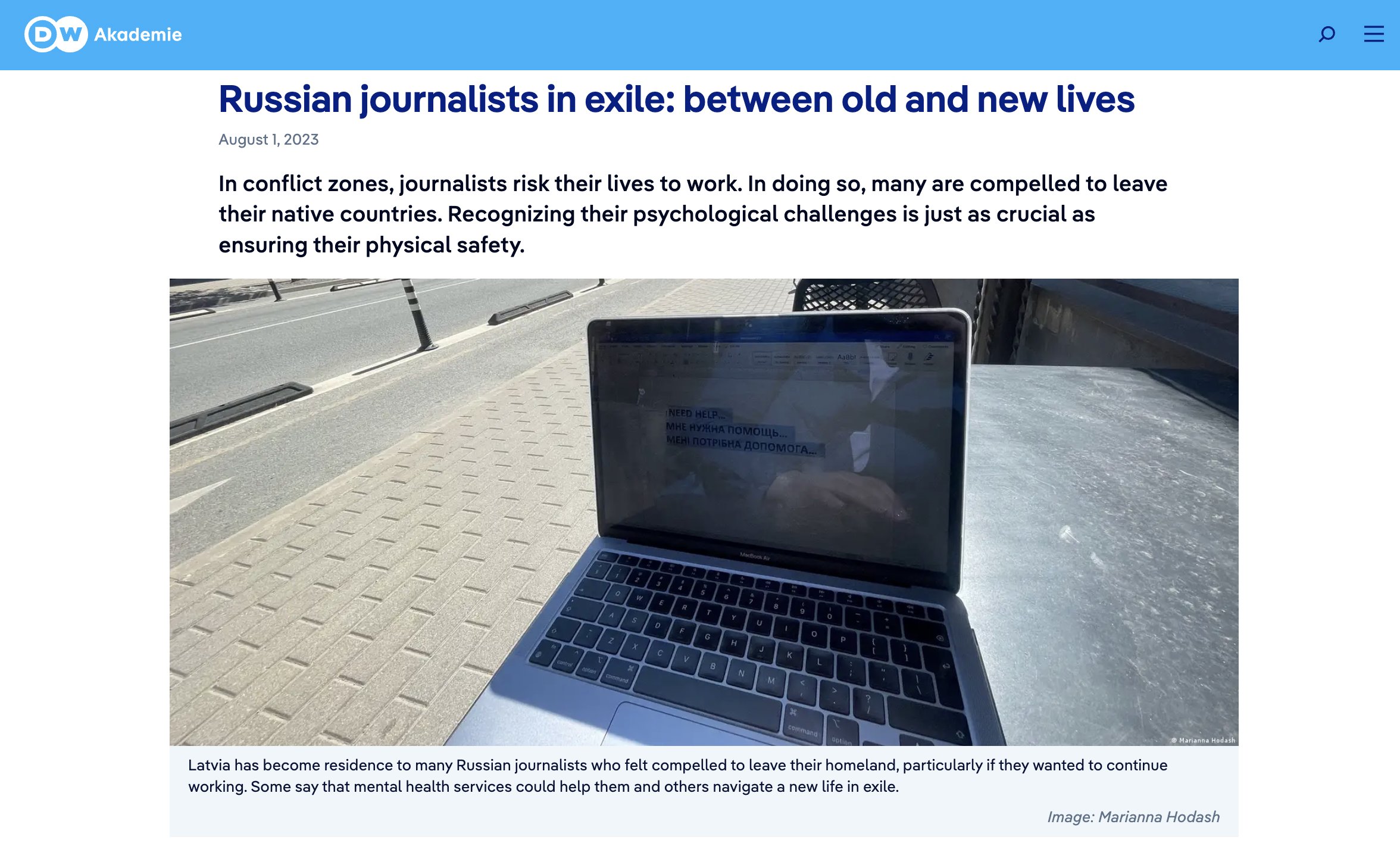
Read The DW report on Russian exiled journalists
https://akademie.dw.com/en/russian-journalists-in-exile/a-66300308 The DW feature on Russian Journalists in Exile offers a powerful complement to RESIST findings by showing how authoritarian repression affects people working in public communication roles — reporters, editors, and cultural producers whose work depends on visibility, networks, and trust. While these journalists are not part of the RESIST sample, their experiences mirror many patterns we have identified across feminist, queer, and human rights activism in exile. Four themes in the reading will help you reflect on broader dynamics of precarity and survival: |
|
Identity crisis in exile ‘The exiled journalists’ identity crisis is real… they’ve become despised in their countries… even their closest connections often label them traitors.’ Exile as ‘social death’ This term is widely used in migration studies to describe the erasure of social identity and belonging when uprooted from one’s networks and publics. In RESIST, queer and trans migrants described this as ‘suspended life’ or ‘living in limbo’, which the article vividly corroborates. The importance of community and mental health support This finding strongly reinforces Topic 3, where care, solidarity, and grassroots mutual aid are presented as key infrastructures of survival. It also shows that emotional support is not merely personal, but political: a tool against isolation imposed by authoritarian repression. Leaving violence behind, but facing new burdens Journalists describe new challenges after arrival: career disruption, language and cultural barriers, insecurity, and bureaucratic uncertainty. This corresponds to RESIST findings where exile replaces immediate danger with new forms of structural and emotional precarity. As Topic 2 notes, safety is not the same as stability, and escaping violence often introduces new vulnerabilities. |
6. EXTRA: Additonal Resources

Additional Recourses
Watch
● Beyond Borders: Feminist Solidarity in Exile (DW Documentary, 2023)
● Transnational Queer Networks (EuroCentralAsia LGBTI, 2024)
● ReFOCUS Media Labs films, https://refocusmedialabs.org/our-productions
Listen
● Migration Matters Podcast, Ep. 5 — “Digital Resistance and Diaspora Care”
● Belarus Feminist Voices (Spotify Series, 2022)
Dean Spade, Andrea Ritchie, Victoria Law, Pauline Rogers, Jarvis Benson (2020) Study and Struggle 2: Abolition, Intersectionality, and Care. Haymarket, 30 September (https://www.youtube.com/live/T5xefwldPLk?si=-xFwcgyRkc3LS4t3)
Vanessa E. Thompson (2021) Policing, Abolitionist Intersectional Care, Surviving Society Podcast, April 6 (https://soundcloud.com/user-622675754/s1e5-vanessa-e-thompson-policing-abolitionist-intersectional-care)