
4.9 Supporting Your Education

Site: OpenLearn Create
Course: College and Career Readiness (For Myanmar Youth)
Book: 4.9 Supporting Your Education
Printed by: Guest user
Date: Thursday, 26 November 2026, 1:07 AM

1. Mentors and Study Support (Pg 1/3)

Navigation Tips
Click the arrow, top left, to go to the previous page
Click the arrow, top right, to go to the next page
Click the link below the image to view it in full screen
Click your browser's back button, top left, to exit full screen

Many students do not progress through higher education alone. Mentors, tutors, and peers play an important role in providing guidance, encouragement, and practical support—helping students navigate academic, administrative, and personal challenges. In an educational context, mentors play an important role in supporting students beyond academic learning. They provide guidance, encouragement, and practical support that helps students navigate challenges related to online learning, personal circumstances, and emotional well-being. Through regular check-ins, mentors help students stay motivated, connected, and engaged, particularly in remote learning environments where students may otherwise feel isolated.
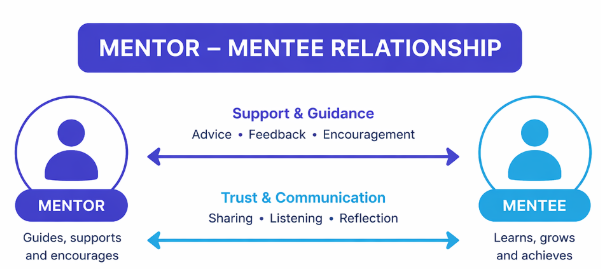
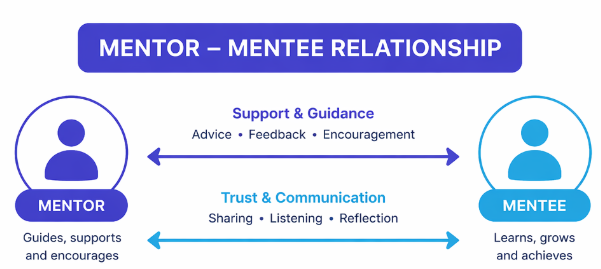
 

Mentorship Overview
🎓

The Role of Mentors

Click to view the image in full screen

🤝

Prospect Burma's Approach

This approach is reflected in the mentorship program delivered by Prospect Burma where they provides online mentorship to their online scholarship students. To address common challenges in online study such as internet access, resource limitations, communication barriers, and mental well-being students are paired with mentors who check in once or twice a week. These mentors do not offer academic support; instead, they focus on practical assistance, motivation, and emotional support to help students continue their studies effectively.


2. Mentorship: Impact Story (Pg 2/3)


Navigation Tips
Click the arrow, top left, to go to the previous page
Click the arrow, top right, to go to the next page 
🎥

Impact Stories

The following video features a short interview with a mentor, sharing his experiences.


📄 Read Transcript

My role as an online mentor is primarily supportive rather than academic. I am not responsible for formal academic instruction, which is provided by partner universities. Instead, I offer guidance, encouragement, and continuity, particularly for students navigating complex personal and logistical circumstances.

For students based in safer environments such as Yangon, support often focuses on motivation, time management, and balancing studies with work and extracurricular commitments. For students in conflict-affected areas, my role is more pastoral in nature, providing emotional support, reassurance, and a stable point of contact.

When students seek informal help in areas such as statistics, research, writing, or understanding academic expectations, I assist where possible by helping them identify appropriate and credible resources. I encourage students to rely on structured and trustworthy sources, including university websites and recognized platforms. Prospect Burma is often a key starting point, both as a scholarship provider and as a source of guidance on eligible and commonly supportive programs, which helps students focus on realistic and well-aligned options from the outset.

I also advise students to carefully review English language requirements for each program, as these can vary significantly by country and institution. Understanding required tests and score thresholds early allows students to plan their preparation alongside course research.

For students with limited or unstable internet access, I help them prioritize and shortlist programs so they can save information and continue working offline.

Although I am not responsible for academic, administrative, or admission decisions, I support students by helping them understand and manage the overall application process. This includes interpreting information from scholarship providers, aligning applications with eligible program lists, and planning timelines that account for document preparation, references, and English language tests.

A major focus of my support is ensuring students do not underestimate English language preparation, which is often a critical benchmark for both university admissions and scholarship applications. I encourage early planning, realistic score targets, and contingency plans in case retesting is needed.

I also help students avoid common pitfalls such as missing deadlines due to connectivity issues, misunderstanding eligibility criteria, relying on incomplete information, and feeling discouraged after multiple rejections. For students in conflict-affected areas, we also discuss backup plans in case documentation or communication is disrupted.

I advise students to approach scholarship searching as a structured, long-term process rather than a last-minute effort. Trusted sources such as Prospect Burma are a good starting point. Students are also encouraged to explore major government and international scholarships that accept applicants from Myanmar, including Chevening in the UK, MEXT in Japan, the European Mobility Programme for Myanmar, and DAAD. In addition, many universities offer scholarships for international students, such as graduate and undergraduate awards at Chulalongkorn University, Mahidol University, and Chiang Mai University.

Using peer networks and alumni connections is also important for learning about less publicized opportunities.

Preparation is essential. I support students in understanding common scholarship requirements, including academic background, leadership experience, English proficiency, personal statements, and academic references, so they can strengthen these areas early rather than reacting when deadlines are announced.

Although I am not an academic mentor, I believe certain foundational skills are critical. These include time management, independent learning, basic research and writing skills, and the ability to seek help when needed. Digital literacy is also essential, especially for students studying online or in hybrid formats. For students under significant stress, resilience and self-care are equally important. I often remind students that sustainable progress matters more than perfection.

My focus is on preparing students emotionally and practically rather than academically. This includes discussions about cultural adjustment, managing expectations, dealing with isolation, and building new support networks. I also encourage students to familiarize themselves with basic academic norms and to make use of university support services when challenges arise.

My main advice to students is to be patient with themselves, remain open to learning, and actively seek help when difficulties arise. For many students, especially those from conflict-affected areas, asking for help is not a weakness but a critical strategy for survival and success in a new academic environment.


3. The Mentee Perspective (Pg 3/3)

Navigation Tips
Click the arrow, top left, to go to the previous page
Click the arrow, top right, to go to the next page 

For many students, especially those studying online from Myanmar at international universities, the higher education journey can feel challenging and isolating. Alongside academic demands, students often face practical barriers such as unstable internet access, power outages, language difficulties, and adapting to unfamiliar teaching and assessment styles. This page brings together insights from a student who has experienced online mentoring while pursuing higher education, sharing how mentorship supported them through both academic and personal challenges.

Through the interviews, the mentee reflects on how regular check-ins with a mentor helped them stay focused. The mentee also shares how mentoring provided practical strategies to navigate studying from Myanmar. By hearing directly from someone who have been mentored, current and future learners, you, can better understand how mentorship can help students successfully progress in their studies.

⚠️ Audio Note: Please note that due to the mentee's location and internet access, the audio quality is not the best. It is good to also read the transcript provided below each video to understand the mentee's testimony.

🎥

Interview with Mentee on Online Mentorship


📄 Read Transcript

As a student from Myanmar studying at an online university, online mentoring helped me stay focused, confident, and organized in pursuing my education goals. I had regular check-ins with my mentor bi-weekly. He helped me break down big long-term goals, like finishing my degree or planning for the next six months or one year. He also advised me on improving my English and helped me break these big steps into smaller, realistic actions for each term.

This kind of support and advice reduced the isolation of studying online. You know, having to be online all the time and in front of the camera can be challenging, but it reminded me that I was not walking alone. That kept me motivated during difficult times, especially with political instability, internet problems, and exam stress from school. So this is how mentoring supported me in my studies.

⚡

Mentee interview on Challenges


📄 Read Transcript

Studying online from Myanmar while enrolling at an international university comes with many practical and social challenges. At the same time, mentoring helped me adapt to these challenges and barriers. Practical challenges in Myanmar include frequent power outages, limited or expensive internet, difficulty accessing some platforms, and the need to use VPNs due to connectivity and political restrictions.

My mentor helped me plan around these issues, such as downloading materials in advance and communicating with instructors when I could not finish my studies on time, especially to explain delays. He also encouraged me to find low-bandwidth alternatives when possible. Sometimes students need to go to learning hubs provided by the university, especially when there are frequent and consecutive power cuts for a few days. We adapt to these practical challenges.

There are also academic challenges. At an international university, everything is in English, and there was a language barrier at first, especially in my second year. I needed to get used to a different teaching style, which is very different from our previous education system. The assessment methods were also different. I struggled with quizzes at first, as well as expectations around academic writing and participation in an international context, where participation points are part of the marking system.


Click here to go to the next page